
Photo: Jon Morrill (Enjoyed Niagara Falls today with Family)
Previous Lesson
Next Lesson
Author: Stephen Weller
2,194 words, 12 minutes read time
Demand for a Miracle – West Coast, Sea of Galilee
Scripture Reference: Matthew 15:39-16:4; Mark 8:10-12
Context:
In Matthew 15:39–16:4 and Mark 8:10–12, Jesus moves from the miracle of feeding the four thousand into a confrontation with the religious leaders that reveals the spiritual blindness of His opponents. After dismissing the crowd, Jesus enters a boat and travels to the region of Magadan (called Dalmanutha in Mark’s account), continuing His ministry among the people. There, the Pharisees—and in Matthew also the Sadducees—come to test Him, not with sincere faith but with hardened unbelief. They demand that Jesus show them a sign from heaven, meaning a dramatic heavenly display that would prove beyond doubt that He was sent by God. This request is striking because Jesus had already performed many miracles: healings, exorcisms, calming storms, and the miraculous feeding of thousands. Their demand was not due to lack of evidence but refusal to accept what was already before them. Jesus rebukes them for their hypocrisy, noting that they can interpret the appearance of the sky to predict the weather, yet they cannot discern “the signs of the times,” meaning the clear evidence that God’s kingdom had arrived in His ministry. Their hearts were spiritually dull even while they claimed religious authority. Jesus then declares that no sign will be given except the “sign of Jonah,” pointing ultimately to His death, burial, and resurrection, just as Jonah emerged after three days. Mark emphasizes Jesus’ deep sigh of grief at their unbelief, showing not only His frustration but His sorrow over hearts so resistant to truth. Instead of continuing the argument, He leaves them and departs, demonstrating that persistent unbelief closes the door to further revelation. This passage highlights the danger of demanding more proof while ignoring the truth already given, and it contrasts true faith with the hardened skepticism of those who see miracles yet refuse to believe.
Event Narrative:
The narrative for this section was obtained from two similar texts, using the highlighted material shown below. The selection was determined by Jerry Peyton and copyrighted in 2015 by Jerry Peyton and Biblical Studies Press L.L.C.
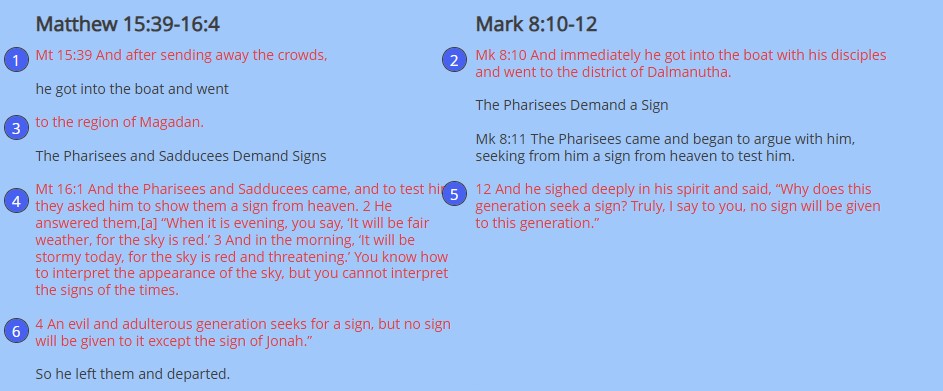
From the above worksheet photo, following the numbers and the text in red, the following narrative is produced.
Mt 15:39 And after sending away the crowds, Mk 8:10 [Jesus] immediately got into the boat with his disciples and went to the district of Dalmanutha, Mt 15:39 to the region of Magadan.
Mt 16:1 [Now] the Pharisees and Sadducees came, to test him, they asked him to show them a sign from heaven.
Mt 16:2 [Jesus] answered them, “When it is evening, you say, ‘It will be fair weather, for the sky is red.’ 3 And in the morning, ‘It will be stormy today, for the sky is red and threatening.’ You know how to interpret the appearance of the sky, but you cannot interpret the signs of the times.”
Mk 8:12 [Jesus] sighed deeply in his spirit and said, “Why does this generation seek a sign? Truly, I say to you, no sign will be given to this generation.” Mt 16:4 An evil and adulterous generation seeks for a sign, but no sign will be given to it except the sign of Jonah.”
Bible Lessons for this event:
H326 A Demand for More Evidence (Matthew 15:39, 16:1-4; Mark 8:10, 12)
Event Summary:
This event describes Jesus’ departure from the region where he performed miracles, his interaction with the Pharisees and Sadducees, and their demand for a sign. The narratives highlight themes of spiritual blindness, faith, the rejection of Jesus’ authority, and the danger of seeking signs without genuine belief.
Key points of this event are:
(1) The Pharisees and Sadducees approach Jesus, asking him to show a sign from heaven to prove his authority. This request reflects their skepticism and lack of faith. (See Matthew 16:1) Demanding signs reveals a lack of genuine faith. True belief in Jesus comes from recognizing His authority and mission, not from seeking proof to satisfy doubt or criticism.
(2) Jesus responds by pointing out that the Pharisees and Sadducees can interpret weather patterns but fail to recognize the spiritual signs of his coming, such as his miracles and teachings. (See Matthew 16:2-3) Spiritual blindness prevents people from recognizing God’s work, even when it is evident. Religious leaders who prioritize worldly concerns over spiritual truth miss the significance of Jesus’ mission.
(3) Jesus declares that no sign will be given except the sign of Jonah, referring to his future death and resurrection. Just as Jonah was in the belly of the fish for three days, Jesus will be in the tomb and rise again. (See Matthew 16:4) The ultimate sign of Jesus’ authority is His resurrection. This act demonstrates His divinity and fulfills God’s plan for salvation, rendering all other signs unnecessary for faith.
(4) Mark notes that Jesus “sighed deeply in His spirit” at the Pharisees’ demand, reflecting his sorrow over their hardened hearts and refusal to believe despite the evidence of his miracles. (See Mark 8:12) Jesus grieves over persistent unbelief and spiritual stubbornness. His sorrow underscores the tragedy of rejecting God’s truth when it is clearly revealed.
(5) This event contrasts the faith of those who followed Jesus to receive healing and teaching with the skepticism of the Pharisees and Sadducees, who demanded proof while ignoring the evidence already before them. Faith does not require constant signs; it involves trusting in what God has already revealed. Skepticism and pride hinder spiritual understanding and growth.
This event highlights the danger of spiritual blindness and skepticism, especially among those who prioritize signs over genuine faith. Jesus calls for trust in God’s revealed truth, emphasizing that the ultimate proof of his authority is his resurrection (the sign of Jonah). The narratives challenge believers to open their hearts to God’s work, avoid demanding constant validation, and recognize Jesus as the fulfillment of God’s promises.
Discussion Questions with Extended Answers:
1. Why did Jesus leave immediately after feeding the four thousand and travel to the region of Magadan (Dalmanutha)?
Answer:
After feeding the four thousand, Jesus dismissed the crowds and entered the boat with His disciples to cross to another region. This movement shows that Jesus’ ministry was not centered on remaining where crowds gathered for miracles, but on continuing His mission of teaching, preaching, and revealing the kingdom of God. The feeding miracle had demonstrated His compassion and divine provision, but many followed Him primarily for signs rather than true faith. By departing, Jesus showed that miracles were meant to point people to truth, not to create dependence on spectacle. His movement into the region of Magadan (called Dalmanutha in Mark) also set the stage for confrontation with the Pharisees and Sadducees, whose unbelief contrasted sharply with the faith Jesus sought.
2. Why did the Pharisees and Sadducees ask Jesus for a sign from heaven?
Answer:
They were not sincerely seeking truth but were testing Jesus. Matthew specifically says they came “to test him.” They had already witnessed numerous miracles—healings, exorcisms, multiplication of food, and authority over nature, yet they demanded something more dramatic, likely a cosmic or heavenly sign such as fire from heaven or an unmistakable display from the sky. Their request revealed hardened unbelief rather than honest inquiry. They were not lacking evidence; they were rejecting the evidence already given. Often unbelief is not due to insufficient proof but an unwillingness to submit to truth. Their hearts were resistant, and no additional sign would change that condition.
3. Why is it significant that both the Pharisees and Sadducees came together against Jesus?
Answer:
The Pharisees and Sadducees were usually theological opponents. The Pharisees emphasized strict adherence to tradition and resurrection, while the Sadducees were more politically connected and denied resurrection and much of the supernatural. Their unity against Jesus reveals how threatening His authority was to both groups. Though divided in doctrine, they were united in opposition to truth. This illustrates how rejection of Christ can unite people who otherwise disagree. Jesus challenged both their legalism and their spiritual blindness. His authority exposed the emptiness of both systems, so they joined together in resistance. Their alliance highlights the growing hostility that would eventually lead to His crucifixion.
4. What did Jesus mean when He said they could interpret the appearance of the sky but not the signs of the times?
Answer:
Jesus pointed out their ability to predict weather by observing the sky, red sky at night or morning, but contrasted that with their failure to recognize spiritual realities. They were skilled in earthly observation but blind to divine revelation. The “signs of the times” referred to the evidence that Messiah had come: fulfilled prophecy, miracles, preaching of repentance, authority over demons, and the manifestation of God’s kingdom through Jesus Himself. They could analyze nature but ignored Scripture’s fulfillment standing before them. This reveals that spiritual blindness is not intellectual inability but moral resistance. They refused to see because acceptance would require repentance and surrender.
5. Why did Jesus call that generation “evil and adulterous”?
Answer:
Jesus used covenant language from the Old Testament. Israel was often described as committing spiritual adultery when they turned from God in unbelief and idolatry. Their generation was “evil” because they rejected God’s truth despite clear revelation, and “adulterous” because they were unfaithful to the covenant relationship God had established with His people. Instead of recognizing the Messiah, they demanded proof while their hearts remained rebellious. Their religious appearance hid deep spiritual corruption. Jesus’ words were not merely harsh criticism; they were a prophetic diagnosis of covenant unfaithfulness and rebellion against God.
6. What is “the sign of Jonah” that Jesus said would be given?
Answer:
The sign of Jonah refers ultimately to Jesus’ death, burial, and resurrection. Just as Jonah was in the belly of the great fish for three days and then emerged, Jesus would be in the grave and rise again on the third day. This would be the supreme validating sign of His identity as Messiah and Son of God. Unlike the dramatic sign they demanded from heaven, the resurrection would be God’s appointed proof. It would demonstrate victory over sin and death and confirm all Jesus taught. Those unwilling to believe His present works would still be accountable when the resurrection occurred. The sign of Jonah points to the gospel itself.
7. Why did Jesus refuse to keep debating with them and simply leave?
Answer:
Jesus recognized the difference between sincere questioning and hardened testing. These leaders were not seekers of truth; they were opponents looking for grounds to accuse Him. Continued debate would not produce faith because their hearts were closed. Sometimes the right response to persistent unbelief is not endless argument but judgment through withdrawal. His leaving symbolized both rejection of their unbelief and the seriousness of missing divine visitation. God had come near in Christ, and their refusal to believe brought consequences. Jesus did not perform signs to entertain skeptics but to reveal truth to those willing to receive it.
8. What lesson should believers learn from this encounter about faith and signs?
Answer:
Believers must understand that true faith rests on God’s revealed truth, not on constant demands for new signs. The Pharisees and Sadducees had abundant evidence but still refused belief because their issue was the heart, not the mind. Many people today say they would believe if only God would prove Himself in some dramatic way, yet Scripture shows that miracles alone do not create faith. Faith comes through hearing and responding to God’s Word. Signs may confirm truth, but they cannot replace repentance and trust. Believers should seek Christ Himself rather than endless external proof. The resurrection remains the greatest sign and the foundation of Christian faith.
9. How does this passage contrast the crowds and the religious leaders?
Answer:
The crowds had just experienced Jesus’ compassion and provision in the feeding miracle, while the religious leaders approached Him with suspicion and hostility. The needy crowds came hungry and received mercy; the leaders came proud and demanding and received rebuke. This contrast shows that humility opens the door to grace, while pride closes it. Those aware of their need are more likely to receive Christ than those convinced of their own righteousness. The religious leaders had knowledge without faith, while many ordinary people responded with trust. Jesus consistently exposed this reversal throughout His ministry.
10. How does this passage prepare for the later revelation of Jesus’ identity?
Answer:
This confrontation prepares the reader for the next major section where Jesus asks His disciples, “Who do you say that I am?” The rejection of the Pharisees and Sadducees highlights the contrast between unbelief and true confession. Religious leaders failed to recognize Messiah despite overwhelming evidence, while Peter would soon confess, “You are the Christ, the Son of the living God.” The sign demand reveals blindness; Peter’s confession reveals divine revelation. This passage therefore marks a turning point—Jesus moves from public confrontation with hardened leaders toward deeper private instruction of His disciples about His identity, suffering, death, and resurrection.


Leave a comment