
Jim Hallman (Ticonderoga NY)
Previous Lesson
Next Lesson
Author: Stephen Weller
2,502 words, 13 minutes read time
Peter’s Confession – Caesarea Philippi, 20 Aerial Miles North of Sea of Galilee
Scripture Reference: Matthew 16:13-20; Mark 8:27-30; Luke 9:18-21
Context:
This pivotal event in the Gospel accounts occurs during a crucial turning point in the ministry of Jesus Christ. Up to this point, Jesus had performed countless miracles, taught with divine authority, healed the sick, cast out demons, fed multitudes, and demonstrated power over nature, yet confusion about His true identity remained widespread among the people. Some believed He was merely a prophet, while others associated Him with figures such as John the Baptist, Elijah, or Jeremiah. As Jesus and His disciples traveled near Caesarea Philippi, a region filled with pagan worship and symbols of worldly power, He intentionally asked His disciples who the crowds believed Him to be and then directed the question personally to them: “Who do you say that I am?” This moment was not for His own information, but to draw out the disciples’ understanding and faith. Speaking on behalf of the Twelve, Peter declared that Jesus is “the Christ, the Son of the living God,” revealing a divinely given understanding that Jesus was not simply a teacher or prophet but the promised Messiah sent by God. In Matthew’s account, Jesus responded by affirming that this truth had been revealed by the Father and declared that upon this confession He would build His church, promising that the gates of Hades would not prevail against it. This confession marks one of the clearest declarations of Jesus’ identity before His death and resurrection and serves as a foundational moment in the development of the disciples’ faith. Immediately after this event, the Gospel narrative begins shifting toward Jerusalem, the cross, and the coming suffering of Christ. Jesus also commanded the disciples not to publicly proclaim Him as the Messiah at that time because the people still misunderstood the nature of His kingdom, expecting a political deliverer rather than a suffering Savior who would redeem humanity through His sacrificial death and resurrection.
Event Narrative:
The narrative for this section was obtained from three similar texts, using the highlighted material shown below. The selection was determined by Jerry Peyton and copyrighted in 2015 by Jerry Peyton and Biblical Studies Press L.L.C.
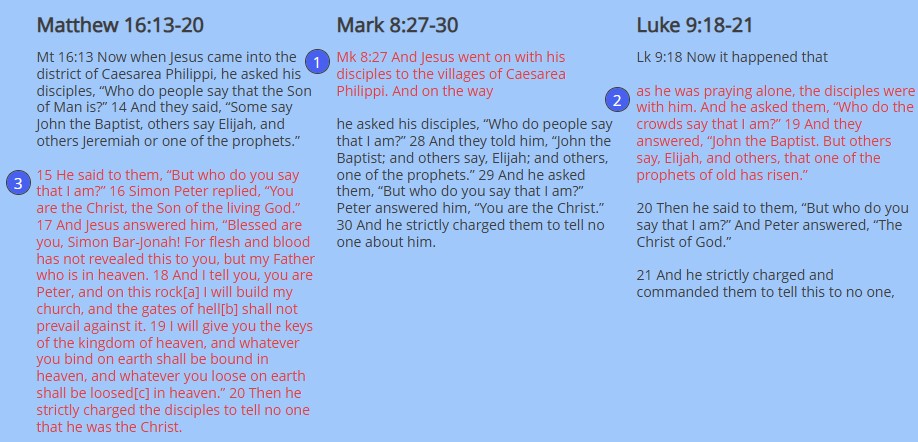
From the above worksheet photo, following the numbers and the text in red, the following narrative is produced.
Mk 8:27 [Then] Jesus went on with his disciples to the villages of Caesarea Philippi. And on the way, Lk 9:18 as he was praying alone, the disciples were with him. And he asked them, “Who do the crowds say that I am?”
Lk 9:19 And they answered, “John the Baptist. But others say, Elijah, and others, that one of the prophets of old has risen.”
Mt 16:15 He said to them, “But who do you say that I am?”
16 Simon Peter replied, “You are the Christ, the Son of the living God.”
17 And Jesus answered him, “Blessed are you, Simon Bar-Jonah! For flesh and blood has not revealed this to you, but my Father who is in heaven. 18 And I tell you, you are Peter, and on this rock, I will build my church, and the gates of hell shall not prevail against it. 19 I will give you the keys of the kingdom of heaven, and whatever you bind on earth shall be bound in heaven, and whatever you [release] on earth shall be [released] in heaven.”
20 Then he strictly charged the disciples to tell no one that he was the Christ.
Bible Lessons for this event:
H384 You Are the Christ, the Son of the Living God (Matthew 16:15-16; Mark 8:27; Luke 9:18-19)
H385 The Uniqueness of Jesus (Matthew 16:16)
H386 On This Rock I Will Build My Church (Matthew 16:17-18)
H387 The Keys of the Kingdom (Matthew 16:18-20)
Event Summary:
This event recounts the pivotal moment when Jesus asks his disciples who they believe he is, and Peter confesses him as the Messiah, the Son of the living God. This moment emphasizes themes of Jesus’ identity, faith, divine revelation, and the foundation of the Church.
Key points of this event are:
(1) The Question of Jesus’ Identity: Jesus asks his disciples, “Who do people say I am?” and then he asks the disciples, “Who do you say I am?” They recount public opinions, comparing Jesus to John the Baptist, Elijah, or a prophet, but Peter boldly declares, “You are the Messiah.” (See Matthew 16:15; Mark 8:27; Luke 9:18-19) Recognizing Jesus’ true identity is central to our faith. Public opinion may vary, but personal conviction about Jesus as the Messiah is the foundation of a relationship with him.
(2) Peter’s Confession of Faith: To the question Jesus asked about who he was, Peter responds, “You are the Christ, the Son of the living God” (See Matthew 16:16) The confession by Peter highlights that Jesus is the fulfillment of God’s promises and the Savior of the world. This recognition comes from a heart open to God’s revelation.
(3) Divine Revelation: Jesus responds to Peter, saying, “Blessed are you, Simon Bar-Jonah! For flesh and blood has not revealed this to you, but my Father who is in heaven.” (Matthew 16:17) True understanding of Jesus’ identity comes through divine revelation, not human reasoning. Faith is a gift from God, requiring spiritual openness.
(4) The Foundation of the Church: Jesus says “You are Peter, and on this rock, I will build my church, and the gates of hell shall not prevail against it. I will give you the keys of the kingdom of heaven, and whatever you bind on earth shall be bound in heaven, and whatever you [release] on earth shall be [released] in heaven.” (See Matthew 16:18-19 ESV) On the foundation of faith in Jesus as the Christ (Messiah) the Church is built. It is this faith that empowers the Church to stand against spiritual opposition and spread the Gospel.
(5) The Call to Secrecy: After revealing to the disciples who he is, he tells them not to tell anyone that he is the Messiah. (See Matthew 16:20) The mission and identity of Jesus were to be fully revealed in God’s timing, particularly through his death and resurrection. Premature disclosure could lead to misunderstanding about his role as a spiritual, not political, Messiah.
This event highlights the centrality of recognizing Jesus as the Messiah, the Son of God. Faith in him is the foundation of the Church and the key to God’s kingdom. This moment underscores the importance of divine revelation in understanding Jesus’ true identity and invites readers to reflect on their own response to the question, “Who do you say I am?” It challenges believers to embrace faith, trust in God’s timing, and participate in the mission of the Church.
Discussion Questions with Extended Answers:
1. Why did Jesus ask the disciples, “Who do people say that I am?”
Answer:
Jesus was not seeking information because He lacked knowledge of public opinion. Instead, He used the question to lead the disciples into deeper reflection about His true identity. The crowds had many ideas about Jesus. Some believed He was John the Baptist raised from the dead, others thought He was Elijah, and some believed He was one of the prophets. These answers revealed that people recognized Jesus as extraordinary, yet they still misunderstood Him.
The question also exposed the difference between public opinion and divine revelation. Many admired Jesus as a teacher or prophet, but only true faith recognized Him as the promised Messiah and Son of God. Jesus first brought the disciples face-to-face with the confusion of the crowds before leading them to make a personal confession of faith. This moment became a turning point in the Gospel accounts because the disciples were moving from simply following Jesus to truly understanding who He was.
2. Why were people comparing Jesus to John the Baptist, Elijah, or one of the prophets?
Answer:
The people saw in Jesus the power, authority, and boldness that characterized the great prophets of Israel. John the Baptist had recently been executed, and many wondered if Jesus was John returned. Elijah was expected by many Jews to appear before the coming of the Messiah according to prophecy. Others saw Jesus as a prophet because of His miracles, teaching authority, and calls to repentance.
These comparisons showed that the people recognized something divine in Jesus’ ministry, but they stopped short of understanding His full identity. The prophets pointed people toward God, but Jesus was more than a prophet, He was the fulfillment of God’s redemptive plan. The crowds saw glimpses of truth but lacked complete understanding because spiritual understanding requires revelation from God.
3. Why did Jesus then ask, “But who do you say that I am?”
Answer:
This was the central question of the passage and one of the most important questions in all Scripture. Jesus moved from general opinions to a personal confession of faith. Salvation is not based on what others think about Jesus, but on one’s own response to Him.
The disciples had walked with Jesus, heard His teaching, witnessed His miracles, and observed His compassion and authority. Now Jesus called them to openly confess what they believed. Faith must become personal and public. The question forced the disciples to decide whether they truly believed Jesus was the Christ.
This question still confronts every generation. People may admire Jesus as a moral teacher, prophet, or historical figure, but the essential issue is whether they believe He is the Christ, the Son of the living God.
4. What was significant about Peter’s confession?
Answer:
Peter declared, “You are the Christ, the Son of the living God” (Matthew 16:16). This confession was foundational because it identified Jesus as both the promised Messiah and the divine Son of God. Peter recognized that Jesus was not merely sent by God, but uniquely related to God in divine authority and nature.
The title “Christ” means “Anointed One,” referring to the promised Savior foretold throughout the Old Testament. Israel had long awaited the Messiah who would bring deliverance and establish God’s kingdom. Peter’s confession showed that the disciples had begun to understand that Jesus fulfilled these promises.
Jesus emphasized that this understanding did not come through human wisdom alone but through revelation from the Father. True recognition of Christ is ultimately a work of God opening the heart and mind to truth.
5. What did Jesus mean when He said, “flesh and blood has not revealed this to you”?
Answer:
Jesus meant that Peter’s confession was not merely the result of human reasoning, education, or observation. Human understanding alone cannot fully comprehend the identity of Christ. Spiritual truth must be revealed by God.
Although Peter had seen miracles and heard Jesus teach, the recognition that Jesus was the Christ came through divine revelation. God the Father opened Peter’s understanding to see the truth. This teaches that faith is not simply intellectual agreement; it is a spiritual awakening brought about by God’s work in the heart.
This statement also highlights the grace of God in salvation. No one comes to true faith apart from God drawing and revealing Himself to them.
6. What did Jesus mean when He said, “on this rock I will build my church”?
Answer:
Jesus was speaking about the foundation upon which His church would stand. The “rock” refers to the truth of Peter’s confession; that Jesus is the Christ, the Son of the living God. The church is built upon the revealed truth of Christ’s identity.
Peter played an important role among the apostles, especially in proclaiming the gospel in the early church, but the ultimate foundation is Christ Himself. Throughout Scripture, God is repeatedly described as the true Rock. The strength and stability of the church rest not on human ability, but on the person and work of Jesus Christ.
Jesus also declared that He Himself would build the church. The church belongs to Christ, grows through His power, and is sustained by His authority.
7. What does Jesus mean by “the gates of hell shall not prevail against it”?
Answer:
Jesus promised that the powers of death, darkness, and Satan would never overcome His church. “Hades” refers to the realm of death, and the “gates” symbolize strength and authority. Even though believers may face persecution, suffering, and spiritual opposition, Christ’s church will endure.
This promise reveals Christ’s ultimate victory. Satan cannot destroy the church because Jesus conquered sin and death through His resurrection. The church may be attacked, opposed, or persecuted, but it cannot be permanently defeated.
This statement also gives believers confidence. The future of God’s kingdom does not depend on human strength but on Christ’s power and authority.
8. What are the “keys of the kingdom of heaven”?
Answer:
Keys symbolize authority and access. Jesus gave the apostles authority to proclaim the message of the kingdom. Through the preaching of the gospel, the door of salvation is opened to those who believe and closed to those who reject Christ.
This authority was exercised in the early church as the apostles preached repentance and forgiveness in Jesus’ name. The church continues this mission today whenever the gospel is faithfully proclaimed. The power is not in human leaders themselves, but in the truth of God’s Word and the authority of Christ.
The image of keys emphasizes stewardship and responsibility. Believers are entrusted with the message that points people to eternal life.
9. Why did Jesus command the disciples not to tell anyone that He was the Christ?
Answer:
At that stage of His ministry, many people misunderstood what the Messiah would be. Most expected a political or military leader who would overthrow Roman rule. If the disciples publicly proclaimed Jesus as the Christ too soon, the crowds might attempt to force Him into a political role that did not align with God’s plan.
Jesus’ mission first required suffering, rejection, death, and resurrection. Only after these events could His identity and mission be fully understood. The disciples themselves still needed greater understanding about the cross and resurrection.
This command also shows that revelation unfolds according to God’s timing. Jesus controlled the timing and manner in which His identity would be fully revealed.
10. Why is this passage considered a major turning point in the Gospels?
Answer:
This passage marks a decisive transition in Jesus’ ministry. Before this moment, the focus was largely on revealing who Jesus was through His miracles and teaching. After Peter’s confession, Jesus began preparing His disciples for His coming suffering, death, and resurrection.
The disciples had now openly confessed Jesus as the Messiah, but they still needed to learn what kind of Messiah He would be. Jesus was not coming merely to establish an earthly kingdom; He came to save sinners through the cross.
This turning point moves the Gospel narrative toward Jerusalem and ultimately toward the crucifixion and resurrection. It reveals that understanding Jesus’ identity must lead to understanding His mission of redemption.


Leave a Reply