
Anastaslos Gialopoulos Photography (Austria)
Previous Lesson
Next Lesson
Author: Stephen Weller
2,646 words, 14 minutes read time
The Cross is Coming for Jesus and His Followers
Scripture Reference: Matthew 16:21-28; Mark 8:31-9:1; Luke 9:22-27
Context:
Following Peter’s confession that Jesus is the Christ, the focus of the Gospel narrative shifts dramatically from the revelation of His identity to the revelation of His mission. In Gospel of Matthew (Matthew 16:21–28), Gospel of Mark (Mark 8:31–9:1), and Gospel of Luke (Luke 9:22–27), Jesus begins openly teaching His disciples that the path of the Messiah will lead not to immediate earthly glory, but to suffering, rejection, death, and resurrection. This marks a major turning point in His ministry because the disciples expected a victorious and reigning Messiah, not a suffering Savior. Jesus specifically explains that He must go to Jerusalem, suffer at the hands of the religious leaders, be killed, and rise again on the third day. Peter’s rebuke of Jesus reveals how deeply the disciples misunderstood God’s redemptive plan, thinking in human terms rather than divine purposes. Jesus responds strongly because any attempt to avoid the cross opposes the will of God and the work of redemption. From this point forward, Jesus not only defines His own mission through suffering and sacrifice, but He also defines true discipleship in the same way. Those who follow Him must deny themselves, take up their cross daily, and follow Him in obedient surrender. Jesus teaches that saving one’s earthly life at the expense of faithfulness to God ultimately leads to eternal loss, while losing one’s life for Christ leads to eternal salvation and glory. The warning about being ashamed of Christ and His words highlights the coming judgment and the certainty of His future return in glory. The promise that some standing there would not taste death until they saw the kingdom of God points forward to the revelation of Christ’s glory in the Transfiguration and ultimately to the advancing power of His kingdom through His death, resurrection, and reign. Together, these parallel passages form one of the clearest revelations in the Gospels that the kingdom of God is established through the suffering Messiah, and that discipleship requires wholehearted commitment, self-denial, perseverance, and eternal perspective.
Event Narrative:
The narrative for this section was obtained from three similar texts, using the highlighted material shown below. The selection was determined by Jerry Peyton and copyrighted in 2015 by Jerry Peyton and Biblical Studies Press L.L.C.
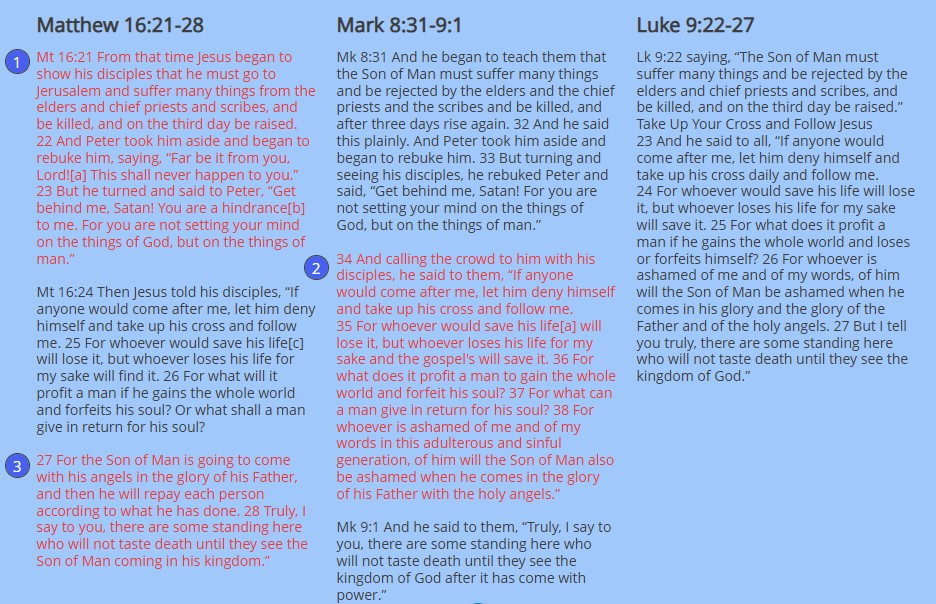
From the above worksheet photo, following the numbers and the text in red, the following narrative is produced.
Mt 16:21 From that time Jesus began to show his disciples that he must go to Jerusalem and suffer many things from the elders and chief priests and scribes, and be killed, and on the third day be raised.
22 And Peter took him aside and began to rebuke him, saying, “Far be it from you, Lord! This shall never happen to you.”
23 But he turned and said to Peter, “Get behind me, Satan! You are a hindrance to me. For you are not setting your mind on the things of God, but on the things of man.”
Mk 8:34 And calling the crowd to him with his disciples, he said to them, “If anyone would come after me, let him deny himself and take up his cross and follow me. 35 For whoever would save his life will lose it, but whoever loses his life for my sake and the gospel’s will save it. 36 For what does it profit a man to gain the whole world and forfeit his soul? 37 For what can a man give in return for his soul?
Mk 8:38 For whoever is ashamed of me and of my words in this adulterous and sinful generation, of him will the Son of Man also be ashamed when he comes in the glory of his Father with the holy angels.” Mt 16:27 For the Son of Man is going to come with his angels in the glory of his Father, and then he will repay each person according to what he has done.
Mt 16:28 Truly, I say to you, there are some standing here who will not taste death until they see the Son of Man coming in his kingdom.”
Bible Lessons for this event:
H388 Peter Rebukes Jesus (Matthew 16:21-22)
H389 Peter Is a Hinderance to Jesus (Matthew 16:23; Mark 8:34)
H390 Deny Oneself, Take Up Cross, Follow Him (Mark 8:34)
H391 Three “For” Statements (Mark 8:35-37)
H392 Be Not Ashamed of Jesus (Matthew 16:27-28; Mark 8:38)
Event Summary:
The focus of this event is on Jesus’ first prediction of his suffering, death, and resurrection, along with his call to discipleship. They emphasize themes of sacrifice, the cost of following Jesus, the reality of suffering, and the promise of eternal life and glory.
Key points of this event are:
(1) Jesus Foretells his Death and Resurrection: The time has come for Jesus to reveal to his disciples that he must suffer, be rejected, killed, and rise on the third day. This prediction shocks the disciples, especially Peter, who rebukes Jesus for saying such things. (See) The suffering and death of Jesus are central to his mission as the Messiah. His path of obedience to God’s will includes sacrifice, rejection, and resurrection, fulfilling God’s redemptive plan.
(2) Peter’s Rebuke and Jesus’ Response: Peter is rebuked by Jesus for misunderstanding his mission, and prompts Jesus to say, “Get behind me, Satan! You are a hindrance to me. For you are not setting your mind on the things of God, but on the things of man.” (Matthew 16:23) As with Peter, human understanding often conflicts with God’s plans. Disciples of Jesus must align their perspective with God’s will, even when it involves suffering and sacrifice.
(3) The Cost of Discipleship: Jesus calls his followers and tells them, “If anyone would come after me, let him deny himself and take up his cross and follow me. For whoever would save his life will lose it, but whoever loses his life for my sake and the gospel’s will save it. For what does it profit a man to gain the whole world and forfeit his soul? For what can a man give in return for his soul?” (See Mark 8:34-36) To be disciples of Jesus requires self-denial, willingness to endure suffering, and total commitment to him. True life is found in surrendering to him and prioritizing eternal rewards over earthly gains.
(4) The Value of the Soul: Jesus asks, “For what does it profit a man to gain the whole world and forfeit his soul? 37 For what can a man give in return for his soul?” (Mark 8:36-37) Having been created by God a person’s soul is of infinite value, far outweighing any worldly success or possessions. Pursuing earthly ambitions at the cost of one’s relationship with God leads to ultimate loss.
(5) The Promise of Glory and Judgment: Jesus then speaks of his return in glory, when he will judge everyone according to their deeds. He also promises that some present will witness the power of God’s kingdom before they die. (See Mark 8:38; Matthew 16:27-28) Thus faithful discipleship leads to eternal reward and participation in Jesus’ glory, but rejecting Jesus and his words results in judgment. However, those who follow him will experience the fullness of God’s kingdom.
This event emphasizes that discipleship involves sacrifice, self-denial, and a commitment to follow Jesus, even in the face of suffering. This event challenge believers to value their souls above worldly pursuits and trust in the promise of eternal life and future glory. They encourage Christians to align their perspective with God’s plans and live with the hope of Jesus’ return and ultimate victory.
Discussion Questions with Extended Answers:
1. Why did Jesus begin teaching the disciples about His coming suffering and death at this point in His ministry?
Answer:
Jesus began revealing His coming suffering, rejection, death, and resurrection after the disciples recognized Him as the Christ. In the Gospel accounts, Peter had just confessed that Jesus is the Messiah. The disciples expected a victorious King who would establish an earthly kingdom, but they did not yet understand that the Messiah must first suffer as the Savior of sinners. Jesus therefore began preparing them for the cross.
This moment marks a major turning point in the ministry of Christ. Jesus shifted the disciples’ focus from popular expectations of glory to the divine necessity of redemption. His suffering was not an accident or defeat; it was part of God’s eternal plan. The words “must suffer” emphasize divine necessity. Salvation required the sacrifice of the Son of God.
Jesus also prepared the disciples for the shock and confusion they would experience during His arrest and crucifixion. Without this teaching, they would have viewed the cross only as failure. Instead, Jesus taught them that the cross would become the pathway to victory, resurrection, and redemption.
2. Why did Peter rebuke Jesus, and what does this reveal about Peter’s understanding?
Answer:
Peter rebuked Jesus because he could not reconcile the idea of a suffering Messiah with his expectations of glory and triumph. He loved Jesus deeply and likely believed he was protecting Him from discouragement or danger. However, Peter’s response revealed that he was thinking from a human perspective rather than from God’s redemptive plan.
Peter understood that Jesus was the Christ, but he did not yet understand the purpose of Christ’s mission. He wanted the crown without the cross. Like many people, Peter valued earthly success, power, and immediate victory more than sacrificial suffering.
Jesus’ sharp response, “Get behind Me, Satan” shows the seriousness of Peter’s mistake. Peter unknowingly echoed Satan’s temptation to avoid the cross. Earlier, Satan had tempted Jesus in the wilderness with glory apart from suffering. Peter’s words reflected the same mindset. Jesus recognized that anything attempting to divert Him from the cross opposed God’s plan of salvation.
This passage teaches believers that sincere intentions are not enough. Even devoted followers can resist God’s purposes when they think only according to human wisdom and earthly desires.
3. What does Jesus mean when He says, “If anyone would come after Me, let him deny himself and take up his cross”?
Answer:
Jesus describes true discipleship as a life of surrender, sacrifice, and obedience. To deny oneself means more than giving up certain pleasures or comforts. It means rejecting self-rule and submitting completely to Christ as Lord. The believer no longer lives primarily for personal ambition, reputation, comfort, or control.
Taking up the cross refers to willingness to suffer, endure shame, and follow Christ faithfully even when obedience is costly. In the Roman world, the cross symbolized death, humiliation, and submission. Jesus called His followers to embrace a path of faithful obedience regardless of opposition or hardship.
This teaching directly contrasts with worldly thinking. The world encourages self-promotion, self-protection, and self-fulfillment, but Jesus calls His followers to self-sacrifice for the sake of God’s kingdom.
Discipleship is therefore not merely intellectual agreement with Christian truth. It is a transformed way of life marked by surrender, perseverance, and devotion to Christ above all else.
4. What does Jesus mean by losing one’s life in order to save it?
Answer:
Jesus teaches a profound spiritual paradox: the person who lives only for self ultimately loses everything, while the person who surrenders life to Christ gains eternal life.
Those who seek to “save” their lives by pursuing worldly security, pleasure, recognition, or independence from God will ultimately lose their souls. Temporary earthly gain cannot satisfy eternal needs. A person may achieve wealth, fame, or influence and still remain spiritually lost.
In contrast, those who “lose” their lives for Christ willingly surrender their desires, ambitions, and even physical safety for the sake of obedience to Him. Such people may experience hardship or persecution in this world, but they gain eternal life and fellowship with God.
Jesus emphasizes eternal perspective. Life is not measured merely by earthly success but by one’s relationship with God. True life is found not in self-preservation but in surrender to Christ.
5. What is the significance of Jesus asking, “What will it profit a man if he gains the whole world and forfeits his soul?”
Answer:
Jesus highlights the incomparable value of the soul. The entire world, with all its wealth, power, pleasure, and possessions, cannot equal the worth of eternal life. Earthly things are temporary, but the soul is eternal.
This question exposes the emptiness of worldly ambition apart from God. Many people spend their lives pursuing success while neglecting their spiritual condition. Jesus warns that worldly gain cannot rescue a person from eternal judgment.
The question also forces every listener to evaluate priorities. What people treasure most reveals the direction of their hearts. If someone gains everything the world offers but remains separated from God, the loss is eternal and irreversible.
Jesus calls His followers to live with eternal values rather than temporary earthly goals. The kingdom of God must take priority over worldly achievement.
6. Why does Jesus speak about His future coming in glory with the angels?
Answer:
Jesus points forward to His future return to remind the disciples that suffering is not the end of the story. Although rejection and the cross were approaching, ultimate victory and glory would follow.
The Son of Man will return in divine glory as Judge and King. At that time He will reward faithfulness and judge humanity according to God’s righteousness. This promise encouraged the disciples to remain faithful even during suffering and persecution.
Jesus also contrasts present suffering with future glory. The path of discipleship may involve hardship now, but eternal reward awaits those who follow Him faithfully. Believers are therefore called to endure with hope and perseverance.
The reference to angels emphasizes Christ’s divine authority and majesty. The One who would soon suffer humiliation on the cross is also the glorious King who will reign eternally.
7. What does Jesus mean when He says some standing there would not taste death until they saw the kingdom of God?
Answer:
Jesus refers to a foretaste or preview of His kingdom glory that some of the disciples would witness. This statement is immediately followed in the Gospel accounts by the Transfiguration, where Peter, James, and John saw Jesus revealed in divine glory.
The Transfiguration provided visible confirmation that Jesus truly is the glorious Son of God despite the coming cross. The disciples saw His majesty, heard the Father’s voice, and witnessed Moses and Elijah speaking with Him. This event strengthened their faith and helped prepare them for the suffering ahead.
Some interpreters also see this statement partially fulfilled through Christ’s resurrection, ascension, and the establishment of the church through the power of the kingdom of God. However, the immediate context strongly connects the statement with the Transfiguration.
Jesus therefore assured the disciples that although suffering would come first, the glory of the kingdom was certain and already beginning to be revealed.
8. What major lesson about discipleship is emphasized throughout these passages?
Answer:
The central lesson is that the way of Christ is the way of the cross before the crown. Jesus Himself would suffer before entering glory, and His followers are called to walk the same path of faithful obedience.
Discipleship involves surrender, perseverance, sacrifice, and eternal perspective. Following Jesus means trusting God’s purposes even when the path includes suffering or difficulty. Believers must reject worldly values and live for the kingdom of God.
These passages also reveal that true glory comes through obedience to God rather than through worldly power or self-exaltation. Jesus transformed the disciples’ understanding of greatness by teaching that eternal victory comes through humility, sacrifice, and faithfulness.
Ultimately, the cross stands at the center of both salvation and discipleship. Christ gave His life to redeem sinners, and His followers are called to live in wholehearted devotion to Him.
 Anchor My Faith
Leave a comment