
Justa Traveler (Lookout Point, Three Pines.(Cape Meares, OR))
Previous Lesson
Next Lesson
Author: Stephen Weller
2,835 words, 15 minutes read time
Faith and Healing a Demon Possessed Boy
Scripture Reference: Matthew 17:14-21; Mark 9:14-29; Luke 9:37-43
Context:
This event takes place immediately after Jesus’ transfiguration on the mountain, where Peter, James, and John witnessed His divine glory and heard the Father declare Him to be His beloved Son. As Jesus descended the mountain with these three disciples, He entered a scene of confusion, disappointment, and spiritual conflict. The remaining disciples had been left behind and were surrounded by a large crowd and scribes who were questioning them. A desperate father had brought his demon-oppressed son to the disciples, hoping they could cast out the evil spirit, but they had failed. The boy suffered violent seizures that often left him injured and in danger of death. The disciples’ inability to help created an opportunity for the scribes to challenge their authority and likely cast doubt on Jesus’ ministry. The contrast between the glory of the mountaintop and the struggle in the valley is striking. While the transfiguration revealed Christ’s divine majesty, the scene below revealed the brokenness of humanity and the ongoing reality of spiritual warfare. The father, exhausted by years of suffering and disappointed by the disciples’ failure, turned to Jesus with a mixture of hope and uncertainty, pleading for mercy. Jesus responded by lamenting the unbelief of the generation and then demonstrated His absolute authority by rebuking the unclean spirit and instantly restoring the boy. Later, when the disciples privately asked why they had been unable to cast out the demon, Jesus explained that their failure was due to unbelief and a lack of dependence upon God. Mark’s account especially emphasizes the necessity of faith and prayer, highlighting the father’s memorable cry, “I believe; help my unbelief!” This miracle serves as a powerful lesson about the supremacy of Christ over demonic powers, the necessity of genuine faith, the importance of prayerful dependence upon God, and the inability of human effort alone to accomplish spiritual work. The event also prepares the disciples for future ministry by teaching them that spiritual victory comes not through personal ability but through trusting reliance on the power and authority of God working through them.
Event Narrative:
The narrative for this section was obtained from three similar texts, using the highlighted material shown below. The selection was determined by Jerry Peyton and copyrighted in 2015 by Jerry Peyton and Biblical Studies Press L.L.C.
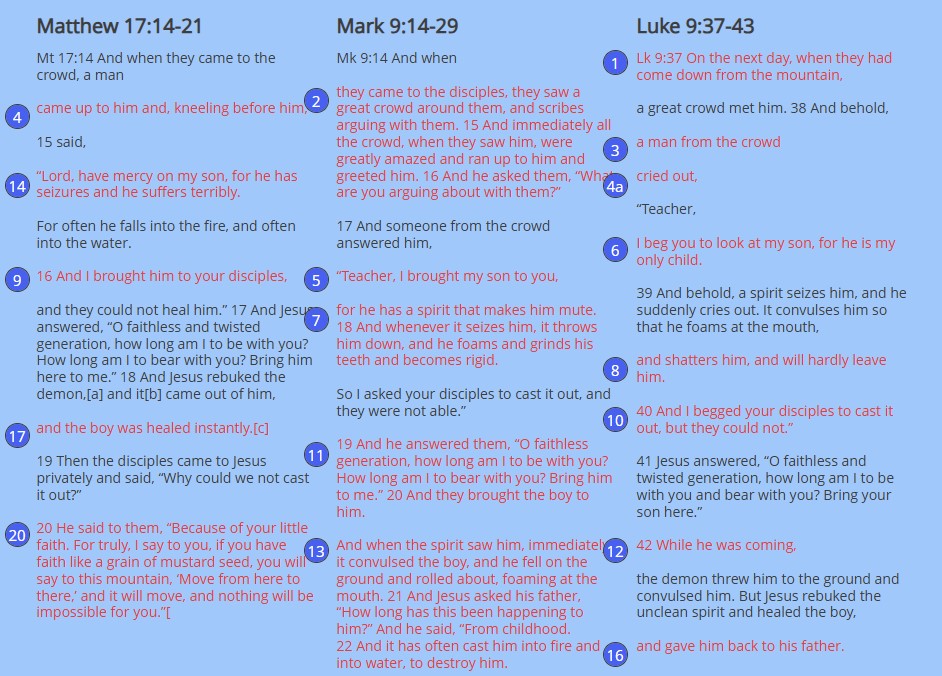
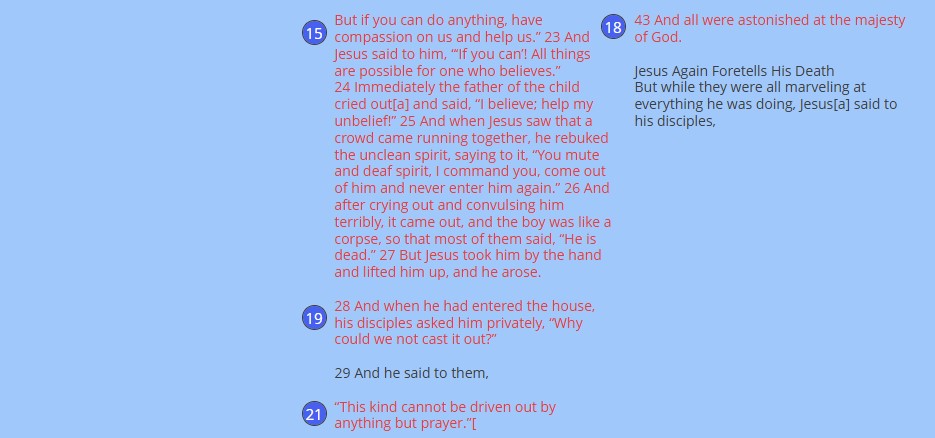
From the above worksheet photo, following the numbers and the text in red, the following narrative is produced:
Lk 9:37 On the next day, when they had come down from the mountain, Mk 9:14 they came to the disciples, they saw a great crowd around them, and scribes arguing with them. 15 And immediately all the crowd, when they saw him, were greatly amazed and ran up to him and greeted him. 16 And he asked them, “What are you arguing about with them?”
Lk 9:38 [Then] a man from the crowd Mt 7:14 came up to him and, kneeling before him, Lk 9:38 cried out, Mk 9:17 “Teacher, I brought my son to you. Lk 9:38 I beg you to look at my son, for he is my only child. Mk 9:17 He has a spirit that makes him mute. 18 And whenever it seizes him, it throws him down, and he foams and grinds his teeth and becomes rigid Lk 9:39 and shatters him and will hardly leave him. Mt 17:16 And I brought him to your disciples, Lk 9:40 and I begged your disciples to cast it out, but they could not.”
Mk 9:19 And he answered them, “O faithless generation, how long am I to be with you? How long am I to bear with you? Bring him to me.”
Mk 9:20 And they brought the boy to him. Lk 9:42 While he was coming, Mk 9:20 and when the spirit saw him, immediately it convulsed the boy, and he fell on the ground and rolled about, foaming at the mouth.
Mk 9:21 Jesus asked his father, “How long has this been happening to him?”
And he said, “From childhood. 22 And it has often cast him into fire and into water, to destroy him. Mt 17:15 “Lord, have mercy on my son, for he has seizures, and he suffers terribly. Mk 9:22 But if you can do anything, have compassion on us and help us.”
Mk 9:23 [Then] Jesus said to him, “‘If you can!’ All things are possible for one who believes.”
Mk 9:24 Immediately the father of the child cried out and said, “I believe; help my unbelief!”
Mk 9:25 And when Jesus saw that a crowd came running together, he rebuked the unclean spirit, saying to it, “You mute and deaf spirit, I command you, come out of him and never enter him again.” 26 And after crying out and convulsing him terribly, it came out, and the boy was like a corpse, so that most of them said, “He is dead.” 27 But Jesus took him by the hand and lifted him up, and he arose. Lk 9:42 [Then Jesus] gave him back to his father. Mt 17:18 And the boy was healed instantly. Lk 9:43 And all were astonished at the majesty of God.
Mk 9:28 And when [Jesus] had entered the house, his disciples asked him privately, “Why could we not cast it out?”
Mt 17:20 He said to them, “Because of your little faith. For truly, I say to you, if you have faith like a grain of mustard seed, you will say to this mountain, ‘Move from here to there,’ and it will move, and nothing will be impossible for you.” Mk 9:29 “This kind cannot be driven out by anything but prayer.”
Bible Lessons for this event:
H400 The Faithless Generation (Matthew 17:14, 16; Mk 9:14-19; Lk 9:37-40)
H401 A Delay for Spiritual Growth (Matthew 17:15; Mark 9:20-24; Luke 9:42)
H402 Jesus Heals the Boy (Matthew 17:18; Mark 9:25-27; Luke 9:42-43)
H403 Is Prayer Important to You? (Matthew 17:20; Mark 9:28-29)
Event Summary:
This event recount Jesus healing a boy possessed by a demon, after his disciples were unable to cast it out. It also highlights themes of faith, dependence on God, prayer, and Jesus’ authority over evil.
Key points of this event are:
(1) Jesus Confronts a Lack of Faith: When the father brings his son to Jesus, explaining the disciples’ inability to cast out the demon, Jesus expresses frustration: “O faithless generation, how long am I to be with you? How long am I to bear with you? Bring him to me.” (On the above worksheet photo see circles 1 – 11) A lack of faith limits what God can do through his followers. Jesus’ response highlights the importance of unwavering trust in God’s power.
(2) The Boy’s Condition and the Father’s Desperation: The boy’s father vividly describes his suffering, including seizures and self-harm caused by the demon. He pleads with Jesus, saying, “From childhood [the demon] has often cast him into fire and into water, to destroy him. But if you can do anything, have compassion on us and help us.” (On the above worksheet photo see circles 12 – 15) The father’s plea demonstrates both desperation and incomplete faith, showing the need for deeper trust in Jesus.
(3) The Importance of Faith: Jesus responds, “‘If you can!’ All things are possible for one who believes.” The father cries out, “I believe; help my unbelief!” Later, Jesus teaches the disciples, saying, “If you have faith like a grain of mustard seed, you will say to this mountain, ‘Move from here to there,’ and it will move, and nothing will be impossible for you.” (On the above worksheet photo see circles 15 – 21) Faith is the key to unlocking God’s power. Even a small amount of genuine faith can achieve great things, but faith must be accompanied by dependence on God.
(4) Jesus Demonstrates His Authority: Jesus rebukes the demon, commanding it to leave the boy and never return. The demon violently convulses the boy before leaving, and Jesus lifts him up, fully restoring him. (On the above worksheet photo see circles 15 – 17) This shows that Jesus has complete authority over evil and the power to bring healing and restoration. His actions show that God’s power is greater than any spiritual force.
(5) The Role of Prayer and Dependence on God: When the disciples ask why they couldn’t cast out the demon, Jesus explains, “This kind can come out only by prayer” (Mark) or “prayer and fasting” (Matthew). (On the above worksheet photo see circles 19 – 21) Spiritual victories require complete dependence on God, cultivated through prayer and fasting. These practices bring the believer’s heart into alignment with God’s will and draw on his power.
(6) The Crowd’s Amazement: After witnessing the boy’s healing, the crowd is astonished at the greatness of God. (On the above worksheet photo see circle 18) Miracles point to God’s glory and inspire awe, revealing his power and compassion for humanity.
This event emphasizes that faith, prayer, and dependence on God are essential for spiritual victory. Jesus again demonstrates his divine authority over evil and his compassion for those who suffer, encouraging believers to trust fully in him, even in challenging circumstances. The passage encourages readers to grow in their faith and cultivate a life of prayer in order to experience God’s power and glory. Faith is the key to unlocking God’s power. Even a small amount of genuine faith can achieve great things, but faith must be accompanied by dependence on God.
Discussion Questions with Extended Answers:
1. What situation did Jesus encounter when He came down from the mountain?
Answer:
Jesus returned from the Mount of Transfiguration and found a large crowd gathered around His disciples. The scribes were arguing with them, and a distressed father had brought his demon-possessed son to the disciples for healing. The disciples had been unable to cast out the demon, which created confusion and provided an opportunity for the religious leaders to criticize them. The contrast is striking: Jesus had just revealed His glory on the mountain, but immediately entered a scene of human suffering, spiritual warfare, and unbelief. This reminds believers that ministry often involves moving from moments of spiritual victory into situations requiring compassion, faith, and service.
2. How did the father describe his son’s condition?
Answer:
The father explained that his son was severely afflicted by an evil spirit. The demon caused the boy to become mute, threw him into violent convulsions, caused him to foam at the mouth, and often cast him into fire or water to destroy him. The father’s description reveals the destructive nature of Satan’s work. The enemy seeks to harm and destroy those under his influence. The father’s desperation is understandable because he had likely watched his son suffer for many years without finding relief. His plea to Jesus demonstrates the hope that Christ alone can bring deliverance when human efforts fail.
3. Why was Jesus disappointed with the crowd and His disciples?
Answer:
Jesus responded by saying, “O faithless and twisted generation.” His words addressed the widespread unbelief surrounding Him. The scribes doubted Him, the crowd lacked understanding, the father struggled with uncertainty, and even the disciples failed to trust God fully. Jesus had repeatedly demonstrated His authority over sickness, nature, death, and demons, yet many still failed to believe. His statement reveals that unbelief is not merely a lack of information but a failure to trust God’s power and character despite clear evidence. Faith is essential for experiencing God’s work.
4. What important statement did the father make about his faith?
Answer:
In Mark’s account, the father said, “I believe; help my unbelief!” This honest confession is one of the most encouraging statements in Scripture. The father possessed genuine faith because he came to Jesus seeking help, yet he recognized that his faith was imperfect. Rather than pretending to have complete confidence, he admitted his weakness and asked Jesus to strengthen him. This teaches believers that faith is not the absence of doubt but trusting Christ despite weaknesses and uncertainties. Jesus responded to this humble request, showing that He honors sincere faith that seeks His help.
5. What did Jesus teach when He said, “All things are possible for one who believes”?
Answer:
Jesus was emphasizing God’s unlimited power and the importance of trusting Him. Faith does not mean that believers can accomplish anything they desire by sheer determination. Rather, faith rests upon God’s ability and willingness to act according to His purposes. When believers trust God, they place themselves in the position to witness His power at work. Jesus was encouraging the father to look beyond the impossibility of the situation and focus on the greatness of God. Faith sees God’s power as greater than any problem.
6. How did Jesus heal the boy?
Answer:
Jesus rebuked the unclean spirit and commanded it to leave the boy and never return. The demon reacted violently, throwing the boy into severe convulsions before departing. The boy then appeared lifeless, causing many to think he had died. However, Jesus took him by the hand and raised him up. This miracle demonstrated Christ’s absolute authority over demonic powers. Unlike exorcists of the day who often used elaborate rituals, Jesus simply spoke a command. The demon obeyed immediately because all spiritual powers are subject to His authority.
7. Why did the disciples fail to cast out the demon?
Answer:
Afterward, the disciples privately asked Jesus why they had been unsuccessful. Jesus explained that their failure was due to their lack of faith. Mark records that Jesus also said, “This kind cannot be driven out by anything but prayer.” The disciples had previously cast out demons successfully, but they may have begun relying on past experiences instead of depending upon God. Prayer expresses dependence on God, while faith trusts His power. Their failure teaches believers that spiritual ministry cannot be accomplished through self-confidence, experience, or human ability. Victory comes through dependence upon God.
8. What does Jesus mean by faith like a mustard seed?
Answer:
In Matthew’s account, Jesus explains that faith as small as a mustard seed can move mountains. The emphasis is not on the amount of faith but on the object of faith. A small faith placed in a great God is powerful. The mustard seed was one of the smallest seeds known in Israel, yet it grew into a large plant. Likewise, genuine faith may begin small, but it can produce remarkable results because it rests upon God’s power. Jesus was teaching that even seemingly insignificant faith can accomplish great things when it trusts Him.
9. What lessons about prayer can be learned from this event?
Answer:
This account demonstrates that prayer is an expression of dependence upon God. The disciples’ inability to cast out the demon revealed that spiritual victories cannot be achieved through routine methods or personal strength. Prayer acknowledges that only God possesses the power necessary to overcome spiritual opposition. Effective ministry flows from a living relationship with God rather than from techniques or past successes. Believers should approach challenges through prayer, recognizing their need for God’s wisdom, strength, and intervention.
10. What does this miracle reveal about Jesus’ authority?
Answer:
This miracle reveals Jesus as the sovereign Lord over the spiritual realm. The demon could not resist His command. Human beings were powerless to solve the problem, but Christ exercised complete authority with a single word. The miracle demonstrates that Jesus is greater than every force of evil and that nothing is beyond His control. It also points to His mission of defeating Satan and delivering people from bondage. Through His death and resurrection, Christ would ultimately secure victory over all the powers of darkness.
11. How does this passage encourage believers facing difficult situations?
Answer:
The father’s experience encourages believers to bring their burdens honestly to Christ. He came with pain, disappointment, uncertainty, and imperfect faith, yet Jesus did not reject him. Instead, Jesus responded with compassion and power. Believers often face situations that seem impossible, but this passage reminds them that no circumstance is beyond God’s ability. Even when faith feels weak, they can pray as the father did, asking God to strengthen their trust. Christ welcomes those who come to Him in humble dependence.
12. What is the central message of this event?
Answer:
The central message is that Jesus possesses absolute authority over evil and responds to genuine faith. Human strength, religious arguments, and personal effort failed to help the boy, but Christ accomplished instantly what no one else could do. The event teaches that believers must rely on God through faith and prayer rather than trusting themselves. It also reveals the compassion of Jesus, who delivers those in bondage and strengthens those whose faith is weak. Ultimately, the passage points to Christ as the only sufficient Savior who can overcome every enemy and provide true deliverance.


Leave a Reply