
HermanvanBon (Good Morning in Napier, South Africa.)
Previous Lesson
Next Lesson
Author: Stephen Weller
2,756 words, 15 minutes read time
The Transfiguration
Scripture Reference: Matthew 17:1-13; Mark 9:2-13; Luke 9:28-36
Context:
The account of the Transfiguration occurs at a critical turning point in Jesus’ ministry. Just days earlier, Peter had confessed that Jesus is the Christ, the Son of the living God (Matthew 16:16), and Jesus had begun openly teaching His disciples that He would soon suffer, be rejected, die, and rise again. This revelation deeply troubled the disciples because their expectations centered on a conquering Messiah who would establish an earthly kingdom. Jesus also challenged them with the difficult call of discipleship, teaching that anyone who would follow Him must deny himself, take up his cross, and follow Him. To strengthen the faith of His closest followers and prepare them for the coming events in Jerusalem, Jesus took Peter, James, and John up a high mountain to pray. There, His divine glory was unveiled before them as His appearance was transformed and His garments became dazzling white. Moses and Elijah appeared with Him, representing the Law and the Prophets and testifying that Jesus is the fulfillment of all God’s redemptive promises. Luke records that they spoke about His “departure” (literally, His exodus), referring to His coming death, resurrection, and ascension through which He would accomplish salvation. As Peter attempted to preserve the moment by suggesting the construction of three shelters, a bright cloud overshadowed them, and God the Father declared, “This is my beloved Son; listen to Him.” This divine affirmation identified Jesus as greater than Moses and Elijah and established His supreme authority. The Transfiguration provided a glimpse of Christ’s heavenly glory before His suffering, assuring the disciples that the cross would not be a defeat but the pathway to His exaltation. As they descended the mountain, Jesus instructed them not to reveal what they had seen until after His resurrection and explained that Elijah had already come in the person and ministry of John the Baptist, who prepared the way for the Messiah. Thus, the Transfiguration serves as a bridge between Jesus’ Galilean ministry and His journey toward the cross, revealing both His divine identity and the certainty of His coming kingdom.
Event Narrative:
The narrative for this section was obtained from three similar texts, using the highlighted material shown below. The selection was determined by Jerry Peyton and copyrighted in 2015 by Jerry Peyton and Biblical Studies Press L.L.C.
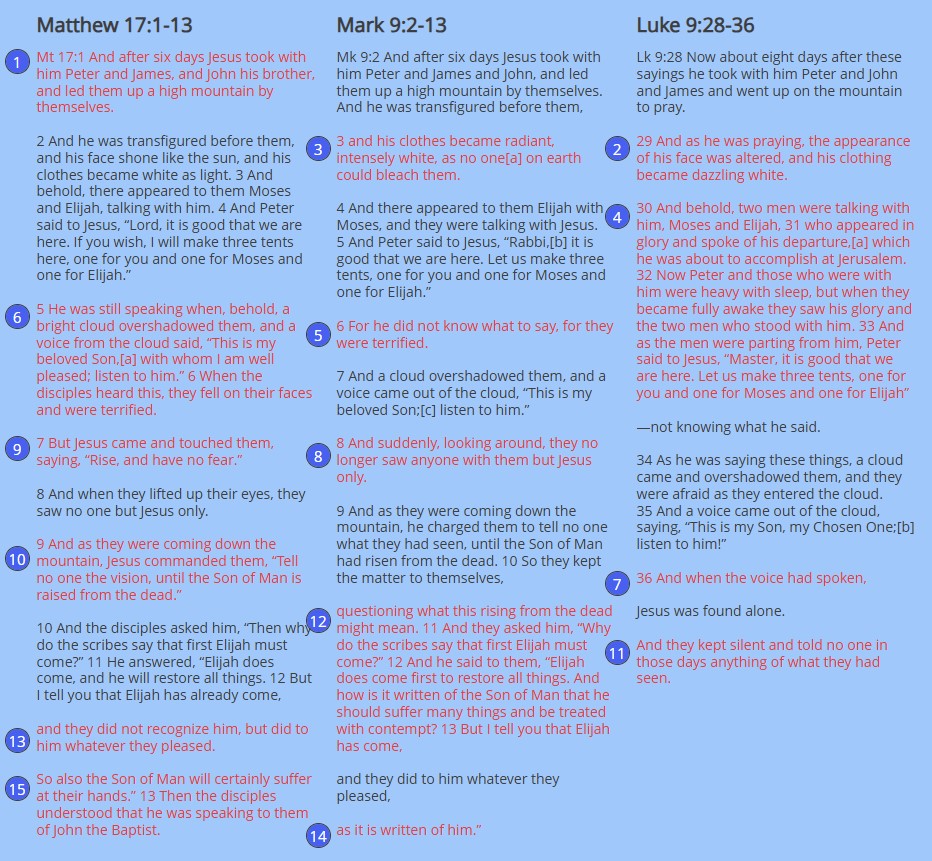
From the above worksheet photo, following the numbers and the text in red, the following narrative is produced.
Mt 17:1 And after six days Jesus took with him Peter and James, and John his brother, and led them up a high mountain by themselves. Lk 9:29 And as [Jesus] was praying, the appearance of his face was altered, and his clothing became dazzling white; Mk 9:3 [they] became radiant, intensely white, as no one on earth could bleach them.
Lk 9:30 And behold, two men were talking with him, Moses and Elijah, 31 who appeared in glory and spoke of his departure, which he was about to accomplish at Jerusalem. 32 Now Peter and those who were with him were heavy with sleep, but when they became fully awake, they saw his glory and the two men who stood with him.
Lk 9:33 And as the men were parting from him, Peter said to Jesus, “Master, it is good that we are here. Let us make three tents, one for you and one for Moses and one for Elijah” Mk 9:6 for he did not know what to say, for they were terrified.
Mt 17:5 [While Peter] was still speaking, behold, a bright cloud overshadowed them, and a voice from the cloud said, “This is my beloved Son, with whom I am well pleased; listen to him.”
Mt 17:6 When the disciples heard this, they fell on their faces and were terrified. Lk 9:36 And when the voice had spoken, Mk 9:8 and suddenly, looking around, they no longer saw anyone with them but Jesus only. Mt 17:7 But Jesus came and touched them, saying, “Rise, and have no fear.”
Mt 17:9 And as they were coming down the mountain, Jesus commanded them, “Tell no one the vision, until the Son of Man is raised from the dead.” Lk 9:36 And they kept silent and told no one in those days anything of what they had seen.
Mk 9:10 [Then the disciples questioned] what this rising from the dead might mean. 11 And they asked [Jesus], “Why do the scribes say that first Elijah must come?”
Mk 9:12 And he said to them, “Elijah does come first to restore all things. And how is it written of the Son of Man that he should suffer many things and be treated with contempt? 13 But I tell you that Elijah has come, Mt 17:12 and they did not recognize him, but did to him whatever they pleased, Mk 9:13 as it is written of him. Mt 17:12 So also the Son of Man will certainly suffer at their hands.”
Mt 17:13 Then the disciples understood that he was speaking to them of John the Baptist.
Bible Lessons for this event:
H394 The Transfiguration of Jesus (Matthew 17:1; Mark 9:3; Luke 9:29)
H395 Moses and Elijah Show Up (Luke 9:30-32)
H396 Peter Did Not Understand (Mark 9:6; Luke 9:32-33)
H397 The Father Spoke (Matthew 17:5-6)
H398 Rise, Have No Fear (Matthew 17:7, 9; Mark 9:8; Luke 9:36)
H399 Elijah or John the Baptist? (Matthew 17:12-13; Mark 9:10-13)
Event Summary:
This event shows that the Transfiguration of Jesus is a significant event where Jesus reveals his divine glory to Peter, James, and John. This event emphasizes themes of Jesus’ divine identity, the fulfillment of prophecy, the importance of listening to him, and the connection between suffering and glory.
Key points of this event are:
(1) Revelation of Jesus’ Divine Glory: Jesus takes Peter, James, and John to a mountain, where his appearance is transformed. His face shines like the sun, and his clothes become dazzling white. (On the above worksheet photo see circles 1 – 3) The Transfiguration reveals the divine nature of Jesus and his connection to the glory of God. It also affirms his identity as the Son of God and provides a glimpse of his future glory.
(2) Presence of Moses and Elijah: Moses and Elijah appeared and spoke with Jesus about his impending death. Moses represented the Law and Elijah the Prophets, who were pointing to Jesus as the fulfillment of both. (On the above worksheet photo see circle 4) Jesus is the culmination of God’s redemptive plan, fulfilling the Law and the Prophets. The presence of Moses and Elijah underscores his role as the Messiah who brings God’s promises to completion.
(3) Peter’s Response and the Divine: Peter was terrified and didn’t know what to say, suggests building shelters for Jesus, Moses, and Elijah, revealing his misunderstanding of the event. A voice from a cloud then declares, “This is my beloved Son, with whom I am well pleased; listen to him.” (On the above worksheet photo see circles 5 -9) God’s command to “listen to him” highlights Jesus’ authority as the ultimate revelation of God’s will. Peter’s reaction shows the disciples are struggling to fully understand the mission of Jesus.
(4) Connection Between Suffering and Glory: As they descend the mountain, Jesus tells the disciples to tell no one until after his resurrection. He explains that the Son of Man must suffer, and that John the Baptist (symbolizing Elijah) has already come to prepare the way. (On the above worksheet photo see circles 10 -14) The Scriptures inform us, and experience reveals to us that the path to glory involves suffering. Jesus connects his Transfiguration to his impending death and resurrection, showing that his mission is to redeem humanity through sacrifice.
This event reveals Jesus’ divine identity and glory, affirming his role as the fulfillment of God’s redemptive plan. It calls believers to listen to him as the ultimate authority and reminds them that the path to glory often involves suffering. This event serves as a foretaste of Jesus’ resurrection and his kingdom, offering hope and encouragement to those who follow him faithfully.
Discussion Questions with Extended Answers:
1. What was the purpose of Jesus taking Peter, James, and John up the mountain?
Answer:
Jesus selected Peter, James, and John to witness a unique revelation of His divine glory. These three disciples formed His inner circle and would later accompany Him during significant events such as the raising of Jairus’s daughter and His prayer in Gethsemane. On the mountain, Jesus allowed them to see beyond His ordinary human appearance and glimpse His heavenly majesty. This experience strengthened their faith and prepared them for the coming shock of His suffering and crucifixion. The Transfiguration demonstrated that Jesus was not merely a prophet or teacher but the divine Son of God whose glory existed before His incarnation and would continue after His resurrection.
2. What happened to Jesus during the Transfiguration?
Answer:
Jesus was transformed before the disciples’ eyes. His face shone like the sun, and His clothes became dazzling white, brighter than any earthly bleaching process could produce. This was not a change in His nature but a temporary unveiling of His divine glory. Throughout His earthly ministry, Jesus veiled His heavenly majesty beneath human flesh. On the mountain, that veil was briefly lifted so the disciples could see who He truly was. The event confirmed His deity and revealed that the suffering Messiah was also the glorious Son of God.
3. Why did Moses and Elijah appear with Jesus?
Answer:
Moses and Elijah represented the Law and the Prophets, the two major divisions of the Old Testament Scriptures. Their appearance demonstrated that the entire Old Testament pointed toward Jesus and found its fulfillment in Him. Moses represented God’s covenant law, while Elijah represented the prophetic witness. Their presence showed continuity between God’s previous revelation and Christ’s ministry. Luke adds that they were discussing Jesus’ coming “departure” (literally “exodus”), referring to His death, resurrection, and ascension. This conversation highlighted that Christ’s sacrificial work was the culmination of God’s redemptive plan revealed throughout Scripture.
4. What does the conversation about Jesus’ “departure” teach us?
Answer:
Luke records that Moses and Elijah spoke with Jesus about the departure He was about to accomplish in Jerusalem. The Greek word used is “exodus,” recalling Israel’s deliverance from Egypt. Jesus would accomplish a greater exodus through His death and resurrection, delivering sinners from the bondage of sin and death. This conversation reveals that the cross was not a tragic accident but the central purpose of Christ’s mission. The Law and the Prophets anticipated this redemptive work, and heaven itself recognized its importance.
5. Why did Peter suggest building three shelters or tabernacles?
Answer:
Peter was overwhelmed by the glory of the moment and wanted to prolong the experience. He suggested building three shelters, one for Jesus, one for Moses, and one for Elijah. Although well-intentioned, Peter failed to understand the full significance of what he was witnessing. By suggesting equal shelters, he unintentionally placed Moses and Elijah on the same level as Jesus. God’s response corrected this misunderstanding by directing all attention to Christ alone. Peter later reflected on this event in his writings and recognized its significance as a revelation of Jesus’ divine majesty.
6. What was the significance of the bright cloud that overshadowed them?
Answer:
The cloud symbolized the visible presence of God, often called the Shekinah glory. Throughout the Old Testament, God’s presence was associated with a cloud that guided Israel, filled the tabernacle, and filled Solomon’s temple. When the cloud overshadowed the disciples, it signified that God Himself was present. This connected Jesus with God’s covenant presence among His people and confirmed that He was the ultimate dwelling place of God among humanity.
7. What did the voice from heaven declare about Jesus?
Answer:
The voice from the cloud proclaimed, “This is my beloved Son, with whom I am well pleased; listen to him.” This declaration combined themes from Psalm 2, which describes God’s King and Son, and Isaiah 42, which describes God’s chosen Servant. God publicly affirmed Jesus’ identity, authority, and mission. The command “listen to him” emphasized that Jesus possesses supreme authority. While Moses and Elijah were faithful servants of God, Jesus is God’s Son and the final, authoritative revelation of God’s will.
8. Why was the command “Listen to Him” so important?
Answer:
The command directs believers to place Jesus above every other authority. Moses represented the Law, Elijah represented the Prophets, but Jesus surpassed both. God’s instruction meant that the disciples must trust Christ’s teaching even when it conflicted with their expectations. At that time, they struggled to understand His predictions of suffering and death. By commanding them to listen to Jesus, God affirmed that His words about the cross, resurrection, and kingdom were true and trustworthy.
9. Why were the disciples afraid when they heard God’s voice?
Answer:
Throughout Scripture, people often responded to God’s direct presence with fear because they recognized His holiness and majesty. The disciples suddenly found themselves surrounded by divine glory and heard the voice of God. Their fear reflected awe and reverence rather than mere terror. They understood that they were experiencing something far beyond ordinary human experience. Their reaction reminds believers of God’s greatness and the proper humility that should accompany worship.
10. What is the significance of Jesus touching the disciples and telling them not to be afraid?
Answer:
After the overwhelming revelation of God’s glory, Jesus approached the disciples, touched them, and encouraged them. This demonstrates both His divine majesty and His compassionate humanity. The One whose glory terrified them was also their loving Savior. Jesus bridged the gap between holy God and sinful humanity. His touch reassured them that they could approach God through Him. This moment beautifully illustrates Christ’s role as mediator.
11. Why did Moses and Elijah disappear, leaving only Jesus?
Answer:
Their disappearance emphasized that Jesus alone is the center of God’s redemptive plan. The Law and the Prophets had fulfilled their purpose by pointing to Him. Once God’s voice affirmed His Son, Moses and Elijah faded from view because the focus belonged entirely to Christ. The disciples looked up and saw “Jesus only,” a powerful picture of the supremacy of Christ over all previous revelation.
12. Why did Jesus tell the disciples not to speak about the vision until after His resurrection?
Answer:
The disciples did not yet fully understand the meaning of Jesus’ mission. If news of the Transfiguration spread before His death and resurrection, people might misunderstand His role and attempt to make Him a political king. The resurrection would provide the necessary context for understanding His glory. Only after Christ conquered death could the disciples accurately testify to what they had seen and explain its significance.
13. Why did the disciples ask about Elijah coming first?
Answer:
Jewish teachers expected Elijah to appear before the arrival of the Messiah based on the prophecy in Malachi 4:5–6. Since the disciples had just seen Elijah on the mountain, they wondered how this prophecy fit with Jesus’ identity as the Messiah. Their question revealed an effort to understand how prophecy and recent events fit together within God’s plan.
14. How did Jesus explain the coming of Elijah?
Answer:
Jesus explained that Elijah had already come in the person and ministry of John the Baptist. John was not literally Elijah returned from heaven, but he came in Elijah’s spirit and power, fulfilling Malachi’s prophecy. Like Elijah, John boldly called people to repentance and prepared the way for God’s work. Sadly, many rejected him, just as many would reject Jesus. This fulfilled prophecy and demonstrated that God’s redemptive plan was unfolding exactly as foretold.
15. What does the Transfiguration teach believers about Jesus today?
Answer:
The Transfiguration reveals that Jesus is the glorious Son of God, the fulfillment of the Law and the Prophets, and the supreme authority over all creation. It reminds believers that the suffering Christ is also the reigning King. The event encourages Christians to trust His words, especially during trials and suffering. Just as the disciples saw His glory before witnessing His crucifixion, believers can endure present hardships knowing that Christ reigns in glory and will one day return in power. The Transfiguration assures us that Jesus is exactly who He claimed to be—the beloved Son of God whom all people must hear, trust, worship, and obey.
 Anchor My Faith
Leave a comment