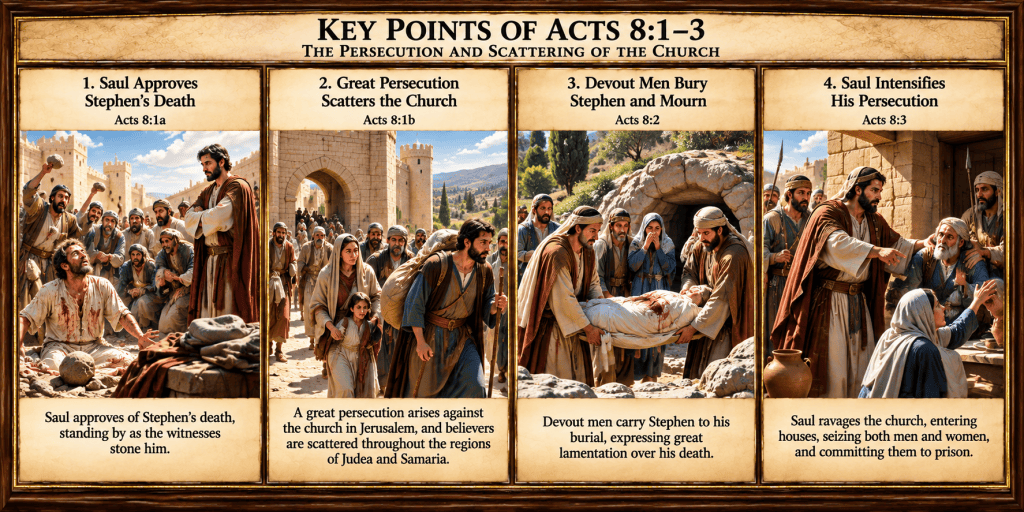
image Acts 8:1-3
New Testament Events Series
Event: nte019 Saul Ravages the Church (Acts 8:1-3)
Facilitator/Editor: Stephen Weller
Information Collection: ChatGPT
Bible Text: BibleGateway
2,435 words, 13 minutes read time
NT Event Index
Event Context
Context for Acts 8:1-3
Acts 8:1–3 – The Persecution of the Church and the Scattering of Believers
Acts 8:1–3 marks a significant turning point in the growth of the early church, following the martyrdom of Stephen in Acts 7:54–60. Stephen’s death, which Saul approved, unleashed a great persecution against the believers in Jerusalem. As opposition intensified, many Christians were forced to flee their homes and scatter throughout the regions of Judea and Samaria, while the apostles remained in Jerusalem. Although this persecution was intended to suppress the growing Christian movement, God used the scattering of believers to advance His purposes and begin fulfilling Jesus’ command in Acts 1:8 that His witnesses would carry the gospel beyond Jerusalem into Judea, Samaria, and eventually to the ends of the earth. Devout men buried Stephen and mourned his death, demonstrating their love and respect for this faithful servant of Christ. Meanwhile, Saul emerged as a determined persecutor of the church, entering homes, dragging away men and women, and committing them to prison. His violent opposition reveals the suffering endured by the early Christians and provides an important background for his dramatic conversion in Acts 9. The central lesson of this passage is that persecution cannot defeat God’s purposes. What appeared to be a devastating setback for the church became an opportunity for the gospel to spread into new regions and reach new people.
Understanding the Event
Event Text
8 And Saul approved of his execution.
And there arose on that day a great persecution against the church in Jerusalem, and they were all scattered throughout the regions of Judea and Samaria, except the apostles. 2 Devout men buried Stephen and made great lamentation over him. 3 But Saul was ravaging the church, and entering house after house, he dragged off men and women and committed them to prison.
Questions with answers
1. What significant event occurred immediately before Acts 8:1–3, and how did it affect the early church?
Answer:
Acts 8:1–3 follows the martyrdom of Stephen, the first Christian martyr recorded in Scripture. In Acts 7, Stephen boldly proclaimed God’s truth before the Jewish religious leaders, explaining Israel’s history and confronting their resistance to the Holy Spirit. His message angered the council, and he was dragged outside the city and stoned to death.
Stephen’s death marked a turning point in the history of the early church. Until this time, the believers had experienced opposition, arrests, and threats, but Stephen’s execution revealed that persecution had become deadly.
Acts 8:1 records that a great persecution arose against the church in Jerusalem on that day. What began with the death of one faithful witness developed into widespread hostility toward the Christian community.
Yet Stephen’s death did not silence the gospel. Instead, the persecution that followed became the occasion for believers to carry the message of Jesus beyond Jerusalem.
Spiritual Lesson: Faithfulness to Christ does not guarantee freedom from suffering. God can accomplish His purposes even through the opposition His people experience.
2. Who was Saul, and what does his approval of Stephen’s execution reveal about him?
Answer:
Saul was a zealous Pharisee who believed that the growing Christian movement threatened the Jewish faith and its traditions. He was deeply committed to the religious teachings he had received and regarded the followers of Jesus as dangerous opponents of what he understood to be God’s truth.
Acts 8:1 states that Saul approved of Stephen’s execution. This reveals that his opposition to Christianity was not merely intellectual disagreement. He supported the violent suppression of those who proclaimed Jesus as the risen Messiah.
Saul’s approval also connects him directly to the events of Acts 7:58, where witnesses laid their garments at his feet during Stephen’s stoning.
At this point, Saul believed he was defending God’s honor. However, his actions demonstrated how religious zeal, when separated from a true understanding of God’s revelation, can lead to serious wrongdoing.
The significance of Saul’s introduction becomes even greater when we consider his later conversion in Acts 9. The man who approved of Stephen’s death would eventually become the apostle Paul, one of Christianity’s most influential missionaries.
Spiritual Lesson: Sincerity and religious enthusiasm do not necessarily mean a person is following God’s will. True faith must be grounded in the truth of Jesus Christ.
3. Why did a great persecution arise against the church in Jerusalem?
Answer:
The persecution arose because the proclamation of Jesus Christ increasingly challenged the authority and religious convictions of influential Jewish leaders.
The apostles had repeatedly preached that Jesus, whom the authorities had rejected and crucified, had been raised from the dead and exalted by God. Their message called people to repentance and faith in Christ.
Stephen’s defense before the Sanhedrin intensified this conflict. He accused his hearers of resisting the Holy Spirit and betraying and murdering the Righteous One, Jesus Christ.
His words exposed a fundamental disagreement concerning the identity of Jesus and the fulfillment of God’s promises.
Following Stephen’s death, hostility expanded beyond individual leaders and became a broader campaign against the believers in Jerusalem.
This persecution was not evidence that the church had failed. Rather, it demonstrated the growing conflict between the gospel and those who rejected its claims.
Spiritual Lesson: Opposition to biblical truth does not invalidate that truth. Believers are called to remain faithful even when obedience to God brings rejection or hardship.
4. Why were the believers scattered throughout Judea and Samaria, and what was the significance of their scattering?
Answer:
Acts 8:1 explains that the believers were scattered throughout the regions of Judea and Samaria because of the persecution in Jerusalem.
The scattering was initially a response to danger. Christians who faced hostility and possible imprisonment left Jerusalem and sought safety in surrounding regions.
However, this movement carried profound spiritual significance.
Before His ascension, Jesus had instructed His disciples in Acts 1:8 that they would be His witnesses in Jerusalem, throughout Judea and Samaria, and to the end of the earth.
Until this point, the church’s activity had been concentrated primarily in Jerusalem. The persecution became the occasion for believers to move into the very regions Jesus had identified.
Although their enemies intended to weaken the church, the scattering contributed to the expansion of the gospel.
Acts 8:4 later explains that those who were scattered went about preaching the word.
Spiritual Lesson: God can use difficult circumstances to open unexpected opportunities for His purposes. What appears to be a setback may become an occasion for spiritual growth and ministry.
5. Why does Acts 8:1 specifically mention that the apostles remained in Jerusalem?
Answer:
Acts 8:1 explains that the believers were scattered throughout Judea and Samaria, except for the apostles.
The passage does not explicitly explain why the apostles remained, but their continued presence suggests that they maintained an important leadership role in the Jerusalem church during this difficult period.
The apostles had been personally commissioned by Jesus and were responsible for teaching, strengthening, and guiding the growing community of believers.
Remaining in Jerusalem would have allowed them to continue providing spiritual leadership and encouragement to those who had not departed.
Their decision also demonstrated courage. Jerusalem had become a dangerous place for followers of Christ, yet the apostles continued their ministry there.
Later in Acts 8, Peter and John traveled from Jerusalem to Samaria after hearing that the Samaritans had received the word of God. This shows that Jerusalem continued to function as an important center of apostolic leadership.
Spiritual Lesson: Christian leadership requires courage, responsibility, and faithfulness. God calls His servants to remain committed to their responsibilities even when circumstances become difficult.
6. Who were the devout men who buried Stephen, and why was their mourning significant?
Answer:
Acts 8:2 records that devout men buried Stephen and made great lamentation over him.
The passage does not identify these men by name or explicitly state whether they were Christian believers or other God-fearing Jews. However, their actions reveal deep respect for Stephen and sorrow over his death.
By giving Stephen a proper burial, they honored a man who had faithfully proclaimed God’s truth and suffered death because of his testimony.
Their great lamentation reveals that Stephen’s death was a genuine tragedy for those who knew and respected him.
The early Christians believed in the resurrection and eternal life through Jesus Christ, yet these promises did not eliminate the sorrow associated with losing a faithful servant of God.
Their mourning demonstrates that grief and faith are not contradictory. Believers can possess confidence in God’s eternal promises while experiencing deep sadness over the death of someone they love.
Their public expression of grief may also have required courage in an atmosphere of increasing hostility toward Christians.
Spiritual Lesson: Christian hope does not require believers to suppress sorrow. Grief can coexist with confidence in God’s promises and the assurance of eternal life.
7. What does Acts 8:3 reveal about the severity of Saul’s persecution of the church?
Answer:
Acts 8:3 describes Saul as ravaging the church, entering house after house, dragging off men and women, and committing them to prison.
The language reveals that Saul’s persecution was aggressive, deliberate, and systematic.
He was not content merely to criticize Christian teaching or oppose the apostles publicly. He actively searched for believers in their homes and forcibly removed them.
The reference to both men and women demonstrates that Saul’s persecution extended throughout the Christian community. Neither gender was exempt from his efforts to suppress the movement.
The mention of individual houses is particularly significant because early Christians frequently gathered in homes for fellowship, prayer, teaching, and worship.
Saul’s actions therefore threatened not only individual believers but also the places where Christian communities gathered.
His campaign was intended to intimidate believers and disrupt the church’s growth.
Nevertheless, Saul’s efforts did not destroy the church. Instead, the gospel continued to spread, demonstrating that human opposition could not ultimately prevent God’s purposes from advancing.
Spiritual Lesson: The church’s strength does not depend upon freedom from opposition. Its ultimate security rests in Jesus Christ, who promised to build His church.
8. What does Saul’s persecution teach us about the danger of misguided religious zeal?
Answer:
Saul’s actions demonstrate that religious commitment can become destructive when it is not guided by a correct understanding of God’s truth.
Saul sincerely believed he was defending the faith of his ancestors. He had received extensive religious training and was deeply devoted to the traditions of Judaism.
However, his understanding of Jesus was fundamentally mistaken.
Instead of recognizing Jesus as the promised Messiah, Saul viewed His followers as a threat that needed to be eliminated.
This misunderstanding led him to approve of Stephen’s death and to imprison other believers.
Later, after encountering the risen Christ, Saul recognized the seriousness of his former actions. In 1 Timothy 1:13–16, Paul reflected on his past as a blasphemer, persecutor, and insolent opponent, while emphasizing the mercy he received from Christ.
His experience illustrates that zeal must be accompanied by humility, truth, and a willingness to submit to God’s revelation.
Spiritual Lesson: Believers must continually examine their convictions in light of Scripture. Genuine devotion to God requires both sincerity and obedience to His revealed truth.
9. How does Acts 8:1–3 demonstrate God’s sovereignty in the midst of suffering?
Answer:
Acts 8:1–3 presents a church experiencing grief, persecution, imprisonment, and displacement.
From a human perspective, these events might have appeared to threaten the survival of Christianity.
Stephen had been killed, believers were fleeing Jerusalem, and Saul was aggressively attempting to destroy the church.
Yet the larger narrative of Acts reveals that these events did not prevent God’s purposes from being fulfilled.
Jesus had already declared that His followers would carry the gospel beyond Jerusalem. The persecution became the circumstance through which many believers entered Judea and Samaria.
This does not mean that God approved of the violence committed against His people or that their suffering was insignificant.
Rather, it demonstrates that human evil cannot ultimately overturn God’s sovereign purposes.
The persecution was real, the suffering was painful, and the losses were significant. Nevertheless, God continued working through His people.
The later conversion of Saul provides another remarkable demonstration of divine sovereignty. The man who attempted to destroy the church would become an instrument for spreading the gospel throughout the Gentile world.
Spiritual Lesson: God’s sovereignty does not mean believers will avoid suffering. It means that suffering and human opposition cannot ultimately defeat His redemptive purposes.
10. How does the persecution in Acts 8:1–3 prepare the way for the next stage of the church’s mission?
Answer:
Acts 8:1–3 serves as an important transition in the book of Acts.
The first seven chapters primarily describe the establishment and growth of the church in Jerusalem.
During this period, the apostles preached, miracles occurred, believers shared their possessions, and thousands responded to the gospel.
However, Jesus had commissioned His followers to carry His message far beyond Jerusalem.
The persecution following Stephen’s death created the circumstances for this geographical expansion.
As believers fled Jerusalem, they carried their faith into new communities.
The following verses describe Philip’s ministry in Samaria, where many people responded to his proclamation of Christ.
Later chapters record the gospel reaching additional regions and eventually extending into the Gentile world.
Thus, Acts 8:1–3 introduces a major development in the fulfillment of Jesus’ commission.
The church was no longer concentrated primarily in Jerusalem. The gospel was beginning to spread into the surrounding world.
Spiritual Lesson: God’s mission is greater than any individual congregation, location, or circumstance. He calls His people to carry the message of salvation wherever He leads them.
Summary of Acts 8:1–3
Theme: Persecution Scatters the Church, but the Gospel Continues to Advance
Acts 8:1–3 describes a decisive turning point in the history of the early church. Following Stephen’s martyrdom, widespread persecution arose against the believers in Jerusalem. Saul emerged as a determined opponent of Christianity, entering homes and imprisoning men and women. While devout men mourned Stephen’s death, many believers fled into Judea and Samaria. Although the persecution brought genuine suffering and loss, it also became the occasion for the gospel to spread beyond Jerusalem, fulfilling the mission Jesus had given His disciples in Acts 1:8. The passage reveals that opposition cannot ultimately defeat God’s purposes and that He remains sovereign even during seasons of suffering.
Central Truth: What persecutors intended to suppress became an occasion for the gospel to spread. God’s purposes continued through the faithfulness of His scattered people.


Leave a Reply