Joshua Verse Study
Page Index
- Introduction and Overview of Joshua
- Overview of Joshua 1-5
- Chapter 1 – Be Strong and Courageous: God’s Commission to Joshua
- Chapter 2 – title
- Chapter 3 – title
- Chapter 4 – title
- Chapter 5 – title
- Overview of Joshua 6-12
- Chapter 6 – title
- Chapter 7 – title
- Chapter 8 – title
- Chapter 9 – title
- Chapter 10 – title
- Chapter 11 – title
- Chapter 12 – title
- Overview of Joshua 13-21
- Chapter 13 – title
- Chapter 14 – title
- Chapter 15 – title
- Chapter 16 – title
- Chapter 17 – title
- Chapter 18 – title
- Chapter 19 – title
- Chapter 20 – title
- Chapter 21 – title
- Overview of Joshua 22-24
- Chapter 22 – title
- Chapter 23 – title
- Chapter 24 – title
Introduction and Overview of Joshua
Introduction and Overview of Joshua
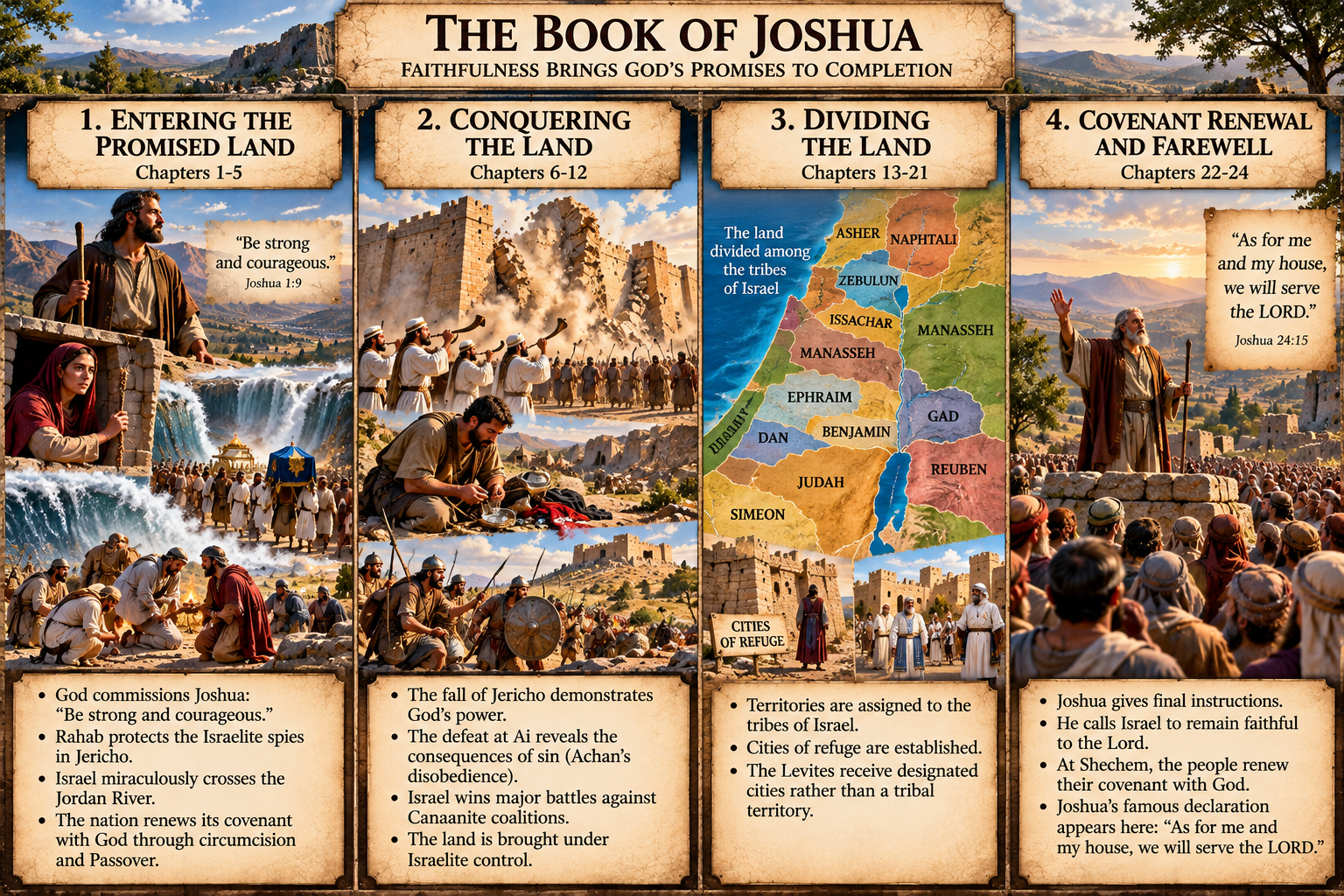
Joshua is the sixth book of the Bible and the first book in the section of Scripture often called the Historical Books. It records Israel’s transition from wandering in the wilderness to possessing the land God promised to Abraham, Isaac, and Jacob.
Key Theme:
God faithfully fulfills His promises, and His people are called to respond with faith, courage, obedience, and covenant loyalty.
Author and Setting
- Traditionally attributed to Joshua, the successor of Moses, with later additions possibly recorded by others.
- The events occur after Moses’ death, around the time Israel enters and settles in Canaan.
- Joshua serves as Israel’s leader, military commander, and spiritual guide.
Simple Outline of Joshua
1. Entering the Promised Land (Chapters 1-5)
- God commissions Joshua: “Be strong and courageous.”
- Rahab protects the Israelite spies in Jericho.
- Israel miraculously crosses the Jordan River.
- The nation renews its covenant with God through circumcision and Passover.
2. Conquering the Land (Chapters 6-12)
- The fall of Jericho demonstrates God’s power.
- The defeat at Ai reveals the consequences of sin (Achan’s disobedience).
- Israel wins major battles against Canaanite coalitions.
- The land is brought under Israelite control.
3. Dividing the Land (Chapters 13-21)
- Territories are assigned to the tribes of Israel.
- Cities of refuge are established.
- The Levites receive designated cities rather than a tribal territory.
4. Covenant Renewal and Farewell (Chapters 22-24)
- Joshua gives final instructions.
- He calls Israel to remain faithful to the Lord.
- At Shechem, the people renew their covenant with God.
- Joshua’s famous declaration appears here:
“But as for me and my house, we will serve the LORD.” (Joshua 24:15)
Major Themes
God’s Faithfulness
The book repeatedly shows that God keeps every promise He makes.
“Not one of all the LORD’s good promises to Israel failed; every one was fulfilled.” (Joshua 21:45)
Courage and Obedience
Joshua’s success is connected to trusting God’s Word and obeying His commands.
Holy Living
The account of Achan teaches that hidden sin affects the whole community.
Inheritance
The land symbolizes God’s gift and provision. Israel receives an inheritance, but they must walk faithfully to enjoy its blessings.
Covenant Commitment
The book ends by challenging every generation to decide whom they will serve.
Key People
- Joshua – Moses’ successor and Israel’s leader.
- Rahab – A Gentile woman whose faith leads to her rescue and inclusion in Israel.
- Caleb – A faithful spy who receives his inheritance in Hebron.
- Achan – His disobedience brings judgment on Israel.
Key Verse
Many consider Joshua 1:9 to summarize the book:
“Have I not commanded you? Be strong and courageous. Do not be frightened, and do not be dismayed, for the Lord your God is with you wherever you go.” (Joshua 1:9 ESV)
Having completed an overview of Joshua and its four major sections, we are almost ready to examine the first section in greater detail, but first we need to ask some questions to check your learning.
Questions of understanding with extended answers
1. Why is it important to begin our study of Joshua with an overview of the entire book?
Answer: An overview helps us see the “big picture” before examining individual passages. Just as a traveler benefits from viewing a map before beginning a journey, a student of Scripture benefits from understanding the overall structure of a biblical book. The overview of Joshua reveals how the events, themes, and lessons fit together. It helps us understand where each chapter belongs within God’s larger purpose of bringing Israel into the Promised Land and establishing them as His covenant people.
2. How many major sections are identified in the overview of Joshua?
Answer: The overview identifies four major sections. These sections organize the book into a logical progression of events. Together, they show Israel’s movement from preparing to enter Canaan, to conquering the land, dividing the inheritance among the tribes, and finally receiving Joshua’s farewell instructions. Understanding these four sections helps readers follow the development of the narrative and recognize the major themes emphasized throughout the book.
3. What does the structure of Joshua teach us about God’s work among His people?
Answer: The structure of Joshua demonstrates that God works according to His plan and promises. The book does not present random events. Instead, each section reveals a step in the fulfillment of God’s covenant promises given centuries earlier to Abraham. God first leads His people into the land, then grants them victory, distributes their inheritance, and finally calls them to faithful obedience. The orderly structure highlights God’s faithfulness, sovereignty, and purpose.
4. What is the central theme that connects all four sections of Joshua?
Answer: The central theme is God’s faithfulness in fulfilling His promises to Israel. Every major section contributes to this theme. God enables Israel to enter the land He promised, gives them victory over their enemies, assigns the inheritance to each tribe, and reminds them of their covenant responsibilities. The book repeatedly shows that God’s promises can be trusted and that success comes through obedience to Him.
5. How does understanding the four sections help us study individual chapters?
Answer: Knowing the four sections provides context for every chapter. When we read a chapter, we can ask where it fits within the larger story. Is it describing preparation, conquest, inheritance, or Joshua’s final instructions? Understanding the chapter’s place within the overall structure helps us interpret its purpose correctly and prevents us from viewing events in isolation from the book’s main message.
6. What can we learn from Joshua’s overall organization about spiritual growth?
Answer: Joshua’s organization illustrates that spiritual progress often occurs in stages. Israel first prepared, then acted in faith, received the promised inheritance, and was finally challenged to remain faithful. Believers today experience a similar pattern. God prepares us, leads us through challenges, blesses us with spiritual blessings, and calls us to continued obedience. The structure of Joshua reminds us that spiritual growth is a journey guided by God’s faithfulness.
7. Why should students pay attention to the major divisions of a biblical book?
Answer: Major divisions reveal how the author organized the material and help us understand the intended message. They allow us to see connections between events and themes that might otherwise be overlooked. In Joshua, the major divisions show a clear progression from promise to possession and from conquest to commitment. Recognizing these divisions enables students to study the book more effectively and appreciate its literary and theological design.
8. What should we expect to learn in the next lesson as we begin studying the first major section?
Answer: The next lesson will focus on the first major section of Joshua and examine its structure, purpose, and key themes. Students will learn how this section introduces the events that prepare Israel to enter and possess the Promised Land. By studying this section carefully, we will gain a deeper understanding of how God prepared His people for the challenges and opportunities that lay ahead.
Review Question
What is the primary purpose of the overview of Joshua?
Answer: The primary purpose of the overview is to provide a framework for understanding the entire book. By identifying the four major sections and their relationship to one another, the overview helps students see the unfolding story of God’s faithfulness and prepares them for a more detailed study of each section in the lessons that follow.
The next lesson will provide an overview of that section as outlined below.
- Entering the Promised Land (Chapters 1-5)
- Conquering the Land (Chapters 6-12)
- Dividing the Land (Chapters 13-21)
- Covenant Renewal and Farewell (Chapters 22-24)
Overview of Joshua 1-5
Overview of Joshua 1-5
Joshua 1-5 serves as the transition from Moses’ leadership to Joshua’s and records Israel’s preparation to enter and begin possessing the Promised Land. These chapters emphasize God’s faithfulness, courage, obedience, and covenant commitment.
Joshua 1: God Commissions Joshua
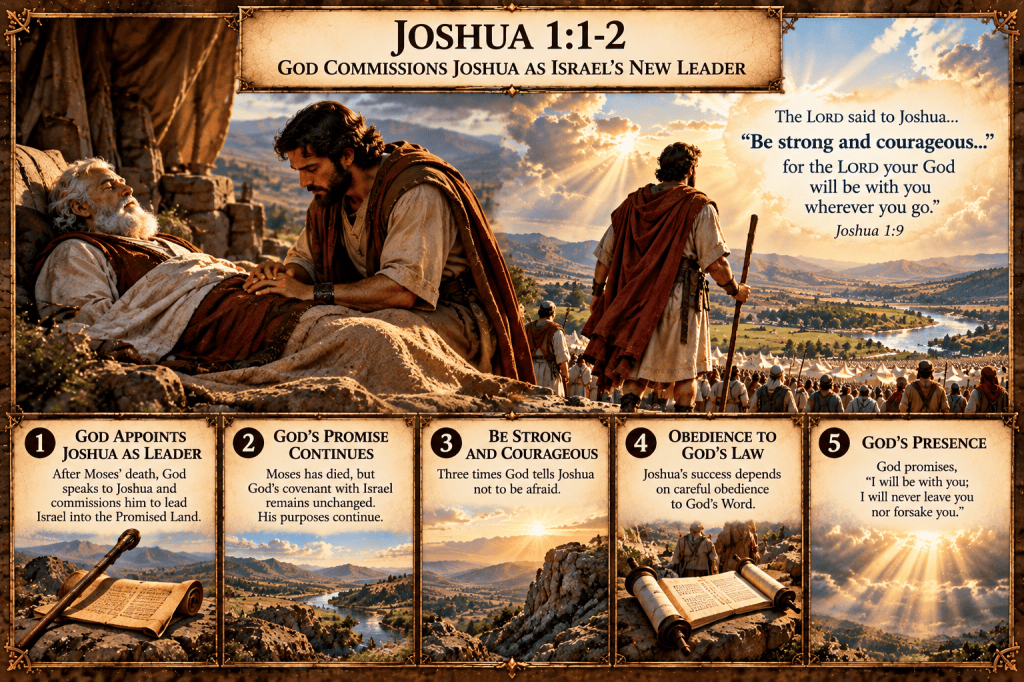
After Moses’ death, God appoints Joshua as Israel’s new leader.
Key Themes
- God’s promise continues. Moses has died, but God’s covenant remains unchanged.
- Be strong and courageous. Three times God tells Joshua not to be afraid.
- Obedience to Scripture. Joshua’s success depends on careful obedience to God’s law.
- God’s presence. God promises, “I will be with you; I will never leave you nor forsake you.”
Important Verse
“Be strong and courageous…for the Lord your God will be with you wherever you go.” (Joshua 1:9)
Joshua then instructs the people to prepare to cross the Jordan River, and the tribes east of the Jordan reaffirm their commitment to help conquer Canaan.
Joshua 2: Rahab and the Spies
Joshua secretly sends two spies into Jericho.
Key Events
- Rahab, a Canaanite woman, hides the spies from the king’s soldiers.
- She declares her faith that Israel’s God is the true God.
- Rahab asks for protection for her family.
- The spies agree that a scarlet cord displayed in her window will identify her house when Jericho falls.
Major Lessons
- Faith can be found in unexpected places.
- God’s salvation extends beyond Israel.
- Rahab becomes an example of faith and later appears in the genealogy of Jesus (Matthew 1:5).
Important Statement
“The Lord your God is God in heaven above and on the earth below.” (Joshua 2:11)
Joshua 3: Crossing the Jordan River
The nation reaches the Jordan River, which is at flood stage.
Key Events
- The priests carry the Ark of the Covenant ahead of the people.
- As their feet enter the water, the river stops flowing.
- Israel crosses on dry ground.
Significance
This miracle parallels the crossing of the Red Sea under Moses:
- The Red Sea marked Israel’s deliverance from Egypt.
- The Jordan marks their entrance into the Promised Land.
God uses this event to establish Joshua’s authority before the nation.
Central Truth
Victory comes not through military strength but through God’s power and presence.
Joshua 4: Memorial Stones
After crossing the Jordan, God commands Joshua to set up twelve stones taken from the riverbed.
Purpose of the Stones
- To remind future generations of God’s mighty acts.
- To create opportunities for parents to teach their children about God’s faithfulness.
- To testify to all nations that God is powerful.
Key Theme
Remembering God’s works strengthens faith.
Important Verse
“These stones are to be a memorial to the people of Israel forever.” (Joshua 4:7)
Joshua 5: Consecration Before Conquest
Before any military campaign begins, God focuses on Israel’s spiritual condition.
Key Events
1. Circumcision Renewed
A generation born in the wilderness had not been circumcised. The covenant sign is restored.
2. Passover Observed
Israel celebrates Passover in Canaan for the first time, remembering God’s redemption from Egypt.
3. Manna Ceases
After decades of wilderness provision, the manna stops because Israel is now eating produce from the land.
4. Commander of the Lord’s Army Appears
Joshua encounters a mysterious divine figure with a drawn sword.
When Joshua asks,
“Are you for us or for our enemies?”
the answer is essentially neither. The real question is whether Joshua is aligned with God’s purposes.
Joshua falls in worship, and the commander tells him:
“Take off your sandals, for the place where you are standing is holy.”
This echoes God’s call to Moses at the burning bush.
Major Themes of Joshua 1-5
1. God’s Faithfulness
God fulfills His promises despite the death of Moses and the passing of generations.
2. Courage Through God’s Presence
Joshua’s confidence rests not in himself but in God’s promise to be with him.
3. Faith and Obedience
Rahab’s faith, Joshua’s obedience, and Israel’s willingness to follow God’s instructions are central.
4. Remembering God’s Works
The memorial stones and Passover celebration help future generations remember God’s deliverance.
5. Spiritual Preparation Before Victory
Before conquering Jericho, Israel renews its covenant relationship with God.
Summary in One Sentence
Joshua 1-5 records Israel’s transition under Joshua, their miraculous entry into the Promised Land, and their spiritual preparation to follow God before beginning the conquest of Canaan.
Like the overview of the book of Joshua, this section includes study questions with extended answers designed to help you become familiar with the key themes, lessons, and content you will encounter.
Questions of Understanding
Questions of understanding with extended answers
1. What is the overall purpose of Joshua 1-5?
Answer: Joshua 1-5 serves as the introduction to Israel’s conquest of Canaan. These chapters describe Israel’s transition from wandering in the wilderness to entering the Promised Land. God commissions Joshua as Moses’ successor, prepares the people for conquest, miraculously brings them across the Jordan River, and renews the covenant before the military campaigns begin.
The emphasis is not primarily on military strategy but on spiritual preparation. God demonstrates that He is still leading His people just as He did under Moses. Israel learns that victory will come through faith, obedience, and dependence on God rather than through their own strength.
2. Why was Joshua chosen to succeed Moses?
Answer: Joshua was chosen because God had prepared him over many years for leadership. He served as Moses’ assistant, accompanied him during important events, and proved himself faithful and courageous. Joshua was also one of only two spies who trusted God’s promise when the twelve spies were sent into Canaan forty years earlier.
His appointment shows that God prepares leaders before calling them into greater responsibilities. Joshua’s success would not depend on personal ability alone but on his willingness to obey God’s Word and lead the people according to God’s instructions.
3. What command does God repeatedly give Joshua in Chapter 1?
Answer: God repeatedly commands Joshua to “be strong and courageous.” This command appears several times because Joshua faced enormous challenges. He was replacing one of history’s greatest leaders, guiding a large nation, and preparing to conquer powerful enemies.
The source of Joshua’s courage was not self-confidence but confidence in God’s presence. God promised, “I will be with you.” The same God who guided Moses would guide Joshua. This teaches believers that courage comes from trusting God’s promises rather than relying solely on personal strength.
4. Why was meditation on God’s Law important for Joshua’s leadership?
Answer: God instructed Joshua to continually meditate on the Book of the Law and obey it carefully. Israel’s success was directly connected to their obedience to God’s Word.
Meditation involved thoughtful reflection, study, and application of God’s commands. Joshua’s leadership would succeed because he followed divine guidance rather than human wisdom. This principle reminds believers that spiritual success comes from knowing and obeying God’s Word in daily life.
5. What role did Rahab play in God’s plan?
Answer: Rahab was a resident of Jericho who hid the Israelite spies and protected them from the king’s men. Though she was a Gentile and had a sinful past, she believed that Israel’s God was the true God.
Her faith led her to act courageously on behalf of God’s people. Because of her faith, she and her family were spared when Jericho was later destroyed. Rahab’s story reveals that God’s grace extends to people from every nation who believe in Him. It also demonstrates that faith is shown through actions.
6. What did Rahab’s confession reveal about the people of Canaan?
Answer: Rahab explained that the inhabitants of Canaan were terrified because they had heard about God’s mighty works, including the crossing of the Red Sea and victories over powerful kings.
Her confession showed that news of God’s power had spread throughout the region. The people recognized God’s greatness, yet most refused to submit to Him. Rahab stands in contrast to them because she responded in faith rather than fear alone.
7. Why was the crossing of the Jordan River significant?
Answer: The crossing of the Jordan marked Israel’s official entrance into the Promised Land. God miraculously stopped the river’s flow, allowing the people to cross on dry ground.
This miracle closely resembled the crossing of the Red Sea under Moses. By performing a similar miracle, God confirmed Joshua’s leadership before the nation. The event demonstrated that God remained faithful to His covenant promises and continued to work powerfully on behalf of His people.
8. What was the purpose of the twelve memorial stones?
Answer: After crossing the Jordan, twelve stones were taken from the riverbed and placed at Gilgal as a memorial.
The stones served as a visual reminder of God’s faithfulness. Future generations would ask about the stones, creating opportunities to tell the story of God’s miraculous provision. The memorial emphasized the importance of remembering God’s works and passing spiritual truths from one generation to the next.
9. How did God exalt Joshua before Israel?
Answer: God exalted Joshua by performing the miracle of the Jordan crossing. Just as God had once parted the Red Sea for Moses, He parted the Jordan River for Joshua.
The people saw that God’s presence was with their new leader. This strengthened their confidence in Joshua and united the nation under his leadership. The event underscores that true spiritual authority comes from God’s call and God’s confirmation.
10. Why were the Israelite males circumcised at Gilgal?
Answer: During the wilderness years, many of the men born after leaving Egypt had not been circumcised. Before beginning the conquest, God commanded that circumcision be performed as a sign of covenant renewal.
This act symbolized Israel’s recommitment to the covenant relationship established with Abraham. The nation paused military preparations to focus on spiritual obedience. It demonstrated that their relationship with God was more important than immediate military readiness.
11. Why did Israel celebrate the Passover after entering Canaan?
Answer: The Passover reminded Israel of God’s deliverance from Egypt. Celebrating it in the Promised Land marked the fulfillment of promises God had made generations earlier.
The feast connected Israel’s past redemption with their present blessings. It encouraged gratitude and reminded them that the God who delivered them from slavery would also give them victory in Canaan.
12. What was the significance of the manna stopping?
Answer: After Israel celebrated Passover and began eating produce from the land, the manna ceased.
For forty years God had miraculously provided food in the wilderness. The ending of manna signaled a new chapter in Israel’s history. They had moved from wilderness wandering to life in the Promised Land. God’s provision continued, but it now came through the resources of the land He had promised them.
13. Who was the Commander of the Lord’s Army that Joshua encountered?
Answer: Near Jericho, Joshua met a mysterious figure described as the Commander of the Lord’s Army. This individual appeared with a drawn sword and accepted Joshua’s worshipful response.
Many scholars believe this was a pre-incarnate appearance of Christ, while others view it as a powerful angelic representative of God. Regardless, the encounter emphasized that the coming battles belonged to the Lord. Joshua learned that the important question was not whether God was on Israel’s side, but whether Israel was aligned with God’s purposes.
14. What spiritual lesson does Joshua learn from his encounter with the Commander?
Answer: Joshua asked whether the Commander was for Israel or for its enemies. The answer indicated that the Commander came as God’s representative rather than as a partisan supporter.
The lesson is profound: God does not simply join human agendas. His people must align themselves with His will. Success comes from submitting to God’s authority and following His commands rather than expecting Him to bless personal plans.
15. What major themes unite Joshua 1-5?
Answer: Several themes run throughout these chapters:
- God’s faithfulness to His promises.
- Courage through God’s presence.
- Obedience to God’s Word.
- Preparation before victory.
- Memorials that preserve spiritual memory.
- Covenant renewal.
- Faith demonstrated through action.
- God’s sovereign leadership over His people.
Together these themes prepare readers for the conquest narratives that follow. Before Israel defeats any enemies, God teaches them that spiritual dependence, faith, obedience, and covenant faithfulness are the true foundations of victory.
Review Question
What is the most important lesson of Joshua 1-5?
Answer: The most important lesson is that God’s people succeed when they trust, obey, and follow Him. Before Israel fought a single battle, God taught them to rely on His presence, remember His faithfulness, renew their commitment to Him, and submit to His authority. The conquest of Canaan would ultimately be God’s work, accomplished through a people willing to walk by faith.
Chapter 1 – Be Strong and Courageous: God’s Commission to Joshua
Chapter 1 contains two sections:
1:1-9 God Commissions Joshua
Lesson Index
- Lesson 1.3 – Joshua 1:1-2 God Appoints Joshua as Israel’s New Leader
- Lesson 1.4 – Joshua 1:3-4 God Reaffirms His Promise of the Land
- Lesson 1.5 – Joshua 1:5 God Promises is Presence and Protection
Lesson 1.3 – Joshua 1:1-2 God Appoints Joshua as Israel’s New Leader
Lesson Details
1 “After the death of Moses, the servant of the Lord, the Lord said to Joshua the son of Nun, Moses’ assistant, 2 “Moses my servant is dead. Now therefore arise, go over this Jordan, you and all this people, into the land that I am giving to them, to the people of Israel.”” (Joshua 1:1-2 ESV)
After the death of Moses
The book of Joshua opens with the death of Moses, Israel’s great leader and prophet. For forty years Moses had guided the Israelites through the wilderness, delivered God’s Law, and led the nation to the border of the Promised Land. His death marked the end of one era and the beginning of another.
Although Moses died, God’s plan did not end. The Lord immediately began preparing Joshua to lead the people forward. This demonstrates that God’s purposes continue even when human leaders pass from the scene. Throughout history, God has faithfully raised up leaders to accomplish His will.
the servant of the Lord
God calls Moses “My servant,” a title of honor that reflects Moses’ lifelong faithfulness. Moses devoted his life to carrying out God’s commands, often under difficult circumstances. He led Israel out of Egypt, interceded for the people during their failures, and faithfully delivered God’s Word.
This title reminds readers that true greatness comes from serving God. Moses’ most important achievement was not his leadership ability but his faithful obedience to the Lord.
the Lord said to Joshua the son of Nun, Moses’ assistant
Before becoming Israel’s leader, Joshua, identified as the son of Nun, served as Moses’ assistant and helper. He had accompanied Moses on important occasions, served as a military commander, and was one of the twelve spies sent to explore Canaan. Unlike most of the spies, Joshua trusted God’s promise and encouraged the people to enter the land.
His years of service prepared him for leadership. God often uses seasons of faithful service to prepare people for greater responsibilities in the future.
2 Moses my servant is dead. Now therefore arise, go over this Jordan, you and all this people, into the land that I am giving to them, to the people of Israel.
Verse 2 opens with God stating that Moses is dead. and then instructs Joshua to lead the nation across the Jordan River and into the Promised Land. This was not merely a suggestion or opportunity; it was a divine command. Israel’s time of waiting had ended, and the time for action had arrived.
The command required faith because many obstacles stood ahead, including the Jordan River and the fortified cities of Canaan.
go over this Jordan
The Jordan River was the final barrier separating Israel from the land God had promised their ancestors. Crossing it symbolized the transition from wandering to possessing God’s promise.
For forty years the nation had lived in the wilderness because of unbelief. Now a new generation stood ready to enter the land. The crossing represented a fresh beginning and the fulfillment of God’s covenant promises.
Spiritually, it illustrates the importance of moving forward in faith when God calls His people to new opportunities and responsibilities.
all this people
The phrase “all this people” emphasizes that Joshua’s responsibility extended to the entire nation. He was not leading a small group but a vast community of Israelites with different needs, personalities, and challenges.
The phrase also highlights God’s concern for all His people. Every person was included in His plan to inherit the land. God’s promise was not only for leaders but for the entire covenant community.
Gaining Insight
What does God’s command reveal about His faithfulness?
God’s command to enter the land demonstrates His commitment to fulfilling promises made centuries earlier to Abraham, Isaac, and Jacob. Human circumstances had changed, generations had passed, and Moses had died, but God’s promise remained unchanged.
This reveals that God’s faithfulness does not depend on human conditions. What He promises, He ultimately accomplishes. Joshua could move forward confidently because the mission rested on God’s faithfulness rather than human ability.
Why did God speak to Joshua immediately after Moses’ death?
It was important that God spoke to Joshua immediately because His work was not finished. The nation needed leadership, direction, and reassurance. Joshua would naturally have felt the weight of succeeding Moses, one of the greatest leaders in Israel’s history.
By speaking directly to Joshua, God provided guidance and confidence. Joshua did not have to rely on his own wisdom because God Himself would lead and direct him.
This teaches believers that God provides guidance when facing major transitions and challenges in life.
What leadership principle can be learned from Joshua’s appointment?
Joshua’s appointment teaches that effective leadership often develops through faithful service. Before Joshua became Israel’s leader, he spent many years serving Moses and learning from him.
God’s preparation process usually takes time. Joshua did not suddenly appear as a leader; he was developed through experience, testing, and obedience. This principle encourages believers to remain faithful in present responsibilities while trusting God to prepare them for future opportunities.
Looking Ahead
Verses 1 and 2 are important as they introduce the book’s central themes:
- God’s faithfulness to His promises.
- The transition of leadership from Moses to Joshua.
- The call to move forward in faith.
- The possession of the Promised Land.
- God’s continued guidance of His people.
Everything that follows in Joshua grows out of these opening verses. The conquest of Canaan begins not with battle plans, but with God’s command and His promise. The success of Joshua and Israel would ultimately depend upon their willingness to trust and obey the Lord.
Closing Remark
As we bring this lesson to a close, we need to think about the main purpose of this lesson. It is that God’s purposes continue through changing circumstances because He remains faithful to His promises. Moses died, but God’s mission remained. Joshua was called to move forward in faith and lead the people into the inheritance God had promised them. These verses remind believers that while leaders and situations may change, God’s plans and promises never fail.
Lesson 1.4 – Joshua 1:3-4 God Reaffirms His Promise of the Land
Lesson Details
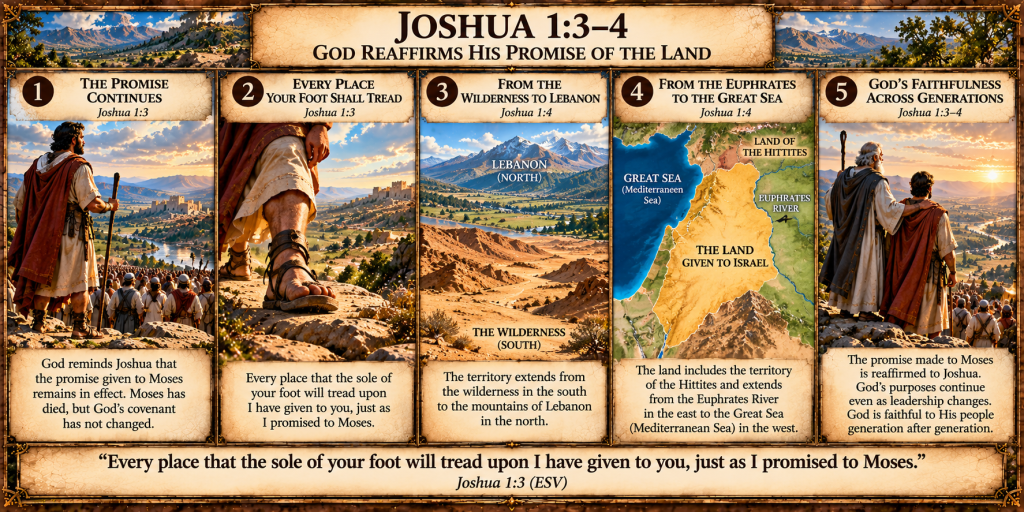
3 Every place that the sole of your foot will tread upon I have given to you, just as I promised to Moses. 4 From the wilderness and this Lebanon as far as the great river, the river Euphrates, all the land of the Hittites to the Great Sea toward the going down of the sun shall be your territory. (Joshua 1:3-4 ESV)
Every place that the sole of your foot will tread upon I have given to you
God continues speaking to Joshua and promised him that every place the Israelites stepped on would belong to them. This was not a new promise, but a continuation of the covenant God had previously given to Moses. The promise showed that God’s plans did not end with Moses’ death. Joshua could move forward confidently because God remained faithful to His word.
I have given
The expression “I have given” is stated as a completed action, even before Israel possessed the land. This demonstrates God’s certainty and sovereignty. What God promises is as good as accomplished, even if its fulfillment has not yet been fully seen.
just as I promised to Moses
God chose Moses to move the Jewish people from bondage in Egypt to a land of promise. Possibly because of slavery, these people had a problem obeying God, and when faced with a military conflict with the people currently occupying the land already given to them, they refused to enter the land. This resulted in God rejecting them and waited until that generation died in the wilderness. We now have a new generation of people, many of which were born after leaving Egypt. Because of the sin of Moses. God told him that he would not enter the promise land. So, we have a new generation of people and a new leader, preparing to enter the promise land.
At this time in history, God reminds Joshua that His promise was not based on Joshua’s abilities but on God’s covenant faithfulness. By pointing back to Moses, God assures Joshua that the mission has continuity. Joshua is not beginning a new plan; he is continuing God’s long-established purpose.
This reminder would strengthen Joshua’s confidence. Leadership had changed, as had the people, but God’s promises had not changed. The same God who guided Moses would guide Joshua and the people under his leadership.
Every place that the sole of your foot will tread upon
Looking back to the beginning of verse 3, we need to consider the meaning of the phrase mentioned above. That phrase indicates actual possession and occupation of the land. God promised the land, but Israel was expected to move forward in faith and take it. The land would not be inherited while they remained stationary on the eastern side of the Jordan.
The statement reveals a balance between divine sovereignty and human responsibility. God grants the inheritance, yet His people must step out in obedience to receive and enjoy it.
From the wilderness and this Lebanon as far as the great river, the river Euphrates, all the land of the Hittites to the Great Sea toward the going down of the sun shall be your territory
God now identifies several landmarks that define the promised territory:
- The wilderness in the south.
- Lebanon in the north.
- The Euphrates River in the east.
- The Great Sea (the Mediterranean Sea) in the west.
- The land inhabited by the Hittites within these boundaries.
These boundaries describe an extensive territory, much larger than what Israel immediately possessed under Joshua’s leadership. The description demonstrates the abundance of God’s provision and the greatness of His promise.
the river Euphrates
The Euphrates was one of the largest and most important rivers of the ancient Near East. By including it as the eastern boundary, God was promising a vast territory. This boundary linked Joshua’s commission back to God’s earlier promises to Abraham. We find that promise in Genesis 15:18: “On that day the Lord made a covenant with Abram, saying, “To your offspring I give this land, from the river of Egypt to the great river, the river Euphrates.”
The mention of the Euphrates highlights the magnitude of what God intended for His people. It reminds readers that God’s vision is often larger than what His servants first imagine.
to the Great Sea toward the going down of the sun
“The Great Sea” is the Mediterranean Sea. To the Israelites, the Mediterranean was the largest body of water they knew. It formed the western boundary of the promised land and represented a natural limit to Israel’s territory.
Its inclusion in the description shows that God had clearly defined the inheritance He intended to give His people. The promise was not vague but specific and measurable.
Insight
This is the section where we need to stop and reflect on what we have covered. Three questions we should look at are: 1. What do these verses teach about God’s faithfulness, 2. How do verses 3-4 encourage believers today, and 3. What is the central lesson of Joshua 1:3-4?
1. What do these verses teach about God’s faithfulness?
Joshua 1:3-4 demonstrates that God keeps His promises across generations. Abraham received the promise. Moses led the people toward its fulfillment. Joshua was commissioned to complete the next stage of God’s plan.
Human leaders come and go, but God’s purposes endure. His promises are not dependent upon a single individual. This truth gave Joshua courage and continues to encourage believers today.
2. How do verses 3-4 encourage believers today
These verses remind believers that God is faithful to fulfill His purposes. Just as Joshua faced an overwhelming task, God’s people today often face challenges that seem beyond their strength. God’s promises provide confidence that He remains present and active.
The passage also teaches that faith involves taking steps of obedience. Israel had to enter the land, and believers today are called to trust God and move forward according to His Word.
3. What is the central lesson of Joshua 1:3-4
The central lesson is that God’s promises are certain and trustworthy. Joshua’s confidence was not based on military strength, experience, or personal ability. It rested entirely on God’s word and covenant faithfulness.
The passage calls believers to trust God’s promises, obey His commands, and move forward with courage, knowing that the God who makes promises is also the God who fulfills them.
Key Takeaway
As we come to the end of this lesson, what have you learned that you are going to take with you? Do you see that God’s promises are secure because they rest on His faithfulness. Joshua’s task was not to create victory but to walk in obedience and claim what God had already promised. Likewise, believers are called to trust God’s Word and step forward in faith, confident that He will accomplish His purposes.
Closing Prayer
Reflecting on the three questions stated above, I think it would be appropriate to add a closing prayer to this lesson.
Gracious Heavenly Father,
We thank You for the promises You gave to Joshua and for the reminder that You are always faithful to Your Word. Just as You kept Your covenant with Abraham, Moses, and Joshua, we know that You remain faithful today.
Help us to trust You when the future seems uncertain. Give us the courage that Joshua needed as he faced challenges and responsibilities that seemed greater than his own strength. Father, remind us that our confidence is not in ourselves, but in Your presence and in Your promises.
Lord, teach us to walk by faith and to take the steps of obedience You place before us. When fear, doubt, or discouragement arise, help us remember that You are with us and that Your purposes cannot fail. May we trust what You have said even before we see the results, knowing that You always accomplish Your will.
Thank You for being a God who keeps His promises from generation to generation. Strengthen our faith, guide our steps, and help us live each day with confidence in Your faithfulness.
In Jesus’ name we pray,
Amen.
Lesson 1.5 – Joshua 1:5 God Promises is Presence and Protection
Lesson Details
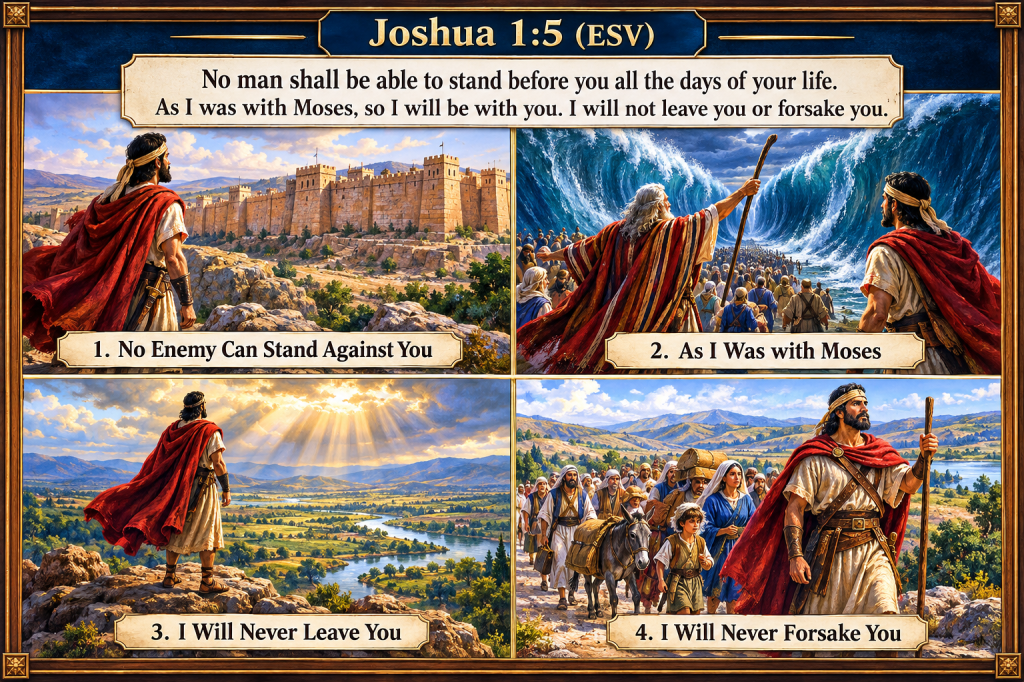
5 “No man shall be able to stand before you all the days of your life. Just as I was with Moses, so I will be with you. I will not leave you or forsake you.” (Joshua 1:5 ESV)
Joshua 1:5 seems quite simple and straight forward. It is one of the great promises God gave to Joshua as he prepared to lead Israel after Moses’ death. Let us look beyond simple recall and encourage deeper understanding, application, and reflection.
Try to imagine that you are Joshua and have just been handed the responsibility of leading these people across the Jordan River into Canaan. Do you have any idea how many people this might be? Let us use ChatGPT to provide a possible number.
At the moment God spoke Joshua 1:5, Joshua was likely standing before the assembled nation of Israel east of the Jordan River, preparing to enter Canaan. The exact number is not given, but Scripture provides enough information to make a reasonable estimate.
The Census Numbers
In Numbers 26, the second wilderness census counted:
- 601,730 fighting men (men aged 20 and older able to serve in the army)
This figure did not include:
- Women
- Children
- The tribe of Levi (23,000 males from one month old and upward)
- Elderly men over military age
Estimating the Total Population
Scholars generally estimate Israel’s total population at this time to have been between 2 and 3 million people.
A possible breakdown:
| Group | Estimated Number |
|---|---|
| Adult fighting men | 601,730 |
| Adult women | 550,000-650,000 |
| Children and youth | 900,000-1,500,000 |
| Levites | 20,000-30,000 |
| Elderly | 50,000-100,000 |
| Total | 2.1-2.9 million |
Who Was Standing Before Joshua?
Not all of these people would have been physically gathered in one place when God spoke privately to Joshua. Joshua 1 records God speaking directly to Joshua after Moses’ death.
However, when Joshua later addressed Israel and gave instructions for crossing the Jordan, he was speaking on behalf of a nation numbering roughly:
2 million to 3 million men, women, and children.
A Helpful Perspective
Imagine Joshua:
- About to succeed Moses
- Facing enemies across the Jordan
- Responsible for perhaps 2.5 million people
- Leading a camp that could stretch for miles
Against that backdrop, God’s words become even more powerful:
“No man shall be able to stand before you all the days of your life… I will be with you. I will not leave you or forsake you.”
Joshua’s confidence could not come from his own leadership skills. No human leader could adequately manage such a vast nation without God’s presence and guidance.
Clearly, we can see that Joshua was not merely leading an army of 600,000 men. He was responsible for perhaps 2 to 3 million Israelites, making God’s promise in Joshua 1:5 one of the most significant assurances of divine presence and leadership in the entire Old Testament.
Joshua faced an enormous responsibility. Moses, Israel’s revered leader for forty years, had died. Joshua was now responsible for leading millions of Israelites into the Promised Land and guiding them through military conflicts and spiritual challenges.
Humanly speaking, Joshua had many reasons to be afraid. He would face powerful enemy nations, difficult decisions, and the expectations of an entire nation. God’s promise assured Joshua that success would not depend merely upon his own abilities but upon God’s presence and power. The promise was meant to strengthen Joshua’s faith and confidence as he began this new chapter of leadership.
Looking at the verse
No man shall be able to stand before you
What does this phrase mean? It does not mean Joshua would never face opposition. Rather, it means that no enemy would ultimately prevail against him while he remained faithful to God’s mission.
The Canaanite nations would resist Israel, and many battles would occur. Yet God promised that these enemies would not be able to defeat Joshua or prevent God’s purposes from being fulfilled. The victory would come because God Himself was fighting for Israel.
This teaches that God’s plans cannot be stopped by human opposition when He chooses to accomplish His purposes.
Just as I was with Moses, so I will be with you.
God reminds Joshua to consider how he walked with Moses in the past, how he had experienced God’s guidance, protection, and power throughout his leadership. Joshua had personally witnessed many of these events, including the Red Sea crossing, the giving of the Law, and God’s provision in the wilderness.
By saying, “Just as I was with Moses, so I will be with you,” God reminded Joshua that the same God who empowered Moses had not changed. Joshua did not need a new or different God for a new challenge.
This comparison helped Joshua understand that God’s faithfulness is consistent across generations. What God had done before, He was fully capable of doing again.
I will be with you
Does not God’s presence meant much more than simply watching you or Joshua from heaven? Yes, It meant active guidance, protection, wisdom, strength, and support.
God would direct Joshua’s decisions, fight for Israel in battle, encourage him during times of uncertainty, and ensure that His promises were fulfilled. God’s presence was the source of Joshua’s success.
Believers today can learn that God’s presence is not merely a comforting idea but a powerful reality that enables His people to carry out His will.
I will not leave you
Have you ever been in a situation when you felt that God had left you? God made the promise to Joshua that he would never abandon him in moments of difficulty or danger. Human companions may fail or leave, but God pledged unwavering faithfulness.
The Hebrew idea behind this statement conveys God’s continual support and commitment. Joshua would never face a battle, challenge, or decision alone.
This promise provided stability during uncertainty because Joshua’s confidence was rooted not in changing circumstances but in God’s unchanging character.
or forsake you
What is the difference between “I will not leave you” and “I will not forsake you”?
The two phrases are closely related, but they emphasize different aspects of God’s faithfulness.
- The focus of “I will not leave you” is on God’s presence
- The Hebrew idea is: I will not let go of you, abandon you, or withdraw My presence from you. It answers the fear: “Am I facing this alone?” We have the assurance that God will always remain with us.
- Joshua was about to lead Israel into the Promised Land without Moses. God’s first assurance was that His presence would remain with Joshua just as it had with Moses.
- The focus of “I will not forsake you” is on God’s commitment and support
- The Hebrew idea is stronger than simple absence. It means:
- I will not desert you.
- I will not abandon you in your time of need.
- I will not turn my back on you.
- I will not fail to help and uphold you.
- It answers the fear: “Will God give up on me when things get difficult?” God’s response is: “No. I remain committed to you.”
- The Hebrew idea is stronger than simple absence. It means:
The following table shows how these two expressions reinforce each other:
| Phrase | Main Emphasis |
|---|---|
| I will not leave you | God’s presence |
| I will not forsake you | God’s loyalty and support |
| Together | God is with you and will not abandon you |
You could paraphrase God’s promise this way:
“I will stay with you, and I will never abandon you. You will never face life’s battles alone, nor will I stop caring for and helping you.”
Insight
We should stop at this point and ask the following four questions and determine an answer:
1. How does this verse reveal God’s character?
This verse reveals that God is faithful, keeps His promises, remains the same through generations, strengthens His servants, and is personally involved in the lives of His people.
The focus of the verse is less on Joshua’s abilities and more on God’s reliability. God’s character, rather than Joshua’s strength, became the foundation for victory.
2. How did Joshua demonstrate faith in this promise?
Looking ahead, we will find that Joshua demonstrated faith by acting upon God’s commands. He led Israel across the Jordan River, organized military campaigns, and obeyed God’s instructions even when they seemed unusual.
For example, marching around Jericho for seven days did not appear to be a military strategy. Joshua obeyed because he trusted God’s promise and presence.
True faith is demonstrated not merely by believing God’s promises but by acting upon them.
3. Is this promise only for Joshua, or does it have meaning for believers today?
The specific promise of conquering Canaan belonged uniquely to Joshua. However, the principle of God’s faithful presence extends to all believers.
The New Testament echoes this promise. Hebrews 13:5 quotes God’s words:
“I will never leave you nor forsake you.”
Believers today may not have Joshua’s military mission, but they can confidently trust God’s presence, guidance, and faithfulness as they serve Him.
4. How should this promise affect a believer’s response to fear?
Fear often arises when people focus on obstacles rather than on God’s presence. Joshua had many reasons to fear, but God’s promise redirected his attention from the size of the challenge to the greatness of God.
When believers remember that God is present, faithful, and sovereign, they gain courage to move forward despite uncertainty. Courage is not the absence of fear; it is trusting God enough to obey Him in the face of fear.
Joshua’s confidence came from the promise, “I will be with you.” As Joshua meets obstacles along the way and experiences God’s presence and provision, he, along with the Psalmist of the past, grow in faith to accept each obstacle in the future.
Questions to Reflect On
1. What challenge in your life most resembles the challenge Joshua faced?
Is it a new responsibility, a health challenge, a family responsibility, or maybe a spiritual growth challenge. But, like Joshua, we sometimes face situations that seem larger than our own strength. Whether it is health concerns, family responsibilities, or new opportunities, we must choose courage over fear and trust that God will guide us through the challenges ahead.
2. Which promise in Joshua 1:5 encourages you most?
Is it God’s presence? His faithfulness? His promise of victory over obstacles? Reflect on why that particular promise speaks to your current circumstances.
3. How can remembering God’s faithfulness in the past strengthen your trust today?
Joshua could look back on God’s work through Moses. Likewise, believers can remember God’s faithfulness throughout Scripture and throughout their own lives as a foundation for present trust.
4. What fears would become smaller if you fully believed God would never leave or forsake you?
Joshua’s courage grew from confidence in God’s presence. Consider how your perspective would change if you continually remembered that God walks with you through every trial.
Key Lesson
Joshua 1:5 teaches that success in God’s calling depends not primarily on human ability but on God’s faithful presence. Joshua could face overwhelming challenges because God promised, “I will be with you. I will not leave you or forsake you.” The same faithful God remains the source of courage, strength, and confidence for believers today.
Closing Prayer
Joshua 1:5 says:
“No man shall be able to stand before you all the days of your life. Just as I was with Moses, so I will be with you. I will not leave you or forsake you.”
This verse contains several promises that we should not just pass over. We must allow them to become powerful prayer points, as suggested below.
1. Pray to Walk in God’s Presence
“I will be with you.”
Prayer:
Father, help me live each day aware of Your presence. Just as You went before Joshua, go before me in every decision, challenge, and opportunity. Let me trust that I never face life’s battles alone.
2. Pray for Courage Against Opposition
“No man shall be able to stand before you.”
Prayer:
Lord, give me courage when I face resistance, criticism, temptation, or difficulty. Help me remember that no obstacle is greater than Your power. Strengthen my faith to stand firm in Your will.
3. Pray to Follow God’s Example of Faithfulness
“As I was with Moses, so I will be with you.”
Prayer:
Father, thank You that You are the same faithful God today. Help me remember how You have guided and provided for me in the past, and give me confidence that You will continue to lead me in the future.
4. Pray Against Fear and Loneliness
“I will not leave you.”
Prayer:
Lord, when I feel isolated, uncertain, or overwhelmed, remind me that You never abandon Your children. Help me rest in the assurance of Your constant presence.
5. Pray for Confidence in God’s Commitment
“I will not forsake you.”
Prayer:
Heavenly Father, thank You that Your love and commitment never fail. When circumstances seem discouraging, help me trust Your promises and remain faithful to You.
Personal Reflection
A question to consider might be:
“Where in my life do I need to believe that God is with me and will not abandon me?”
For many of us, the answer may involve health concerns, family responsibilities, ministry opportunities, financial pressures, or stepping into new seasons of service. Joshua learned that success was not found in his own strength, but in God’s presence. The same principle applies to us today.
1:10-18 Joshua Assumes Command
Joshua 1:5 God Promises is Presence and Protection
Bible Lesson
5 “No man shall be able to stand before you all the days of your life. Just as I was with Moses, so I will be with you. I will not leave you or forsake you.” (Joshua 1:5 ESV)
Joshua 1:5 seems quite simple and straight forward. It is one of the great promises God gave to Joshua as he prepared to lead Israel after Moses’ death. Let us look beyond simple recall and encourage deeper understanding, application, and reflection.
Try to imagine that you are Joshua and have just been handed the responsibility of leading these people across the Jordan River into Canaan. Do you have any idea how many people this might be? Let us use ChatGPT to provide a possible number.
At the moment God spoke Joshua 1:5, Joshua was likely standing before the assembled nation of Israel east of the Jordan River, preparing to enter Canaan. The exact number is not given, but Scripture provides enough information to make a reasonable estimate.
The Census Numbers
In Numbers 26, the second wilderness census counted:
- 601,730 fighting men (men aged 20 and older able to serve in the army)
This figure did not include:
- Women
- Children
- The tribe of Levi (23,000 males from one month old and upward)
- Elderly men over military age
Estimating the Total Population
Scholars generally estimate Israel’s total population at this time to have been between 2 and 3 million people.
A possible breakdown:
| Group | Estimated Number |
|---|---|
| Adult fighting men | 601,730 |
| Adult women | 550,000-650,000 |
| Children and youth | 900,000-1,500,000 |
| Levites | 20,000-30,000 |
| Elderly | 50,000-100,000 |
| Total | 2.1-2.9 million |
Who Was Standing Before Joshua?
Not all of these people would have been physically gathered in one place when God spoke privately to Joshua. Joshua 1 records God speaking directly to Joshua after Moses’ death.
However, when Joshua later addressed Israel and gave instructions for crossing the Jordan, he was speaking on behalf of a nation numbering roughly:
2 million to 3 million men, women, and children.
A Helpful Perspective
Imagine Joshua:
- About to succeed Moses
- Facing enemies across the Jordan
- Responsible for perhaps 2.5 million people
- Leading a camp that could stretch for miles
Against that backdrop, God’s words become even more powerful:
“No man shall be able to stand before you all the days of your life… I will be with you. I will not leave you or forsake you.”
Joshua’s confidence could not come from his own leadership skills. No human leader could adequately manage such a vast nation without God’s presence and guidance.
Clearly, we can see that Joshua was not merely leading an army of 600,000 men. He was responsible for perhaps 2 to 3 million Israelites, making God’s promise in Joshua 1:5 one of the most significant assurances of divine presence and leadership in the entire Old Testament.
Joshua faced an enormous responsibility. Moses, Israel’s revered leader for forty years, had died. Joshua was now responsible for leading millions of Israelites into the Promised Land and guiding them through military conflicts and spiritual challenges.
Humanly speaking, Joshua had many reasons to be afraid. He would face powerful enemy nations, difficult decisions, and the expectations of an entire nation. God’s promise assured Joshua that success would not depend merely upon his own abilities but upon God’s presence and power. The promise was meant to strengthen Joshua’s faith and confidence as he began this new chapter of leadership.
Looking at the verse
No man shall be able to stand before you
What does this phrase mean? It does not mean Joshua would never face opposition. Rather, it means that no enemy would ultimately prevail against him while he remained faithful to God’s mission.
The Canaanite nations would resist Israel, and many battles would occur. Yet God promised that these enemies would not be able to defeat Joshua or prevent God’s purposes from being fulfilled. The victory would come because God Himself was fighting for Israel.
This teaches that God’s plans cannot be stopped by human opposition when He chooses to accomplish His purposes.
Just as I was with Moses, so I will be with you.
God reminds Joshua to consider how he walked with Moses in the past, how he had experienced God’s guidance, protection, and power throughout his leadership. Joshua had personally witnessed many of these events, including the Red Sea crossing, the giving of the Law, and God’s provision in the wilderness.
By saying, “Just as I was with Moses, so I will be with you,” God reminded Joshua that the same God who empowered Moses had not changed. Joshua did not need a new or different God for a new challenge.
This comparison helped Joshua understand that God’s faithfulness is consistent across generations. What God had done before, He was fully capable of doing again.
I will be with you
Does not God’s presence meant much more than simply watching you or Joshua from heaven? Yes, It meant active guidance, protection, wisdom, strength, and support.
God would direct Joshua’s decisions, fight for Israel in battle, encourage him during times of uncertainty, and ensure that His promises were fulfilled. God’s presence was the source of Joshua’s success.
Believers today can learn that God’s presence is not merely a comforting idea but a powerful reality that enables His people to carry out His will.
I will not leave you
Have you ever been in a situation when you felt that God had left you? God made the promise to Joshua that he would never abandon him in moments of difficulty or danger. Human companions may fail or leave, but God pledged unwavering faithfulness.
The Hebrew idea behind this statement conveys God’s continual support and commitment. Joshua would never face a battle, challenge, or decision alone.
This promise provided stability during uncertainty because Joshua’s confidence was rooted not in changing circumstances but in God’s unchanging character.
or forsake you
What is the difference between “I will not leave you” and “I will not forsake you”?
The two phrases are closely related, but they emphasize different aspects of God’s faithfulness.
- The focus of “I will not leave you” is on God’s presence
- The Hebrew idea is: I will not let go of you, abandon you, or withdraw My presence from you. It answers the fear: “Am I facing this alone?” We have the assurance that God will always remain with us.
- Joshua was about to lead Israel into the Promised Land without Moses. God’s first assurance was that His presence would remain with Joshua just as it had with Moses.
- The focus of “I will not forsake you” is on God’s commitment and support
- The Hebrew idea is stronger than simple absence. It means:
- I will not desert you.
- I will not abandon you in your time of need.
- I will not turn my back on you.
- I will not fail to help and uphold you.
- It answers the fear: “Will God give up on me when things get difficult?” God’s response is: “No. I remain committed to you.”
- The Hebrew idea is stronger than simple absence. It means:
The following table shows how these two expressions reinforce each other:
| Phrase | Main Emphasis |
|---|---|
| I will not leave you | God’s presence |
| I will not forsake you | God’s loyalty and support |
| Together | God is with you and will not abandon you |
You could paraphrase God’s promise this way:
“I will stay with you, and I will never abandon you. You will never face life’s battles alone, nor will I stop caring for and helping you.”
Insight
We should stop at this point and ask the following four questions and determine an answer:
1. How does this verse reveal God’s character?
This verse reveals that God is faithful, keeps His promises, remains the same through generations, strengthens His servants, and is personally involved in the lives of His people.
The focus of the verse is less on Joshua’s abilities and more on God’s reliability. God’s character, rather than Joshua’s strength, became the foundation for victory.
2. How did Joshua demonstrate faith in this promise?
Looking ahead, we will find that Joshua demonstrated faith by acting upon God’s commands. He led Israel across the Jordan River, organized military campaigns, and obeyed God’s instructions even when they seemed unusual.
For example, marching around Jericho for seven days did not appear to be a military strategy. Joshua obeyed because he trusted God’s promise and presence.
True faith is demonstrated not merely by believing God’s promises but by acting upon them.
3. Is this promise only for Joshua, or does it have meaning for believers today?
The specific promise of conquering Canaan belonged uniquely to Joshua. However, the principle of God’s faithful presence extends to all believers.
The New Testament echoes this promise. Hebrews 13:5 quotes God’s words:
“I will never leave you nor forsake you.”
Believers today may not have Joshua’s military mission, but they can confidently trust God’s presence, guidance, and faithfulness as they serve Him.
4. How should this promise affect a believer’s response to fear?
Fear often arises when people focus on obstacles rather than on God’s presence. Joshua had many reasons to fear, but God’s promise redirected his attention from the size of the challenge to the greatness of God.
When believers remember that God is present, faithful, and sovereign, they gain courage to move forward despite uncertainty. Courage is not the absence of fear; it is trusting God enough to obey Him in the face of fear.
Joshua’s confidence came from the promise, “I will be with you.” As Joshua meets obstacles along the way and experiences God’s presence and provision, he, along with the Psalmist of the past, grow in faith to accept each obstacle in the future.
Questions to Reflect On
1. What challenge in your life most resembles the challenge Joshua faced?
Is it a new responsibility, a health challenge, a family responsibility, or maybe a spiritual growth challenge. But, like Joshua, we sometimes face situations that seem larger than our own strength. Whether it is health concerns, family responsibilities, or new opportunities, we must choose courage over fear and trust that God will guide us through the challenges ahead.
2. Which promise in Joshua 1:5 encourages you most?
Is it God’s presence? His faithfulness? His promise of victory over obstacles? Reflect on why that particular promise speaks to your current circumstances.
3. How can remembering God’s faithfulness in the past strengthen your trust today?
Joshua could look back on God’s work through Moses. Likewise, believers can remember God’s faithfulness throughout Scripture and throughout their own lives as a foundation for present trust.
4. What fears would become smaller if you fully believed God would never leave or forsake you?
Joshua’s courage grew from confidence in God’s presence. Consider how your perspective would change if you continually remembered that God walks with you through every trial.
Key Lesson
Joshua 1:5 teaches that success in God’s calling depends not primarily on human ability but on God’s faithful presence. Joshua could face overwhelming challenges because God promised, “I will be with you. I will not leave you or forsake you.” The same faithful God remains the source of courage, strength, and confidence for believers today.
Closing Prayer
Joshua 1:5 says:
“No man shall be able to stand before you all the days of your life. Just as I was with Moses, so I will be with you. I will not leave you or forsake you.”
This verse contains several promises that we should not just pass over. We must allow them to become powerful prayer points, as suggested below.
1. Pray to Walk in God’s Presence
“I will be with you.”
Prayer:
Father, help me live each day aware of Your presence. Just as You went before Joshua, go before me in every decision, challenge, and opportunity. Let me trust that I never face life’s battles alone.
2. Pray for Courage Against Opposition
“No man shall be able to stand before you.”
Prayer:
Lord, give me courage when I face resistance, criticism, temptation, or difficulty. Help me remember that no obstacle is greater than Your power. Strengthen my faith to stand firm in Your will.
3. Pray to Follow God’s Example of Faithfulness
“As I was with Moses, so I will be with you.”
Prayer:
Father, thank You that You are the same faithful God today. Help me remember how You have guided and provided for me in the past, and give me confidence that You will continue to lead me in the future.
4. Pray Against Fear and Loneliness
“I will not leave you.”
Prayer:
Lord, when I feel isolated, uncertain, or overwhelmed, remind me that You never abandon Your children. Help me rest in the assurance of Your constant presence.
5. Pray for Confidence in God’s Commitment
“I will not forsake you.”
Prayer:
Heavenly Father, thank You that Your love and commitment never fail. When circumstances seem discouraging, help me trust Your promises and remain faithful to You.
Personal Reflection
A question to consider might be:
“Where in my life do I need to believe that God is with me and will not abandon me?”
For many of us, the answer may involve health concerns, family responsibilities, ministry opportunities, financial pressures, or stepping into new seasons of service. Joshua learned that success was not found in his own strength, but in God’s presence. The same principle applies to us today.

