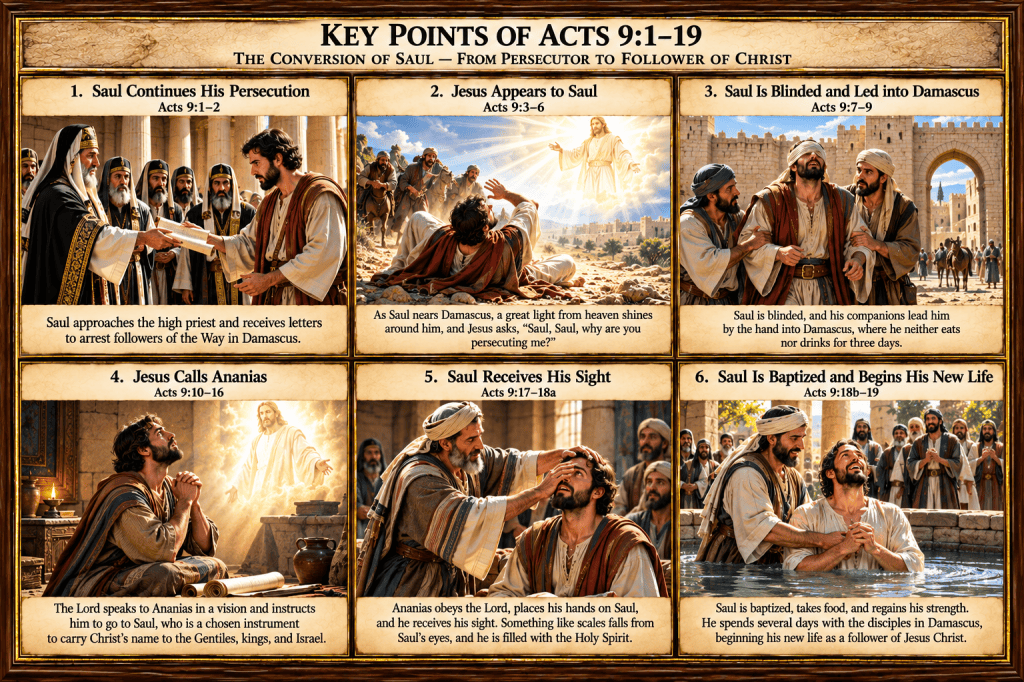
image Acts 1:1-19
New Testament Events Series
Event: nte023 The Conversion of Saul (Acts 9:1–19a)
Facilitator/Editor: Stephen Weller
Information Collection: ChatGPT
Bible Text: BibleGateway
3,240 words, 17 minutes read time
NT Event Index
Event Context
Context for Acts 9:1–19
Acts 9:1–19 records one of the most significant turning points in the early Christian church: the dramatic conversion of Saul, a fierce persecutor of believers who would later become known as the apostle Paul. Following the martyrdom of Stephen (Acts 7:54–60) and the widespread persecution of Christians in Jerusalem (Acts 8:1–3), Saul continued his determined efforts to destroy the growing church. Armed with authorization from the high priest, he traveled toward Damascus to arrest followers of Jesus and bring them back to Jerusalem. However, his journey was interrupted by a brilliant light from heaven and the voice of the risen Jesus, who confronted Saul with the words, “Saul, Saul, why are you persecuting me?” (Acts 9:4, ESV). Struck blind and humbled by this encounter, Saul was led into Damascus, where he remained without sight, food, or drink for three days. Meanwhile, the Lord appeared in a vision to a disciple named Ananias, instructing him to visit Saul, restore his sight, and reveal God’s purpose for his life. Despite his initial fear because of Saul’s reputation, Ananias obeyed, demonstrating the importance of faith and submission to God’s direction. Saul’s sight was restored, he was filled with the Holy Spirit, and he was baptized, marking the beginning of his transformed life as a follower of Christ. This passage reveals the extraordinary power of God’s grace to redeem even the most determined opponent of the gospel and demonstrates His sovereign authority in choosing and preparing individuals for His purposes. Saul’s conversion also anticipates the expansion of the gospel beyond Israel, as God declares that Saul will become His chosen instrument to carry the name of Jesus before Gentiles, kings, and the children of Israel (Acts 9:15).
Understanding the Event
Event Text
The Conversion of Saul
9 But Saul, still breathing threats and murder against the disciples of the Lord, went to the high priest 2 and asked him for letters to the synagogues at Damascus, so that if he found any belonging to the Way, men or women, he might bring them bound to Jerusalem. 3 Now as he went on his way, he approached Damascus, and suddenly a light from heaven shone around him. 4 And falling to the ground, he heard a voice saying to him, “Saul, Saul, why are you persecuting me?” 5 And he said, “Who are you, Lord?” And he said, “I am Jesus, whom you are persecuting. 6 But rise and enter the city, and you will be told what you are to do.” 7 The men who were traveling with him stood speechless, hearing the voice but seeing no one. 8 Saul rose from the ground, and although his eyes were opened, he saw nothing. So they led him by the hand and brought him into Damascus. 9 And for three days he was without sight, and neither ate nor drank.
10 Now there was a disciple at Damascus named Ananias. The Lord said to him in a vision, “Ananias.” And he said, “Here I am, Lord.” 11 And the Lord said to him, “Rise and go to the street called Straight, and at the house of Judas look for a man of Tarsus named Saul, for behold, he is praying, 12 and he has seen in a vision a man named Ananias come in and lay his hands on him so that he might regain his sight.” 13 But Ananias answered, “Lord, I have heard from many about this man, how much evil he has done to your saints at Jerusalem. 14 And here he has authority from the chief priests to bind all who call on your name.” 15 But the Lord said to him, “Go, for he is a chosen instrument of mine to carry my name before the Gentiles and kings and the children of Israel. 16 For I will show him how much he must suffer for the sake of my name.” 17 So Ananias departed and entered the house. And laying his hands on him he said, “Brother Saul, the Lord Jesus who appeared to you on the road by which you came has sent me so that you may regain your sight and be filled with the Holy Spirit.” 18 And immediately something like scales fell from his eyes, and he regained his sight. Then he rose and was baptized; 19 and taking food, he was strengthened. (Acts 9:1–19 ESV)
Questions with answers
1. What was Saul’s attitude toward Christians before his encounter with Jesus? (Acts 9:1–2)
Answer: Saul was a determined persecutor of the early church, actively seeking to arrest and imprison followers of Jesus Christ. He believed that Christianity threatened the Jewish faith and traditions he was committed to defending. His persecution was not passive disagreement but an organized effort to eliminate the growing Christian movement. Saul obtained authorization from the high priest to travel to Damascus, where he intended to arrest believers, both men and women, and bring them bound to Jerusalem. His actions reveal how religious zeal, when separated from God’s truth, can lead to serious spiritual blindness. Saul believed he was serving God, yet he was opposing the very Messiah God had sent. His experience demonstrates that sincerity and religious dedication do not necessarily mean someone is following God’s will.
2. What happened to Saul as he approached Damascus, and why was this encounter significant? (Acts 9:3–4)
Answer: As Saul approached Damascus, a brilliant light from heaven suddenly surrounded him, causing him to fall to the ground. He heard a voice asking, “Saul, Saul, why are you persecuting me?” This extraordinary encounter interrupted Saul’s mission and brought him face-to-face with the risen Jesus Christ. The significance of this event extends beyond Saul’s personal conversion. It demonstrates that Jesus was alive, exalted, and actively involved in the lives of His followers. Saul had regarded Jesus as a false Messiah, but now he encountered undeniable evidence of His resurrection and divine authority. The event also reveals God’s sovereign ability to intervene in a person’s life, even when that individual is actively resisting Him. Saul’s journey toward persecution became the beginning of his transformation into a servant of Christ.
3. Why did Jesus ask Saul, “Why are you persecuting me?” rather than asking why he was persecuting Christians? (Acts 9:4–5)
Answer: Jesus’ question reveals the profound spiritual relationship between Christ and His church. Although Saul was physically persecuting believers, Jesus identified their suffering as persecution directed against Himself. This demonstrates the unity between Christ and those who belong to Him. Christians are not merely followers of a religious teacher; they are members of Christ’s spiritual body, intimately connected to their Savior. When believers suffer because of their faith, Christ is not indifferent to their pain. He identifies with them and remains personally involved in their circumstances. This truth would later become foundational to Paul’s teaching about the church as the body of Christ (1 Corinthians 12:12–27). Jesus’ words also confronted Saul with the seriousness of his actions. He was not defending God’s honor, as he believed, but attacking God’s own Son through the persecution of His people.
4. What does Saul’s question, “Who are you, Lord?” reveal about his understanding at that moment? (Acts 9:5)
Answer: Saul’s question reveals his confusion and growing recognition that he was encountering a supernatural authority far greater than himself. When Jesus identified Himself as the One Saul was persecuting, Saul’s understanding of God, righteousness, and religious obedience was suddenly challenged. Everything Saul had believed about Jesus required reconsideration. The One he regarded as a dangerous religious impostor was actually the risen Lord. This revelation exposed the spiritual blindness that had shaped Saul’s previous actions. His question marks the beginning of a radical change in perspective, moving from self-confidence in his religious achievements toward recognition of Christ’s supreme authority. True conversion involves more than changing outward behavior; it begins with recognizing who Jesus truly is and acknowledging His rightful authority over one’s life.
5. Why did Jesus instruct Saul to enter Damascus rather than immediately explaining everything that would happen to him? (Acts 9:6)
Answer: Jesus instructed Saul to enter Damascus, where he would receive further directions. This command required Saul to abandon his original purpose and submit to the authority of the One he had been opposing. Instead of entering the city as a powerful persecutor carrying official authorization, Saul would enter as a humbled man awaiting God’s instructions. Jesus did not reveal the entire future at once, demonstrating that following God often requires obedience before complete understanding. Saul had to take the next step in faith, trusting that further guidance would come. This pattern appears throughout Scripture, where God reveals His purposes progressively as His servants respond in obedience. Saul’s experience teaches that genuine submission to Christ includes a willingness to follow His direction even when the path ahead remains uncertain.
6. What is the significance of Saul’s temporary blindness following his encounter with Jesus? (Acts 9:8–9)
Answer: Saul’s physical blindness powerfully reflected the spiritual blindness that had characterized his previous life. Although highly educated in Jewish law and confident in his religious understanding, Saul had failed to recognize Jesus as the promised Messiah. After encountering Christ, he could no longer see physically and had to depend on others to lead him into Damascus. This reversal was striking: the man who intended to enter the city with authority over Christians now entered helpless and dependent. During the following three days, Saul neither ate nor drank, experiencing a period of profound reflection and preparation. Scripture does not explicitly explain every reason for his fasting, but the experience clearly marked a decisive interruption of his former life. His blindness demonstrated human weakness before divine power, while his eventual restoration would illustrate God’s ability to bring both physical sight and spiritual understanding.
7. Who was Ananias, and why did God choose him to minister to Saul? (Acts 9:10–12)
Answer: Ananias was a disciple of Jesus living in Damascus. Unlike Saul, who possessed religious authority and a reputation for persecuting Christians, Ananias appears as an ordinary believer willing to respond to God’s direction. The Lord spoke to him in a vision and instructed him to visit Saul at the house of Judas on Straight Street. God revealed that Saul was praying and had seen a vision of Ananias coming to restore his sight. The choice of Ananias demonstrates that God accomplishes extraordinary purposes through faithful individuals who may not possess public prominence or worldly influence. Ananias would become an important instrument in Saul’s spiritual restoration and acceptance into the Christian community. His participation also emphasizes that conversion is not merely an isolated personal experience; God brings believers into fellowship with others who share their faith in Christ.
8. Why was Ananias hesitant to approach Saul, and what does his response teach about fear and obedience? (Acts 9:13–14)
Answer: Ananias was understandably hesitant because he knew Saul’s reputation as a violent persecutor of Christians. He had heard reports of the suffering Saul had inflicted upon believers in Jerusalem and knew that Saul possessed authority to arrest Christians in Damascus. From a human perspective, approaching Saul appeared extremely dangerous. Ananias expressed these concerns directly to the Lord, revealing both his fear and his awareness of the situation. His response demonstrates that faithful believers may experience genuine fear when God calls them into difficult circumstances. However, fear does not have to prevent obedience. Ananias did not conceal his concerns, nor did God condemn him for expressing them. Instead, God provided additional information about His purpose for Saul. The passage teaches that obedience often requires trusting God’s knowledge and authority above our limited understanding of circumstances.
9. What did God mean when He described Saul as His “chosen instrument”? (Acts 9:15–16)
Answer: God revealed that Saul had been selected for a special mission: to carry the name of Jesus before Gentiles, kings, and the children of Israel. This declaration demonstrates God’s sovereign authority to choose and prepare individuals for His purposes, regardless of their previous actions. Saul, who had attempted to destroy the church, would become one of its most influential missionaries and teachers. His calling was not based on personal merit or a history of righteousness but on God’s grace and divine purpose. The reference to Gentiles was especially significant because Saul would play a central role in spreading the gospel beyond the Jewish community. God also revealed that Saul would suffer for Christ’s name. His future ministry would involve both extraordinary opportunities and considerable hardship. Being chosen by God does not guarantee a life free from suffering; rather, it establishes a purpose through which even suffering can serve God’s greater plan.
10. What does Saul’s transformation teach about God’s grace and the possibility of redemption? (Acts 9:1–16)
Answer: Saul’s transformation provides one of Scripture’s most powerful demonstrations of God’s grace. Before encountering Christ, Saul was actively persecuting believers and attempting to suppress the gospel. Yet God did not treat Saul’s past as an obstacle beyond the reach of divine mercy. Instead, Jesus confronted him, revealed the truth, and redirected his life toward service in the kingdom of God. This transformation illustrates that salvation is not earned through religious achievement or moral perfection but is made possible through God’s grace in Jesus Christ. Saul’s experience also demonstrates that no person should be considered beyond God’s ability to redeem. The same individual who once caused suffering among Christians would later endure suffering to proclaim the message he had opposed. His life became a testimony to the transforming power of God’s mercy and the possibility of a completely new direction through faith in Christ.
11. How did Ananias demonstrate obedience and compassion when he visited Saul? (Acts 9:17)
Answer: After receiving God’s instructions, Ananias entered the house where Saul was staying and placed his hands upon him. Remarkably, he addressed Saul as “Brother Saul,” demonstrating his willingness to receive the former persecutor as someone whom Christ had called. This greeting represented a significant act of faith and compassion. Ananias was not responding to Saul’s established reputation but to God’s revealed purpose for his life. He explained that Jesus, who had appeared to Saul on the road, had sent him so Saul might regain his sight and be filled with the Holy Spirit. Ananias’ actions demonstrate that Christian obedience often involves extending grace to individuals whose past behavior has caused fear or suffering. His willingness to trust God’s work in Saul’s life helped establish the foundation for Saul’s relationship with the Christian community. Genuine Christian love recognizes the possibility of transformation through God’s power.
12. What is the significance of Saul regaining his sight and being baptized? (Acts 9:17–18)
Answer: Saul’s restoration of sight marked the completion of an important stage in his encounter with Jesus. Something like scales fell from his eyes, and he could see again. This physical healing also serves as a powerful illustration of the spiritual understanding Saul had gained through his encounter with Christ. The man who had previously rejected Jesus now recognized Him as Lord. Saul then arose and was baptized, publicly identifying himself with the very faith he had attempted to destroy. Baptism signified his new allegiance to Jesus Christ and his entrance into the community of believers. The passage also connects his restoration with the ministry of Ananias and the work of the Holy Spirit. Saul’s experience demonstrates that genuine conversion produces visible changes in a person’s life. His former mission of persecution was abandoned, and his new identity as a follower of Jesus began to take shape through obedience and fellowship.
13. Why is Saul’s conversion considered a turning point in the history of the early church? (Acts 9:1–19)
Answer: Saul’s conversion represents a major turning point because one of the church’s most determined enemies became one of its most influential messengers. Until this encounter, Saul had devoted himself to suppressing the Christian movement. Following his conversion, he would eventually become known as Paul, the apostle whose missionary journeys helped spread the gospel throughout the Roman world. His ministry would contribute significantly to the establishment of churches among Gentile populations and to the development of Christian teaching through his letters. This transformation also illustrates God’s ability to turn opposition into opportunity. The persecution Saul had supported contributed to the scattering of believers, which helped spread the gospel into new regions. God then transformed Saul himself into an instrument for extending that same message. His conversion demonstrates that the growth of the church ultimately depends upon God’s sovereign purposes rather than human strength or opposition.
14. What can believers learn from the different roles of Saul and Ananias in God’s plan? (Acts 9:10–19)
Answer: Saul and Ananias demonstrate that God assigns different responsibilities to His servants while accomplishing one unified purpose. Saul was chosen for a highly visible ministry that would eventually influence countless people across the Roman world. Ananias, by contrast, was called to perform a relatively brief but essential act of obedience. Without Ananias’ willingness to respond to God’s instructions, an important part of Saul’s restoration and introduction to the Christian community would have been missing. Their experiences demonstrate that faithfulness cannot be measured solely by public recognition or the apparent size of one’s ministry. God values obedience in both extraordinary assignments and ordinary acts of service. Ananias’ ministry also illustrates how one faithful action can have consequences extending far beyond what the individual can see. Every believer has opportunities to participate in God’s work through compassion, encouragement, prayer, and obedience to His Word.
15. How does Acts 9:1–19 demonstrate the difference between religious zeal and genuine faith in Jesus Christ?
Answer: Before his conversion, Saul possessed extraordinary religious zeal. He was deeply committed to Jewish traditions and believed that persecuting Christians was an appropriate way to defend God’s honor. However, his dedication was directed against the very Savior whom God had sent. His experience reveals that religious enthusiasm, intellectual knowledge, and sincere conviction do not automatically produce a right relationship with God. Genuine faith requires recognizing Jesus Christ as Lord and responding to Him with trust and obedience. Saul’s encounter with Christ transformed the foundation of his religious life. Instead of relying on his own understanding and authority, he began submitting to the risen Savior. This distinction remains important for believers today. Religious activity, biblical knowledge, and personal dedication are valuable when rooted in genuine faith, but they cannot replace a personal relationship with Jesus Christ. True spiritual transformation begins with Christ and produces a life increasingly shaped by His truth, grace, and purposes.
Summary: The Central Truth of Acts 9:1–19
The conversion of Saul demonstrates the extraordinary power of Jesus Christ to transform human lives. A determined persecutor became a chosen servant, a spiritually blind man received understanding, and a fearful disciple became an instrument of God’s grace. Throughout the passage, God’s sovereignty, mercy, and redemptive purpose are unmistakable. Saul’s conversion reminds believers that no one is beyond the reach of God’s grace, while Ananias’ obedience demonstrates that even seemingly small acts of faithfulness can contribute to God’s greater purposes.
Key Lesson: God’s grace can transform the strongest opposition into faithful service, and His purposes are accomplished through those who respond to His calling with faith and obedience.


Leave a Reply