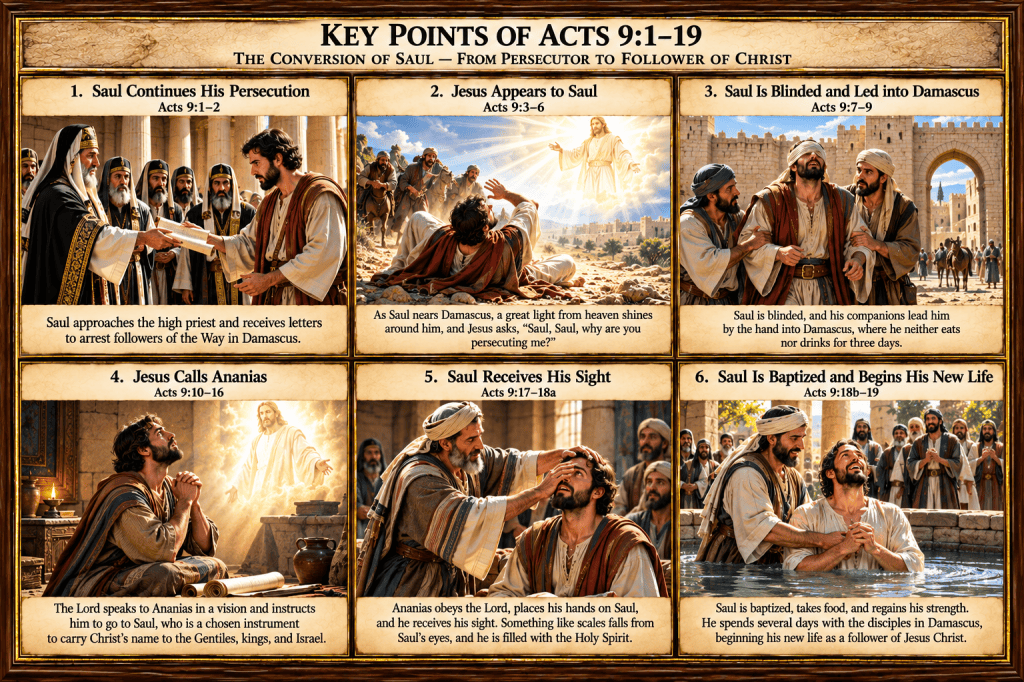
image Acts 1:1-19
New Testament Events Series
Event: nte024 Saul Proclaims Jesus in Synagogues (Acts 9:19b-22)
Facilitator/Editor: Stephen Weller
Information Collection: ChatGPT
Bible Text: BibleGateway
2,696 words, 14 minutes read time
NT Event Index
Event Context
Context for Acts 9:19b–22
Acts 9:19b–22 describes the remarkable transformation of Saul following his encounter with the risen Jesus Christ on the road to Damascus. Once a fierce persecutor of Christians, Saul had been blinded by the glory of Christ, confronted with the truth of His identity, and subsequently healed and baptized through the ministry of Ananias. After regaining his strength, Saul spent several days with the disciples in Damascus and immediately began proclaiming in the synagogues that Jesus is the Son of God. His preaching astonished those who knew of his violent opposition to the followers of Jesus, particularly because he had originally traveled to Damascus to arrest believers and bring them to Jerusalem. Rather than continuing his persecution, Saul boldly defended the very faith he had sought to destroy. As he grew stronger in his understanding and proclamation of the gospel, he confounded the Jews living in Damascus by demonstrating that Jesus was the Christ, the promised Messiah. This passage reveals the transforming power of God’s grace, the immediate evidence of genuine conversion, and the boldness that comes from encountering the risen Lord. Saul’s dramatic change illustrates how God can turn even the strongest opponent of the gospel into a powerful witness for His truth, preparing Saul for his future ministry as the apostle Paul.
Understanding the Event
Event Text
For some days he was with the disciples at Damascus. 20 And immediately he proclaimed Jesus in the synagogues, saying, “He is the Son of God.” 21 And all who heard him were amazed and said, “Is not this the man who made havoc in Jerusalem of those who called upon this name? And has he not come here for this purpose, to bring them bound before the chief priests?” 22 But Saul increased all the more in strength, and confounded the Jews who lived in Damascus by proving that Jesus was the Christ. (Acts 9:19b–22 ESV)
Questions with answers
1. What significant change occurred in Saul’s life following his encounter with Jesus on the road to Damascus?
Answer:
Saul experienced a remarkable transformation from being a determined persecutor of Christians to becoming a devoted follower and preacher of Jesus Christ. Before his encounter with the risen Lord, Saul believed that Christianity threatened the Jewish faith and that persecuting believers was a service to God. However, when Jesus revealed Himself to Saul, everything changed.
Following his conversion, Saul received his sight, was baptized, regained his strength, and began spending time with the disciples in Damascus. The man who had traveled to Damascus intending to arrest followers of Jesus was now living among them as a fellow believer.
This transformation demonstrates the extraordinary power of God’s grace. Saul’s conversion was not merely a change of religious opinion but a complete redirection of his life. His former determination to oppose Christ became a passionate commitment to proclaim Him.
Spiritual Application: No person is beyond the transforming power of God’s grace. The same Lord who changed Saul’s heart continues to bring spiritual renewal to those who turn to Him in faith.
2. Why was Saul’s decision to associate with the disciples in Damascus significant? (Acts 9:19b)
Answer:
Saul’s decision to spend time with the disciples in Damascus demonstrated that his relationship with Christians had fundamentally changed. Previously, he had regarded followers of Jesus as enemies who needed to be arrested and punished. Now he sought fellowship with the very people he had intended to persecute.
This association was also significant for the disciples. They had every reason to fear Saul because his reputation as a persecutor was well known. Accepting him into their community required recognizing that God had genuinely transformed his life.
Christian fellowship provided Saul with an opportunity to grow in his understanding of Jesus and become established among believers. Although Saul had received a direct revelation of Christ, he did not separate himself from the Christian community.
Spiritual Application: Genuine conversion changes not only a person’s relationship with God but also their relationship with God’s people. Christian fellowship provides encouragement, instruction, accountability, and opportunities for spiritual growth.
3. What did Saul begin preaching in the synagogues, and why was his message so important? (Acts 9:20)
Answer:
Acts 9:20 tells us that Saul immediately began proclaiming Jesus in the synagogues, declaring that Jesus is the Son of God.
This proclamation represented a dramatic reversal of Saul’s previous beliefs and activities. He had once opposed those who confessed Jesus as the Messiah, but now he publicly declared Jesus’ divine identity.
The title “Son of God” is central to understanding who Jesus is. It identifies Him as having a unique relationship with the Father and affirms His divine identity. Saul’s preaching therefore went beyond presenting Jesus as an influential teacher or prophet. He proclaimed Jesus as the divine Son whom God had sent.
The synagogues were natural places for Saul to begin his ministry because he was familiar with the Jewish Scriptures and could explain how they pointed to Jesus.
Spiritual Application: The foundation of Christian faith is the identity and saving work of Jesus Christ. Faithful Christian teaching must direct attention to who Jesus is rather than merely presenting moral principles or religious traditions.
4. Why did Saul begin preaching Jesus almost immediately after his conversion? (Acts 9:20)
Answer:
Saul’s immediate proclamation of Jesus reflected the profound impact of his encounter with the risen Lord. Having personally experienced the reality of Christ, Saul could no longer remain committed to his former opposition.
His understanding of Jesus had been completely transformed. Previously, Saul considered the claims of Christians to be false and dangerous. Now he knew that Jesus was alive and truly was the Son of God.
Saul also possessed extensive knowledge of the Old Testament Scriptures. His education and familiarity with Jewish religious teaching equipped him to explain the promises concerning the Messiah. His encounter with Christ gave him a new understanding of those Scriptures.
Although Saul would continue to grow in knowledge and maturity, he already understood the central truth that Jesus is the Son of God.
Spiritual Application: A believer does not need to possess complete biblical knowledge before sharing the truth about Jesus. A genuine understanding of Christ provides a foundation for witnessing, while continued study and discipleship strengthen that witness.
5. Why were the people who heard Saul preaching so astonished? (Acts 9:21)
Answer:
The people were astonished because Saul’s preaching directly contradicted his well-known reputation and previous mission.
Saul had become recognized for persecuting Christians in Jerusalem. His journey to Damascus had been undertaken with the intention of arresting believers and taking them to the chief priests. Those who knew his background expected him to continue opposing the followers of Jesus.
Instead, they heard him publicly proclaiming the very Jesus whose followers he had sought to destroy.
Their astonishment revealed the extraordinary nature of Saul’s transformation. His change was so dramatic that those who heard him struggled to reconcile his present message with his former conduct.
The reaction of the listeners also demonstrates that Saul’s conversion was not a private experience without visible consequences. His transformed beliefs produced observable changes in his actions and relationships.
Spiritual Application: A life transformed by Christ can become a powerful testimony. When a believer’s attitudes, priorities, and conduct change, others may recognize evidence of God’s work even before they fully understand its spiritual significance.
6. What does the reaction of the people in Damascus reveal about Saul’s former reputation? (Acts 9:21)
Answer:
The reaction of the people reveals that Saul’s reputation as a persecutor extended beyond Jerusalem. The believers and Jewish communities in Damascus knew that Saul had been actively seeking to destroy those who called upon the name of Jesus.
His actions in Jerusalem had established him as a determined opponent of Christianity. Furthermore, his purpose in coming to Damascus was known: he intended to arrest Christians and bring them before the religious authorities.
Consequently, Saul’s preaching created confusion among his listeners. They could not easily understand how someone so firmly committed to destroying the Christian movement could suddenly become one of its defenders.
This contrast highlights the difference between Saul’s former identity and his new identity in Christ. His past was real, but it no longer determined the direction of his life.
Spiritual Application: A person’s past does not have to define their future. Through repentance and faith in Christ, individuals can receive forgiveness and begin living according to a new purpose.
7. What does Acts 9:22 mean when it says that Saul increased all the more in strength?
Answer:
The statement that Saul increased in strength describes his growing effectiveness and confidence in proclaiming Jesus as the Messiah.
The passage connects this increasing strength with Saul’s ability to confound the Jews living in Damascus by proving that Jesus was the Christ.
His strength was not primarily physical or political. Rather, it was demonstrated through his growing ability to explain and defend the truth about Jesus.
Saul already possessed extensive knowledge of the Jewish Scriptures. Following his conversion, he understood those Scriptures in light of the revelation of Jesus Christ. As he continued proclaiming the gospel, his ability to present its truth became increasingly effective.
This growth also illustrates an important principle of Christian discipleship: spiritual maturity develops as believers continue learning, exercising faith, and faithfully serving the Lord.
Spiritual Application: Spiritual strength grows through dependence upon God, knowledge of His Word, and faithful obedience. Believers should seek continual growth rather than remaining satisfied with their present level of understanding.
8. How did Saul demonstrate from the Scriptures that Jesus was the Christ? (Acts 9:22)
Answer:
Acts 9:22 states that Saul confounded the Jews in Damascus by proving that Jesus was the Christ. Although Luke does not record Saul’s specific arguments in this passage, his knowledge of the Old Testament Scriptures would have enabled him to explain how Jesus fulfilled the promises concerning the Messiah.
The word “Christ” means “Anointed One” and corresponds to the Hebrew title “Messiah.”
Saul could now understand the significance of Old Testament prophecies concerning the coming Savior. Passages describing the Messiah’s identity, suffering, death, and victory provided a foundation for explaining the person and work of Jesus.
For example, Isaiah 53 describes the suffering servant who bears the sins of others, while Psalm 16:10 speaks of God’s Holy One not seeing corruption. These passages became important in early Christian preaching about Jesus’ death and resurrection.
Saul’s encounter with the risen Christ had transformed his interpretation of Scripture. He now recognized that the promises of God found their fulfillment in Jesus.
Spiritual Application: The Old and New Testaments form one unified revelation of God’s redemptive plan. Studying Scripture with Christ at the center helps believers understand how God’s promises are fulfilled through Him.
9. What is the significance of Saul proclaiming Jesus as both the Son of God and the Christ? (Acts 9:20, 22)
Answer:
These two titles emphasize complementary truths about the identity of Jesus.
By proclaiming Jesus as the Son of God, Saul declared His unique divine identity and relationship with the Father. Jesus was not simply another religious leader but the Son of God who had come into the world.
By proving that Jesus was the Christ, Saul identified Him as the promised Messiah foretold in the Jewish Scriptures. Jesus was the fulfillment of God’s covenant promises and the Savior whom Israel had long awaited.
Together, these declarations reveal the foundation of Saul’s preaching. Jesus is both the divine Son of God and the promised Messiah.
This understanding also explains why Saul’s conversion was so significant. He had not merely joined a different religious movement. He had come to recognize that the Jesus he once opposed was the fulfillment of God’s redemptive purposes.
Spiritual Application: A correct understanding of Jesus’ identity is essential to Christian faith. Recognizing Him as both Son of God and Messiah leads believers to worship Him, trust His saving work, and submit to His authority.
10. Why did Saul’s preaching confound the Jews living in Damascus? (Acts 9:22)
Answer:
Saul’s preaching confounded the Jews because he presented a persuasive case that Jesus was the promised Messiah, even though Saul himself had previously rejected that conclusion.
As a man trained in Jewish religious teaching, Saul understood the Scriptures and the expectations surrounding the coming Messiah. His arguments therefore carried particular significance among those familiar with Jewish beliefs.
The listeners faced two unexpected realities. First, Saul had dramatically changed his position concerning Jesus. Second, he was now using his knowledge of Scripture to defend the very message he had once attempted to suppress.
The passage indicates that Saul’s arguments challenged his listeners, but it does not say that everyone accepted his message. Being confronted with convincing biblical reasoning does not necessarily produce saving faith.
Spiritual Application: Faithful witnessing involves presenting biblical truth clearly and persuasively while recognizing that the response of each listener remains a matter of personal responsibility before God.
11. What does Saul’s transformation teach about God’s ability to use unlikely people for His purposes?
Answer:
Saul’s transformation demonstrates that God is not limited by a person’s previous failures, hostility, or sinful conduct when accomplishing His purposes.
From a human perspective, Saul appeared to be one of the least likely individuals to become a preacher of Jesus Christ. He had actively persecuted believers and attempted to suppress the Christian movement.
Yet God intervened in his life, revealed the truth about Jesus, and redirected his abilities toward proclaiming the gospel.
Saul’s education, determination, knowledge of Scripture, and willingness to act decisively had previously been directed against the church. Following his conversion, those same abilities became valuable in defending and spreading the Christian faith.
God did not approve of Saul’s former persecution. Instead, His grace brought Saul to repentance and transformed the direction in which his abilities were used.
Spiritual Application: God can redeem a person’s past and redirect their gifts toward meaningful service. Believers should not underestimate what God can accomplish through someone whose life has been transformed by His grace.
12. What central lessons about conversion, spiritual growth, and witnessing can believers learn from Acts 9:19b–22?
Answer:
This passage provides three important lessons about the Christian life.
First, genuine conversion produces a new direction in life. Saul’s transformation was evident in his relationships, convictions, and actions. He moved from persecuting Christians to joining their fellowship and proclaiming Jesus as the Son of God.
Second, spiritual growth strengthens a believer’s effectiveness. Saul did not remain at the same level of understanding or ability. Acts 9:22 describes his increasing strength as he continued demonstrating that Jesus was the Christ. His example encourages believers to grow continually in their knowledge of Scripture and ability to communicate its truth.
Third, witnessing must remain centered upon Jesus Christ. Saul’s message was not primarily about his remarkable personal experience. Although his conversion was extraordinary, his preaching focused on the identity of Jesus as the Son of God and promised Messiah.
These lessons reveal that the Christian life involves more than an initial profession of faith. It includes continuing transformation, spiritual development, fellowship with other believers, and faithful testimony concerning Jesus.
Spiritual Application: Every believer should seek a life in which faith is demonstrated through changed conduct, increasing spiritual maturity, and a willingness to share the truth of Christ with others.
Summary Theme: From Persecutor to Proclaimer
Acts 9:19b–22 reveals the transforming power of God’s grace through Saul’s remarkable change from persecutor to preacher. The man who traveled to Damascus to arrest followers of Jesus now joined their fellowship and boldly proclaimed that Jesus is the Son of God. As Saul grew stronger in his understanding and defense of the Scriptures, he demonstrated that Jesus was the promised Messiah. His conversion reminds believers that genuine faith produces a transformed life, continued spiritual growth, and a desire to make Christ known.
Key Truth: God’s grace can transform even the strongest opponent of Christ into a faithful witness who boldly proclaims His truth.


Leave a Reply