image Acts 9:32-35
New Testament Events Series
Event: nte027 The Healing of Aeneas (Acts 9:32-35)
Facilitator/Editor: Stephen Weller
Information Collection: ChatGPT
Bible Text: BibleGateway
1,932 words, 10 minutes read time
NT Event Index
Event Context
Context for Acts 9:32-35
Acts 9:32–35 marks a transition in the narrative of the early church from the conversion and initial ministry of Saul to the continuing ministry of the apostle Peter. Following a period of peace, growth, and spiritual strengthening among the churches throughout Judea, Galilee, and Samaria (Acts 9:31), Peter traveled among the believers to encourage and strengthen them in their faith. During his visit to Lydda, a town northwest of Jerusalem, Peter encountered Aeneas, a man who had been bedridden for eight years because of paralysis. Demonstrating the continuing power of the risen Christ working through His apostles, Peter declared, “Aeneas, Jesus Christ heals you” (Acts 9:34, ESV). Aeneas immediately arose, providing visible evidence of Christ’s healing power and authority. This miracle was not performed to glorify Peter but to direct attention to Jesus Christ, who remained actively at work through His followers. The healing also had a significant evangelistic impact, as the people of Lydda and Sharon witnessed its results and turned to the Lord. This passage emphasizes the authority of Jesus Christ, the faithfulness of His servants, and the power of God’s work to bring both physical restoration and spiritual transformation. It also prepares the reader for Peter’s subsequent ministry in Joppa, where another remarkable miracle would further demonstrate the life-giving power of the risen Savior.
Understanding the Event
Event Text
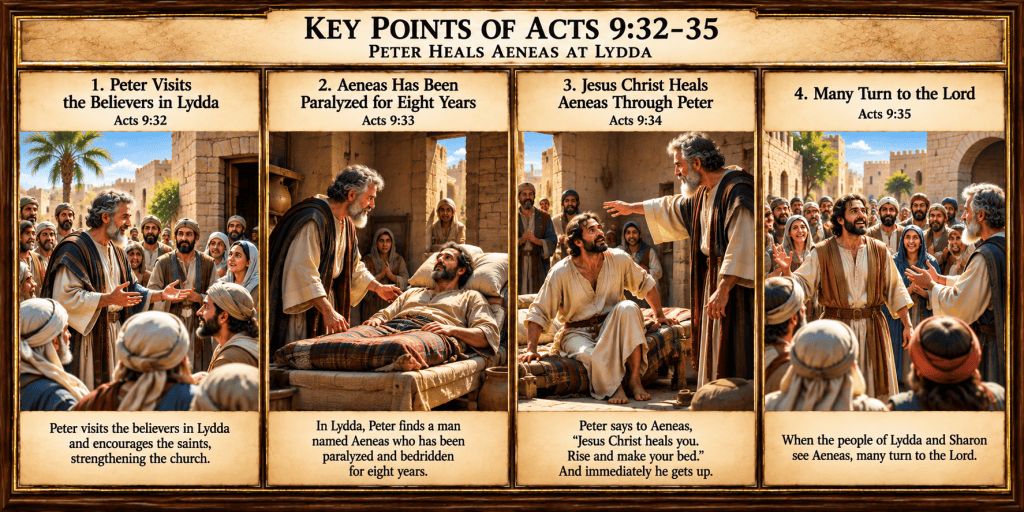
32 Now as Peter went here and there among them all, he came down also to the saints who lived at Lydda. 33 There he found a man named Aeneas, bedridden for eight years, who was paralyzed. 34 And Peter said to him, “Aeneas, Jesus Christ heals you; rise and make your bed.” And immediately he rose. 35 And all the residents of Lydda and Sharon saw him, and they turned to the Lord. (Acts 9:32-35 ESV)
Questions with answers
1. What was Peter doing when he came to Lydda, and what does this reveal about his ministry?
Answer: Acts 9:32 describes Peter traveling among the believers and visiting the saints who lived at Lydda. His ministry involved more than preaching to large gatherings; he also traveled to strengthen, encourage, and support established communities of believers. Following the conversion of Saul and a period of peace for the church (Acts 9:31), Peter continued the work of building up the body of Christ. His visit demonstrates the importance of spiritual leadership that remains connected to the needs of individual congregations. Peter’s willingness to travel and minister among the saints reflects his obedience to Christ’s commission to shepherd His people. This passage reminds believers that Christian ministry includes teaching, encouragement, fellowship, and practical demonstrations of God’s compassion.
2. Who was Aeneas, and why is his physical condition significant to the account?
Answer: Aeneas was a man living in Lydda who had been bedridden for eight years because he was paralyzed (Acts 9:33). Scripture provides few personal details about him, but the length and severity of his condition emphasize the extraordinary nature of the healing that followed. For eight years, Aeneas had been unable to move about normally or care for himself independently. His condition represented a serious and enduring physical limitation that human effort had not overcome. By identifying both his paralysis and the duration of his suffering, Luke establishes the unmistakable significance of the miracle. The healing would demonstrate that the power of Jesus Christ was not limited by the severity or duration of human suffering. Aeneas’s experience also illustrates how Christ’s compassion reaches individuals whose circumstances may appear hopeless.
3. Why did Peter declare that Jesus Christ was healing Aeneas rather than claiming the power for himself?
Answer: In Acts 9:34, Peter explicitly identifies Jesus Christ as the source of Aeneas’s healing. This declaration is central to understanding the miracle because Peter refuses to present himself as possessing independent supernatural power. Instead, he directs attention to the risen and living Christ, who continues His work through the apostles. Peter had previously demonstrated this same principle when explaining the healing of the lame man at the temple in Acts 3:12–16. By giving Christ the credit, Peter reinforces the truth that the apostles were servants and witnesses rather than the ultimate source of divine authority. The miracle therefore becomes a testimony to Jesus’ continuing presence and power following His ascension. For believers, Peter’s example emphasizes humility in ministry and the importance of directing all glory to God rather than seeking personal recognition.
4. What is the significance of Peter commanding Aeneas to rise and make his bed?
Answer: Peter’s instruction for Aeneas to rise and make his bed demonstrates the completeness and immediacy of the healing. A man who had been bedridden for eight years was suddenly able to stand, move, and perform an ordinary task that his paralysis had previously prevented. The command was not merely symbolic; it called Aeneas to act upon the healing Christ had provided. His immediate response confirmed that the restoration was genuine and complete. The instruction also resembles the healing ministry of Jesus, who commanded a paralyzed man to rise, take up his bed, and go home (Mark 2:11–12). This parallel reinforces the continuity between Jesus’ earthly ministry and His continuing work through the apostles. Spiritually, the event illustrates that Christ’s power produces real transformation, enabling individuals to respond to His work in ways previously impossible.
5. What does the immediate healing of Aeneas reveal about the power and authority of Jesus Christ?
Answer: Acts 9:34 records that Aeneas rose immediately after Peter declared that Jesus Christ was healing him. There was no prolonged recovery, gradual improvement, or additional treatment described. The instantaneous restoration demonstrates the extraordinary power and authority of the risen Christ over physical disability. Although Jesus had ascended into heaven, His power remained active through those He had commissioned to proclaim the gospel. The miracle confirmed that Jesus was alive and continuing His redemptive mission through the ministry of His apostles. It also provided visible evidence supporting the message Peter preached. This event encourages believers to recognize that Christ’s authority was not confined to His earthly ministry. At the same time, the passage describes a particular miraculous healing rather than promising that every believer will experience immediate physical restoration.
6. How did the people of Lydda and Sharon respond to the healing of Aeneas?
Answer: Acts 9:35 explains that the residents of Lydda and Sharon who saw Aeneas turned to the Lord. The healing had an impact extending beyond Aeneas himself, becoming a powerful testimony throughout the surrounding region. Lydda was a town northwest of Jerusalem, while Sharon referred to the fertile coastal plain in that part of Judea. The miracle provided compelling evidence of the power of Jesus Christ and helped bring people to faith. Their response demonstrates that the ultimate purpose of the miracle was not simply the restoration of one man’s physical abilities but also the advancement of the gospel. The account emphasizes that the people turned to the Lord, not to Peter, confirming that the healing directed attention toward Jesus. Through this event, God used the restoration of one individual to influence an entire community.
7. What relationship does this passage establish between miraculous healing and the proclamation of the gospel?
Answer: The healing of Aeneas demonstrates how miraculous signs accompanied and supported the proclamation of the gospel during the early development of the church. The apostles had been commissioned to bear witness to Jesus Christ, and God sometimes confirmed their testimony through extraordinary works. In this account, the healing was not presented as an isolated display of supernatural ability but as evidence of the risen Christ’s continuing power. The response of the people in Lydda and Sharon shows that the miracle served a greater spiritual purpose by directing individuals toward faith in Jesus. Physical restoration was a wonderful gift to Aeneas, but the spiritual response of the surrounding population extended its significance. This teaches that acts of compassion and demonstrations of God’s power should ultimately point people toward Christ and the salvation found in Him.
8. How does Peter’s healing of Aeneas demonstrate the continuation of Jesus’ ministry through the apostles?
Answer: During His earthly ministry, Jesus healed the sick, restored the disabled, and demonstrated the arrival of God’s kingdom through acts of divine compassion and authority. In Acts 9:32–35, Peter performs a similar work, but he clearly identifies Jesus Christ as the One providing the healing. This distinction is important because it shows that the apostles were continuing Christ’s mission rather than establishing ministries independent of Him. The resemblance between Peter’s command to Aeneas and Jesus’ commands to those He healed further emphasizes this continuity. Through the Holy Spirit, the risen Christ continued working through His chosen witnesses. The account therefore supports one of the central themes of Acts: Jesus continues to build His church through the Spirit-empowered ministry of His followers. Peter’s actions illustrate faithful obedience to that calling.
9. What can believers learn from the way Peter approached Aeneas and addressed his suffering?
Answer: Peter’s encounter with Aeneas demonstrates the importance of recognizing individual needs and responding with compassion and faithfulness. Although Peter was involved in the larger mission of strengthening the churches, he did not overlook a single man who had suffered from paralysis for many years. The passage does not describe a lengthy conversation or explain how Peter learned about Aeneas, but it clearly shows that his ministry addressed a specific human need. Peter also directed attention to Jesus rather than himself, demonstrating humility and dependence upon divine authority. For believers today, this example encourages attentiveness to people who are suffering, practical expressions of compassion, and confidence in Christ’s ability to work according to His will. While Christians cannot presume that every illness will be miraculously healed, they can follow Peter’s example by serving others and pointing them toward the hope found in Jesus.
10. What is the central spiritual lesson of Acts 9:32–35, and how can it be applied to Christian life today?
Answer: The central spiritual lesson of Acts 9:32–35 is that the risen Jesus Christ continues His work through faithful servants, demonstrating His power and drawing people to Himself. Peter’s ministry in Lydda shows how God can use an encounter with one individual to produce consequences extending throughout an entire community. Aeneas received physical restoration, while many who witnessed the result turned to the Lord. The account reminds believers that effective ministry depends upon Christ’s power rather than human ability or personal recognition. It also emphasizes that acts of compassion can provide meaningful opportunities to bear witness to the gospel. In practical Christian living, this passage encourages believers to remain attentive to those in need, serve with humility, trust Christ’s authority, and recognize that even seemingly small acts of faithful service may have far-reaching spiritual consequences. Above all, the passage directs attention to Jesus Christ as the source of healing, hope, and salvation.
Summary of the Passage
Acts 9:32–35 presents a remarkable example of the risen Christ working through the ministry of the apostle Peter. The healing of Aeneas demonstrates Christ’s continuing authority, Peter’s dependence upon divine power, and the relationship between compassionate ministry and the spread of the gospel. What began as the restoration of one man became a testimony that influenced people throughout Lydda and Sharon.
Key Truth: The power belongs to Jesus Christ, the ministry is carried out through His servants, and the glory belongs to God.


Leave a Reply