image Acts 8:9-25
New Testament Events Series
Event: nte021 Simon the Magician Believes (Acts 8:9-25)
Facilitator/Editor: Stephen Weller
Information Collection: ChatGPT
Bible Text: BibleGateway
3,744 words, 20 minutes read time
NT Event Index
Event Context
Context for Acts 8:9-25
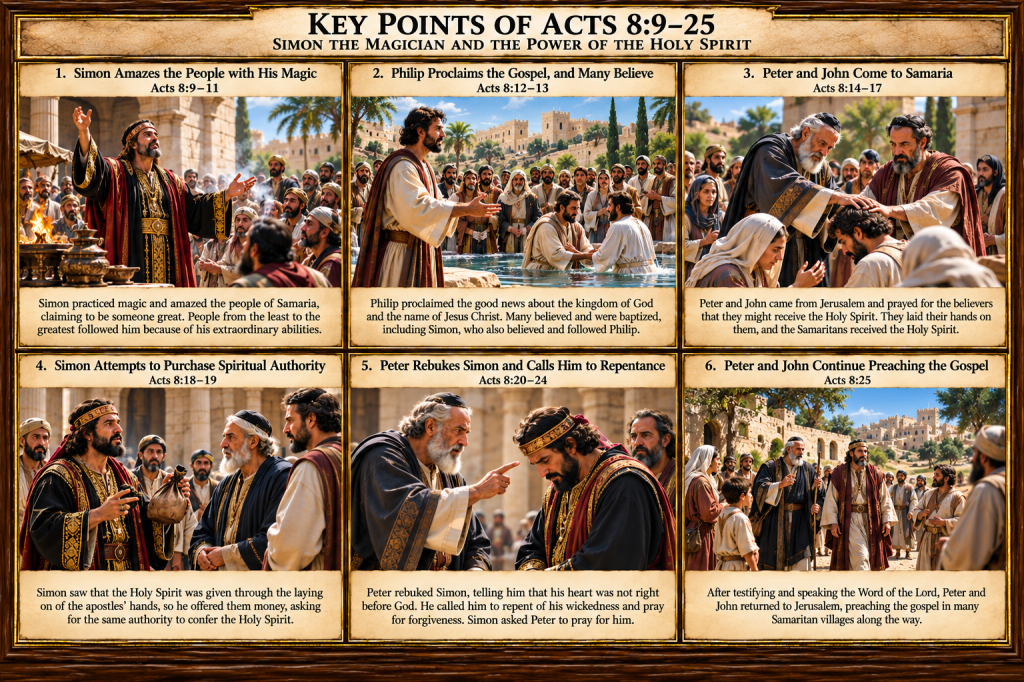
Acts 8:9–25 takes place during the spread of the gospel into Samaria following the persecution of the church in Jerusalem after Stephen’s martyrdom. Philip had traveled to Samaria, proclaiming Jesus Christ, performing miraculous signs, and bringing great joy to the city as many people believed and were baptized (Acts 8:4–8). Among those who responded was Simon, a man who had previously amazed the Samaritans with his magical practices and claimed to possess extraordinary power. Although Simon professed belief and was baptized, his understanding of God’s power remained deeply flawed. When the apostles Peter and John arrived from Jerusalem and prayed for the Samaritan believers to receive the Holy Spirit, Simon witnessed the Spirit being given through the laying on of the apostles’ hands. Desiring this authority for himself, Simon offered money to purchase the ability to bestow the Holy Spirit upon others. Peter sharply rebuked him, declaring that God’s gift could not be purchased and calling Simon to repent of his wicked intentions. Simon responded by asking Peter to pray that the threatened judgment would not come upon him, although the passage does not establish whether he genuinely repented. This encounter reveals the difference between outward religious profession and a heart rightly devoted to God, emphasizing that the Holy Spirit is a divine gift rather than a power to be controlled for personal advantage. The passage also demonstrates the growing unity of the church as Jewish and Samaritan believers were brought together through faith in Christ and the work of the Holy Spirit. Peter and John then returned toward Jerusalem, proclaiming the gospel in many Samaritan villages along the way, further advancing Jesus’ commission that His witnesses carry the gospel beyond Jerusalem into Judea and Samaria (Acts 1:8).
Understanding the Event
Event Text
Simon the Magician Believes
9 But there was a man named Simon, who had previously practiced magic in the city and amazed the people of Samaria, saying that he himself was somebody great. 10 They all paid attention to him, from the least to the greatest, saying, “This man is the power of God that is called Great.” 11 And they paid attention to him because for a long time he had amazed them with his magic. 12 But when they believed Philip as he preached good news about the kingdom of God and the name of Jesus Christ, they were baptized, both men and women. 13 Even Simon himself believed, and after being baptized he continued with Philip. And seeing signs and great miracles[a] performed, he was amazed.
14 Now when the apostles at Jerusalem heard that Samaria had received the word of God, they sent to them Peter and John, 15 who came down and prayed for them that they might receive the Holy Spirit, 16 for he had not yet fallen on any of them, but they had only been baptized in the name of the Lord Jesus. 17 Then they laid their hands on them and they received the Holy Spirit. 18 Now when Simon saw that the Spirit was given through the laying on of the apostles’ hands, he offered them money, 19 saying, “Give me this power also, so that anyone on whom I lay my hands may receive the Holy Spirit.” 20 But Peter said to him, “May your silver perish with you, because you thought you could obtain the gift of God with money! 21 You have neither part nor lot in this matter, for your heart is not right before God. 22 Repent, therefore, of this wickedness of yours, and pray to the Lord that, if possible, the intent of your heart may be forgiven you. 23 For I see that you are in the gall[b] of bitterness and in the bond of iniquity.” 24 And Simon answered, “Pray for me to the Lord, that nothing of what you have said may come upon me.”
25 Now when they had testified and spoken the word of the Lord, they returned to Jerusalem, preaching the gospel to many villages of the Samaritans
Questions with answers
1. Who was Simon, and what influence did he have among the people of Samaria? (Acts 8:9–11)
Answer: Simon was a man who practiced magic in Samaria and had gained considerable influence over the people through his extraordinary displays. He presented himself as someone great, and the people, from the least to the greatest, paid attention to him. They even referred to him as the power of God called Great. His reputation had developed over a long period because his magical practices amazed the population.
Simon’s influence demonstrates how easily people can mistake impressive displays of power for genuine spiritual authority. His activities attracted attention to himself rather than directing people toward the true God. The Samaritans were captivated by what Simon could do, but they lacked the spiritual understanding necessary to distinguish deception from divine truth.
This passage reminds believers that popularity, extraordinary abilities, and public recognition do not necessarily indicate God’s approval. True spiritual authority is measured by faithfulness to God’s Word and the exaltation of Jesus Christ rather than personal greatness.
2. How did Philip’s preaching change the spiritual atmosphere in Samaria? (Acts 8:12)
Answer: Philip brought a message fundamentally different from Simon’s demonstrations of magic. Rather than promoting himself, Philip proclaimed the good news about the kingdom of God and the name of Jesus Christ. His message centered on salvation, repentance, and the authority of the risen Savior.
As the Samaritans heard and believed Philip’s preaching, both men and women were baptized. Their response demonstrated that the gospel was reaching people who had previously been captivated by Simon’s influence.
The contrast between Simon and Philip is significant. Simon attracted followers through amazement and personal reputation, while Philip directed people toward Christ through the proclamation of God’s truth. The people began responding to the gospel rather than merely admiring extraordinary demonstrations.
This transformation illustrates the power of the gospel to redirect hearts from spiritual confusion toward saving truth. Genuine Christian ministry does not seek to build admiration for the messenger but to lead people into a relationship with Jesus Christ.
3. Why is Simon’s own response to Philip’s preaching significant? (Acts 8:13)
Answer: Acts 8:13 records that Simon himself believed and was baptized. He continued following Philip and was amazed by the signs and great miracles being performed. At first glance, Simon appeared to have experienced the same spiritual transformation as the other Samaritans.
However, Luke emphasizes that Simon remained fascinated by the miraculous demonstrations he witnessed. Having previously used extraordinary displays to gain influence, Simon now encountered genuine works of divine power that exceeded anything he had practiced.
His continued amazement raises an important question about the nature of his faith. Was Simon genuinely surrendering himself to Jesus Christ, or was he primarily attracted to the power associated with Christian ministry?
The passage does not explicitly describe Simon’s inward thoughts at the moment of baptism. Nevertheless, Peter’s later rebuke reveals a serious spiritual problem in his heart.
Simon’s experience teaches that outward religious participation does not automatically establish inward spiritual transformation. Baptism, association with believers, and enthusiasm for spiritual experiences must be accompanied by sincere repentance and genuine faith in Christ.
4. Why did the apostles in Jerusalem send Peter and John to Samaria? (Acts 8:14)
Answer: When the apostles in Jerusalem heard that Samaria had received the Word of God, they sent Peter and John to investigate and minister among the new believers. This development was especially important because longstanding religious and cultural divisions existed between Jews and Samaritans.
The spread of the gospel into Samaria represented a significant fulfillment of Jesus’ commission in Acts 1:8, where He instructed His followers to become His witnesses in Jerusalem, Judea, Samaria, and to the ends of the earth.
Peter and John’s visit helped establish that the Samaritan believers belonged to the same Christian community as the Jewish believers in Jerusalem. The gospel was not creating separate religious movements but bringing different peoples together under the lordship of Jesus Christ.
Their ministry also demonstrated apostolic recognition of God’s work among the Samaritans. The church was expanding beyond its original Jewish setting, and the apostles witnessed this important development firsthand.
This passage emphasizes that salvation through Jesus Christ transcends ethnic, cultural, and historical divisions. God’s redemptive purpose includes people from every background who respond to the gospel in faith.
5. Why had the Holy Spirit not yet fallen upon the Samaritan believers? (Acts 8:15–16)
Answer: When Peter and John arrived, they prayed that the Samaritan believers might receive the Holy Spirit. Luke explains that the Spirit had not yet fallen upon any of them, although they had been baptized in the name of the Lord Jesus.
This sequence is unusual when compared with other New Testament passages describing the relationship between faith and receiving the Holy Spirit. For example, Ephesians 1:13 associates believing the gospel with being sealed by the promised Holy Spirit.
Acts 8 records a special moment in the historical expansion of the early church. One important interpretation is that God delayed this visible reception of the Spirit so that the apostles could personally witness and affirm the inclusion of the Samaritans within the same body of Christ.
The delay helped prevent the longstanding division between Jews and Samaritans from becoming a permanent division within Christianity.
Christians differ in their interpretation of whether this passage establishes a continuing pattern of receiving the Holy Spirit after conversion. However, the immediate context clearly emphasizes God’s acceptance of the Samaritans and the unity of the expanding church.
The central lesson is that the Holy Spirit is God’s gift, and His presence confirms that believers belong to Christ rather than to separate religious or ethnic communities.
6. What happened when Peter and John laid their hands on the Samaritan believers? (Acts 8:17)
Answer: After praying for the Samaritan believers, Peter and John laid their hands on them, and they received the Holy Spirit. This event visibly confirmed God’s acceptance of the Samaritans as members of the growing Christian church.
The laying on of hands was a meaningful act of identification, blessing, and recognition. In this particular situation, it accompanied the reception of the Holy Spirit through the ministry of the apostles.
Luke does not describe precisely what outward manifestations occurred when the Samaritans received the Spirit. However, Simon evidently observed something that convinced him that the apostles possessed remarkable spiritual authority.
The event demonstrated that the same Holy Spirit who empowered the believers in Jerusalem was now working among the Samaritans.
It is important to recognize that Peter and John did not independently control the Holy Spirit. God was the source of this spiritual gift, and the apostles served as His appointed witnesses and instruments.
This distinction becomes especially important in the following verses, when Simon misunderstands the nature of spiritual authority and attempts to acquire it for himself.
7. Why did Simon offer money to Peter and John? (Acts 8:18–19)
Answer: Simon observed that the Holy Spirit was given through the laying on of the apostles’ hands. Impressed by what he witnessed, he offered them money and requested the same authority so that anyone upon whom he laid his hands might receive the Holy Spirit.
His request exposed a fundamental misunderstanding of God’s power. Simon viewed spiritual authority as something that could be acquired, possessed, and exercised according to personal desire.
Having previously enjoyed influence through magical practices, Simon apparently saw an opportunity to obtain a greater form of power. Instead of recognizing the Holy Spirit as God’s sovereign gift, he treated spiritual ministry as though it operated according to the same principles as his former profession.
His request also suggests that his attention remained focused on what he could accomplish rather than on what God desired to accomplish through him.
This incident became associated with the term simony, which describes the buying or selling of spiritual offices, privileges, or sacred things.
The lesson is that God’s gifts cannot be purchased, manipulated, or used for personal advancement. Spiritual authority is entrusted by God for His purposes and glory, never as a means of acquiring prestige or influence.
8. Why did Peter respond so strongly to Simon’s offer? (Acts 8:20–21)
Answer: Peter immediately recognized the seriousness of Simon’s request and delivered a forceful rebuke. He declared that Simon and his money faced destruction because Simon believed that the gift of God could be obtained with money.
Peter’s response was not simply a rejection of financial payment. It addressed Simon’s distorted understanding of God, salvation, and spiritual authority.
Simon had treated the Holy Spirit as a commodity rather than recognizing Him as the divine Person whose presence and gifts are granted according to God’s will.
Peter further declared that Simon had neither part nor lot in the matter because his heart was not right before God. This statement revealed that the fundamental problem was not Simon’s lack of religious involvement but the condition of his heart.
Although Simon had professed belief and received baptism, Peter’s words exposed a serious inconsistency between his outward religious identification and his inward spiritual condition.
This passage teaches that God examines motives as well as actions. Religious activity cannot substitute for a heart that genuinely trusts, honors, and submits to Him.
9. What did Peter command Simon to do, and what does this reveal about repentance? (Acts 8:22)
Answer: Peter commanded Simon to repent of his wickedness and pray to the Lord that, if possible, the intention of his heart might be forgiven.
This instruction identified repentance as the appropriate response to Simon’s sin. Simon needed more than a change in outward behavior; he needed a fundamental change in his thinking, desires, and attitude toward God.
His attempt to purchase spiritual authority originated in the intentions of his heart. Therefore, genuine repentance required acknowledging the sinful motivation behind his request and turning away from it.
Peter also directed Simon to pray to the Lord, emphasizing that forgiveness comes from God rather than through human authority or financial payment.
The words “if possible” communicate the seriousness of Simon’s spiritual condition. They do not establish that God’s mercy is unavailable to genuinely repentant sinners. Rather, they underscore the danger of approaching God with a corrupt heart while presuming upon His grace.
This passage reminds believers that repentance involves recognizing sin, rejecting sinful motives, and seeking God’s forgiveness with humility and sincerity.
10. What did Peter mean when he described Simon as being in the gall of bitterness and the bond of iniquity? (Acts 8:23)
Answer: Peter used vivid language to describe Simon’s spiritual condition. The expression “gall of bitterness” suggests something deeply poisonous or corrupt, while the “bond of iniquity” portrays a person held captive by sin.
These descriptions reveal that Simon’s problem extended beyond a single inappropriate request. His thinking and desires remained influenced by sinful attitudes that had not been properly confronted.
Although Simon had abandoned his public practice of magic and associated himself with Philip, his desire for spiritual power exposed the continuing influence of his former ambitions.
Peter’s words suggest that Simon was not spiritually free in the way he appeared to be outwardly. His desire for personal greatness had become a form of bondage.
The language also echoes Old Testament warnings about hearts turning away from the Lord toward corruption and unfaithfulness.
This passage teaches that sin can enslave the human heart even when outward religious behavior appears acceptable. Genuine freedom requires more than changing one’s public identity; it requires God’s transforming work within the heart.
11. How did Simon respond to Peter’s rebuke, and what does his response reveal? (Acts 8:24)
Answer: Simon asked Peter and John to pray to the Lord for him so that none of the things Peter had spoken would happen to him.
His response demonstrated that he recognized the seriousness of Peter’s warning. Rather than arguing with the apostles or attempting to justify his behavior, Simon requested their prayers.
However, his words also raise questions about the depth of his repentance. He specifically expressed concern about avoiding the consequences of Peter’s judgment, but Luke does not record an explicit confession of his sinful motives or a personal prayer of repentance.
This distinction is important because fear of punishment is not necessarily the same as genuine sorrow over sin.
A person may regret the consequences of wrongdoing without fully recognizing the offense committed against God.
Nevertheless, the passage does not reveal Simon’s final spiritual condition. Scripture leaves his ultimate response unresolved, and readers should avoid claiming certainty beyond what Luke records.
The lesson encourages careful self-examination. Genuine repentance is concerned not only with escaping judgment but also with restoring a right relationship with God.
12. What did Peter and John do after confronting Simon? (Acts 8:25)
Answer: After testifying and speaking the Word of the Lord, Peter and John returned toward Jerusalem. Along the way, they preached the gospel in many Samaritan villages.
Their continued ministry demonstrates that the incident involving Simon did not distract them from their central mission of proclaiming Jesus Christ.
The apostles had witnessed the acceptance of the Samaritans into the Christian community, addressed a serious spiritual problem, and continued spreading the good news throughout the region.
Their actions also reveal the expanding reach of the gospel. What began with Philip’s preaching in one Samaritan city now extended into numerous villages.
This development fulfilled the direction established by Jesus in Acts 1:8. The gospel was moving beyond Jerusalem and Judea into Samaria, preparing the way for its eventual spread throughout the Gentile world.
The passage concludes with a picture of faithful ministry: proclaiming God’s Word, correcting spiritual error, strengthening believers, and continuing the mission of making Christ known.
13. What is the difference between being impressed by spiritual power and possessing genuine saving faith? (Acts 8:9–24)
Answer: Simon’s experience illustrates an important distinction between fascination with spiritual experiences and genuine faith in Jesus Christ.
Simon was impressed by Philip’s miracles and later by the apostles’ ability to minister in connection with the reception of the Holy Spirit. His attention repeatedly returned to extraordinary displays of power.
Genuine saving faith, however, is centered on Jesus Christ Himself rather than merely on the benefits, experiences, or abilities associated with Christianity.
True faith recognizes human sinfulness, trusts Christ for salvation, and responds to God’s grace with repentance and submission.
A person may admire Christian teaching, participate in religious ceremonies, and associate with believers without fully understanding the meaning of surrendering to Christ.
Simon’s story warns against confusing external religious enthusiasm with inward spiritual transformation.
At the same time, the passage encourages believers to examine their own motives. The essential question is not simply whether someone desires God’s power or blessings, but whether that person genuinely desires God and seeks to honor Him.
14. What does this passage teach about the relationship between money, power, and Christian ministry? (Acts 8:18–23)
Answer: Simon’s attempt to purchase spiritual authority reveals the danger of treating ministry as a means of personal advancement.
Money is not inherently evil, and Scripture recognizes the legitimate financial support of Christian ministry. However, Simon’s request was wrong because he attempted to purchase something that belongs entirely to God’s sovereign authority.
He viewed the Holy Spirit’s work as a resource that could be controlled and distributed through a transaction.
Peter’s rejection established an important principle: God’s grace and spiritual gifts are not commodities.
Christian ministry must never become an enterprise in which divine favor, spiritual authority, or the promise of God’s power is offered in exchange for money.
This warning remains relevant wherever religious influence is used to manipulate people, obtain wealth, or establish personal control.
Faithful ministry seeks to serve others, proclaim Christ, and glorify God. It recognizes that spiritual gifts are entrusted for service rather than personal enrichment.
15. How does Acts 8:9–25 contribute to the larger message of the book of Acts?
Answer: Acts 8:9–25 records a significant stage in the fulfillment of Christ’s command to take the gospel beyond Jerusalem.
The persecution that followed Stephen’s death scattered believers into new regions, and Philip’s ministry brought the message of Jesus Christ to Samaria.
The response of the Samaritans demonstrated that God’s salvation was not limited to the Jewish people. Through the ministry of Peter and John, their reception of the Holy Spirit confirmed their inclusion in the expanding Christian church.
At the same time, Simon’s experience introduced an important warning about the dangers that could arise within this growing movement.
As Christianity expanded, the church needed to distinguish genuine faith from superficial profession, divine authority from personal ambition, and the work of the Holy Spirit from attempts to manipulate spiritual power.
The passage therefore presents two complementary truths: the gospel is freely offered to all who believe, and genuine participation in God’s kingdom requires a heart rightly oriented toward Him.
The growing church was called not only to reach new people but also to preserve the integrity of its message and ministry.
Summary: Central Lessons from Acts 8:9–25
1. The gospel is greater than human influence. Philip’s proclamation of Jesus Christ redirected the Samaritans from fascination with Simon toward the truth of salvation.
2. Outward profession must be accompanied by inward transformation. Simon’s baptism and association with believers did not prevent Peter from identifying serious corruption in his heart.
3. The Holy Spirit is God’s gift. Divine power cannot be purchased, controlled, or obtained through human ambition.
4. God’s salvation crosses human divisions. The reception of the Holy Spirit by the Samaritans demonstrated their inclusion in the one body of Christ.
5. Repentance addresses the intentions of the heart. Peter called Simon to turn from his wickedness and seek God’s forgiveness.
6. Spiritual gifts are intended for God’s glory. Christian ministry must serve Christ and others rather than becoming a means of personal recognition or financial gain.
7. The mission of the gospel must continue. Despite the confrontation with Simon, Peter and John continued proclaiming the Word of God throughout Samaria.
Central Truth: Acts 8:9–25 teaches that genuine faith is not measured by fascination with spiritual power, outward religious participation, or personal influence, but by a heart that responds to Jesus Christ in sincere faith, repentance, and humble submission to God.


Leave a Reply