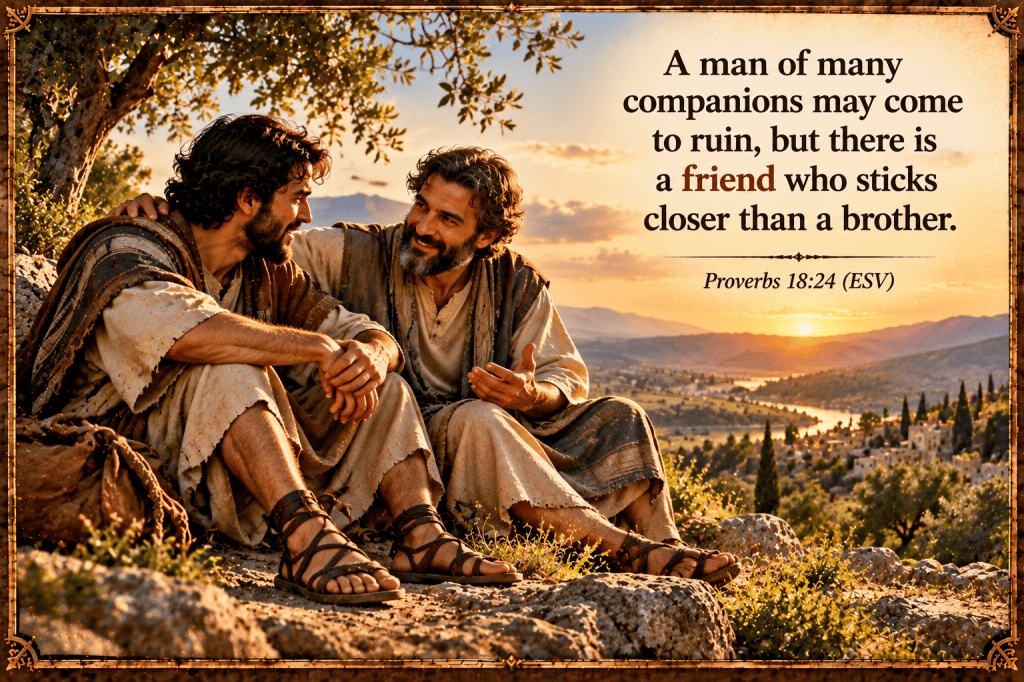
image Proverbs 18:24
dv1014-Daily Verse
Author: Stephen Weller
Facilitator: Stephen Weller
2,430 words, 13 minutes read time
Live as Servants of God
Encouragement
1 Peter 2:16 says:
“Live as free people, but do not use your freedom as a cover-up for evil; live as God’s slaves.” (NIV)
This verse provides several powerful encouragements:
- You are truly free in Christ.
Peter reminds believers that they are no longer slaves to sin, fear, or the opinions of others. Because of what Christ has done, they can live with confidence and dignity. - Freedom comes with purpose.
Christian freedom is not permission to do whatever we want. Instead, it frees us to do what is right. We are liberated to love, serve, and obey God willingly. - Serving God is not bondage but fulfillment.
The phrase “God’s slaves” sounds paradoxical. Peter’s point is that the highest freedom is found in belonging to God. When we submit to Him, we become the people we were created to be. - You can choose integrity even when pressured.
In a culture that may encourage compromise, this verse encourages believers to use their freedom responsibly and honorably, reflecting God’s character.
A devotional thought
1 Peter 2:16 reminds us that Christian freedom is not self-centered independence but God-centered living. We are free from the power of sin so that we can freely serve the Lord. True freedom is not doing whatever we desire; it is having the ability and desire to do what pleases God.
Encouragement: When you feel restricted by obedience to God, remember that His ways are not chains. In Christ, obedience is the pathway to genuine freedom, peace, and purpose.
Bible Lesson
Live as people who are free, not using your freedom as a cover-up for evil, but living as servants of God. (1 Peter 2:16 ESV)
This verse is found in the first paragraph of a section titled, “Submission to Authority.” The three verses leading up to this one reads, 13 “Be subject for the Lord’s sake to every human institution, whether it be to the emperor as supreme, 14 or to governors as sent by him to punish those who do evil and to praise those who do good. 15 For this is the will of God, that by doing good you should put to silence the ignorance of foolish people.” Our submission to authority imitates the submission of Jesus to the authority of his Father. As Jesus did good in obeying his Father and was praised for it, we are also to do good for this is the will of God. Out doing good not only pleases God but will help in putting to silence the ignorance of foolish people by helping them understand the things of God.
As believers we are free, not as a license to sin but to devote that freedom to doing what is good. 13 “For you were called to freedom, brothers. Only do not use your freedom as an opportunity for the flesh, but through love serve one another. 14 For the whole law is fulfilled in one word: “You shall love your neighbor as yourself” (Galatians 5:13 – 14 ESV). 31 “If you abide in my word, you are truly my disciples, 32 and you will know the truth, and the truth will set you free.” (John 8:31 – 32 ESV). If we are born again we are disciples of Jesus and if he sets us free, we will be free indeed (John 8:36).
Since we as believers are no longer under the law but under grace, we may think that we can continue to sin when convenient. Paul says, “By no means! Do you not know that if you present yourselves to anyone as obedient slaves, you are slaves of the one whom you obey, either of sin, which leads to death, or of obedience, which leads to righteousness?” (Romans 6:15 – 16 ESV). Having been set free from sin, we have through obedience from the heart become slaves of righteousness (Romans 6:17 – 18).
Before our salvation we presented ourselves as slaves to impurity and to lawlessness leading to more lawlessness, so now we must present ourselves as slaves to righteousness leading to our sanctification (Romans 6:19). Sin leads us away from God while obedience out of love brings us closer.
Questions with Answers
16 “Live as people who are free, not using your freedom as a cover-up for evil, but living as servants of God.” (1 Peter 2:16 ESV)
1. What does Peter mean when he tells believers to live as people who are free?
Answer: Peter reminds believers that through faith in Jesus Christ, they have been set free from the bondage of sin and the condemnation of the law. This freedom is not primarily political or social independence but spiritual freedom made possible through Christ’s redeeming work. Christians are no longer enslaved to sin as their master but are empowered to live in righteousness and obedience to God.
This freedom also changes how believers approach daily life. Rather than being controlled by selfish desires, fear, or worldly expectations, they can make decisions guided by God’s Word and the Holy Spirit. True Christian freedom is not the absence of responsibility but the ability to live according to God’s will. As Jesus explains in John 8:36, those whom the Son sets free are truly free.
2. Why does Peter warn believers not to use their freedom as a cover-up for evil?
Answer: Peter recognizes that Christian freedom can be misunderstood or deliberately misused. Some might claim that because they have been forgiven through Christ, they are free to disregard God’s commandments or behave dishonestly. Peter firmly rejects this thinking. Freedom from sin’s condemnation does not grant permission to continue practicing sin.
The phrase “cover-up for evil” describes using the appearance of spiritual freedom to conceal sinful motives or behavior. A believer might justify dishonesty, rebellion, selfishness, or disrespect by claiming personal freedom. However, genuine Christian liberty should produce greater holiness, not greater lawlessness.
Paul teaches a similar principle in Galatians 5:13, encouraging believers not to use freedom as an opportunity for the flesh but to serve one another through love. Christian freedom must always be exercised within the boundaries of God’s righteousness.
3. How can Christians be both free people and servants of God?
Answer: At first, freedom and servanthood may appear contradictory. Ordinarily, a servant is understood to be under another person’s authority, while a free person possesses independence. However, Peter reveals an important spiritual truth: believers experience their greatest freedom when they willingly submit themselves to God.
Before salvation, people are enslaved to sin, even when they believe they are acting independently. Through Christ, they are released from sin’s dominion and brought into a new relationship with God. They now belong to Him and are called to serve Him faithfully.
Being a servant of God means recognizing His authority over our thoughts, decisions, relationships, and conduct. This submission is not oppressive because God is perfectly righteous, loving, and wise. Romans 6:22 explains that those set free from sin become servants of God, producing the fruit of holiness and ultimately eternal life.
Thus, Christian freedom and servanthood complement one another. We are freed from the mastery of sin so that we may joyfully serve the Lord.
4. How does 1 Peter 2:16 relate to the surrounding teaching about submitting to human authorities?
Answer: The immediate context of 1 Peter 2:13–17 addresses the Christian’s responsibility toward governing authorities and society. Peter instructs believers to submit to human institutions for the Lord’s sake, demonstrating honorable conduct before others.
Verse 16 explains the spiritual attitude that should accompany this submission. Christians possess freedom in Christ, but they should not use that freedom as an excuse for unnecessary rebellion, disrespect, or wrongdoing. Instead, they should demonstrate their commitment to God through responsible and honorable behavior.
Their submission to legitimate human authority is ultimately an expression of obedience to God. However, human authority is not absolute. When human commands directly contradict God’s commands, believers must obey God rather than men, as demonstrated in Acts 5:29.
Peter’s teaching establishes a balance between spiritual freedom, respect for earthly authority, and ultimate allegiance to God. Christians should be known for integrity and righteousness rather than using their faith to justify disorderly conduct.
5. What is the difference between worldly freedom and Christian freedom?
Answer: Worldly freedom is frequently understood as the ability to do whatever one desires without interference or restriction. This understanding places personal independence and individual preference at the center of life. However, Scripture teaches that unrestricted pursuit of personal desires can lead to bondage rather than genuine freedom.
Christian freedom begins with deliverance from the power and penalty of sin through Jesus Christ. It is not centered on satisfying personal desires but on living in harmony with God’s purposes.
For example, a person may believe that freedom means being able to respond angrily whenever offended. Christian freedom provides the spiritual ability to respond instead with patience, forgiveness, and self-control. Similarly, worldly freedom may encourage selfish ambition, while Christian freedom enables sacrificial service.
The essential difference is that worldly freedom often emphasizes personal autonomy, while Christian freedom emphasizes transformation through Christ. The believer is free not merely to choose but to choose what honors God.
6. How should our identity as servants of God influence our relationships with others?
Answer: Recognizing ourselves as servants of God should produce humility, respect, compassion, and responsibility in our relationships. If we belong to God, our treatment of others must reflect His character rather than our personal preferences or emotional reactions.
This principle applies to family relationships, friendships, employment, church fellowship, and interactions with those who hold different beliefs. Christians should not use their spiritual freedom to dominate, manipulate, mistreat, or disregard others.
Instead, they should demonstrate the servant-hearted attitude of Jesus Christ. Philippians 2:3–4 encourages believers to reject selfish ambition, consider others significant, and look to their interests.
Serving God also means recognizing that our conduct can either strengthen or weaken our Christian witness. When believers demonstrate patience under pressure, honesty in difficult circumstances, and kindness toward others, they provide visible evidence of God’s transforming grace.
7. What practical examples demonstrate the proper use of Christian freedom?
Answer: Christian freedom becomes evident through everyday decisions that reflect obedience to God and concern for others.
A believer demonstrates freedom when choosing forgiveness rather than retaliation, truthfulness rather than deception, or generosity rather than selfishness. Freedom is also exercised when Christians willingly limit personal preferences to protect another person’s conscience or spiritual well-being.
For example, a Christian may have the freedom to participate in an activity that is not inherently sinful. However, if participating would encourage another believer to violate their conscience, love may lead that Christian to refrain voluntarily. Paul discusses this principle in 1 Corinthians 8:9, warning believers to ensure that their freedom does not become a stumbling block to others.
Likewise, Christians demonstrate freedom through responsible citizenship, faithful work, respectful communication, and voluntary service.
These actions reveal that Christian liberty is not measured by how much a believer can do but by how faithfully that freedom is used to glorify God.
8. How does living as a servant of God provide a testimony to unbelievers?
Answer: Peter places considerable emphasis on the believer’s conduct before an unbelieving world. In 1 Peter 2:12, he encourages Christians to maintain honorable behavior among the Gentiles so that even those who accuse them of wrongdoing may observe their good deeds and glorify God.
Living as a servant of God makes Christian faith visible through practical actions. When believers respond to hostility with kindness, fulfill their responsibilities faithfully, respect others, and refuse to compromise their integrity, they demonstrate that their lives are governed by a higher authority.
This testimony is particularly powerful when believers experience unfair treatment. Their willingness to remain faithful under difficult circumstances reflects the example of Jesus Christ, whose suffering and obedience are emphasized later in 1 Peter 2:21–23.
Such conduct does not guarantee that unbelievers will immediately accept the gospel. However, it removes unnecessary obstacles and provides credible evidence of the transforming power of Christ.
The believer’s freedom becomes a witness when it is expressed through humble obedience rather than selfish independence.
9. What spiritual dangers arise when Christians emphasize freedom without responsibility?
Answer: When Christian freedom is separated from obedience and responsibility, several spiritual dangers emerge. Believers may become careless about sin, resistant to correction, insensitive to others, or increasingly focused on personal rights rather than godly character.
One significant danger is self-deception. A person may begin to interpret God’s grace as permission to continue behaviors that Scripture condemns. Jude 4 warns against those who pervert God’s grace into sensuality.
Another danger is damage to Christian fellowship. When personal freedom becomes more important than love, believers may create division, offend weaker consciences, or neglect opportunities to serve.
Peter’s instruction protects against these dangers by placing freedom within the framework of servanthood. Christians belong to God, and their freedom must be exercised under His authority.
Spiritual maturity is demonstrated not by insisting upon every personal liberty but by discerning when obedience, humility, and love require restraint.
10. What central lesson should believers remember from 1 Peter 2:16?
Answer: The central lesson of 1 Peter 2:16 is that Christian freedom is a gift from God that must be exercised in obedience to Him, never as an excuse for sinful behavior.
Through Jesus Christ, believers have been liberated from sin’s dominion and brought into a new relationship with God. This freedom carries both privilege and responsibility. Christians are no longer bound to live according to their former sinful desires; they are now empowered to pursue righteousness and serve God willingly.
Peter’s instruction also teaches that true spiritual freedom is compatible with humility, responsible citizenship, respect for others, and voluntary submission to legitimate authority.
The greatest expression of Christian freedom is not independence from God but joyful dependence upon Him. When believers recognize that they belong to the Lord, their freedom becomes an instrument of holiness, service, and testimony.
Ultimately, 1 Peter 2:16 calls Christians to demonstrate through their daily conduct that they have been set free from sin in order to live as faithful servants of God.
Concluding Spiritual Truth
Freedom in Christ is not freedom to live without restraint; it is freedom to live without the mastery of sin. The Christian is liberated from bondage to sin and called into willing service to God. Our freedom finds its highest purpose when expressed through righteousness, humility, love, and obedience to the One who redeemed us.


Leave a Reply