image xx
New Testament Events Series
Event: nte022 Philip and the Ethiopian Eunuch (Acts 8:26–40)
Facilitator/Editor: Stephen Weller
Information Collection: ChatGPT
Bible Text: BibleGateway
3,399 words, 18 minutes read time
NT Event Index
Event Context
Context for Acts 8:26–40
Acts 8:26–40 — Philip and the Ethiopian Eunuch: The Gospel Reaches Beyond Israel
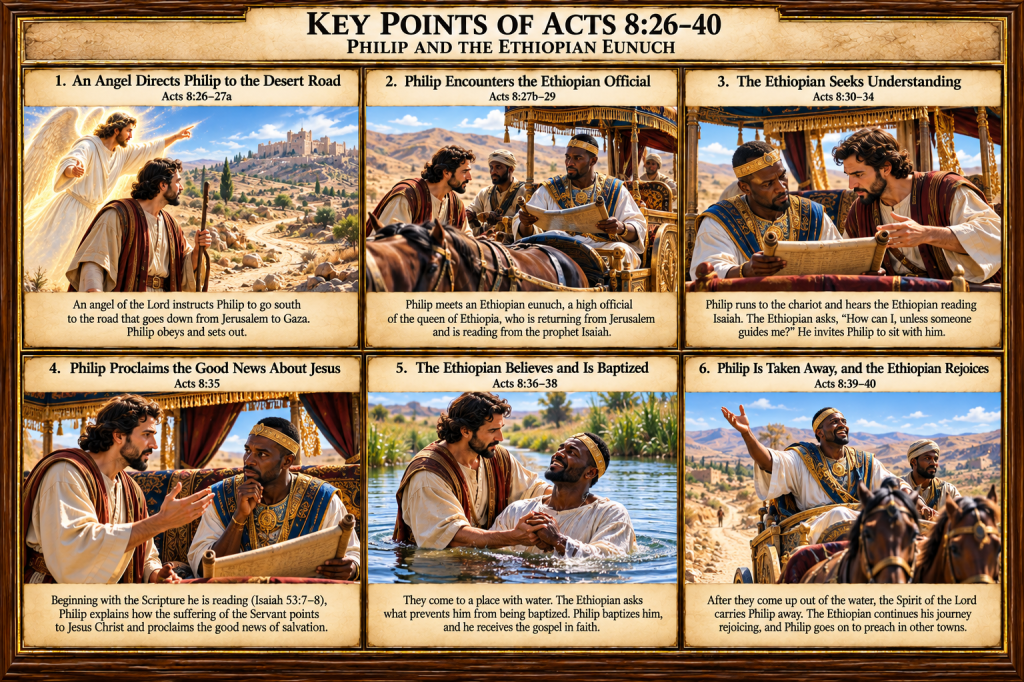
Context: Acts 8:26–40 records the remarkable encounter between Philip the evangelist and an Ethiopian eunuch, demonstrating God’s sovereign direction in spreading the gospel beyond the borders of Israel. Following Philip’s successful ministry in Samaria, an angel of the Lord directs him to travel south along the desert road from Jerusalem to Gaza. There, Philip encounters an Ethiopian official who serves as treasurer to the queen of Ethiopia and is returning home after worshiping in Jerusalem. The official is reading from the prophet Isaiah, specifically a passage concerning the suffering servant (Isaiah 53:7–8), but does not understand its meaning. Prompted by the Holy Spirit, Philip approaches the chariot and explains how the Scripture points to Jesus Christ, whose suffering, death, and resurrection fulfill God’s plan of salvation. As Philip shares the good news, the Ethiopian responds in faith and requests baptism when they come upon water. After baptizing him, Philip is suddenly carried away by the Spirit of the Lord, while the Ethiopian continues his journey rejoicing. This passage emphasizes God’s guidance through the Holy Spirit, the fulfillment of Old Testament prophecy in Jesus Christ, the importance of understanding Scripture, and the universal reach of the gospel. It also illustrates how God prepares individual hearts to receive His Word and uses obedient believers to bring the message of salvation to people of different nations and backgrounds.
Understanding the Event
Event Text
Philip and the Ethiopian Eunuch
26 Now an angel of the Lord said to Philip, “Rise and go toward the south[a] to the road that goes down from Jerusalem to Gaza.” This is a desert place. 27 And he rose and went. And there was an Ethiopian, a eunuch, a court official of Candace, queen of the Ethiopians, who was in charge of all her treasure. He had come to Jerusalem to worship 28 and was returning, seated in his chariot, and he was reading the prophet Isaiah. 29 And the Spirit said to Philip, “Go over and join this chariot.” 30 So Philip ran to him and heard him reading Isaiah the prophet and asked, “Do you understand what you are reading?” 31 And he said, “How can I, unless someone guides me?” And he invited Philip to come up and sit with him. 32 Now the passage of the Scripture that he was reading was this:
“Like a sheep he was led to the slaughter
and like a lamb before its shearer is silent,
so he opens not his mouth.
33 In his humiliation justice was denied him.
Who can describe his generation?
For his life is taken away from the earth.”
34 And the eunuch said to Philip, “About whom, I ask you, does the prophet say this, about himself or about someone else?” 35 Then Philip opened his mouth, and beginning with this Scripture, he told him the good news about Jesus. 36 And as they were going along the road they came to some water, and the eunuch said, “See, here is water! What prevents me from being baptized?”[b] 38 And he commanded the chariot to stop, and they both went down into the water, Philip and the eunuch, and he baptized him. 39 And when they came up out of the water, the Spirit of the Lord carried Philip away, and the eunuch saw him no more, and went on his way rejoicing. 40 But Philip found himself at Azotus, and as he passed through, he preached the gospel to all the towns until he came to Caesarea. (Acts 8:26–40 ESV)
Questions with answers
1. Why did God direct Philip to travel to a desert road, and what does this reveal about divine guidance? (Acts 8:26–27)
Answer: An angel of the Lord instructed Philip to leave his ministry in Samaria and travel south toward the road connecting Jerusalem and Gaza. This was a remarkable instruction because Philip had been experiencing a fruitful ministry in Samaria, where many people were responding to the gospel. Yet God directed him away from a place of visible success to a seemingly deserted road. Philip obeyed without knowing whom he would encounter or what God intended to accomplish. His obedience demonstrates that God’s purposes are not always immediately apparent to those He calls. The Lord was preparing an encounter with an Ethiopian official who needed someone to explain the Scriptures. This teaches believers that faithful obedience to God’s direction is more important than understanding every detail of His plan. God sees opportunities that His servants cannot yet recognize, and He may use a single encounter to accomplish purposes extending far beyond what they can imagine.
2. Who was the Ethiopian eunuch, and why was his encounter with Philip significant? (Acts 8:27–28)
Answer: The Ethiopian eunuch was a high-ranking official responsible for the treasury of Candace, the queen of the Ethiopians. His position indicates that he was a trusted administrator with considerable authority and responsibility. He had traveled to Jerusalem to worship, demonstrating his interest in the God of Israel and his willingness to undertake a substantial journey for religious purposes. As he returned home, he was reading from the prophet Isaiah, revealing a desire to understand God’s Word. His encounter with Philip was significant because it demonstrated that the gospel was extending beyond the Jewish people and the communities already reached by the apostles. The Ethiopian represented a different geographical region, cultural background, and social position. God’s arrangement of this meeting illustrates that salvation through Jesus Christ is not restricted by nationality, ethnicity, or social standing. The gospel is intended for all who believe, and God actively works to bring His message to those who are seeking Him.
3. What does the Holy Spirit’s instruction to Philip reveal about God’s involvement in evangelism? (Acts 8:29–30)
Answer: The Holy Spirit instructed Philip to approach the Ethiopian’s chariot and remain near it. Philip immediately responded, running to the chariot and hearing the official reading from Isaiah. This encounter reveals that evangelism is not merely a human effort to persuade others but a work in which God takes the initiative. The Holy Spirit directed Philip to the precise location where a spiritually interested person was searching for understanding. At the same time, Philip had to respond obediently and take the initiative to begin a conversation. God’s sovereignty and human responsibility worked together: the Spirit provided the opportunity, and Philip faithfully acted upon it. This teaches believers to remain sensitive to opportunities for sharing the gospel and to recognize that God may already be preparing the hearts of those they encounter. Effective evangelism involves dependence upon the Holy Spirit, readiness to obey, and a willingness to engage others with compassion and understanding.
4. Why did Philip ask the Ethiopian whether he understood what he was reading? (Acts 8:30–31)
Answer: Philip asked the Ethiopian whether he understood the passage from Isaiah because reading Scripture and understanding its meaning are not necessarily the same thing. The Ethiopian acknowledged his difficulty by asking how he could understand unless someone guided him. His response demonstrated humility, teachability, and a sincere desire to learn. Although he possessed an important government position and had access to the Scriptures, he recognized his need for spiritual instruction. Philip’s question also provides an important example of how believers can begin conversations about faith. Rather than immediately delivering a sermon, Philip asked a thoughtful question that allowed the Ethiopian to express his need. This approach respected the man’s desire to understand and created an opportunity for meaningful instruction. The passage emphasizes the importance of biblical teaching, spiritual guidance, and the willingness to receive instruction. God frequently uses knowledgeable and faithful believers to help others understand the truth revealed in His Word.
5. What passage of Scripture was the Ethiopian reading, and how did it point to Jesus Christ? (Acts 8:32–33)
Answer: The Ethiopian was reading Isaiah 53:7–8, a passage describing the suffering of a servant who was led like a sheep to slaughter and remained silent before those who oppressed Him. The passage speaks of humiliation, injustice, and a life taken away. These descriptions find their fulfillment in Jesus Christ, who willingly endured rejection, false accusations, suffering, and crucifixion. Like a lamb brought to slaughter, Jesus submitted to His suffering without attempting to escape the Father’s redemptive purpose. His death was not simply the result of human injustice but was central to God’s plan for the salvation of sinners. Isaiah 53, understood in its broader context, reveals that the suffering servant bears the sins of others and accomplishes reconciliation through His sacrifice. The Ethiopian’s reading placed him at a remarkable point in Scripture, where the promises of the Old Testament could be explained through the life, death, and resurrection of Jesus Christ. This demonstrates the unity of Scripture and the way the Old Testament prepares for the revelation of the Messiah.
6. Why was the Ethiopian’s question about the identity of the suffering servant so important? (Acts 8:34)
Answer: The Ethiopian asked Philip whether Isaiah was speaking about himself or someone else. This question was important because understanding the identity of the suffering servant was essential to understanding the passage’s fulfillment and its message of salvation. The Ethiopian recognized that Isaiah was describing an individual who suffered unjustly, but he did not know whom the prophet intended to identify. His question opened the door for Philip to explain that the prophecy pointed to Jesus Christ. The encounter demonstrates that sincere religious interest and familiarity with Scripture do not automatically produce a complete understanding of the gospel. The Ethiopian needed to recognize that Jesus was the promised Messiah who fulfilled God’s redemptive plan. His willingness to ask questions also illustrates the value of approaching Scripture with humility. Rather than pretending to understand what remained unclear, he sought instruction. This attitude allowed him to receive the truth about Christ and respond in faith.
7. How did Philip use the Old Testament to proclaim the gospel of Jesus Christ? (Acts 8:35)
Answer: Philip began with the very passage the Ethiopian was reading and used it to proclaim the good news about Jesus. This is a powerful example of Christ-centered biblical teaching. Philip did not treat Isaiah’s prophecy as an isolated historical statement but explained its significance in light of Jesus’ suffering, death, and resurrection. Although Luke does not record Philip’s complete explanation, the passage makes clear that Jesus was the central subject of his message. Philip likely explained how the suffering servant described by Isaiah corresponded to the Messiah who gave His life for sinners. The broader message of the gospel includes humanity’s need for forgiveness, Christ’s sacrificial death, His victory over death, and the promise of salvation through faith in Him. Philip’s approach demonstrates that the Old Testament and New Testament are united in revealing God’s plan of redemption. It also teaches that effective biblical instruction should move beyond simply explaining historical details to revealing how Scripture points to Jesus Christ and the salvation He provides.
8. Why did the Ethiopian immediately express a desire to be baptized? (Acts 8:36)
Answer: As Philip and the Ethiopian traveled along the road, they came to some water, and the Ethiopian asked what prevented him from being baptized. His question reveals that Philip’s explanation of the gospel had produced a personal response. The Ethiopian was no longer merely investigating the meaning of Isaiah’s prophecy; he was ready to identify himself with Jesus Christ. Baptism was an outward expression of his response to the gospel and his willingness to become a follower of Christ. His desire to be baptized demonstrates the connection between hearing God’s Word, responding in faith, and publicly acknowledging allegiance to Jesus. The Ethiopian did not insist upon returning to Jerusalem or waiting for a more convenient occasion. Instead, he recognized the opportunity before him and desired to respond immediately. His example emphasizes the importance of responding to God’s truth rather than postponing obedience. Baptism does not earn salvation; rather, it visibly expresses identification with Christ and the faith through which salvation is received.
9. What does the baptism of the Ethiopian teach about faith, obedience, and inclusion in the church? (Acts 8:36–38)
Answer: The baptism of the Ethiopian demonstrates that the gospel welcomes people from every nation and social background through faith in Jesus Christ. The Ethiopian was a foreign official whose cultural background and personal circumstances distinguished him from many of the earliest Jewish believers. Nevertheless, these differences did not prevent him from receiving the gospel and being baptized. Philip and the Ethiopian went down into the water, and Philip baptized him, providing a visible expression of the man’s response to Christ. This event illustrates the expanding reach of the gospel described in Acts 1:8, where Jesus commissioned His followers to bear witness beyond Jerusalem and Judea to the ends of the earth. It also shows that Christian identity is established through a relationship with Jesus Christ rather than through nationality, social position, or cultural heritage. The Ethiopian’s baptism was both a personal act of obedience and a testimony to the universal scope of God’s saving grace.
Textual note: Some Bible translations include an additional statement of faith in Acts 8:37. The ESV places this verse in a footnote because it is absent from the earliest manuscripts. The surrounding account nevertheless clearly connects the Ethiopian’s reception of the gospel with his request for baptism.
10. What is the significance of Philip being carried away by the Spirit after the baptism? (Acts 8:39–40)
Answer: After the Ethiopian was baptized, the Spirit of the Lord carried Philip away, and the Ethiopian no longer saw him. Philip subsequently appeared at Azotus and continued preaching the gospel as he traveled through the region until he reached Caesarea. This unusual event emphasizes God’s sovereign direction over Philip’s ministry. Just as the Lord had guided him to the Ethiopian, He now directed him to continue proclaiming Christ elsewhere. Philip’s departure also demonstrates that the Ethiopian’s new relationship with God did not depend upon Philip’s continued physical presence. The Ethiopian had heard the gospel, responded to its message, and been baptized. He could now continue his journey as a believer in Jesus Christ. Meanwhile, Philip remained faithful to his calling as an evangelist, carrying the good news into additional communities. The account reminds believers that God’s work extends beyond any single individual or encounter. His servants may be present for only a brief period, but the truth they share can produce lasting spiritual consequences.
11. Why did the Ethiopian continue on his way rejoicing? (Acts 8:39)
Answer: The Ethiopian continued his journey rejoicing because his encounter with Philip had brought him a new understanding of God’s Word and the good news of Jesus Christ. He had begun his journey reading a prophecy that he could not fully understand, but through Philip’s explanation, he learned that the suffering servant pointed to Jesus, the Savior. His joy reflected more than intellectual satisfaction; it was the response of someone who had received the message of salvation and publicly expressed his faith through baptism. This joy is consistent with the broader message of Acts, where the reception of the gospel frequently produces gladness, worship, and transformed lives. The Ethiopian’s circumstances had not necessarily changed. He was still traveling home to fulfill his responsibilities as a government official. Yet his spiritual understanding and relationship with God had been transformed. His rejoicing illustrates that the gospel provides a source of joy grounded in the saving work of Jesus Christ rather than in favorable external circumstances.
12. How does this encounter demonstrate the fulfillment of Jesus’ command in Acts 1:8? (Acts 8:26–40)
Answer: Before His ascension, Jesus told His disciples that they would receive power from the Holy Spirit and become His witnesses in Jerusalem, throughout Judea and Samaria, and to the ends of the earth. The encounter between Philip and the Ethiopian illustrates the continuing fulfillment of this commission. The gospel had already spread from Jerusalem into Samaria through persecution and the preaching of believers such as Philip. Now God arranged for an Ethiopian official to hear the message of Jesus Christ while traveling home from Jerusalem. This encounter extended the gospel’s reach to a person connected with a distant region beyond the traditional boundaries of Israel. Although Acts does not describe what the Ethiopian did after returning home, his conversion demonstrates the international scope of the Christian mission. The account reveals that the expansion of the church was not merely the result of human planning or missionary strategy. The Holy Spirit actively directed believers, prepared opportunities, and brought people from different backgrounds into contact with the gospel. God’s purpose was to make salvation through Jesus Christ known among all nations.
13. What does Philip’s example teach believers about personal evangelism? (Acts 8:26–40)
Answer: Philip’s ministry to the Ethiopian provides several important principles for personal evangelism. First, he was obedient to God’s direction, even when the purpose of his journey was not immediately clear. Second, he was attentive to the spiritual needs of another person, recognizing the Ethiopian’s interest in Scripture. Third, he began with a thoughtful question rather than making assumptions about what the man understood. Fourth, he used Scripture as the foundation for his explanation and directed the conversation toward Jesus Christ. Finally, he allowed the Ethiopian to respond personally to the truth he had received. These principles demonstrate that evangelism involves more than presenting religious information. It requires spiritual sensitivity, biblical understanding, genuine concern for others, and a willingness to engage in meaningful conversation. Philip’s example also reminds believers that individual encounters can be just as significant in God’s purposes as preaching to large crowds. The value of ministry is measured by faithfulness to God’s calling rather than by the number of people reached.
14. What does Acts 8:26–40 teach about God’s concern for individual salvation? (Acts 8:26–40)
Answer: One of the most remarkable features of this passage is the personal attention God gives to a single individual seeking spiritual understanding. Philip had been ministering among crowds in Samaria, yet God directed him to a deserted road for the sake of one Ethiopian traveler. This demonstrates that God’s concern for salvation extends to individuals as well as entire communities. The Ethiopian was not overlooked because he lived far from Jerusalem or belonged to a different cultural background. God arranged the circumstances necessary for him to hear and understand the gospel. The account also reveals the relationship between divine initiative and human response. God provided the messenger, the Scripture, and the opportunity, while the Ethiopian listened, asked questions, and responded to the message of Christ. This encounter reflects the personal nature of God’s redemptive work. Each person matters to Him, and the gospel invitation extends to all who will believe. The passage encourages Christians to recognize the spiritual significance of individual relationships and opportunities to share God’s Word.
Summary: Central Truths of Acts 8:26–40
The encounter between Philip and the Ethiopian eunuch reveals several essential truths about God’s work of salvation:
- Divine Guidance: God directs His servants according to His purposes, even when His plans are not immediately understood.
- The Authority of Scripture: God’s Word provides the foundation for understanding His plan of redemption.
- Jesus Christ as the Fulfillment of Prophecy: The suffering servant of Isaiah 53 points to Jesus and His sacrificial death for sinners.
- The Universal Gospel: Salvation through Jesus Christ is available to people of every nation, culture, and social position.
- Faith and Obedience: Receiving the gospel calls for a personal response of faith expressed through obedience to Christ.
- The Joy of Salvation: Understanding and receiving the good news of Jesus Christ brings spiritual joy.
- The Continuing Mission: The Holy Spirit guides believers in carrying the gospel to others, fulfilling Christ’s command to be His witnesses.
Central Lesson: Acts 8:26–40 demonstrates that God sovereignly prepares opportunities for people to hear the gospel, uses faithful believers to explain His Word, and welcomes all who respond to Jesus Christ in faith. Philip’s obedience and the Ethiopian’s joyful response provide a lasting example of how divine guidance, biblical truth, and personal faith come together in God’s work of redemption.


Leave a Reply