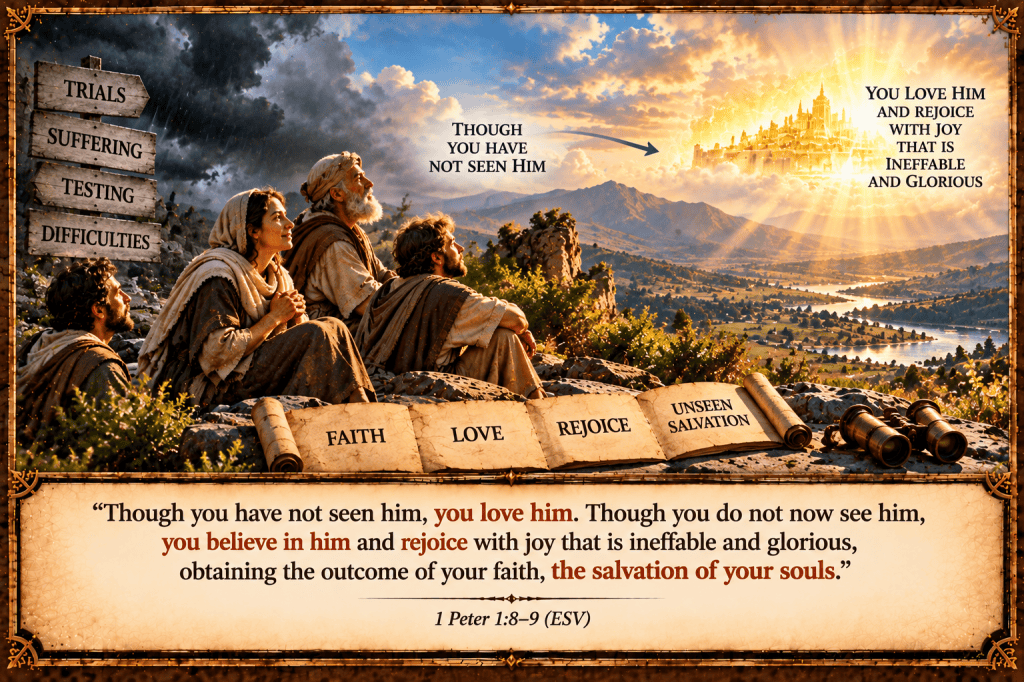
image 1 Peter 1:8-9
dv1015-Daily Verse
Author: Stephen Weller
Facilitator: Stephen Weller
2,080 words, 11 minutes read time
Believing In What We Can Not See
Encouragement
1 Peter 1:8-9 offers powerful encouragement to believers who have never seen Jesus physically yet still trust and love Him.
The passage teaches that:
- Faith does not require physical sight.
Peter reminds Christians that although they had not seen Christ, they loved Him and believed in Him. This encourages us that genuine faith is possible even when God is not visibly present. - Trust in Christ brings deep joy.
Believers can experience a joy that goes beyond circumstances because their confidence rests in a living Savior rather than temporary situations. - Salvation is secure.
Peter points to the ultimate outcome of faith: the salvation of our souls. This gives hope that our present struggles are not the end of the story. - God rewards persevering faith.
The passage assures us that continuing to trust Christ through trials has eternal significance. Faith is not wasted; it leads to God’s promised inheritance.
Practical encouragement
When life is difficult and God seems distant, these verses remind us that:
- We can love Christ even without seeing Him.
- We can trust His promises even when we do not understand our circumstances.
- We can experience joy that comes from knowing Him.
- We can look forward with confidence to the fulfillment of our salvation.
In essence, 1 Peter 1:8-9 encourages believers to keep trusting Jesus, rejoice in Him now, and remain hopeful because faith will ultimately be rewarded with the full realization of God’s salvation.
Bible Lesson
8 Though you have not seen him, you love him. Though you do not now see him, you believe in him and rejoice with joy that is inexpressible and filled with glory, 9 obtaining the outcome of your faith, the salvation of your souls. (1 Peter 1:8-9 ESV)
The section in which our verses are found opens with the statement that 3 “[God the Father] has caused us to be born again to a living hope through the resurrection of Jesus Christ from the dead, 4 to an inheritance that is imperishable, undefiled, and unfading, kept in heaven for you, 5 who by God’s power are being guarded through faith for a salvation ready to be revealed in the last time.” (1 Peter 1:3 – 5 ESV). Ephesians 2:1 – 3 describes us as “children of wrath” but then we learn how we come to “believe in him and rejoice with joy that is inexpressible and filled with glory.”
4 “But God, being rich in mercy, because of the great love with which he loved us, 5 even when we were dead in our trespasses, made us alive together with Christ—by grace you have been saved— 6 and raised us up with him and seated us with him in the heavenly places in Christ Jesus, 7 so that in the coming ages he might show the immeasurable riches of his grace in kindness toward us in Christ Jesus.” (Ephesians 2:4 – 7 ESV). We have not seen Jesus Christ but because of what God has done in our lives, we now love him and believe in him rejoice with joy that is inexpressible. When the Father causes us to be born again God the Holy Spirit comes to live within us. God is love and his fruit is love and one of its characteristics is joy; a joy based on his love and not on external circumstances.
We must be careful how we interpret the statement “obtaining the outcome of your faith, the salvation of your souls.” We must remember that we were once spiritually dead (Ephesians 2:1) and had no desire for God: 10 “None is righteous, no, not one; 11 no one understands; no one seeks for God. 12 All have turned aside; together they have become worthless; no one does good, not even one.” (Romans 3:10 – 12 ESV). Without God intervening, we would remain in our sin, but he provided even the faith we needed. Our salvation was purely a gift from God. There was nothing we did accept receive the gift: 8 “For by grace you have been saved through faith. And this is not your own doing; it is the gift of God, 9 not a result of works, so that no one may boast.” (Ephesians 2:8 – 9 ESV).
Like an orphan chosen by its future parents, God chose us from the domain of darkness and adopted us as his children. Only a few has he chosen but no one who desires salvation has been overlooked. How this fills my heart with love and joy. How about you?
Questions with Answers
1. What does Peter mean when he says believers love Jesus even though they have not seen Him?
Answer: Peter emphasizes the remarkable nature of Christian faith: believers can have a genuine and deeply personal love for Jesus Christ without having physically seen Him. Unlike Peter, who walked with Jesus during His earthly ministry, many of his readers had never encountered Jesus in person. Nevertheless, through the testimony of the apostles, the truth of Scripture, and the work of the Holy Spirit, they had come to know and love Him. This love is not based on physical sight but on spiritual understanding and faith in His character, sacrifice, and promises. Their love demonstrates that a relationship with Christ is founded on trust in who He is rather than on visible evidence of His presence. Jesus affirmed this truth in John 20:29 when He blessed those who believe without seeing. For Christians today, this provides encouragement that their relationship with Christ is no less real because they have not seen Him physically.
2. How can believers have faith in Jesus Christ when they cannot see Him?
Answer: Faith in Jesus Christ rests upon the trustworthy revelation of God rather than the necessity of physical sight. Believers come to know Christ through the Scriptures, which reveal His life, teachings, death, resurrection, and promises. The Holy Spirit works through God’s Word to strengthen their confidence in Him. Hebrews 11:1 describes faith as assurance concerning what is hoped for and conviction concerning what is not seen. Peter’s readers faced trials and persecution, yet they continued believing in Christ because they trusted His promises and understood that their salvation rested upon His completed work. Their faith was not blind optimism but confidence in the truth of the gospel. Similarly, believers today demonstrate faith by trusting God’s Word, obeying His commands, and remaining faithful even when circumstances make His presence difficult to recognize.
3. What is the meaning of the phrase “joy that is inexpressible and filled with glory” in verse 8?
Answer: Peter describes a spiritual joy that exceeds the ability of ordinary human language to express. This joy comes from knowing Jesus Christ, trusting His promises, and possessing the assurance of salvation through Him. Unlike temporary happiness, which often depends upon favorable circumstances, Christian joy is rooted in an enduring relationship with the Savior. Peter’s readers were experiencing various trials, as described in 1 Peter 1:6–7, yet their faith produced joy because they understood that their suffering was temporary and their eternal inheritance was secure. The expression “filled with glory” points to the heavenly character of this joy and anticipates the glory believers will experience when Christ is revealed. This teaches that genuine Christian joy can coexist with hardship, sorrow, and uncertainty because its foundation is God’s faithfulness rather than earthly comfort.
4. What does Peter mean when he describes salvation as the outcome of faith in verse 9?
Answer: Peter identifies salvation as the ultimate goal and promised outcome of genuine faith in Jesus Christ. Salvation includes forgiveness of sins, reconciliation with God, deliverance from condemnation, and the promise of eternal life. Although believers experience salvation’s blessings in the present, its complete fulfillment awaits the return of Christ, when they will enter fully into the inheritance God has prepared for them. The surrounding passage emphasizes this future dimension of salvation, particularly in 1 Peter 1:5, where Peter speaks of salvation ready to be revealed in the last time. Faith is not the achievement that earns salvation; rather, it is the means by which believers receive God’s gracious gift through Jesus Christ. This understanding encourages Christians to persevere, knowing that their present trust in Christ leads toward the complete realization of God’s saving promises.
5. How are love, faith, and joy connected in these verses?
Answer: Peter presents love, faith, and joy as interconnected expressions of a living relationship with Jesus Christ. Love arises from recognizing who Christ is and appreciating what He has accomplished through His sacrificial death and resurrection. Faith expresses confidence in His character, promises, and saving work, even though He remains physically unseen. Joy flows from this loving and trusting relationship because believers possess the assurance that their salvation is secure in Him. These qualities strengthen one another: growing faith deepens love, increasing love encourages trust, and continued confidence in Christ produces spiritual joy. Peter’s description demonstrates that Christianity is more than intellectual agreement with religious truths; it involves a transformed heart that loves Christ, depends upon Him, and rejoices in His salvation. Together, these qualities sustain believers through life’s difficulties and direct their attention toward eternal hope.
6. How does this passage encourage believers who are experiencing trials or suffering?
Answer: Peter wrote to Christians who were facing difficulties because of their faith, and his words remind them that suffering does not diminish the reality of their relationship with Christ. Although they could not see Jesus physically and their circumstances were challenging, they could continue loving Him, trusting Him, and rejoicing in His promises. Their trials did not mean that God had abandoned them. Instead, as Peter explains in the preceding verses, tested faith can demonstrate its genuineness and bring praise, glory, and honor when Jesus Christ is revealed. The assurance of salvation gives believers a perspective that extends beyond present suffering. They can endure difficulties with hope because their eternal future rests in God’s faithfulness. For Christians today, this passage provides reassurance that joy and confidence in Christ remain possible even during seasons of grief, uncertainty, physical weakness, or hardship.
7. What is the difference between believing in Christ and merely knowing facts about Him?
Answer: Knowing facts about Jesus involves understanding historical and biblical information concerning His identity, teachings, miracles, death, and resurrection. While such knowledge is important, genuine saving faith goes further by personally trusting Jesus Christ as Savior and Lord. Peter’s description of believers who love Christ, believe in Him, and rejoice in His salvation demonstrates that authentic faith involves the heart as well as the mind. A person may possess extensive knowledge of Scripture without personally depending upon Christ for forgiveness and eternal life. Genuine faith receives the truth of the gospel and responds with trust, love, and a growing desire to obey God. This distinction challenges believers to examine whether their relationship with Christ is merely intellectual or whether their knowledge of Him has produced personal devotion, spiritual transformation, and confidence in His saving grace.
8. How can Christians strengthen their love, faith, and joy in Jesus Christ?
Answer: Christians strengthen their relationship with Christ by consistently engaging with God’s Word, seeking Him in prayer, obeying His commands, and remembering His faithfulness. Scripture reveals the character of Jesus, the depth of His love, and the certainty of His promises. Prayer provides an opportunity to express gratitude, confess sin, seek guidance, and deepen dependence upon God. Obedience demonstrates love for Christ and allows faith to become visible through daily conduct. Fellowship with other believers also provides encouragement, instruction, and mutual support. During difficult circumstances, remembering God’s past faithfulness and focusing on the promised completion of salvation can renew spiritual joy. Ultimately, growth in love, faith, and joy is not accomplished through human effort alone but through the gracious work of the Holy Spirit as believers continue to abide in Christ.
Concluding Truth
1 Peter 1:8–9 teaches that genuine faith does not require physical sight to produce a deep love for Jesus Christ, an enduring spiritual joy, and confidence in the promised completion of salvation. Believers can rejoice even in difficult circumstances because their hope rests not in what they can presently see but in the Savior they know and trust. The passage encourages Christians to remain faithful, deepen their love for Christ, and look forward with confidence to the fulfillment of God’s eternal promises.


Leave a Reply