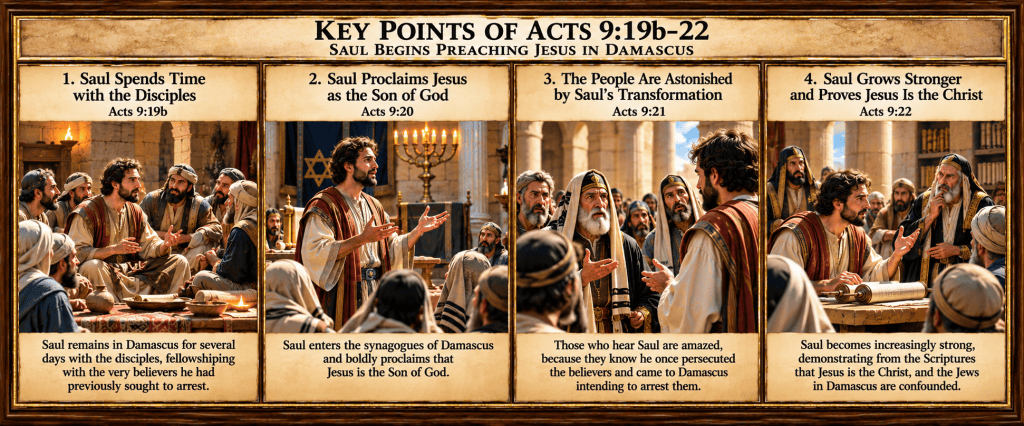
image Acts 9:19b–22
dv1016-Daily Verse
Author: Stephen Weller
Facilitator: Stephen Weller
2,372 words, 13 minutes read time
The Lord Is Exalted Above All
Encouragement
1 Chronicles 29:11 is a powerful declaration of praise and confidence in God’s absolute sovereignty:
“Yours, O LORD, is the greatness and the power and the glory and the victory and the majesty. Indeed everything that is in the heavens and on the earth belongs to You; Yours is the dominion, O LORD, and You exalt Yourself as head over all.” (NASB)
Encouragement from this verse
1. God is greater than every challenge. David begins by acknowledging God’s greatness, power, glory, victory, and majesty. Whatever difficulty we face, it is never larger than God’s power. This can bring peace when circumstances seem overwhelming.
2. God is already victorious. The verse attributes victory to God. Believers can find courage knowing that ultimate victory belongs to Him, even when present situations are uncertain or difficult.
3. Everything belongs to God. David reminds us that everything in heaven and earth is God’s. Our resources, opportunities, relationships, and future are under His authority. We do not carry life’s burdens alone.
4. God is in control. The statement, “Yours is the dominion,” emphasizes God’s rule over all things. When the world feels chaotic, this verse reassures us that God remains on the throne and nothing is outside His knowledge or authority.
5. Worship shifts our perspective. David spoke these words near the end of his life while preparing for the temple that Solomon would build. Instead of focusing on his own achievements, he focused on God’s greatness. The verse encourages us to lift our eyes from our limitations to God’s limitless character.
Devotional Thought
When you feel weak, uncertain, or discouraged, 1 Chronicles 29:11 invites you to remember who God is. His greatness is greater than your problem, His power is stronger than your weakness, His victory is greater than your setbacks, and His rule extends over every detail of your life. What seems impossible to you is never beyond the authority of the King who possesses “the greatness and the power and the glory and the victory and the majesty.”
Key encouragement: Because God reigns over everything, you can trust Him with anything.
Bible Lesson
Yours, O Lord, is the greatness and the power and the glory and the victory and the majesty, for all that is in the heavens and in the earth is yours. Yours is the kingdom, O Lord, and you are exalted as head above all. (1 Chronicles 29:11 ESV)
This verse is taken from a prayer David is praying in the presence of all the assembly. That prayer is: 10 “Blessed are you, O Lord, the God of Israel our father, forever and ever. 11 Yours, O Lord, is the greatness and the power and the glory and the victory and the majesty, for all that is in the heavens and in the earth is yours. Yours is the kingdom, O Lord, and you are exalted as head above all. 12 Both riches and honor come from you, and you rule over all. In your hand are power and might, and in your hand it is to make great and to give strength to all. 13 And now we thank you, our God, and praise your glorious name.” (1 Chronicles 29:10 – 13 ESV).
This prayer of David, covered by verses 10 through 19, is a prayer of praise and supplication that marks the climax of his reign. In verse 11, David is praising the Lord for his greatness, power, glory, victory, and majesty because everything that is in the heavens and in the earth is his as he created it all and said that it was good. Besides all of this he has a kingdom and has been exalted as head above all. He is “the King of the ages, immortal, invisible, the only God, be honor and glory forever and ever. Amen.” (1 Timothy 1:17 ESV). In Revelation 5:13 (ESV), John writes, “And I heard every creature in heaven and on earth and under the earth and in the sea, and all that is in them, saying, “To him who sits on the throne and to the Lamb be blessing and honor and glory and might forever and ever!”’
The Lord is Jesus Christ and 15” He is the image of the invisible God, the firstborn of all creation. 16 For by him all things were created, in heaven and on earth, visible and invisible, whether thrones or dominions or rulers or authorities—all things were created through him and for him. 17 And he is before all things, and in him all things hold together. 18 And he is the head of the body, the church. He is the beginning, the firstborn from the dead, that in everything he might be preeminent. 19 For in him all the fullness of God was pleased to dwell, 20 and through him to reconcile to himself all things, whether on earth or in heaven, making peace by the blood of his cross.” (Colossians 1:15 – 20 ESV).
To think that the Lord who created all and is over all was willing to enter into his creation as the man we know as Jesus, and suffer and die on a cross, taking our sin and in exchange clothing us with his righteousness. How can we so easily live for ourselves and not serve him out of love doing the works assign to us to do (Ephesians 2:10)? “Jesus gave his life, what more could he give? Oh, how he loves you and me.” (From CCLI Song Number 15850)
Questions with Answers
Key Verse — 1 Chronicles 29:11 (ESV)
“Yours, O LORD, is the greatness and the power and the glory and the victory and the majesty, for all that is in the heavens and in the earth is yours. Yours is the kingdom, O LORD, and you are exalted as head above all.”
Discussion Questions with Extended Answers
1. What does David acknowledge about God’s character in 1 Chronicles 29:11?
Answer: David acknowledges that all greatness, power, glory, victory, and majesty belong to God. These qualities are not merely attributes God possesses in limited measure; they are expressions of His perfect and eternal nature. God is the ultimate source of everything worthy of honor and praise. Unlike human rulers, whose authority and accomplishments are temporary, God’s greatness is unlimited and everlasting.
David’s declaration reminds believers that no human achievement, position, or possession can compare with God’s glory. Recognizing His greatness produces humility, worship, and dependence upon Him. When believers understand that all power and majesty belong to God, they are encouraged to trust His wisdom and authority rather than relying solely on their own abilities.
2. Why does David declare that everything in heaven and earth belongs to God?
Answer: David recognizes God’s absolute ownership of creation. Everything that exists, whether visible or invisible, belongs to Him because He is the Creator and Sustainer of all things. Nothing exists independently of His power, and nothing lies beyond His sovereign authority. This includes the natural world, earthly kingdoms, human possessions, and every resource entrusted to mankind.
The surrounding passage provides important context. David and the people of Israel had generously contributed materials for the construction of the temple. Yet David understood that even these offerings came from resources God had already provided. In 1 Chronicles 29:14, he acknowledges that everything they had given came from God’s hand.
This truth changes the believer’s understanding of stewardship. Possessions, abilities, opportunities, and blessings are not ultimately our own. They are gifts entrusted to us for responsible use and God’s glory. Recognizing His ownership encourages gratitude, generosity, and faithful stewardship.
3. What does the phrase “Yours is the kingdom, O LORD” reveal about God’s sovereignty?
Answer: This declaration affirms that God possesses supreme authority over all creation. Although earthly kings and governments exercise temporary authority, God’s kingdom transcends every human institution. His rule is eternal, His purposes cannot ultimately be defeated, and His authority is not dependent upon human approval.
David was himself a powerful king, yet he willingly acknowledged that his authority was subordinate to God’s. This demonstrates remarkable humility. Rather than claiming ultimate credit for Israel’s prosperity or his accomplishments, David recognized that his kingship existed under God’s sovereign direction.
For believers, this truth provides assurance that history is not governed merely by human ambition or unpredictable circumstances. God remains sovereign even when earthly events appear uncertain. His purposes are trustworthy, and His authority provides a foundation for confidence, obedience, and hope.
4. How does David’s prayer demonstrate humility despite his position as king?
Answer: David’s prayer demonstrates humility because he directs all honor toward God rather than himself. As king of Israel, David possessed considerable wealth, military power, and national influence. He had experienced victories, established Jerusalem as the nation’s capital, and prepared extensively for the construction of the temple. Nevertheless, he refused to regard these accomplishments as evidence of his own independent greatness.
Instead, David acknowledged that every blessing and achievement originated with God. His attitude reveals that genuine humility does not require denying one’s responsibilities or accomplishments. Rather, humility recognizes the true source of the strength, wisdom, and opportunities that make those accomplishments possible.
David’s example challenges believers to examine their own attitudes toward success. Whether experiencing professional achievements, financial blessings, spiritual growth, or personal accomplishments, Christians should respond with gratitude rather than pride. Giving glory to God protects the heart from self-exaltation and encourages faithful service.
5. What is the significance of David describing God as exalted above all?
Answer: David’s declaration that God is exalted as head above all emphasizes His supreme position over every created thing. No earthly authority, spiritual power, or human institution can rival His greatness. God’s authority is not limited by geography, history, or circumstance. He reigns over all creation with perfect wisdom, righteousness, and power.
This truth also establishes the proper relationship between God and humanity. People are called to worship, honor, and obey Him because He alone possesses ultimate authority. His exalted position means that human wisdom must remain subordinate to divine truth.
For Christians, this understanding finds further expression in the lordship of Jesus Christ. Philippians 2:9–11 describes Christ’s exaltation and the universal acknowledgment of His lordship. David’s declaration of God’s supremacy therefore harmonizes with the New Testament revelation of Christ’s divine authority.
Recognizing God’s exalted position encourages reverence in worship, submission to His Word, and confidence in His eternal purposes.
6. How should the recognition of God’s greatness influence our prayers and worship?
Answer: Recognizing God’s greatness should lead believers to approach Him with reverence, gratitude, humility, and confidence. David’s prayer begins by praising God’s character rather than immediately presenting personal requests. His example demonstrates that worship should focus first upon who God is, not merely upon what we desire Him to provide.
When believers acknowledge God’s power, glory, and sovereignty, their prayers become expressions of trust rather than attempts to control circumstances. They recognize that God possesses both the authority and wisdom to accomplish His purposes.
This does not mean that personal needs and concerns are unimportant. Scripture encourages believers to bring their requests before God. However, acknowledging His greatness helps place those requests within the larger understanding of His perfect will.
Worship also extends beyond spoken prayers and songs. A life characterized by obedience, generosity, gratitude, and faithful service reflects the conviction that God deserves honor in every area of life.
7. How does 1 Chronicles 29:11 encourage believers during times of uncertainty or difficulty?
Answer: This verse provides encouragement by reminding believers that God’s power and authority remain unchanged regardless of earthly circumstances. Human strength is limited, resources can disappear, and situations may develop beyond our control. Yet God’s greatness, sovereignty, and faithfulness are never diminished.
David’s declaration that all victory and power belong to God reminds believers that their ultimate security rests in Him rather than in favorable circumstances. Even when difficulties persist, God remains worthy of trust because His character is perfect and His purposes are eternal.
This assurance does not promise that believers will avoid suffering or experience immediate deliverance from every hardship. Instead, it establishes a firm foundation for enduring difficulties with faith. God’s sovereignty assures believers that suffering does not place them beyond His knowledge, presence, or authority.
Romans 8:28 reinforces this confidence by teaching that God works for the good of those who love Him and are called according to His purpose. Believers can therefore face uncertainty with prayerful dependence, knowing that the God who reigns over all creation remains faithful.
8. What practical lessons can believers apply from David’s declaration in their daily lives?
Answer: David’s declaration provides several practical lessons concerning the believer’s relationship with God.
First, believers should cultivate humility by recognizing that their abilities, resources, and opportunities ultimately come from God. This understanding discourages pride and encourages gratitude.
Second, believers should practice faithful stewardship. Since everything belongs to God, possessions and responsibilities should be managed according to His principles rather than selfish desires.
Third, believers should maintain confidence in God’s sovereignty. Recognizing His authority helps prevent fear and discouragement from dominating their responses to difficult circumstances.
Fourth, believers should make worship a consistent priority. David’s prayer demonstrates that honoring God should not be reserved for special occasions but should become a regular expression of faith.
Finally, believers should seek to glorify God through their conduct. First Corinthians 10:31 teaches that even ordinary activities should be performed for God’s glory. This transforms everyday decisions, relationships, work, and service into opportunities to honor Him.
The central lesson is that God deserves the highest place in every area of life because all greatness, power, glory, and authority belong to Him alone.
Concluding Spiritual Truth
1 Chronicles 29:11 teaches that everything belongs to God, all authority rests in His hands, and all glory is rightfully His. David’s prayer invites believers to exchange pride for humility, anxiety for trust, and self-centered ambition for worship. When God is recognized as supreme over all creation, every blessing becomes an occasion for thanksgiving, every responsibility becomes an opportunity for stewardship, and every circumstance becomes an invitation to trust His sovereign care.


Leave a Reply