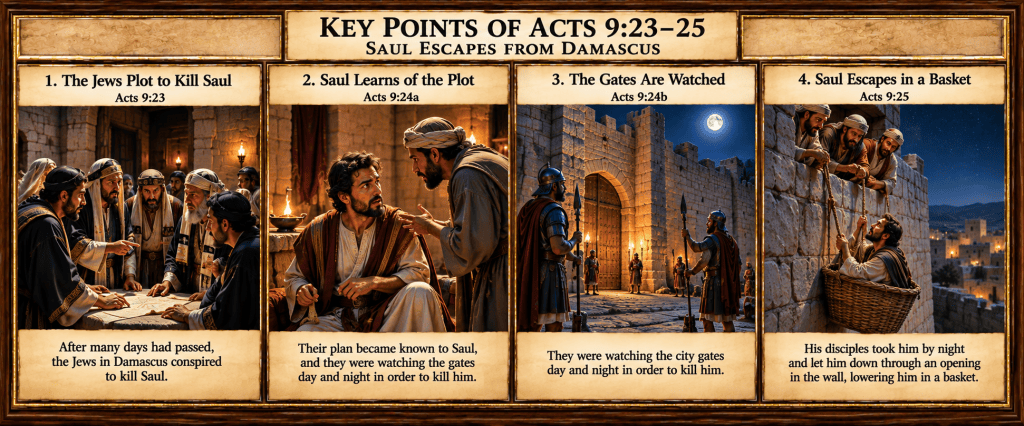
image Acts 9:23–25
New Testament Events Series
Event: nte025 Saul Escapes from Damascus (Acts 9:23–25)
Facilitator/Editor: Stephen Weller
Information Collection: ChatGPT
Bible Text: BibleGateway
1,735 words, 9 minutes read time
NT Event Index
Event Context
Context for Acts 9:23–25
Acts 9:23–25 – Saul Escapes from Damascus
Following his dramatic conversion on the road to Damascus, Saul began boldly proclaiming in the synagogues that Jesus is the Son of God and the promised Messiah (Acts 9:19–22). His transformation from a fierce persecutor of Christians into a passionate defender of the faith astonished those who knew his former reputation. As Saul grew stronger in his understanding and proclamation of the gospel, opposition against him intensified. After many days, the Jews in Damascus plotted to kill him, watching the city gates day and night to prevent his escape. However, Saul learned of their conspiracy, and his disciples helped him escape by lowering him in a basket through an opening in the city wall under cover of darkness. This event marked an important turning point in Saul’s ministry, as the man who once pursued believers to imprison and persecute them now became the target of persecution himself. In 2 Corinthians 11:32–33, Paul later recalled this escape, identifying the involvement of a governor under King Aretas. Acts 9:23–25 illustrates God’s providential protection, the courage and faithfulness of fellow believers, and the personal cost of following Christ. Saul’s escape was not an act of cowardice but a practical means of preserving his life so that he could continue fulfilling God’s calling to proclaim the gospel.
Understanding the Event
Event Text
Saul Escapes from Damascus
23 When many days had passed, the Jews[a] plotted to kill him, 24 but their plot became known to Saul. They were watching the gates day and night in order to kill him, 25 but his disciples took him by night and let him down through an opening in the wall,[b] lowering him in a basket. (Acts 9:23-25 ESV)
Questions with answers
1. Why did the Jews in Damascus plot to kill Saul?
Answer: The Jews in Damascus plotted to kill Saul because his dramatic conversion and powerful preaching threatened their opposition to Jesus Christ. Saul had originally traveled to Damascus to arrest followers of Jesus, but after encountering the risen Lord, he became a bold witness for the very faith he had intended to destroy. Acts 9:22 explains that Saul was increasing in strength and confounding the Jews by proving that Jesus was the Christ. His knowledge of the Scriptures and his ability to explain how Jesus fulfilled Old Testament prophecy made his testimony particularly difficult to challenge. Rather than accepting his message, some of his opponents responded with hostility and planned his death. Their reaction illustrates how resistance to God’s truth can develop into persecution when individuals refuse to reconsider deeply held beliefs. Saul’s experience also demonstrates that faithfully proclaiming the gospel does not guarantee acceptance, even when the message is supported by convincing evidence.
2. What is the significance of the phrase “When many days had passed” in Acts 9:23?
Answer: The phrase “When many days had passed” indicates that Saul’s ministry in Damascus developed over a period of time rather than immediately resulting in an attempt on his life. Galatians 1:17–18 provides additional information about this period, explaining that Saul traveled into Arabia, returned to Damascus, and eventually went to Jerusalem after three years. Although Acts does not specify exactly when these events occurred within that period, the two accounts help establish that Saul’s early Christian life included spiritual growth, preparation, and public ministry. During this time, his understanding of Jesus as the promised Messiah became increasingly evident through his preaching. The passage reminds believers that spiritual maturity develops through time, study, experience, and dependence upon God. Saul’s transformation was immediate in its direction, but his preparation for the extensive ministry that followed unfolded over time.
3. How did Saul learn about the plot against his life, and what does this reveal about God’s protection?
Answer: Acts 9:24 states that the plot against Saul became known to him, although the passage does not identify who informed him or how the information reached him. His enemies were watching the city gates day and night, intending to kill him when an opportunity arose. Their determination reveals the seriousness of the danger Saul faced. Yet the discovery of their plans provided an opportunity for him to escape. This event illustrates how God’s providential care can operate through ordinary circumstances, including information, human relationships, and practical decisions. God did not visibly intervene through a miraculous display, but Saul’s life was preserved through circumstances that allowed him to avoid his enemies. Believers can learn that trusting God’s protection does not mean ignoring danger. Faith and wise action often work together as Christians seek to fulfill God’s purposes.
4. Why were the city gates being watched day and night?
Answer: The city gates were the primary controlled entrances and exits of ancient Damascus. By watching these locations continuously, Saul’s enemies hoped to prevent him from escaping and create an opportunity to kill him. Their surveillance demonstrates that the opposition was organized, deliberate, and persistent rather than merely an emotional reaction to his preaching. Second Corinthians 11:32–33 provides additional historical information, explaining that an official under King Aretas was guarding Damascus to seize Paul. Together, these passages reveal the seriousness of the threat and the difficulties Saul encountered early in his ministry. The experience also foreshadows the repeated persecution he would face throughout his missionary journeys. Saul had once possessed authority to pursue Christians, but now he experienced the danger of being pursued because of his own faith in Christ.
5. How did Saul’s disciples help him escape from Damascus?
Answer: Acts 9:25 explains that Saul’s disciples took him during the night and lowered him through an opening in the city wall in a basket. This unusual escape allowed him to avoid the guarded gates where his enemies were waiting. The expression “his disciples” refers to followers or associates connected with Saul’s ministry, demonstrating that he was no longer isolated but had developed relationships with believers who were willing to protect him. Their actions required cooperation, courage, and careful planning. By helping Saul escape, they participated in preserving the life of a man whom God would use extensively to spread the gospel. Their example demonstrates the importance of Christian fellowship and mutual responsibility. Ministry is not accomplished through prominent leaders alone; faithful individuals working quietly behind the scenes often make significant contributions to God’s work.
6. Why did Saul choose to escape rather than remain in Damascus and confront his enemies?
Answer: Saul’s decision to escape demonstrates that Christian courage does not require unnecessarily exposing oneself to danger. Although he had boldly proclaimed Jesus as the Messiah, remaining in Damascus under these circumstances would likely have resulted in his death. Escaping did not mean that Saul had abandoned his faith or become unwilling to suffer for Christ. Instead, he recognized the need to preserve his life so that he could continue the ministry to which Jesus had called him. Jesus had previously instructed His disciples to flee to another town when persecuted (Matthew 10:23), establishing a principle of wise action in the face of hostility. Saul would later endure imprisonment, beatings, and other severe hardships for the gospel, demonstrating that his escape was not motivated by a permanent avoidance of suffering. His example teaches believers to distinguish between courageous faithfulness and unnecessary risk.
7. How does Saul’s escape demonstrate the importance of Christian community?
Answer: Saul’s escape illustrates that believers need the encouragement, protection, and practical assistance of other Christians. Although Saul had received a personal calling from Jesus Christ, he was not expected to accomplish his ministry independently. The disciples who helped him escape recognized the danger and took action to preserve his life. Their willingness to assist Saul was particularly significant because he had previously persecuted followers of Jesus. The Christian community that he once threatened had now become a source of support and protection. This transformation demonstrates the reconciling power of the gospel, which brings former enemies together through their shared faith in Christ. It also reminds believers that acts of service, even those performed without public recognition, can have lasting spiritual consequences. By helping Saul escape, these disciples contributed to the continuation of a ministry that would eventually influence countless people throughout the world.
8. What does Saul’s experience reveal about the cost of following Jesus Christ?
Answer: Saul’s experience reveals that following Jesus can involve rejection, hostility, personal danger, and the loss of former relationships. Before his conversion, Saul had been respected among those who opposed the Christian movement and had received authority to arrest believers. After his conversion, his circumstances changed dramatically. He became the target of the same kind of hostility he had previously directed toward others. His escape from Damascus marked an early example of the suffering that would characterize much of his ministry. In Acts 9:16, Jesus had already declared that Saul would be shown how much he must suffer for His name. This passage demonstrates that genuine discipleship involves loyalty to Christ even when obedience brings hardship. At the same time, Saul’s preservation shows that opposition cannot ultimately defeat the purposes of God. Believers are encouraged to remain faithful, trusting that their circumstances do not place them beyond God’s care.
9. What spiritual lessons can believers learn from the unusual method of Saul’s escape?
Answer: The method of Saul’s escape demonstrates that God can accomplish His purposes through simple and unexpected means. Rather than delivering Saul through a spectacular miracle or a confrontation with his enemies, his life was preserved through the practical actions of fellow believers using a basket and an opening in the city wall. The contrast between Saul’s extraordinary calling and his humble escape is especially meaningful. The man who would become a major missionary and writer of New Testament letters began his ministry by being lowered secretly from a city wall. This experience illustrates that God’s servants must be willing to accept humble circumstances and depend upon the assistance of others. It also reminds Christians that divine providence frequently operates through ordinary resources and faithful people. What may appear insignificant at the moment can become an important part of God’s larger plan.
10. How does Acts 9:23–25 prepare readers for Saul’s future ministry?
Answer: Acts 9:23–25 introduces several patterns that would continue throughout Saul’s ministry: bold proclamation of Jesus Christ, strong opposition from unbelievers, dependence upon fellow Christians, personal suffering, and God’s providential preservation. Saul’s escape from Damascus was not the conclusion of his ministry but an early step in a much greater calling. Acts 9:15 identifies him as God’s chosen instrument to carry the name of Jesus before Gentiles, kings, and the children of Israel. His experiences in Damascus helped prepare him for the challenges he would encounter during his missionary journeys. The passage also demonstrates that setbacks and apparent defeats do not necessarily indicate that God’s work has failed. Saul was forced to leave Damascus, but his departure allowed him to continue serving Christ elsewhere. His life illustrates that God’s purposes often advance through circumstances that initially appear to be obstacles.
Summary of Understanding
Acts 9:23–25 demonstrates the dramatic transformation of Saul from a persecutor of Christians into a persecuted follower of Jesus Christ. His enemies sought to kill him because of his bold proclamation that Jesus was the Messiah, but fellow believers helped him escape through an opening in the city wall. This event emphasizes God’s providential protection, the importance of Christian fellowship, the wisdom of avoiding unnecessary danger, and the cost of faithful discipleship. Saul’s escape was not a retreat from his calling but a means of preserving his life for the ministry that lay ahead.
Central Truth: Faithfulness to Christ does not guarantee freedom from opposition, but God can use the courage, wisdom, and practical assistance of His people to preserve and advance His purposes.


Leave a Reply