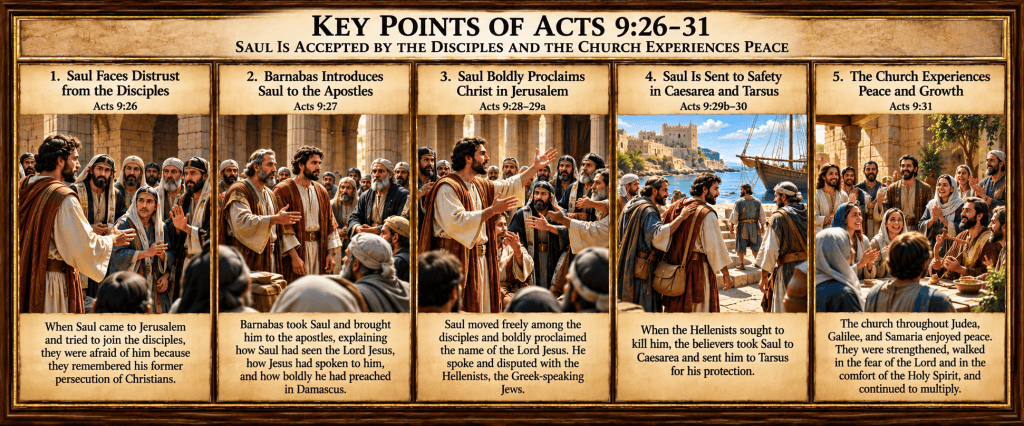
image Acts 9:26–31
New Testament Events Series
Event: nte026 Saul in Jerusalem (Acts 9:26–31)
Facilitator/Editor: Stephen Weller
Information Collection: ChatGPT
Bible Text: BibleGateway
2,672 words, 14 minutes read time
NT Event Index
Event Context
Context for Acts 9:26–31
Acts 9:26–31 — Saul Accepted by the Disciples and the Church Strengthened
Following his dramatic conversion on the road to Damascus and his escape from those seeking to kill him, Saul traveled to Jerusalem, where he attempted to join the disciples. However, the believers were afraid of him, remembering his fierce persecution of the church and doubting the sincerity of his conversion. Barnabas, whose name means “son of encouragement,” intervened by bringing Saul to the apostles and explaining how he had encountered the risen Lord and boldly preached in Jesus’ name in Damascus. Through Barnabas’s testimony, Saul gained acceptance among the believers and began speaking boldly in Jerusalem, particularly disputing with the Hellenists, Greek-speaking Jews who opposed his message. When they plotted to kill him, the brothers protected Saul by taking him to Caesarea and sending him to Tarsus, his hometown. The passage concludes with a description of the church throughout Judea, Galilee, and Samaria experiencing peace, spiritual growth, and multiplication. Walking in the fear of the Lord and in the comfort of the Holy Spirit, the believers were strengthened in their faith. This passage emphasizes the transforming power of God’s grace, the importance of encouragement and acceptance within the Christian community, the courage required to proclaim the gospel despite opposition, and the Holy Spirit’s continuing work in strengthening and expanding the church.
Understanding the Event
Event Text
Saul in Jerusalem
26 And when he had come to Jerusalem, he attempted to join the disciples. And they were all afraid of him, for they did not believe that he was a disciple. 27 But Barnabas took him and brought him to the apostles and declared to them how on the road he had seen the Lord, who spoke to him, and how at Damascus he had preached boldly in the name of Jesus. 28 So he went in and out among them at Jerusalem, preaching boldly in the name of the Lord. 29 And he spoke and disputed against the Hellenists.[a] But they were seeking to kill him. 30 And when the brothers learned this, they brought him down to Caesarea and sent him off to Tarsus.
31 So the church throughout all Judea and Galilee and Samaria had peace and was being built up. And walking in the fear of the Lord and in the comfort of the Holy Spirit, it multiplied. (Acts 9:26-31 ESV)
Questions with answers
Acts 9:26–31 — Saul Accepted by the Disciples and the Church Strengthened
1. Why were the disciples in Jerusalem afraid of Saul when he attempted to join them? (Acts 9:26)
Answer: When Saul arrived in Jerusalem and attempted to join the disciples, they were afraid of him because of his reputation as a fierce persecutor of Christians. Before his conversion, Saul had actively sought to arrest believers and had approved of Stephen’s execution (Acts 7:58–8:3). His sudden claim to be a follower of Jesus seemed difficult to believe, especially to those who had experienced or witnessed his persecution.
Their fear reveals the lasting consequences of Saul’s former actions. Although God had genuinely transformed Saul’s heart, the disciples had not yet seen sufficient evidence of that transformation. Their hesitation illustrates the difficulty of rebuilding trust after serious wrongdoing. It also demonstrates that spiritual transformation can occur immediately through God’s grace, while human relationships may require time, testimony, and observable evidence of changed behavior.
2. What role did Barnabas play in helping Saul become accepted by the apostles? (Acts 9:27)
Answer: Barnabas played a crucial role by taking Saul to the apostles and explaining what had happened to him. He testified that Saul had seen the Lord on the road to Damascus, that Jesus had spoken to him, and that Saul had boldly preached in the name of Jesus in Damascus. Barnabas provided the credibility and personal support Saul needed to overcome the disciples’ fear and suspicion.
Barnabas, whose name is associated with encouragement (Acts 4:36), demonstrated the importance of recognizing God’s work in another person’s life. Rather than allowing Saul’s past to determine his future, Barnabas acknowledged the evidence of genuine conversion. His willingness to stand beside Saul helped open the door for Saul’s acceptance into the Christian community.
This passage teaches that mature believers can serve as bridges between those seeking fellowship and those who remain uncertain. Encouragement involves more than offering kind words; it sometimes requires personal involvement, discernment, and the courage to support someone whom others distrust.
3. What evidence did Barnabas present to demonstrate that Saul’s conversion was genuine? (Acts 9:27)
Answer: Barnabas presented three significant pieces of evidence. First, Saul had encountered the risen Lord on the road to Damascus. Second, Jesus had spoken directly to him, establishing that Saul’s transformation began through divine intervention. Third, Saul had boldly preached in Damascus in the name of Jesus, publicly proclaiming the very Savior whose followers he had previously persecuted.
These details demonstrated that Saul’s conversion was not merely an emotional experience or an unverified claim. His behavior had changed dramatically. The man who had once sought to silence Christians was now risking his own safety to proclaim Jesus Christ.
The account emphasizes that genuine faith produces visible evidence in a person’s life. Saul’s actions supported his testimony. His willingness to endure opposition for Christ provided compelling evidence that his allegiance had changed. Barnabas recognized this transformation and helped others understand that God’s grace could reach even someone with Saul’s violent history.
4. What does Saul’s acceptance among the disciples reveal about Christian fellowship and forgiveness? (Acts 9:27–28)
Answer: After Barnabas introduced Saul and explained his conversion, Saul was able to associate freely with the believers in Jerusalem. Acts 9:28 describes him going in and out among them, indicating that he had been welcomed into their fellowship and was participating openly in the life of the Christian community.
This acceptance illustrates the reconciling power of the gospel. Saul’s former identity as a persecutor did not permanently exclude him from fellowship with those he had once threatened. Through faith in Jesus Christ, he had become their brother in the Lord.
The passage also demonstrates that Christian forgiveness and restored trust are related but distinct. The disciples’ initial caution was understandable, yet Barnabas helped them recognize the evidence of God’s transforming grace. Their eventual acceptance of Saul shows that believers should not permanently define repentant people by their past sins.
Christian fellowship is founded upon a shared relationship with Jesus Christ. When God transforms a life, the church should be prepared to recognize that transformation and welcome the believer into the family of faith.
5. How did Saul demonstrate courage and commitment to Christ while in Jerusalem? (Acts 9:28–29)
Answer: Saul demonstrated courage by preaching boldly in the name of the Lord Jesus while moving freely among the believers in Jerusalem. He also spoke and disputed with the Hellenists, Greek-speaking Jews, who strongly opposed his message. His willingness to engage them showed that he was not intimidated by controversy or the possibility of persecution.
This was a remarkable reversal of Saul’s former position. Previously, he had been the persecutor of those who proclaimed Jesus. Now he was proclaiming Jesus himself and facing the hostility that he had once directed toward others.
Saul’s boldness was rooted in his conviction that Jesus was the risen Messiah. His encounter with Christ had transformed both his beliefs and his purpose. He no longer sought the approval of those who opposed Christianity but was committed to making the truth of the gospel known.
His example teaches that genuine commitment to Christ may require courage in the face of rejection, criticism, and danger. Faithful witness does not guarantee acceptance, but it calls believers to remain steadfast in proclaiming the truth.
6. Why did the Hellenists seek to kill Saul, and what does their opposition reveal? (Acts 9:29)
Answer: The Hellenists were Greek-speaking Jews with whom Saul spoke and disputed concerning Jesus Christ. As Saul proclaimed Jesus as the Messiah, his message challenged their understanding of the Scriptures and their rejection of Jesus. Their opposition became so intense that they sought to kill him.
The passage does not specify every reason for their hostility, but Saul’s transformation would have been especially striking. A man who had once defended the persecution of Christians was now publicly defending the Christian faith. His knowledge of Jewish teaching and his conviction concerning Jesus made him a formidable witness.
Their attempt to kill Saul reveals the seriousness of the opposition faced by the early church. The gospel challenged deeply held religious convictions, and some opponents responded with violence rather than accepting its message.
This incident also illustrates a recurring theme in Acts: opposition cannot ultimately prevent the advancement of God’s purposes. Although Saul faced deadly threats, God continued to preserve his life and prepare him for further ministry.
7. How did the believers respond when they learned that Saul’s life was in danger? (Acts 9:30)
Answer: When the believers learned of the plot against Saul, they took action to protect him. They brought him down to Caesarea and sent him away to Tarsus, his hometown. Their response demonstrated practical concern for Saul’s safety and a recognition that his ministry could continue elsewhere.
This action also shows how significantly Saul’s relationship with the church had changed. The believers who initially feared him were now actively protecting him from those who wanted to kill him. Their willingness to assist Saul provides evidence that he had been accepted as a brother in Christ.
The decision to send Saul away was not an abandonment of his calling or a surrender to opposition. Rather, it was a wise response to immediate danger. God had important work for Saul to accomplish, and preserving his life allowed him to continue preparing for that calling.
This passage teaches that Christian courage does not require unnecessary exposure to danger. Faithfulness and wisdom work together. There are times when remaining in a difficult situation is necessary, and other times when withdrawing allows God’s work to continue in another place.
8. What is the significance of Saul being sent to Tarsus? (Acts 9:30)
Answer: Tarsus was Saul’s hometown, located in the region of Cilicia. Sending him there removed him from the immediate threat in Jerusalem and returned him to a familiar environment. Although Acts does not describe all of Saul’s activities during this period, his departure marked an important transition in his developing ministry.
Saul had already experienced conversion, proclaimed Christ in Damascus, faced persecution, and established fellowship with believers in Jerusalem. These experiences were preparing him for the broader missionary work that would later characterize his life.
The significance of Tarsus becomes clearer in Acts 11:25–26, when Barnabas travels there to find Saul and brings him to Antioch. There, Saul participates in teaching the growing church, preparing for the missionary journeys that follow.
This sequence demonstrates that God’s calling often unfolds through stages of preparation, service, opposition, and new opportunities. A period away from prominent ministry does not necessarily mean that God’s purposes have been interrupted. God can use quieter seasons to prepare His servants for responsibilities that lie ahead.
9. What does Acts 9:31 reveal about the condition of the church after Saul’s departure? (Acts 9:31)
Answer: Acts 9:31 describes a period of peace, spiritual strengthening, and numerical growth among the churches throughout Judea, Galilee, and Samaria. Following the persecution and turmoil described earlier in Acts, the believers experienced a season in which the church was being built up and multiplying.
The verse identifies several important characteristics of the church. The believers walked in the fear of the Lord, lived in the comfort of the Holy Spirit, and experienced continued growth. These qualities demonstrate that the church’s strength was not measured solely by increasing numbers but also by spiritual maturity and reverence for God.
The phrase fear of the Lord describes an attitude of deep reverence, worship, and obedience toward God. The comfort of the Holy Spirit emphasizes the Spirit’s strengthening, encouragement, and sustaining presence among believers.
The passage presents a balanced picture of healthy church life. Spiritual growth and numerical growth were occurring together. The believers were being strengthened inwardly while the gospel continued to spread outwardly.
10. How are the fear of the Lord and the comfort of the Holy Spirit connected in the growth of the church? (Acts 9:31)
Answer: The fear of the Lord and the comfort of the Holy Spirit describe two complementary aspects of the Christian life. The fear of the Lord produces reverence, humility, and obedience, while the comfort of the Holy Spirit provides encouragement, strength, and assurance of God’s presence.
These qualities are not contradictory. Reverence for God does not eliminate joy or comfort, and the encouragement of the Holy Spirit does not diminish the seriousness of obedience. Instead, they work together to produce a spiritually healthy community.
A church that fears the Lord recognizes God’s holiness and authority. Its members seek to honor Him through faithful teaching, righteous living, and obedience to His Word. A church strengthened by the Holy Spirit experiences the encouragement and spiritual power necessary to persevere through difficulty and continue its mission.
Acts 9:31 connects these qualities with the church’s multiplication. The growth of the early church was more than the result of human organization or persuasive preaching. It reflected the work of God among people who reverenced Him and depended upon His Spirit.
11. What does this passage teach about God’s ability to transform relationships through His grace? (Acts 9:26–31)
Answer: Acts 9:26–31 provides a powerful example of how God’s grace can transform relationships that were once characterized by fear, hostility, and mistrust. Saul had previously persecuted Christians, causing suffering among those who followed Jesus. His conversion changed his relationship with Christ, but his relationships with other believers still needed to be restored.
Through Barnabas’s encouragement and testimony, Saul was gradually welcomed into the fellowship of the disciples. Those who had once feared him became his companions and eventually acted to protect his life.
This transformation demonstrates that the gospel changes more than individual beliefs. It creates a new community in which former enemies can become brothers and sisters in Christ.
God’s grace does not erase the reality of past wrongdoing, but it makes repentance, forgiveness, and reconciliation possible. The church is called to recognize genuine spiritual transformation and extend fellowship to those whom Christ has redeemed.
The passage encourages believers to avoid permanently defining others by their former sins while also exercising wisdom in rebuilding trust.
12. What central lessons can believers and churches today learn from Acts 9:26–31?
Answer: This passage provides several enduring lessons concerning spiritual transformation, encouragement, courage, fellowship, and church growth.
Saul’s experience teaches that no person’s past is beyond the transforming power of Jesus Christ. His conversion was genuine, and his new life demonstrated a radical change in allegiance and purpose.
Barnabas demonstrates the importance of encouragement and personal involvement in the lives of other believers. His willingness to support Saul helped overcome fear and opened the way for restored fellowship. Churches today need individuals who recognize God’s work in others and help them become established in the Christian community.
Saul’s bold preaching illustrates the courage required to remain faithful to Christ when facing opposition. His example reminds believers that proclaiming the gospel may involve rejection or suffering, yet the message of Christ remains worthy of faithful witness.
The believers’ decision to protect Saul shows that wisdom and courage are not opposites. Their actions preserved his life and allowed his ministry to continue.
Finally, Acts 9:31 reveals the characteristics of a spiritually healthy church: reverence for God, encouragement through the Holy Spirit, spiritual maturity, peace, and growth.
The central truth of Acts 9:26–31 is that God’s transforming grace changes individuals, restores fellowship, strengthens believers, and builds His church through the continuing work of the Holy Spirit.


Leave a Reply