jvs001 – Verse-by-Verse Study of Joshua
Study of Joshua
Facilitator/Editor: Stephen Weller
Information Collection: ChatGPT
Bible Text: BibleGateway
14,175 words, 75 minutes read time
Page Index
- Introduction and Overview of Joshua
- Overview of Joshua 1-5 Entering the Promise Land
- Chapter 1 – Be Strong and Courageous: God’s Commission to Joshua
- Chapter 2 – title
- Chapter 3 – title
- Chapter 4 – title
- Chapter 5 – title
- Overview of Joshua 6-12 Conquering the Land
- Chapter 6 – title
- Chapter 7 – title
- Chapter 8 – title
- Chapter 9 – title
- Chapter 10 – title
- Chapter 11 – title
- Chapter 12 – title
- Overview of Joshua 13-21 Diving the Land
- Chapter 13 – title
- Chapter 14 – title
- Chapter 15 – title
- Chapter 16 – title
- Chapter 17 – title
- Chapter 18 – title
- Chapter 19 – title
- Chapter 20 – title
- Chapter 21 – title
- Overview of Joshua 22-24 Covenant Renewal and Farewell
- Chapter 22 – title
- Chapter 23 – title
- Chapter 24 – title
Introduction and Overview of Joshua

Lance Raab (Fresh snowfall gave us beautiful winter scenery all over Cape Cod in Massachusetts.)
Joshua is the sixth book of the Bible and the first book in the section of Scripture often called the Historical Books. It records Israel’s transition from wandering in the wilderness to possessing the land God promised to Abraham, Isaac, and Jacob.
Key Theme:
God faithfully fulfills His promises, and His people are called to respond with faith, courage, obedience, and covenant loyalty.
Author and Setting
- Traditionally attributed to Joshua, the successor of Moses, with later additions possibly recorded by others.
- The events occur after Moses’ death, around the time Israel enters and settles in Canaan.
- Joshua serves as Israel’s leader, military commander, and spiritual guide.
Simple Outline of Joshua
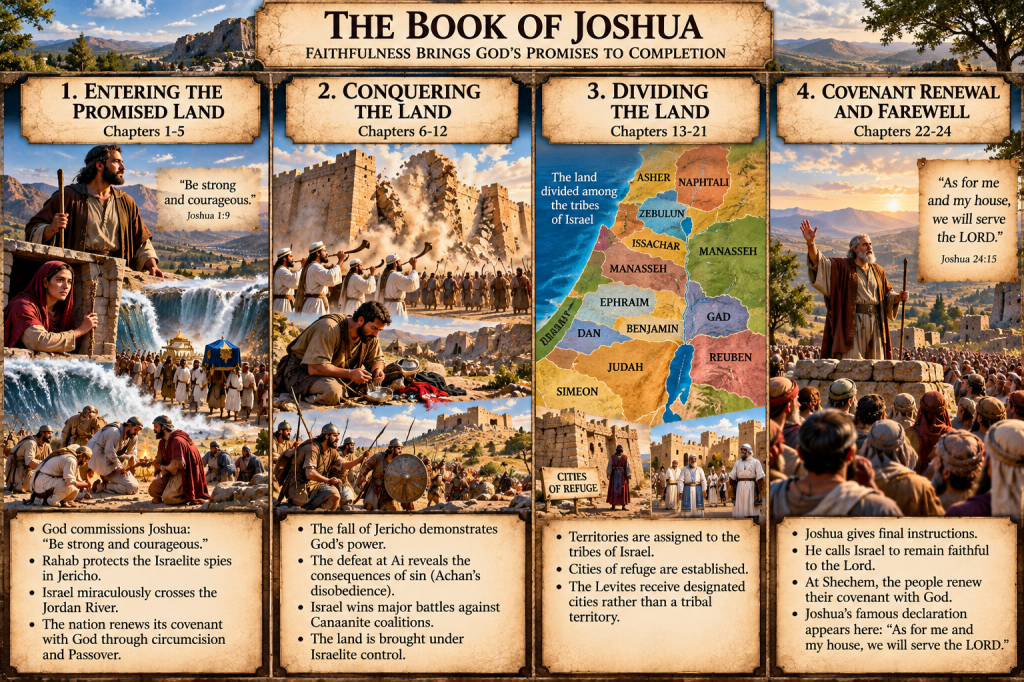
1. Entering the Promised Land (Chapters 1-5)
- God commissions Joshua: “Be strong and courageous.”
- Rahab protects the Israelite spies in Jericho.
- Israel miraculously crosses the Jordan River.
- The nation renews its covenant with God through circumcision and Passover.
2. Conquering the Land (Chapters 6-12)
- The fall of Jericho demonstrates God’s power.
- The defeat at Ai reveals the consequences of sin (Achan’s disobedience).
- Israel wins major battles against Canaanite coalitions.
- The land is brought under Israelite control.
3. Dividing the Land (Chapters 13-21)
- Territories are assigned to the tribes of Israel.
- Cities of refuge are established.
- The Levites receive designated cities rather than a tribal territory.
4. Covenant Renewal and Farewell (Chapters 22-24)
- Joshua gives final instructions.
- He calls Israel to remain faithful to the Lord.
- At Shechem, the people renew their covenant with God.
- Joshua’s famous declaration appears here:
“But as for me and my house, we will serve the LORD.” (Joshua 24:15)
Major Themes
God’s Faithfulness
The book repeatedly shows that God keeps every promise He makes.
“Not one of all the LORD’s good promises to Israel failed; every one was fulfilled.” (Joshua 21:45)
Courage and Obedience
Joshua’s success is connected to trusting God’s Word and obeying His commands.
Holy Living
The account of Achan teaches that hidden sin affects the whole community.
Inheritance
The land symbolizes God’s gift and provision. Israel receives an inheritance, but they must walk faithfully to enjoy its blessings.
Covenant Commitment
The book ends by challenging every generation to decide whom they will serve.
Key People
- Joshua – Moses’ successor and Israel’s leader.
- Rahab – A Gentile woman whose faith leads to her rescue and inclusion in Israel.
- Caleb – A faithful spy who receives his inheritance in Hebron.
- Achan – His disobedience brings judgment on Israel.
Key Verse
Many consider Joshua 1:9 to summarize the book:
“Have I not commanded you? Be strong and courageous. Do not be frightened, and do not be dismayed, for the Lord your God is with you wherever you go.” (Joshua 1:9 ESV)
Having completed the introduction and overview of Joshua and its four major sections, we are almost ready to examine the first section in greater detail, but first we need to ask some questions to check our understanding.
Questions to Stimulate
Your
Understanding
1. Why is it important to begin our study of Joshua with an overview of the entire book?
Answer: An overview helps us see the “big picture” before examining individual passages. Just as a traveler benefits from viewing a map before beginning a journey, a student of Scripture benefits from understanding the overall structure of a biblical book. The overview of Joshua reveals how the events, themes, and lessons fit together. It helps us understand where each chapter belongs within God’s larger purpose of bringing Israel into the Promised Land and establishing them as His covenant people.
2. How many major sections are identified in the overview of Joshua?
Answer: The overview identifies four major sections. These sections organize the book into a logical progression of events. Together, they show Israel’s movement from preparing to enter Canaan, to conquering the land, dividing the inheritance among the tribes, and finally receiving Joshua’s farewell instructions. Understanding these four sections helps readers follow the development of the narrative and recognize the major themes emphasized throughout the book.
3. What does the structure of Joshua teach us about God’s work among His people?
Answer: The structure of Joshua demonstrates that God works according to His plan and promises. The book does not present random events. Instead, each section reveals a step in the fulfillment of God’s covenant promises given centuries earlier to Abraham. God first leads His people into the land, then grants them victory, distributes their inheritance, and finally calls them to faithful obedience. The orderly structure highlights God’s faithfulness, sovereignty, and purpose.
4. What is the central theme that connects all four sections of Joshua?
Answer: The central theme is God’s faithfulness in fulfilling His promises to Israel. Every major section contributes to this theme. God enables Israel to enter the land He promised, gives them victory over their enemies, assigns the inheritance to each tribe, and reminds them of their covenant responsibilities. The book repeatedly shows that God’s promises can be trusted and that success comes through obedience to Him.
5. How does understanding the four sections help us study individual chapters?
Answer: Knowing the four sections provides context for every chapter. When we read a chapter, we can ask where it fits within the larger story. Is it describing preparation, conquest, inheritance, or Joshua’s final instructions? Understanding the chapter’s place within the overall structure helps us interpret its purpose correctly and prevents us from viewing events in isolation from the book’s main message.
6. What can we learn from Joshua’s overall organization about spiritual growth?
Answer: Joshua’s organization illustrates that spiritual progress often occurs in stages. Israel first prepared, then acted in faith, received the promised inheritance, and was finally challenged to remain faithful. Believers today experience a similar pattern. God prepares us, leads us through challenges, blesses us with spiritual blessings, and calls us to continued obedience. The structure of Joshua reminds us that spiritual growth is a journey guided by God’s faithfulness.
7. Why should students pay attention to the major divisions of a biblical book?
Answer: Major divisions reveal how the author organized the material and help us understand the intended message. They allow us to see connections between events and themes that might otherwise be overlooked. In Joshua, the major divisions show a clear progression from promise to possession and from conquest to commitment. Recognizing these divisions enables students to study the book more effectively and appreciate its literary and theological design.
8. What should we expect to learn in the next lesson as we begin studying the first major section?
Answer: The next lesson will focus on the first major section of Joshua and examine its structure, purpose, and key themes. Students will learn how this section introduces the events that prepare Israel to enter and possess the Promised Land. By studying this section carefully, we will gain a deeper understanding of how God prepared His people for the challenges and opportunities that lay ahead.
Review Question
What is the primary purpose of the overview of Joshua?
Answer: The primary purpose of the overview is to provide a framework for understanding the entire book. By identifying the four major sections and their relationship to one another, the overview helps students see the unfolding story of God’s faithfulness and prepares them for a more detailed study of each section in the lessons that follow.
1. Entering the Promised Land (Chapters 1-5) (jvd002)
Joshua 1-5 serves as the introduction to Israel’s conquest of the Promised Land and highlights God’s faithfulness, Joshua’s leadership, and the people’s preparation for entering Canaan. Following the death of Moses, God commissions Joshua as Israel’s new leader, encouraging him to be strong and courageous and promising His presence wherever he goes. God emphasizes the importance of obeying His law, assuring Joshua that success will come through faithful devotion to His Word. Joshua then prepares the nation to cross the Jordan River and reminds the tribes settled east of the Jordan of their commitment to help their fellow Israelites secure the land.
Before the invasion begins, Joshua sends two spies to Jericho. There they are protected by Rahab, a Canaanite woman who demonstrates remarkable faith in Israel’s God. Rahab acknowledges that the surrounding nations have heard about God’s mighty works and are filled with fear. Because of her faith and assistance, she receives a promise that she and her family will be spared when Jericho falls.
In chapters 3 and 4, God performs a miracle reminiscent of the Red Sea crossing. As the priests carrying the Ark of the Covenant step into the Jordan River, the waters stop flowing, allowing the entire nation to cross on dry ground. This miraculous event confirms Joshua’s leadership before the people and demonstrates that God is with him just as He was with Moses. After crossing, twelve stones are taken from the riverbed and set up as a memorial so future generations will remember how God brought Israel into the land.
Chapter 5 focuses on Israel’s spiritual preparation for conquest. The new generation born during the wilderness wanderings is circumcised, renewing the covenant established with Abraham. The people then celebrate the Passover in the Promised Land for the first time. Following this celebration, the manna that had sustained Israel for forty years ceases, and the nation begins to eat from the produce of Canaan. The chapter concludes with Joshua encountering the Commander of the Lord’s army, a divine figure who reminds him that victory will come not through human strength but through God’s sovereign leadership.
Together, Joshua 1-5 establishes the major themes of the book: God’s unwavering faithfulness to His promises, the necessity of obedience and covenant commitment, the transition of leadership from Moses to Joshua, and the assurance that the conquest of Canaan will succeed because the Lord Himself goes before His people.
Chapter 1 Index
- Section 1 – God Commissions Joshua
- xx
- Section 2 – Joshua Assumes Command
- xx
jvs004 – Joshua 1:1–5 — God’s Commission to Joshua and the Promise of His Presence
1:1 After the death of Moses, the servant of the Lord, the Lord said to Joshua the son of Nun, Moses’ assistant, 2 “Moses my servant is dead. Now therefore arise, go over this Jordan, you and all this people, into the land that I am giving to them, to the people of Israel. 3 Every place that the sole of your foot will tread upon I have given to you, just as I promised to Moses. 4 From the wilderness and this Lebanon as far as the great river, the river Euphrates, all the land of the Hittites to the Great Sea toward the going down of the sun shall be your territory. 5 No man shall be able to stand before you all the days of your life. Just as I was with Moses, so I will be with you. I will not leave you or forsake you. (Joshua 1:1-5 ESV)
After the death of Moses – The book of Joshua opens with the death of Moses marking a major transition in Israel’s history. Moses had led the Israelites out of Egypt, guided them through forty years in the wilderness, and delivered God’s Law to the people. However, he was not permitted to lead them into the Promised Land because of his disobedience at Meribah (Numbers 20:7–12).
His death represents the conclusion of one stage of God’s redemptive plan and the beginning of another. Although Moses was an extraordinary leader, God’s purposes did not depend upon any one individual. The Lord’s covenant promises remained unchanged, even when the human leader responsible for guiding Israel was gone.
This transition teaches an important theological truth: God’s work continues even when His servants change. Moses had completed his appointed responsibility, and Joshua would now lead Israel into the fulfillment of God’s promises. God’s is sovereign over history. Leadership changes, circumstances change, and generations pass away, but God’s faithfulness remains constant.
xx
1. What is the significance of Moses’ death at the beginning of the book of Joshua? (Joshua 1:1)
Answer:
The death of Moses marks a major transition in Israel’s history. Moses had led the Israelites out of Egypt, guided them through forty years in the wilderness, and delivered God’s Law to the people. However, he was not permitted to lead them into the Promised Land because of his disobedience at Meribah (Numbers 20:7–12).
His death represents the conclusion of one stage of God’s redemptive plan and the beginning of another. Although Moses was an extraordinary leader, God’s purposes did not depend upon any one individual. The Lord’s covenant promises remained unchanged, even when the human leader responsible for guiding Israel was gone.
This transition teaches an important theological truth: God’s work continues even when His servants change. Moses had completed his appointed responsibility, and Joshua would now lead Israel into the fulfillment of God’s promises.
The passage also demonstrates God’s sovereignty over history. Leadership changes, circumstances change, and generations pass away, but God’s faithfulness remains constant.
2. Why does God identify Joshua as Moses’ assistant, and what does this reveal about Joshua’s preparation for leadership? (Joshua 1:1)
Answer:
Joshua is introduced as the son of Nun and Moses’ assistant, emphasizing that his appointment to leadership was not sudden or accidental. He had spent many years serving alongside Moses, observing his leadership, witnessing God’s mighty works, and learning the importance of obedience and dependence upon the Lord.
Joshua had already demonstrated courage and faithfulness. In Exodus 17:8–13, he commanded Israel’s forces against the Amalekites. In Numbers 13–14, Joshua and Caleb were the only two spies who encouraged Israel to trust God’s promise despite the intimidating inhabitants of Canaan.
Joshua’s years of service prepared him for greater responsibility. His leadership developed through experience, obedience, and faithful service rather than personal ambition.
This reveals an important principle of spiritual leadership: God frequently prepares His servants through years of faithful service before entrusting them with greater responsibilities.
Joshua’s authority ultimately came from God’s appointment, not merely from his experience or his association with Moses.
3. Why does God command Joshua to arise and cross the Jordan River? (Joshua 1:2)
Answer:
God’s command to Joshua marks the moment when Israel must move from preparation to action. For forty years, the Israelites had wandered in the wilderness because the previous generation refused to trust God’s promise and enter Canaan (Numbers 14:26–35).
Now the time had come for the next generation to enter the land God had promised to Abraham, Isaac, and Jacob.
The Jordan River represented a significant physical obstacle. Crossing it required Israel to trust God’s power rather than depend entirely upon human ability. Joshua 3 later describes how God miraculously stopped the river’s waters, allowing the people to cross on dry ground.
The command also demonstrates that God’s promises call for a response of faith and obedience. God had promised the land, but Israel still had to move forward according to His instructions.
Faith does not mean remaining inactive while waiting for God to accomplish His purposes. Genuine faith responds to God’s Word through obedient action.
Joshua’s responsibility was to lead the people forward, trusting that the God who had brought them out of Egypt would also bring them into Canaan.
4. What is the significance of God’s statement that He is giving the land to the Israelites? (Joshua 1:2–3)
Answer:
God’s declaration emphasizes that possession of the Promised Land originated in His sovereign promise rather than Israel’s military strength or personal merit.
Centuries earlier, God had promised Abraham that his descendants would inherit the land of Canaan (Genesis 12:7; 15:18–21). This promise was repeated to Isaac and Jacob and remained central to God’s covenant relationship with Israel.
When God tells Joshua that He is giving the land to Israel, He confirms that His ancient covenant remains in effect.
The land was a divine gift, but receiving that gift involved obedience, courage, and perseverance. Israel would face fortified cities, powerful armies, and numerous challenges. Nevertheless, their confidence was to rest upon God’s faithfulness rather than their own strength.
Deuteronomy 9:4–6 further explains that Israel was not receiving the land because of its own righteousness.
This distinction is essential: God’s blessings originate in His grace, while His people are called to respond with faith and obedience.
The promise of the land demonstrates that God remembers His commitments and fulfills them according to His perfect timing.
5. What does God mean when He tells Joshua that every place the sole of his foot treads will be given to Israel? (Joshua 1:3)
Answer:
This statement emphasizes the certainty of God’s promise and the responsibility of Israel to act upon it.
God had already promised the land to Moses and the Israelites. By repeating that promise to Joshua, He assures the new leader that the covenant remains unchanged.
The imagery of walking upon the land represents taking possession of the territory God had designated for Israel. However, this was not an unrestricted promise that Israel could claim any territory it desired. The promise applied to the land within the boundaries God established.
The Israelites would still need to cross the Jordan, confront their enemies, and occupy the land. God’s promise did not eliminate the need for effort, but it provided the foundation for their confidence.
This passage illustrates the relationship between divine sovereignty and human responsibility. God guaranteed His covenant purpose, while Israel was responsible for obeying His commands.
The broader spiritual principle is that trusting God’s promises should produce faithful action rather than passive expectation.
Believers today should not interpret this verse as a promise of unlimited material possessions or territorial success. Instead, it illustrates the importance of responding obediently to what God has actually promised and commanded.
6. Why does God describe the geographical boundaries of the Promised Land? (Joshua 1:4)
Answer:
God identifies the boundaries of the land to demonstrate that His promise concerns a real geographical inheritance rather than merely a symbolic blessing.
The description includes the wilderness, Lebanon, the Euphrates River, the land of the Hittites, and the Great Sea, which is the Mediterranean Sea.
These boundaries connect God’s instructions to Joshua with the earlier covenant promises made to Abraham (Genesis 15:18–21).
By describing the territory, God establishes the scope of Israel’s inheritance and reinforces the historical reality of His covenant.
The boundaries also remind Joshua that Israel’s mission was determined by God. Joshua was not free to pursue unlimited conquest according to personal ambition. His responsibility was to carry out the assignment the Lord had given.
The full extent of these boundaries was not immediately occupied during Joshua’s lifetime. Israel’s control of the territory developed over time, and the precise relationship between the promised boundaries and Israel’s later historical borders remains a subject of biblical interpretation.
The central theological truth is that God’s promises are specific, purposeful, and governed by His sovereign will.
7. What does God’s promise that no man will be able to stand before Joshua reveal about the source of Joshua’s success? (Joshua 1:5)
Answer:
God’s assurance that no one would be able to stand successfully against Joshua throughout his lifetime establishes that the ultimate source of Joshua’s success would be divine power rather than human ability.
Joshua was an experienced military leader, but he faced enormous challenges. The inhabitants of Canaan possessed fortified cities, organized armies, and established territories.
From a human perspective, Israel’s conquest appeared extremely difficult. Yet God promised Joshua that opposition would not ultimately defeat the mission He had appointed him to accomplish.
This promise did not mean that Joshua would never experience setbacks. Joshua 7 records Israel’s defeat at Ai following Achan’s disobedience. That event demonstrated the importance of covenant faithfulness and obedience.
Nevertheless, God’s larger purpose remained secure.
Joshua’s confidence was therefore to rest upon God’s presence and faithfulness, not upon military strategy alone.
The success of God’s appointed mission depends ultimately upon God’s power, not merely upon the strength or ability of His servants.
8. Why does God remind Joshua that He was with Moses, and how would this encourage Joshua? (Joshua 1:5)
Answer:
God’s statement, “Just as I was with Moses, so I will be with you,” connects Joshua’s new responsibility with the Lord’s previous faithfulness.
Joshua had personally witnessed how God worked through Moses. He had seen the deliverance from Egypt, the crossing of the Red Sea, the provision of manna, and God’s guidance throughout the wilderness.
These experiences provided compelling evidence that God was able to accomplish what human strength could not.
Joshua was now assuming responsibility for an entire nation. He would face difficult decisions, military conflicts, and the challenge of maintaining Israel’s obedience to God’s covenant.
God did not promise Joshua that leadership would be easy. Instead, He promised that the same divine presence that sustained Moses would sustain him.
This assurance removed the need for Joshua to compare himself with Moses. Joshua did not have to become another Moses; he needed to remain faithful to the God who had called him.
The lesson extends beyond Joshua’s circumstances: God’s servants are not required to possess identical abilities, because their ultimate confidence rests in the unchanging character of God.
9. What is the meaning of God’s promise, “I will not leave you or forsake you”? (Joshua 1:5)
Answer:
This promise is one of the most encouraging statements in Joshua’s commission. God assures Joshua that His presence will remain with him throughout the responsibilities and challenges ahead.
The promise contains two closely related assurances.
First, God will not leave Joshua. He will not withdraw His sustaining presence or abandon the mission He has entrusted to him.
Second, God will not forsake Joshua. He will remain faithful to His covenant commitments even when Joshua encounters opposition, uncertainty, or difficulty.
This assurance does not mean Joshua will be free from hardship. He will still face battles, disappointments, and demanding decisions. However, he will never face those responsibilities without God’s faithful presence.
The promise also has significance for Christians today. Hebrews 13:5 applies this same assurance of God’s faithfulness to believers, encouraging them to live without being controlled by the love of money or fear of insecurity.
Although the specific promise of military success belonged to Joshua’s historical calling, the broader assurance of God’s faithful presence remains a source of Christian encouragement.
God’s presence does not guarantee the absence of difficulties, but it provides the assurance that His people are never abandoned by Him.
10. How do Joshua 1:1–5 demonstrate the relationship between God’s promises and human obedience?
Answer:
Throughout these opening verses, God’s promises and Joshua’s responsibilities are closely connected.
God promises to give Israel the land, but Joshua must lead the people across the Jordan. God guarantees His support, but Joshua must confront the challenges ahead. God assures Joshua of His presence, but Joshua must exercise courage and faithful leadership.
This relationship demonstrates that divine sovereignty and human responsibility are not opposing principles.
God determines His purposes and possesses the power to accomplish them. At the same time, He calls His people to participate through obedience, faith, and perseverance.
Joshua could not accomplish the conquest independently of God, but neither was he instructed to remain inactive while God completed everything without him.
The same principle appears throughout Scripture. Noah obeyed God’s instructions to build the ark. Abraham responded to God’s call by leaving his homeland. Moses confronted Pharaoh according to God’s command.
In each case, faith expressed itself through obedience.
For Christians, obedience is not a means of earning salvation or forcing God to fulfill personal desires. Rather, obedience is the appropriate response to God’s grace and revealed will.
Faith trusts God’s promises, and obedience demonstrates that trust through action.
Central Message of Joshua 1:1–5
God’s purposes continue from one generation to the next because His faithfulness does not depend upon human leaders. As Joshua assumes responsibility after Moses’ death, God assures him that the covenant promises remain unchanged, that the Promised Land will be given to Israel, and that His divine presence will sustain Joshua throughout his mission.
The passage emphasizes three foundational truths: God keeps His promises, God calls His people to obedient action, and God remains faithful to those He commissions.
Joshua’s confidence was not to rest upon his experience, military ability, or personal strength, but upon the Lord who declared, “I will not leave you or forsake you” (Joshua 1:5, ESV).
Lesson 1.4 – Joshua 1:3-4 God Reaffirms His Promise of the Land
Joshua 1:7 Strength, Courage, and Faithful Obedience to God’s Word
Lesson Details
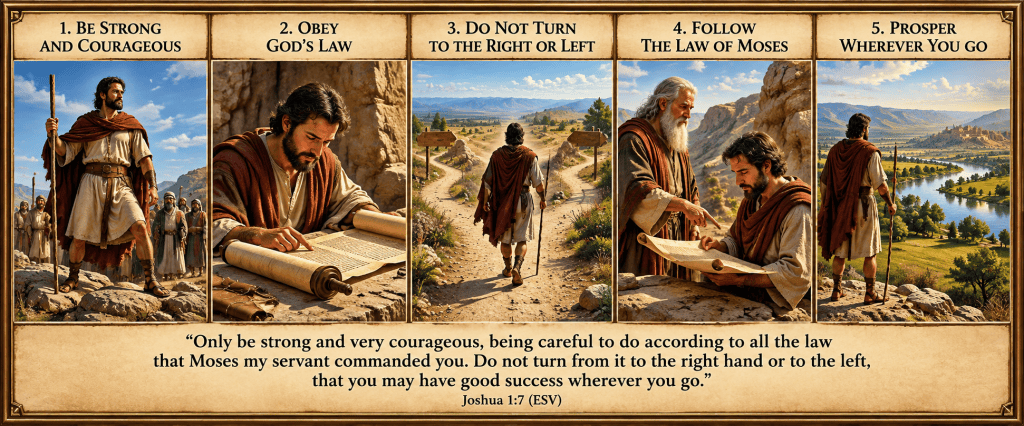
7 “Only be strong and very courageous, being careful to do according to all the law that Moses my servant commanded you. Do not turn from it to the right hand or to the left, that you may have good success wherever you go.” (Joshua 1:7 ESV)
Understanding the Verse
Only be strong and very courageous
Test

