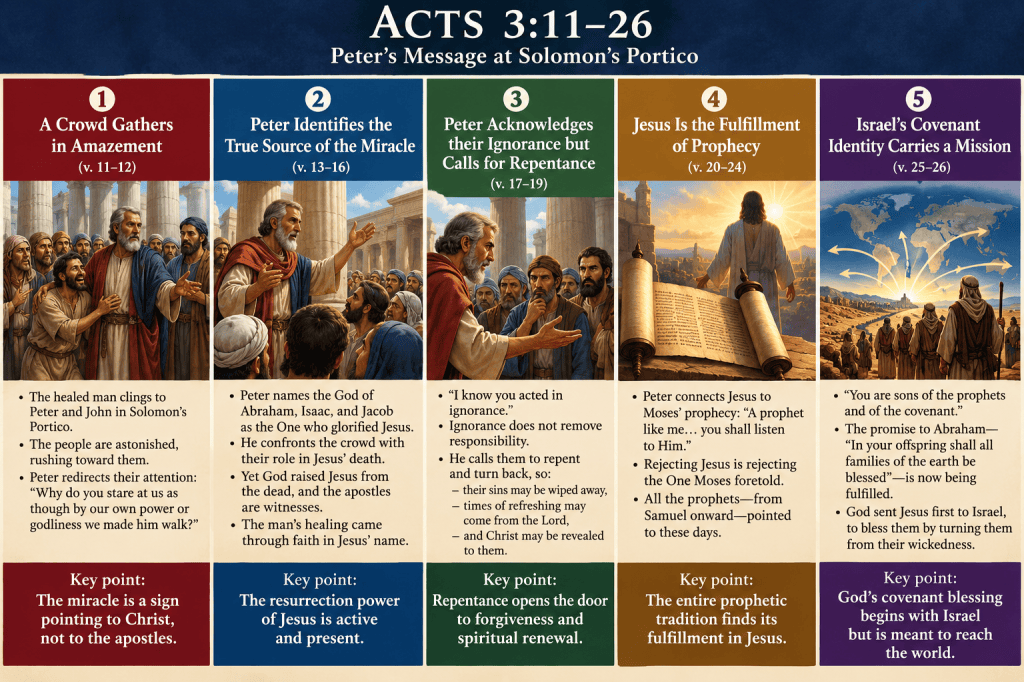
image Acts 3:11-26
New Testament Events Series
Event: nte008 Peter preaches in Solomon’s Portico (Acts 3:11–26)
Facilitator/Editor: Stephen Weller
Information Collection: ChatGPT
Bible Text: BibleGateway
2,515 words, 13 minutes read time
NT Event Index
Event Context
Context for Acts 3:11-26
Acts 3:11–26 follows immediately after Peter and John heal a man who had been unable to walk from birth at the temple’s Beautiful Gate (Acts 3:1–10). As the healed man clings to Peter and John and the astonished crowd gathers at Solomon’s Portico, Peter quickly redirects attention away from himself and John and toward Jesus Christ. He explains that the miracle was not accomplished by their own power or godliness but through faith in the name of Jesus—the same Jesus whom the people had rejected and delivered over to be crucified, but whom God raised from the dead. Peter acknowledges that they and their rulers acted in ignorance, yet he shows that Christ’s suffering fulfilled what God had foretold through the prophets. He then calls his listeners to repent and turn back to God, promising that their sins may be blotted out and that “times of refreshing” may come from the presence of the Lord. Drawing upon Moses, Samuel, and the covenant God made with Abraham, Peter presents Jesus as the fulfillment of Israel’s prophetic and covenant hopes. The passage therefore moves from miracle to proclamation, from conviction to repentance, and from Old Testament promise to fulfillment in Christ, emphasizing that God raised up His Servant Jesus and sent Him first to Israel to bless them by turning them from their wickedness.
Understanding the Event
Event Text
Peter Speaks in Solomon’s Portico
11 While he clung to Peter and John, all the people, utterly astounded, ran together to them in the portico called Solomon’s. 12 And when Peter saw it he addressed the people: “Men of Israel, why do you wonder at this, or why do you stare at us, as though by our own power or piety we have made him walk? 13 The God of Abraham, the God of Isaac, and the God of Jacob, the God of our fathers, glorified his servant[a] Jesus, whom you delivered over and denied in the presence of Pilate, when he had decided to release him. 14 But you denied the Holy and Righteous One, and asked for a murderer to be granted to you, 15 and you killed the Author of life, whom God raised from the dead. To this we are witnesses. 16 And his name—by faith in his name—has made this man strong whom you see and know, and the faith that is through Jesus[b] has given the man this perfect health in the presence of you all.
17 “And now, brothers, I know that you acted in ignorance, as did also your rulers. 18 But what God foretold by the mouth of all the prophets, that his Christ would suffer, he thus fulfilled. 19 Repent therefore, and turn back, that your sins may be blotted out, 20 that times of refreshing may come from the presence of the Lord, and that he may send the Christ appointed for you, Jesus, 21 whom heaven must receive until the time for restoring all the things about which God spoke by the mouth of his holy prophets long ago. 22 Moses said, ‘The Lord God will raise up for you a prophet like me from your brothers. You shall listen to him in whatever he tells you. 23 And it shall be that every soul who does not listen to that prophet shall be destroyed from the people.’ 24 And all the prophets who have spoken, from Samuel and those who came after him, also proclaimed these days. 25 You are the sons of the prophets and of the covenant that God made with your fathers, saying to Abraham, ‘And in your offspring shall all the families of the earth be blessed.’ 26 God, having raised up his servant, sent him to you first, to bless you by turning every one of you from your wickedness.”
Questions with answers
1. Why did the healed man cling to Peter and John after his healing?
Answer:
The man who had been unable to walk from birth had just experienced a complete and unmistakable healing through the name of Jesus Christ. His clinging to Peter and John expressed amazement, gratitude, and perhaps a desire to remain near those through whom God had worked. The scene quickly attracted a crowd at Solomon’s Portico. Peter recognized that the miracle had created an opportunity to direct attention away from himself and John and toward Jesus. The healed man therefore became visible evidence that something extraordinary had occurred, while Peter explained the true source of the miracle.
2. Why did Peter immediately reject the idea that he and John had healed the man by their own power or godliness?
Answer:
Peter wanted the crowd to understand that neither apostolic power nor personal holiness was the ultimate cause of the healing. He asked why they were staring at them “as though by our own power or piety we have made him walk” (Acts 3:12). The miracle was not intended to glorify Peter and John but to testify to Jesus Christ. This establishes an important principle for Christian ministry: when God works through His servants, the glory belongs to Him. Peter used the crowd’s amazement not to elevate himself but to point them to Christ.
3. Why did Peter refer to God as “the God of Abraham, the God of Isaac, and the God of Jacob”?
Answer:
Peter deliberately connected Jesus with the God of Israel and His covenant promises. The miracle and the message about Jesus were not the introduction of a different God or an unrelated religion. Rather, Peter presented Jesus as the fulfillment of God’s redemptive work revealed throughout Israel’s history. By using language deeply familiar to his Jewish audience, Peter showed continuity between God’s promises to the patriarchs and His work through Jesus. The God who called Abraham and established His covenant had now “glorified his servant Jesus” (Acts 3:13).
4. What contrast did Peter make between what the people had done to Jesus and what God had done?
Answer:
Peter presented a striking contrast. The people had delivered Jesus over, denied Him before Pilate, rejected “the Holy and Righteous One,” and asked for a murderer to be released instead. Ultimately, Peter said, they “killed the Author of life.” God, however, “raised [Jesus] from the dead” (Acts 3:13–15). Human rejection did not overturn God’s purposes. The resurrection became God’s decisive vindication of Jesus and the foundation of the apostles’ witness. Peter and John could testify personally to this truth because they had seen the risen Christ.
5. What did Peter mean when he said that faith in Jesus’ name had made the lame man strong?
Answer:
Peter explained that the healing came through Jesus rather than through any inherent power possessed by the apostles. Acts 3:16 emphasizes “his name” and “faith in his name.” In biblical thought, the name represents the person, authority, and power of the one named. Peter was therefore declaring that the risen Jesus was responsible for the man’s complete restoration. The formerly lame man standing before the crowd served as tangible evidence that Jesus, though no longer physically present among them, was alive and continuing His work through His apostles.
6. Why did Peter say that the people and their rulers had acted “in ignorance”?
Answer:
Peter did not deny their responsibility for rejecting Jesus, but he acknowledged that they had not fully understood whom they were rejecting or the significance of their actions. This introduced a note of mercy into an otherwise forceful confrontation. Their ignorance did not make repentance unnecessary; instead, it provided the setting for Peter’s invitation to repent. God was offering forgiveness even to people implicated in Jesus’ rejection and death. Peter’s sermon therefore combines a truthful confrontation with sin and a gracious invitation to restoration.
7. How did the suffering of Christ fulfill what God had foretold through the prophets?
Answer:
Peter explained that Christ’s suffering was not an unexpected defeat. God had announced beforehand “by the mouth of all the prophets, that his Christ would suffer” (Acts 3:18). Jesus’ rejection and crucifixion therefore took place within God’s redemptive plan. Passages such as Isaiah 53 had prepared Israel for a suffering servant who would bear sin and bring salvation. Peter wanted his listeners to recognize that the cross, rather than disproving Jesus’ identity as Messiah, was part of the scriptural testimony concerning Him.
8. What did Peter call the people to do in response to his message?
Answer:
Peter commanded them, “Repent therefore, and turn back” (Acts 3:19). Repentance involves more than regret or sorrow; it is a turning away from sin and a turning toward God. Peter did not merely provide information about Jesus. He called his listeners to respond personally to what God had done through Christ. The same people who had participated in rejecting Jesus were being invited to turn to Him. This demonstrates the remarkable reach of God’s grace: even serious sin does not place a repentant sinner beyond the offer of forgiveness.
9. What does it mean that their sins would be “blotted out”?
Answer:
The expression presents forgiveness as the complete removal of a record of guilt. Peter promised that those who repented and turned to God could have their sins “blotted out” (Acts 3:19). The image emphasizes the completeness of divine forgiveness. God was not merely offering to overlook their past temporarily; He was offering genuine cleansing and reconciliation through Christ. This promise is especially powerful in the context of Peter’s audience because he had just confronted them with their involvement in rejecting Jesus. The very Christ they had rejected was now the One through whom forgiveness was offered.
10. What are the “times of refreshing” Peter mentioned?
Answer:
Peter connected repentance with “times of refreshing” coming “from the presence of the Lord” (Acts 3:20). The phrase conveys restoration, renewal, and blessing that come from God. In the immediate context, it is tied to forgiveness and restored relationship with God, while Peter also looks forward to the larger fulfillment of God’s redemptive purposes associated with Christ’s return and the restoration spoken of by the prophets. Salvation therefore includes both present spiritual renewal and future hope.
11. What did Peter teach about Jesus’ present position and future return?
Answer:
Peter explained that heaven must receive Christ “until the time for restoring all the things about which God spoke by the mouth of his holy prophets long ago” (Acts 3:21). Jesus had ascended to heaven, but His ascension was not the conclusion of God’s plan. Peter pointed forward to Christ’s return and the fulfillment of God’s promised restoration. The Christian message therefore looks backward to Christ’s death and resurrection, upward to His present exaltation, and forward to His return and the completion of God’s redemptive purposes.
12. Why did Peter quote Moses’ prophecy about a prophet like him?
Answer:
Peter cited Deuteronomy 18:15–19 to identify Jesus as the promised prophet whom God’s people must hear. Moses had said that God would raise up a prophet “like me from your brothers” and commanded the people to listen to Him. Peter applied this promise directly to Jesus. This strengthened his argument from Israel’s own Scriptures: accepting Jesus was not a rejection of Moses but the proper response to what Moses himself had foretold. Peter also stressed the seriousness of rejecting this promised prophet.
13. Why did Peter mention Samuel and the prophets who followed him?
Answer:
Peter wanted his listeners to see that Jesus stood at the center of the prophetic hope of Israel. Moses had spoken of the coming Prophet, and “all the prophets who have spoken, from Samuel and those who came after him,” had proclaimed the days now unfolding (Acts 3:24). Peter therefore presented the gospel not as an isolated teaching but as the fulfillment of a long sequence of divine promises. Israel’s Scriptures had been pointing forward to God’s saving work, and Peter declared that this fulfillment had arrived in Jesus.
14. What privilege did Peter say his Jewish listeners possessed?
Answer:
Peter told them, “You are the sons of the prophets and of the covenant that God made with your fathers” (Acts 3:25). They were heirs of the promises God had given throughout Israel’s history. This privilege brought responsibility: because they had received the Scriptures and covenant promises, they were being called to recognize their fulfillment in Christ. Peter was not separating Jesus from Israel’s covenant history; he was showing that God’s work through Jesus stood within that history and brought its promises toward fulfillment.
15. How does God’s promise to Abraham connect Jesus with blessing for all nations?
Answer:
Peter quoted God’s promise to Abraham: “And in your offspring shall all the families of the earth be blessed” (Acts 3:25). This reaches back to Genesis and shows that God’s redemptive plan was always larger than one nation. God chose Abraham and Israel as part of His purpose to bring blessing to the world. Peter identifies Jesus as central to the fulfillment of that promise. The gospel begins among Israel, but its intended reach extends to “all the families of the earth,” anticipating the worldwide mission that unfolds throughout Acts.
16. In what sense did God send Jesus to Israel “first”?
Answer:
Peter concluded that God raised up His servant and sent Him “to you first” (Acts 3:26). Israel received the initial proclamation because of its unique place in God’s covenant history and promises. Yet the word “first” also anticipates the expansion of the gospel beyond Israel. This pattern becomes increasingly visible throughout Acts and reaches a programmatic expression in Acts 1:8: Jerusalem, Judea, Samaria, and the ends of the earth. The blessing promised through Abraham would ultimately extend to all peoples.
17. According to Peter, what is one of the central blessings Jesus brings?
Answer:
Peter described Christ’s blessing as “turning every one of you from your wickedness” (Acts 3:26). This is significant because salvation is not presented merely as receiving benefits from God while continuing unchanged. One of God’s great blessings is deliverance from sin itself. Christ calls people away from rebellion and into a restored relationship with God. Repentance, forgiveness, and transformed living therefore belong together in Peter’s presentation of the gospel.
18. What is the central message of Acts 3:11–26?
Answer:
The central message is that the risen Jesus is the promised Messiah through whom God offers forgiveness, restoration, and blessing, calling people to repent and turn to Him. Peter begins with a physical miracle but quickly directs attention to a much greater spiritual reality. The healed man demonstrates the continuing power of the risen Christ; the Scriptures demonstrate that Jesus fulfills God’s ancient promises; and Peter’s appeal demonstrates the appropriate response: repentance and faith. The passage moves from miracle → Jesus → Scripture → repentance → forgiveness → restoration → worldwide blessing, making the healing a doorway through which Peter proclaims the larger message of salvation in Christ.


Leave a Reply