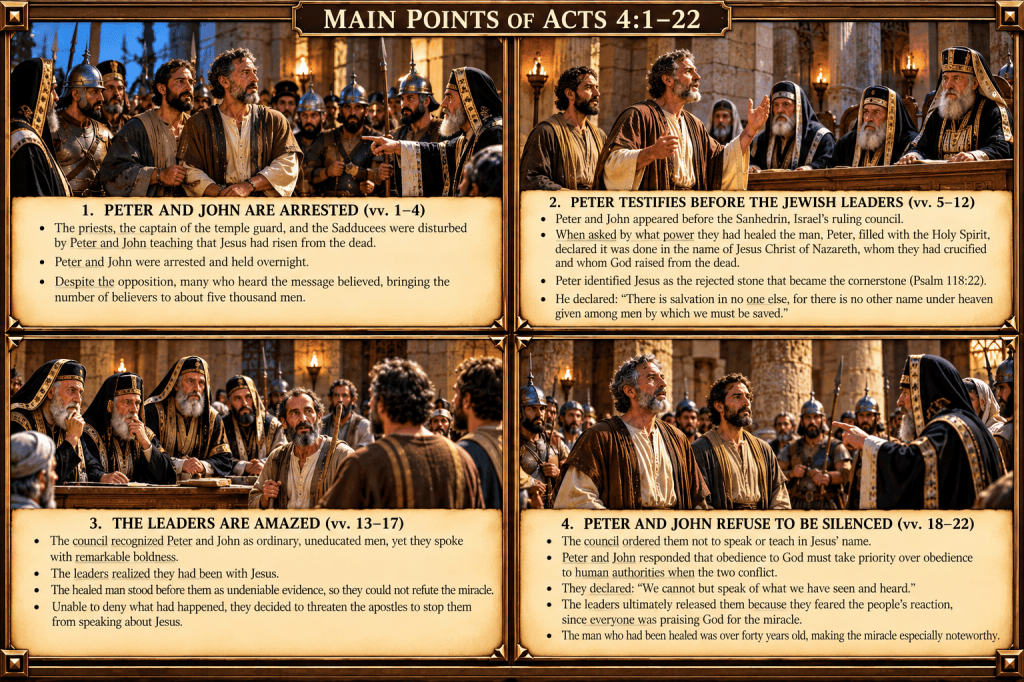
image Acts 4:1-22
New Testament Events Series
Event: nte009 Peter and John before the Council (Acts 4:1–22)
Facilitator/Editor: Stephen Weller
Information Collection: ChatGPT
Bible Text: BibleGateway
2,511 words, 13 minutes read time
NT Event Index
Event Context
Context for Acts 4:1-22
Acts 4:1–22 follows immediately after the healing of the man who had been lame from birth at the temple gate and Peter’s sermon to the amazed crowd in Acts 3. As Peter and John proclaim that the man’s healing came through faith in Jesus Christ and boldly announce Jesus’ resurrection from the dead, the temple authorities—particularly the priests, the captain of the temple, and the Sadducees—become greatly disturbed and have the apostles arrested. The next day, Peter and John are brought before the Jewish ruling council, where they are questioned about the authority behind the miracle. Filled with the Holy Spirit, Peter declares that the man was healed “by the name of Jesus Christ of Nazareth” (Acts 4:10, ESV), the very Jesus whom they crucified and whom God raised from the dead. Peter then makes the exclusive claim that salvation is found in Christ alone. Although the leaders recognize Peter and John as ordinary, uneducated men, they are astonished by their boldness and realize that they had been with Jesus. Because the healed man is standing before them, the council cannot deny what has happened. Unable to refute the miracle but determined to stop the message from spreading, the authorities command the apostles not to speak or teach in Jesus’ name. Peter and John refuse to place human authority above obedience to God, declaring that they cannot stop speaking about what they have seen and heard. The passage therefore marks the first organized opposition to the church in Acts and establishes an important pattern that will continue throughout the book: the gospel advances through Spirit-empowered witness even in the face of threats, persecution, and opposition.
Understanding the Event
Event Text
Peter and John Before the Council
4 And as they were speaking to the people, the priests and the captain of the temple and the Sadducees came upon them, 2 greatly annoyed because they were teaching the people and proclaiming in Jesus the resurrection from the dead. 3 And they arrested them and put them in custody until the next day, for it was already evening. 4 But many of those who had heard the word believed, and the number of the men came to about five thousand.
5 On the next day their rulers and elders and scribes gathered together in Jerusalem, 6 with Annas the high priest and Caiaphas and John and Alexander, and all who were of the high-priestly family. 7 And when they had set them in the midst, they inquired, “By what power or by what name did you do this?” 8 Then Peter, filled with the Holy Spirit, said to them, “Rulers of the people and elders, 9 if we are being examined today concerning a good deed done to a crippled man, by what means this man has been healed, 10 let it be known to all of you and to all the people of Israel that by the name of Jesus Christ of Nazareth, whom you crucified, whom God raised from the dead—by him this man is standing before you well. 11 This Jesus[a] is the stone that was rejected by you, the builders, which has become the cornerstone.[b] 12 And there is salvation in no one else, for there is no other name under heaven given among men[c] by which we must be saved.”
13 Now when they saw the boldness of Peter and John, and perceived that they were uneducated, common men, they were astonished. And they recognized that they had been with Jesus. 14 But seeing the man who was healed standing beside them, they had nothing to say in opposition. 15 But when they had commanded them to leave the council, they conferred with one another, 16 saying, “What shall we do with these men? For that a notable sign has been performed through them is evident to all the inhabitants of Jerusalem, and we cannot deny it. 17 But in order that it may spread no further among the people, let us warn them to speak no more to anyone in this name.” 18 So they called them and charged them not to speak or teach at all in the name of Jesus. 19 But Peter and John answered them, “Whether it is right in the sight of God to listen to you rather than to God, you must judge, 20 for we cannot but speak of what we have seen and heard.” 21 And when they had further threatened them, they let them go, finding no way to punish them, because of the people, for all were praising God for what had happened. 22 For the man on whom this sign of healing was performed was more than forty years old
Questions with answers
1. Why were the priests, the captain of the temple, and the Sadducees disturbed by Peter and John?
Answer:
The religious authorities were disturbed because Peter and John were publicly teaching the people and proclaiming that Jesus had risen from the dead. This was especially offensive to the Sadducees, who denied the resurrection of the dead. But the issue went beyond a theological disagreement. Peter and John were boldly declaring that the Jesus whom the authorities had rejected and crucified was alive and that God had vindicated Him. Their message challenged both the Sadducees’ beliefs and the authority of the religious leadership. The apostles were not presenting the resurrection as an abstract doctrine; they were proclaiming it as a historical reality demonstrated in Jesus Christ.
2. What happened to Peter and John because of their preaching?
Answer:
The authorities arrested Peter and John and placed them in custody until the following day because it was already evening. This was the first recorded instance in Acts of the apostles being arrested for proclaiming Christ. Their imprisonment illustrates how quickly opposition arose against the early church. Yet the arrest did not stop the gospel. Acts 4:4 explains that many who had heard the message believed, and the number of men grew to about five thousand. Human authorities could imprison the messengers, but they could not prevent God’s Word from producing faith.
3. What does the growth of the believers to about five thousand reveal about the early church?
Answer:
The rapid growth demonstrates the powerful work of God through the preaching of the gospel. At Pentecost, about three thousand people had responded to Peter’s message (Acts 2:41), and now the number of men alone had grown to about five thousand. This growth occurred despite increasing opposition. Luke therefore presents an important contrast: the authorities were attempting to silence the gospel while God was continuing to expand its influence. Opposition did not mean that God’s work had failed; instead, the gospel continued advancing even in the face of resistance.
4. What question did the religious council ask Peter and John?
Answer:
The council asked, “By what power or by what name did you do this?” (Acts 4:7, ESV). Their question referred particularly to the healing of the man who had been lame from birth in Acts 3. The leaders could not easily deny that something remarkable had happened, so they demanded to know the source of the apostles’ authority. Their question provided Peter with exactly the opportunity he needed to proclaim Jesus Christ. What was intended as an interrogation became another occasion for gospel witness.
5. What enabled Peter to answer the religious leaders so boldly?
Answer:
Acts 4:8 says that Peter was “filled with the Holy Spirit.” This is particularly significant when compared with Peter’s earlier denial of Jesus. Before the crucifixion, Peter had been frightened enough to deny knowing Christ when questioned by people in the high priest’s courtyard. Now he stood before the highest religious authorities in Jerusalem and openly proclaimed Jesus. His courage was not merely a matter of improved personality or greater self-confidence. Luke emphasizes the empowering presence of the Holy Spirit, fulfilling Jesus’ promise that His followers would receive power to become His witnesses (Acts 1:8).
6. According to Peter, how had the lame man been healed?
Answer:
Peter declared that the man had been healed “by the name of Jesus Christ of Nazareth” (Acts 4:10, ESV). Peter refused to take personal credit for the miracle. The healing was evidence of the power and authority of the risen Christ. Peter further reminded the council that they had crucified Jesus but that God had raised Him from the dead. Thus, the healed man standing before them became visible evidence supporting the apostles’ testimony: the Jesus whom the leaders had rejected was alive and continuing His work through His apostles.
7. Why did Peter emphasize that the leaders had crucified Jesus but God had raised Him from the dead?
Answer:
Peter placed human rejection and divine vindication side by side. The religious authorities had rejected Jesus and participated in bringing about His crucifixion, but their verdict was not God’s verdict. God raised Jesus from the dead, demonstrating that Jesus truly is the Messiah and Lord. This contrast appears repeatedly in the preaching of Acts: human beings rejected Christ, but God exalted Him. Peter therefore called the council to confront the significance of what God had done rather than simply defend their previous judgment concerning Jesus.
8. What did Peter mean when he described Jesus as “the stone that was rejected”?
Answer:
Peter drew from Psalm 118:22: “The stone that the builders rejected has become the cornerstone.” The builders represent those who should have recognized God’s work but instead rejected Jesus. Yet the One they rejected became the cornerstone—the essential foundation of God’s saving work. The image emphasizes a dramatic reversal: Jesus appeared to have been rejected and defeated at the cross, but through His resurrection God revealed Him to be central to His redemptive plan. What human judgment discarded, God established as foundational.
9. What does Acts 4:12 teach about salvation?
Answer:
Peter makes an unmistakably Christ-centered declaration: “And there is salvation in no one else” (Acts 4:12, ESV). Salvation is not found in religious position, human achievement, political power, or obedience to a religious system. It is found in Jesus Christ. Peter adds that there is no other name under heaven given among mankind by which people must be saved. The same Jesus through whose name the lame man received physical healing is the One through whom sinners receive spiritual salvation. Jesus is therefore not merely one source of help among many; Peter presents Him as God’s appointed and unique Savior.
10. Why were the members of the council astonished by Peter and John?
Answer:
The council recognized Peter and John as “uneducated, common men” yet was astonished by their boldness. This does not mean that the apostles were unintelligent; rather, they had not received the formal rabbinic training associated with recognized religious teachers. Nevertheless, they spoke with remarkable confidence and understanding. The leaders also recognized that “they had been with Jesus” (Acts 4:13, ESV). Their effectiveness did not arise from prestigious credentials but from their relationship with Christ, their eyewitness knowledge of Him, and the empowering work of the Holy Spirit.
11. Why was the healed man so important to the apostles’ testimony?
Answer:
The healed man was standing beside Peter and John, making it impossible for the council simply to dismiss the miracle as a fabricated story. Acts 4:14 says that when the leaders saw the healed man standing with them, “they had nothing to say in opposition.” The man’s presence provided visible confirmation that something extraordinary had occurred. The authorities might reject Peter’s interpretation of the event, but they could not easily deny the event itself. The transformed life of the healed man stood as tangible evidence of Christ’s power.
12. What dilemma did the religious leaders face?
Answer:
The leaders wanted to stop the apostles’ message, but they could not deny that a remarkable miracle had taken place. The healing was widely known throughout Jerusalem, and attempting to deny it would damage their credibility with the people. Their solution was therefore not to disprove the apostles’ claims but to command them to stop speaking in the name of Jesus. This reveals an important feature of the conflict: the central issue was no longer whether the man had been healed, but whether the apostles would continue publicly proclaiming Jesus.
13. How did Peter and John respond when commanded not to speak or teach in the name of Jesus?
Answer:
Peter and John replied, “Whether it is right in the sight of God to listen to you rather than to God, you must judge” (Acts 4:19, ESV). They recognized legitimate human authority, but they also understood that human authority is never greater than God’s authority. Jesus had commissioned them to be His witnesses, so obeying the council’s command would require disobeying Christ. Their response establishes an important biblical principle: when human commands directly contradict God’s commands, allegiance to God must take precedence.
14. Why did Peter and John say, “we cannot but speak of what we have seen and heard”?
Answer:
Peter and John were eyewitnesses. They had traveled with Jesus, heard His teaching, witnessed His miracles, seen His crucifixion, and encountered Him alive after His resurrection. Their message was therefore not merely a religious theory they had adopted. They were testifying to events they believed they had personally witnessed. Their conviction was so strong that silence was not an acceptable option. The gospel had become the defining truth of their lives, and Christ had specifically commissioned them to testify about Him.
15. Why did the council release Peter and John?
Answer:
After threatening them further, the council released them because it could find no suitable way to punish them without provoking the people. Everyone was praising God for what had happened, and the healed man was more than forty years old, making the miracle especially remarkable. The authorities remained opposed to the apostles’ preaching, but public recognition of the miracle limited what they could do at that moment. Once again, Luke shows God’s providential protection of His witnesses while the gospel continues to advance.
16. What central lesson does Acts 4:1–22 teach about Christian witness?
Answer:
Acts 4:1–22 demonstrates that faithful witness to Jesus Christ may encounter opposition, but opposition does not remove the believer’s responsibility to testify about Him. Peter and John did not depend upon social standing, education, or political influence. They depended upon the Holy Spirit, proclaimed the resurrection of Jesus, pointed people to salvation in Christ alone, and remained obedient when pressured to remain silent. The passage presents a powerful progression: the gospel is proclaimed, opposition arises, the Spirit provides boldness, Christ is exalted, and the witnesses remain faithful. Their courage rested not in confidence that circumstances would be easy, but in confidence that the risen Jesus was worthy of their obedience.


Leave a comment