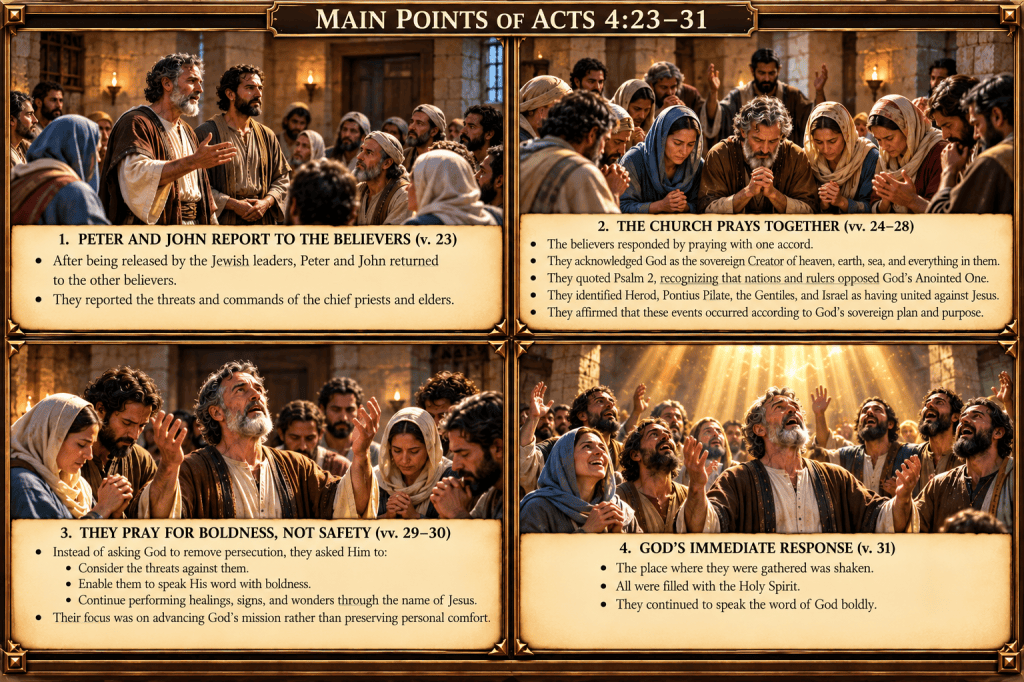
image Acts 4:23–31
New Testament Events Series
Event: nte010 The Believer’s Pray for Boldness (Acts 4:23–31)
Facilitator/Editor: Stephen Weller
Information Collection: ChatGPT
Bible Text: BibleGateway
1,642 words, 9 minutes read time
NT Event Index
Event Context
Context for Acts 4:23-31
Acts 4:23–31 follows immediately after Peter and John are released by the Jewish ruling council, where they had been questioned and threatened for proclaiming the resurrection of Jesus and healing a man who had been lame from birth (Acts 3:1–10; 4:1–22). Rather than being intimidated into silence, Peter and John return to the other believers and report what the chief priests and elders had said. The church responds collectively, not with fear or a prayer for the removal of opposition, but by lifting their voices to the sovereign God who created all things and whose purposes cannot be overturned. Quoting Psalm 2, they understand the hostility against Jesus—and now against His followers—as part of the opposition Scripture had already anticipated. Their prayer centers on courage: they ask God to enable His servants to continue speaking His word with boldness while He confirms the gospel through His power. God answers dramatically—the place where they are gathered is shaken, they are all filled with the Holy Spirit, and they continue speaking the word of God boldly. The passage therefore marks an important development in Acts: persecution does not silence the church but drives believers to prayer, deeper dependence upon the Holy Spirit, and even greater boldness in proclaiming Christ.
Understanding the Event
Event Text
The Believers Pray for Boldness
23 When they were released, they went to their friends and reported what the chief priests and the elders had said to them. 24 And when they heard it, they lifted their voices together to God and said, “Sovereign Lord, who made the heaven and the earth and the sea and everything in them, 25 who through the mouth of our father David, your servant,[a] said by the Holy Spirit,
“‘Why did the Gentiles rage,
and the peoples plot in vain?
26 The kings of the earth set themselves,
and the rulers were gathered together,
against the Lord and against his Anointed’[b]—
27 for truly in this city there were gathered together against your holy servant Jesus, whom you anointed, both Herod and Pontius Pilate, along with the Gentiles and the peoples of Israel, 28 to do whatever your hand and your plan had predestined to take place. 29 And now, Lord, look upon their threats and grant to your servants to continue to speak your word with all boldness, 30 while you stretch out your hand to heal, and signs and wonders are performed through the name of your holy servant Jesus.” 31 And when they had prayed, the place in which they were gathered together was shaken, and they were all filled with the Holy Spirit and continued to speak the word of God with boldness.
Questions with answers
1. What did Peter and John do after they were released by the Jewish authorities?
Answer:
After their release, Peter and John immediately returned to the other believers and reported everything the chief priests and elders had said to them. They had been commanded not to speak or teach in the name of Jesus, yet they did not face this opposition alone. They returned to the fellowship of believers, where the entire church could respond together. This demonstrates the importance of Christian community during times of difficulty. Peter and John shared their burden with fellow believers, and together they brought the situation before God in prayer.
2. How did the believers respond when they heard Peter and John’s report?
Answer:
The believers responded by praying together: “they lifted their voices together to God” (Acts 4:24). Their first response was not panic, retaliation, or an attempt to escape the situation. Instead, they turned immediately to God. Their united prayer reveals their dependence upon Him and their confidence that He remained sovereign even though powerful authorities opposed them. Their unity was not merely organizational; they were spiritually united in their trust in God and their commitment to the mission Christ had given them.
3. Why did the believers begin their prayer by calling God the “Sovereign Lord”?
Answer:
They addressed God as the “Sovereign Lord” and acknowledged Him as the Creator of heaven, earth, sea, and everything in them (Acts 4:24). By beginning with God’s sovereignty rather than their circumstances, they placed the threats against them in the proper perspective. The religious authorities possessed considerable human power, but their authority was limited. God alone rules over creation and history. Remembering who God is strengthened the believers to face opposition without surrendering their mission.
4. Why did the believers quote Psalm 2:1–2 in their prayer?
Answer:
The believers understood their circumstances in light of Scripture. Psalm 2 describes the nations and rulers opposing the Lord and His Anointed One. They recognized that this pattern had been fulfilled most clearly in the opposition to Jesus and was now continuing against His followers. Rather than interpreting persecution as evidence that God’s plan had failed, they saw opposition as something Scripture had already anticipated. God’s Word therefore gave them a framework for understanding what was happening around them.
5. How did the believers connect Herod, Pontius Pilate, the Gentiles, and Israel with God’s plan?
Answer:
Acts 4:27 identifies Herod, Pontius Pilate, the Gentiles, and the peoples of Israel as participants in the opposition against Jesus, God’s “holy servant.” Yet verse 28 declares that they ultimately did what God’s hand and plan had predestined to take place. This does not remove their responsibility for their actions; rather, it emphasizes God’s sovereignty over human opposition. The crucifixion appeared to be the triumph of Jesus’ enemies, but God used those very events to accomplish His redemptive purpose. Human resistance could not overturn God’s plan.
6. What is significant about what the believers did not ask God to do?
Answer:
The believers did not ask God to remove their enemies, eliminate persecution, or make their circumstances comfortable. Instead, they prayed, “Lord, look upon their threats and grant to your servants to continue to speak your word with all boldness” (Acts 4:29). Their primary concern was not personal safety but faithfulness to their calling. They recognized the reality of the threats but asked God for the courage necessary to continue proclaiming Christ despite them.
7. What did the believers mean when they asked for “boldness”?
Answer:
Biblical boldness is not arrogance, harshness, or recklessness. It is Spirit-given confidence to speak God’s truth faithfully despite fear, opposition, or consequences. Peter and John had already demonstrated this kind of courage before the Sanhedrin. Now the entire believing community prayed for the same strength. Their request acknowledges that courage for Christian witness ultimately comes from God rather than merely from human personality or determination.
8. Why did the believers pray for signs and wonders to accompany their proclamation?
Answer:
They asked God to stretch out His hand “to heal, and signs and wonders are performed through the name of your holy servant Jesus” (Acts 4:30). In Acts, miraculous works repeatedly accompanied the apostolic proclamation and pointed people toward the authority and identity of Jesus. The healing of the lame man in Acts 3 had created the opportunity for Peter to preach Christ publicly. Thus, the believers prayed that God would continue working powerfully while they faithfully proclaimed His Word.
9. What happened after the believers finished praying?
Answer:
Acts 4:31 records three striking results: the place where they gathered was shaken, they were all filled with the Holy Spirit, and they continued speaking God’s Word with boldness. The shaking of the place served as a visible demonstration of God’s presence and response. More importantly, God supplied exactly what they had requested—the spiritual power and courage necessary to continue their witness. Opposition had not silenced the church; through prayer and the Spirit’s empowering presence, the believers became even more determined to proclaim Christ.
10. What does it mean that they were “all filled with the Holy Spirit” when the Spirit had already come at Pentecost?
Answer:
The believers had already received the Holy Spirit at Pentecost, so Acts 4:31 does not describe the first coming of the Spirit to the church. Rather, it shows a fresh empowering of believers for a particular need and mission. Throughout Acts, being filled with the Spirit is closely associated with effective witness, courage, and faithful proclamation. The passage therefore demonstrates the believers’ continuing dependence upon the Holy Spirit rather than suggesting that Pentecost needed to be repeated.
11. What does Acts 4:23–31 teach about the relationship between prayer and persecution?
Answer:
The passage shows that opposition should drive believers toward God rather than away from their mission. The early Christians did not deny the seriousness of the threats—they specifically brought them before God. Yet their prayer moved from the threats to God’s sovereignty, from God’s sovereignty to Scripture, and from Scripture to their mission. Prayer did not become an escape from difficulty; it became the means through which they received strength to remain faithful within difficulty.
12. What is the central lesson of Acts 4:23–31?
Answer:
The central lesson is that God’s sovereign purposes cannot be stopped by human opposition, and God’s people can depend upon the Holy Spirit for courage to continue proclaiming Christ. The believers faced genuine threats, but they viewed those threats through the larger reality of God’s sovereignty. They prayed according to Scripture, entrusted their circumstances to God, and asked for boldness rather than comfort. God answered by filling them with the Holy Spirit, and “they continued to speak the word of God with boldness” (Acts 4:31). Their experience provides a powerful pattern: opposition leads to prayer, prayer rests upon God’s sovereignty, and dependence upon God produces courageous witness.


Leave a comment