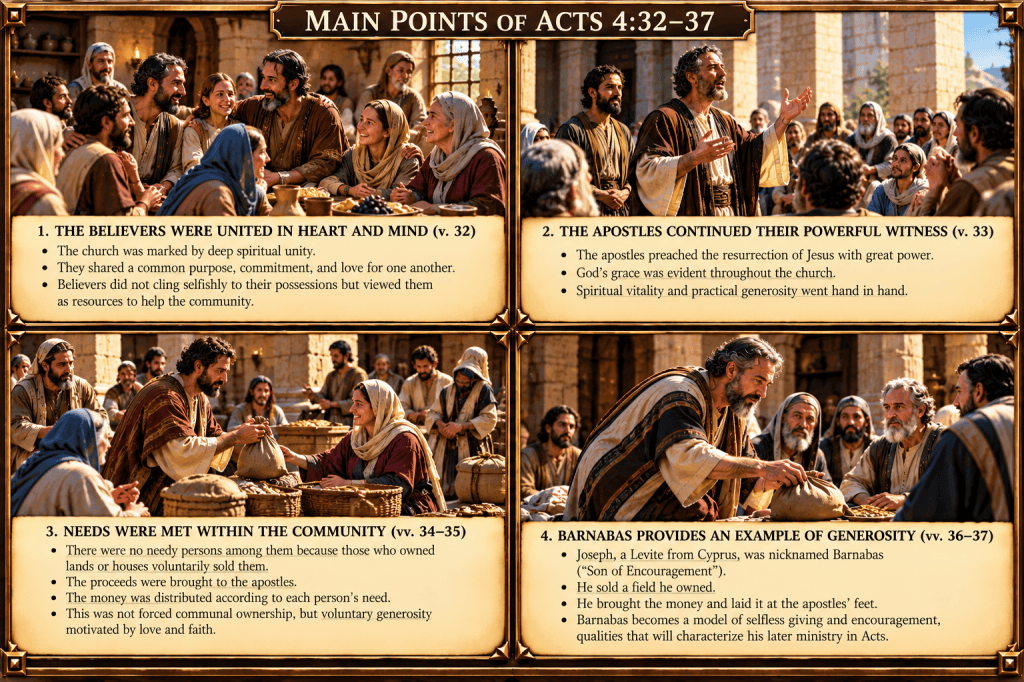
image Acts 4:32-37
New Testament Events Series
Event: nte011 They Had Everything in Common (Acts 4:32–37)
Facilitator/Editor: Stephen Weller
Information Collection: ChatGPT
Bible Text: BibleGateway
1,581 words, 8 minutes read time
NT Event Index
Event Context
Context for Acts 4:32-37
Acts 4:32–37 describes the remarkable unity and generosity of the early church following the apostles’ prayer for boldness and their fresh filling with the Holy Spirit in Acts 4:23–31. Although the believers were living under increasing opposition from the religious authorities, their fellowship was characterized by being “of one heart and soul” (Acts 4:32, ESV). This spiritual unity expressed itself practically: believers did not regard their possessions as exclusively their own but willingly shared their resources so that the needs of fellow Christians could be met. At the same time, the apostles continued to testify “with great power” to the resurrection of the Lord Jesus, and “great grace was upon them all” (Acts 4:33, ESV). Those who owned property sometimes voluntarily sold it and entrusted the proceeds to the apostles for distribution according to need. Luke concludes by introducing Joseph, a Levite from Cyprus whom the apostles called Barnabas, meaning “son of encouragement.” His generous sale of a field provides a specific example of the sacrificial spirit that characterized the church and also introduces a man who will later become an important leader, encourager, and missionary in the book of Acts.
Understanding the Event
Event Text
“They Had Everything in Common
“32 Now the full number of those who believed were of one heart and soul, and no one said that any of the things that belonged to him was his own, but they had everything in common. 33 And with great power the apostles were giving their testimony to the resurrection of the Lord Jesus, and great grace was upon them all. 34 There was not a needy person among them, for as many as were owners of lands or houses sold them and brought the proceeds of what was sold 35 and laid it at the apostles’ feet, and it was distributed to each as any had need. 36 Thus Joseph, who was also called by the apostles Barnabas (which means son of encouragement), a Levite, a native of Cyprus, 37 sold a field that belonged to him and brought the money and laid it at the apostles’ feet.” (Acts 4:32-37 ESV)
Questions with answers
1. What characterized the unity of the believers in Acts 4:32?
Answer:
Luke describes the believers as being “of one heart and soul” (Acts 4:32, ESV). Their unity went deeper than simply gathering together or agreeing on every minor matter. They were united by their faith in Jesus Christ, their experience of salvation, and their commitment to His mission. This spiritual unity affected the way they treated one another. They did not regard their possessions merely as resources for their own benefit but willingly made what they had available to meet the needs of others. Their shared life demonstrated that genuine Christian unity involves both a common faith and practical love.
2. What does it mean that “no one said that any of the things that belonged to him was his own”?
Answer:
This does not mean that the believers ceased to own private property. Acts 4:34–37 shows that individuals still possessed lands and houses and voluntarily chose whether to sell them. Rather, Acts 4:32 describes their attitude toward their possessions. They recognized that what God had entrusted to them could be used to bless others. Instead of holding tightly to their possessions, they willingly shared with believers who were in need. Their generosity flowed from transformed hearts rather than from compulsory redistribution.
3. What central message did the apostles continue to proclaim?
Answer:
The apostles continued to give “their testimony to the resurrection of the Lord Jesus” (Acts 4:33, ESV). The resurrection remained at the center of their preaching because it confirmed Jesus’ identity and demonstrated His victory over sin and death. This is especially significant because the religious authorities had recently commanded Peter and John not to speak or teach in Jesus’ name (Acts 4:18). Instead of becoming silent, the apostles continued their witness with great power. Their courage demonstrated the work of the Holy Spirit within them.
4. What is the significance of the statement, “great grace was upon them all”?
Answer:
The phrase connects the church’s powerful witness with the transforming work of God’s grace. God’s grace was evident not only in the apostles’ preaching but also in the life of the entire community. The believers displayed unity, generosity, compassion, and concern for one another. Thus, the passage presents proclamation and practice together: the apostles proclaimed the risen Christ, while the church demonstrated the effects of the gospel through its shared life. God’s grace changed both their message and their relationships.
5. How were the needs of poorer believers being met?
Answer:
Acts 4:34–35 explains that believers who owned lands or houses sometimes sold them and brought the proceeds to the apostles. The funds were then “distributed to each as any had need” (ESV). The emphasis was not on making everyone possess exactly the same amount but on ensuring that genuine needs within the Christian community were addressed. Those with greater resources voluntarily used what God had given them to help those who lacked necessities.
6. Why did believers bring the proceeds of their sales to the apostles?
Answer:
Bringing the proceeds and laying them “at the apostles’ feet” demonstrated trust and submission to the leadership God had established in the early church. Rather than personally controlling how every gift would be used, the donors entrusted the resources to the apostles so they could be distributed according to need. This also helped make the assistance a ministry of the whole church rather than merely a series of private acts of generosity. Later, as the church grew, Acts 6:1–6 shows that additional organization became necessary to oversee the distribution of assistance.
7. Was the selling of property required of every Christian?
Answer:
The passage presents the selling of property as voluntary generosity, not as a requirement imposed upon every believer. People who owned property chose to sell it when needs arose. This becomes particularly clear in the following account of Ananias and Sapphira. Peter tells Ananias that the property remained his before it was sold and that the proceeds remained at his disposal afterward (Acts 5:4). Their sin was not keeping some of the money but lying about their gift. Therefore, Acts 4 emphasizes willing generosity produced by faith and love rather than compulsory surrender of possessions.
8. Who was Barnabas, and why does Luke introduce him here?
Answer:
Barnabas was originally named Joseph. He was a Levite and a native of Cyprus. The apostles gave him the name Barnabas, which Luke explains as meaning “son of encouragement” (Acts 4:36, ESV). Luke introduces him as a specific example of the generosity just described. Barnabas owned a field, sold it, and brought the proceeds to the apostles. His actions illustrate in one individual the spirit of generosity that characterized the larger Christian community.
9. Why is Barnabas’s introduction important for the rest of Acts?
Answer:
Barnabas becomes an important figure as Acts develops. He later supports Saul when other believers are understandably hesitant to trust him after his conversion (Acts 9:26–27). He helps strengthen the growing church at Antioch (Acts 11:22–26), participates in missionary work with Paul (Acts 13:1–3), and later gives John Mark another opportunity after Paul does not want to take him on another missionary journey (Acts 15:36–39). His first appearance in Acts therefore establishes a pattern that continues throughout his life: Barnabas uses what God has given him—possessions, influence, encouragement, and ministry—to strengthen others.
10. What relationship does Acts 4:32–37 show between belief in the gospel and practical generosity?
Answer:
The passage deliberately places the apostles’ testimony about Christ’s resurrection alongside the believers’ generosity. Their faith was not merely something they confessed verbally; it transformed the way they viewed possessions and other people. Because they belonged to Christ, they also understood themselves as belonging to a spiritual family. The resurrection message proclaimed by the apostles produced a community in which love became visible through action. Gospel truth resulted in gospel-shaped living.
11. What does this passage teach about the Christian view of possessions?
Answer:
Acts 4:32–37 teaches that possessions should be viewed as resources entrusted by God rather than as the ultimate source of security or personal identity. The believers still possessed property, but they refused to allow their possessions to become more important than people. When another believer had a genuine need, those who had resources were willing to sacrifice. The principle is therefore not simply “sell everything,” but rather “hold everything with an open hand before God.” Christian stewardship asks how what God has provided can be used faithfully for His purposes and for the good of others.
12. What is the central lesson of Acts 4:32–37?
Answer:
The central lesson is that a church transformed by the gospel displays both spiritual unity and practical love. The believers were united in heart and soul, the apostles boldly testified to the resurrection of Jesus, God’s grace was powerfully evident among them, and material needs were met through voluntary generosity. Barnabas provides a personal example of this spirit. Acts 4:32–37 therefore gives a compelling picture of a community in which faith in the risen Christ changed relationships, priorities, possessions, and concern for others.


Leave a comment