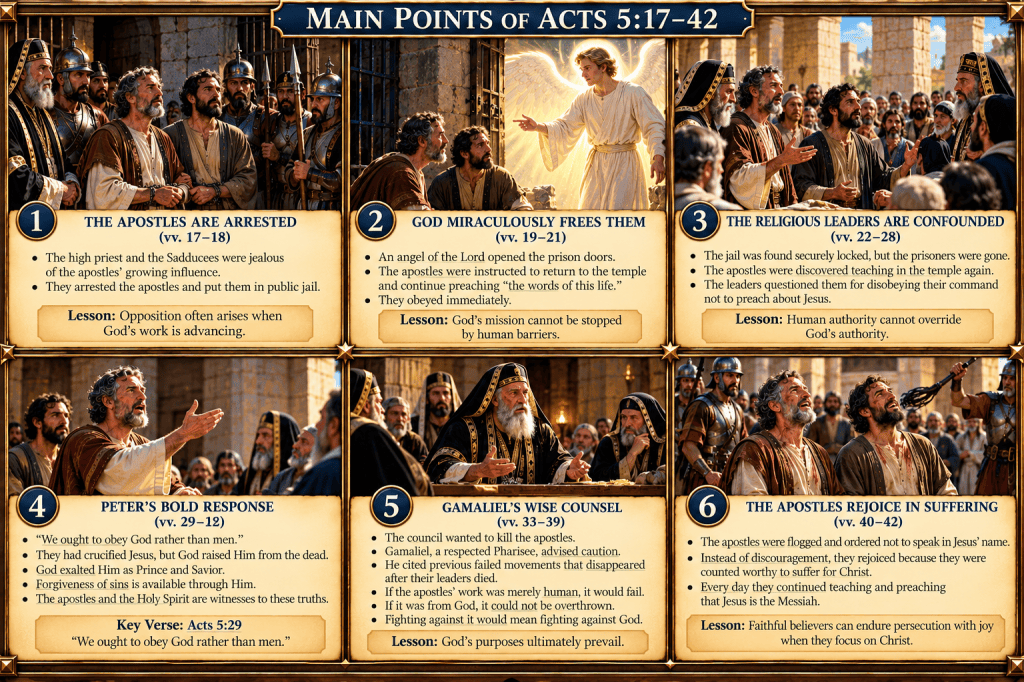
image Acts 5:17-42
New Testament Events Series
Event: nte014 The apostles Arrested and Freed (Acts 5:17–42)
Facilitator/Editor: Stephen Weller
Information Collection: ChatGPT
Bible Text: BibleGateway
1,735 words, 9 minutes read time
NT Event Index
Event Context
Context for Acts 5:17–42
Acts 5:17–42 takes place during a period of remarkable growth and increasing opposition in the early Jerusalem church. Immediately beforehand, the apostles were performing many signs and wonders, and increasing numbers of people were believing in the Lord (Acts 5:12–16). This success provoked the high priest and the Sadducees, who were filled with jealousy and had already warned Peter and John not to teach in the name of Jesus (Acts 4:18–21). They arrested the apostles and placed them in prison, but during the night an angel of the Lord released them and commanded them to return to the temple and continue proclaiming “the words of this Life.” When the apostles were brought again before the Sanhedrin, Peter boldly declared that obedience to God must take precedence over obedience to human authorities and again testified to Jesus’ death, resurrection, exaltation, and offer of repentance and forgiveness. The council became enraged and considered killing them, but the respected Pharisee Gamaliel urged caution, reasoning that if the apostles’ work were merely human it would fail, but if it were from God they would not be able to stop it. After being beaten and ordered once more not to speak in Jesus’ name, the apostles were released. Rather than being discouraged, they rejoiced that they had been counted worthy to suffer dishonor for Christ and continued teaching and preaching Jesus as the Christ every day, both in the temple and from house to house. The passage therefore demonstrates the unstoppable advance of the gospel, the apostles’ courageous obedience, God’s protection and sovereignty, and the willingness of Christ’s followers to suffer rather than abandon their witness.
Understanding the Event
Event Text
The Apostles Arrested and Freed
17 But the high priest rose up, and all who were with him (that is, the party of the Sadducees), and filled with jealousy 18 they arrested the apostles and put them in the public prison. 19 But during the night an angel of the Lord opened the prison doors and brought them out, and said, 20 “Go and stand in the temple and speak to the people all the words of this Life.” 21 And when they heard this, they entered the temple at daybreak and began to teach.
Now when the high priest came, and those who were with him, they called together the council, all the senate of the people of Israel, and sent to the prison to have them brought. 22 But when the officers came, they did not find them in the prison, so they returned and reported, 23 “We found the prison securely locked and the guards standing at the doors, but when we opened them we found no one inside.” 24 Now when the captain of the temple and the chief priests heard these words, they were greatly perplexed about them, wondering what this would come to. 25 And someone came and told them, “Look! The men whom you put in prison are standing in the temple and teaching the people.” 26 Then the captain with the officers went and brought them, but not by force, for they were afraid of being stoned by the people.
27 And when they had brought them, they set them before the council. And the high priest questioned them, 28 saying, “We strictly charged you not to teach in this name, yet here you have filled Jerusalem with your teaching, and you intend to bring this man’s blood upon us.” 29 But Peter and the apostles answered, “We must obey God rather than men. 30 The God of our fathers raised Jesus, whom you killed by hanging him on a tree. 31 God exalted him at his right hand as Leader and Savior, to give repentance to Israel and forgiveness of sins. 32 And we are witnesses to these things, and so is the Holy Spirit, whom God has given to those who obey him.”
33 When they heard this, they were enraged and wanted to kill them. 34 But a Pharisee in the council named Gamaliel, a teacher of the law held in honor by all the people, stood up and gave orders to put the men outside for a little while. 35 And he said to them, “Men of Israel, take care what you are about to do with these men. 36 For before these days Theudas rose up, claiming to be somebody, and a number of men, about four hundred, joined him. He was killed, and all who followed him were dispersed and came to nothing. 37 After him Judas the Galilean rose up in the days of the census and drew away some of the people after him. He too perished, and all who followed him were scattered. 38 So in the present case I tell you, keep away from these men and let them alone, for if this plan or this undertaking is of man, it will fail; 39 but if it is of God, you will not be able to overthrow them. You might even be found opposing God!” So they took his advice, 40 and when they had called in the apostles, they beat them and charged them not to speak in the name of Jesus, and let them go. 41 Then they left the presence of the council, rejoicing that they were counted worthy to suffer dishonor for the name. 42 And every day, in the temple and from house to house, they did not cease teaching and preaching that the Christ is Jesus
Questions with answers
1. Why did the high priest and the Sadducees become angry with the apostles?
Answer:
The high priest and the Sadducees were filled with jealousy because the apostles were attracting large crowds and exercising increasing influence among the people. The apostles were also boldly proclaiming the resurrection of Jesus—an especially troubling message for the Sadducees, who denied the resurrection. Their opposition therefore involved both theological disagreement and concern over their own authority. Instead of considering whether God might be working through the apostles, they responded by arresting them and placing them in public prison. Their reaction illustrates how jealousy and a desire to preserve power can blind people to the work of God.
2. What was significant about the angel releasing the apostles from prison?
Answer:
During the night, an angel of the Lord opened the prison doors and brought the apostles out. This demonstrated that human authorities could not prevent the mission God had given them. The religious leaders had the authority to imprison the apostles, but they did not have authority over God’s purposes. Significantly, the angel did not tell the apostles to escape Jerusalem or hide for their safety. Instead, he commanded them to return to the temple and continue proclaiming “all the words of this Life.” Their miraculous release was therefore not merely an act of rescue; it was God’s provision so that His mission could continue.
3. What does the apostles’ immediate return to the temple teach about obedience?
Answer:
The apostles returned to the temple at daybreak and began teaching, exactly as they had been commanded. They knew that returning to such a public location could result in their immediate rearrest, yet obedience to God mattered more than personal safety. Their response demonstrates courageous faith. They did not wait for circumstances to become safer or easier before obeying. When God’s command was clear, they acted. Their example teaches believers that genuine obedience is demonstrated most clearly when following God involves risk, sacrifice, or opposition.
4. Why were the religious leaders perplexed when they discovered that the apostles were no longer in prison?
Answer:
The officers found the prison securely locked and the guards standing at the doors, yet the apostles were gone. There was no ordinary explanation for their disappearance. The leaders were perplexed because the situation demonstrated that something beyond their control had occurred. Ironically, while they were trying to suppress evidence of God’s activity, God provided another remarkable demonstration of His power. The event emphasizes one of the major themes of Acts: no prison, threat, government, or religious authority can ultimately stop the advance of the gospel when God has determined that it will go forward.
5. Why did the officers bring the apostles before the council without using force?
Answer:
The officers feared that the people might stone them if they treated the apostles violently. The apostles had gained considerable respect among the population because of their teaching and the miraculous signs occurring through their ministry. This created an unusual reversal: although the religious authorities possessed official power, they were forced to proceed cautiously because the people recognized something extraordinary in the apostles’ ministry. God’s protection did not always mean removing opposition; sometimes it meant restraining the actions of those who opposed His servants.
6. What accusation did the high priest make against the apostles?
Answer:
The high priest reminded the apostles that they had been strictly commanded not to teach in Jesus’ name. Yet instead of obeying that prohibition, they had “filled Jerusalem” with their teaching. This accusation unintentionally provides a remarkable testimony to the effectiveness of the early church’s witness. The gospel had become so widely proclaimed that even its enemies acknowledged its influence throughout Jerusalem. The leaders were also disturbed that the apostles’ teaching placed responsibility for Jesus’ death upon them. They wanted the preaching stopped rather than confronting the truth of what the apostles were proclaiming.
7. What did Peter mean when he said, “We must obey God rather than men”?
Answer:
Peter was expressing the principle that God’s authority is supreme over every human authority. Christians are normally called to respect and obey governing authorities, but when human commands directly contradict God’s commands, obedience to God must take priority. Jesus had commanded the apostles to be His witnesses, while the Sanhedrin had commanded them to stop speaking about Jesus. They could not obey both. Therefore, the apostles respectfully but firmly chose obedience to God. Their statement was not an excuse for rebellion; it was a declaration of ultimate allegiance to God.
8. How did Peter summarize the gospel before the council?
Answer:
Peter presented the central message of the gospel in a remarkably concise form. The religious leaders had killed Jesus by hanging Him on a tree, but “the God of our fathers raised Jesus.” God then exalted Jesus at His right hand as “Leader and Savior,” providing repentance and forgiveness of sins. Peter therefore proclaimed Christ’s death, resurrection, exaltation, and saving work. Even while standing before hostile authorities, Peter did not soften the message. He confronted their sin while simultaneously declaring that forgiveness was available through the very Jesus they had rejected.
9. What role did the Holy Spirit have in the apostles’ witness?
Answer:
Peter declared that the apostles were witnesses of these events, “and so is the Holy Spirit, whom God has given to those who obey him.” The apostles testified from firsthand experience—they had seen the risen Christ. But their testimony was accompanied and empowered by the Holy Spirit. The growth of the church was therefore not simply the result of persuasive human preaching. God Himself, through the Holy Spirit, confirmed and empowered the message about Jesus. This explains the extraordinary courage of the apostles and the effectiveness of their witness despite intense opposition.
10. Who was Gamaliel, and why was his advice important?
Answer:
Gamaliel was a respected Pharisee and teacher of the law who was highly regarded by the people. Rather than immediately supporting the council’s desire to punish the apostles severely, he urged caution. He cited earlier movements led by Theudas and Judas the Galilean. After those leaders died, their followers scattered and their movements disappeared. Gamaliel therefore advised the council not to act rashly against the apostles. His reasoning was simple: if the Christian movement were merely human, it would eventually collapse on its own; if it were from God, the council would not be able to overthrow it.
11. What important principle is expressed in Gamaliel’s warning, “you might even be found opposing God”?
Answer:
Gamaliel recognized that there was a danger in fighting something that God Himself might be accomplishing. His words contain a profound warning: people should be very careful before setting themselves against what may genuinely be God’s work. Human beings cannot ultimately defeat God’s purposes. Throughout Acts, this principle becomes increasingly evident. Authorities imprison the apostles, threaten them, beat them, and later persecute the church, yet the gospel continues to spread. Opposition does not destroy God’s mission; remarkably, God often uses the opposition itself to advance His purposes.
12. Why were the apostles beaten before being released?
Answer:
Although the council accepted Gamaliel’s recommendation not to kill the apostles, it still attempted to intimidate them. The apostles were beaten and again commanded not to speak in the name of Jesus. The punishment was intended to discourage further preaching by attaching physical suffering to continued obedience. Yet the council misunderstood the depth of the apostles’ conviction. These men had encountered the risen Christ and had been commissioned by Him. Physical punishment could cause pain, but it could not erase what they had seen or silence what they had been commanded to proclaim.
13. Why did the apostles rejoice after being beaten?
Answer:
The apostles left the council “rejoicing that they were counted worthy to suffer dishonor for the name.” Their joy did not mean that suffering itself was pleasant. Rather, they understood their suffering as evidence that they were faithfully identified with Jesus. Christ Himself had been rejected, humiliated, and persecuted; therefore, suffering because of loyalty to Him was considered an honor. Their response reveals how completely their perspective had changed. Instead of measuring God’s faithfulness by comfort or freedom from hardship, they measured their lives by faithfulness to Christ.
14. Did the threats and beating cause the apostles to stop preaching?
Answer:
No. Acts 5:42 emphasizes that “every day, in the temple and from house to house, they did not cease teaching and preaching that the Christ is Jesus.” The council commanded silence, but the apostles responded with continued proclamation. Their ministry occurred both publicly in the temple and personally from house to house. The opposition therefore failed completely in its primary objective. Instead of silencing the gospel, persecution demonstrated the courage and conviction of its messengers.
15. What is the central lesson of Acts 5:17–42?
Answer:
The passage demonstrates that God’s mission cannot be stopped by human opposition. Prison doors could not contain the apostles, religious authorities could not silence them, threats could not intimidate them, and physical suffering could not destroy their joy. Their confidence rested not in their own strength but in the risen and exalted Jesus whom they proclaimed.
The passage also presents a powerful picture of Christian faithfulness: obey God above all, proclaim Christ boldly, trust God when opposition comes, and remain faithful even when obedience involves suffering. Acts 5:17–42 shows the gospel advancing precisely where its enemies were attempting to suppress it. What appeared to be an effort to silence the church instead became another opportunity for the apostles to testify that Jesus is the risen Leader and Savior who gives repentance and forgiveness of sins.


Leave a comment