image Acts 6:1-7
New Testament Events Series
Event: nte015 Seven Chosen to Serve (Acts 6:1–7)
Facilitator/Editor: Stephen Weller
Information Collection: ChatGPT
Bible Text: BibleGateway
2,575 words, 14 minutes read time
NT Event Index
Event Context
Context for Acts 6:1-7
Acts 6:1–7 takes place during a period of rapid growth in the early church at Jerusalem. As the number of disciples increased, a practical problem threatened the unity of the fellowship: the Hellenistic, or Greek-speaking, Jewish believers complained that their widows were being overlooked in the church’s daily distribution of food, while the Hebrew-speaking widows were being cared for. Recognizing both the seriousness of the problem and their primary calling to prayer and the ministry of the Word, the twelve apostles instructed the congregation to select seven respected men who were “of good repute, full of the Spirit and of wisdom” to oversee this responsibility. The church chose seven men, including Stephen and Philip, and the apostles prayed and laid their hands on them, affirming their appointment to this ministry. Rather than allowing a practical dispute to divide the growing church or distract the apostles from their God-given mission, the believers responded with wise organization, spiritual leadership, and shared responsibility. The result was continued growth: “the word of God continued to increase,” the number of disciples multiplied greatly in Jerusalem, and even many priests became obedient to the faith. Thus, Acts 6:1–7 demonstrates that the church advances most effectively when spiritual ministry and practical service are both valued, responsibilities are entrusted to qualified believers, and unity is preserved so that the proclamation of God’s Word can continue unhindered.
Understanding the Event
Event Text
Seven Chosen to Serve
6 Now in these days when the disciples were increasing in number, a complaint by the Hellenists[a] arose against the Hebrews because their widows were being neglected in the daily distribution. 2 And the twelve summoned the full number of the disciples and said, “It is not right that we should give up preaching the word of God to serve tables. 3 Therefore, brothers,[b] pick out from among you seven men of good repute, full of the Spirit and of wisdom, whom we will appoint to this duty. 4 But we will devote ourselves to prayer and to the ministry of the word.” 5 And what they said pleased the whole gathering, and they chose Stephen, a man full of faith and of the Holy Spirit, and Philip, and Prochorus, and Nicanor, and Timon, and Parmenas, and Nicolaus, a proselyte of Antioch. 6 These they set before the apostles, and they prayed and laid their hands on them.
7 And the word of God continued to increase, and the number of the disciples multiplied greatly in Jerusalem, and a great many of the priests became obedient to the faith.
Questions with answers
1. What problem arose within the growing church in Jerusalem?
Answer:
As the number of disciples increased, a complaint arose from the Hellenists against the Hebrews because the Hellenist widows were being neglected in the daily distribution of food (Acts 6:1). The Hellenists were Greek-speaking Jews, while the Hebrews were primarily Aramaic-speaking Jews who were more closely connected with traditional Jewish culture. The problem therefore involved both a practical need and a potential division within the church. Luke does not say that the neglect was intentional, but as the church grew, its ministry became increasingly difficult to administer fairly. The incident demonstrates that even a Spirit-filled church can experience organizational problems and interpersonal tensions. The important question is not whether difficulties arise, but whether God’s people respond to them with wisdom, fairness, and spiritual maturity.
2. Why did the twelve apostles say they should not give up preaching the Word of God to serve tables?
Answer:
The apostles were not suggesting that caring for widows or distributing food was unimportant. In fact, their response shows how seriously they regarded the problem. However, they recognized that God had given them a particular responsibility: prayer and the ministry of the Word (Acts 6:4). If they became responsible for every administrative need of the rapidly growing church, their primary calling would suffer. This establishes an important principle of ministry: every form of service matters, but not every believer is called to perform every task. Effective ministry requires recognizing different responsibilities and allowing qualified people to serve according to their calling and gifts.
3. What qualifications were required of the seven men chosen for this responsibility?
Answer:
The apostles instructed the believers to select “seven men of good repute, full of the Spirit and of wisdom” (Acts 6:3, ESV). These qualifications are significant because the responsibility involved much more than simply distributing food. The men needed a good reputation because they would be trusted with resources and would serve people who already believed they had been treated unfairly. They needed to be full of the Holy Spirit because Christian service must be spiritually grounded. They also needed wisdom because they would have to make fair and practical decisions. Acts therefore teaches that even seemingly ordinary ministries should be entrusted to people of proven character, spiritual maturity, and sound judgment.
4. Why was the whole congregation involved in selecting the seven men?
Answer:
The apostles established the qualifications, but they told the believers, “pick out from among you seven men” (Acts 6:3). This allowed the congregation to identify individuals whose character and reputation were already known within the Christian community. The apostles then formally appointed those selected. This reveals a cooperative pattern of leadership: the apostles provided spiritual direction and maintained oversight, while the congregation participated meaningfully in addressing the church’s needs. Rather than imposing a solution without consultation, the leaders involved the people most familiar with those who would serve.
5. Who were the seven men selected, and what may be significant about their names?
Answer:
The seven were Stephen, Philip, Prochorus, Nicanor, Timon, Parmenas, and Nicolaus, a proselyte from Antioch (Acts 6:5). All seven have Greek names, which may suggest that they were particularly connected with the Greek-speaking portion of the church, although Greek names alone do not prove that all seven were Hellenists. If they were, their selection would have been especially appropriate because the complaint had arisen from the Hellenistic believers. The church was not merely acknowledging the problem; it was entrusting responsibility to men who could command the confidence of those who felt overlooked. Stephen receives special emphasis as “a man full of faith and of the Holy Spirit.”
6. What was the significance of the apostles praying and laying their hands on the seven?
Answer:
After the seven were presented, the apostles prayed and laid their hands on them (Acts 6:6). Prayer demonstrated dependence upon God and acknowledged that this ministry was ultimately spiritual service performed for Him. The laying on of hands publicly identified these men with the ministry they were being entrusted to perform and expressed the apostles’ recognition and commissioning of them. Their work was therefore not treated as an insignificant administrative chore. Caring for vulnerable members of Christ’s church was a genuine ministry worthy of prayer, qualified servants, and public recognition.
7. What does this passage teach about the relationship between practical service and spiritual ministry?
Answer:
Acts 6:1–7 refuses to separate practical service from spiritual faithfulness. The apostles needed to devote themselves to prayer and teaching, while the seven needed to ensure that vulnerable widows received proper care. Both responsibilities were necessary for the health of the church. The distinction was not between important spiritual work and unimportant physical work, but between different responsibilities within the same body of believers. A healthy church needs faithful preaching and prayer, but it must also demonstrate the truth it proclaims through compassion, fairness, generosity, and practical care.
8. How did resolving the problem contribute to the continued growth of the church?
Answer:
Acts 6:7 immediately reports the result: “the word of God continued to increase, and the number of the disciples multiplied greatly in Jerusalem.” The church did not allow an internal dispute to distract it permanently from its mission. By addressing the practical problem wisely, responsibilities were distributed appropriately, unity was protected, neglected believers were cared for, and the apostles remained focused on prayer and the Word. The result was not merely better administration—it created conditions in which the gospel ministry continued to flourish. Good organization became a servant of spiritual mission rather than a substitute for it.
9. Why is the statement that “a great many of the priests became obedient to the faith” particularly significant?
Answer:
This statement shows how powerfully the gospel was penetrating Jerusalem. The priests were deeply connected with the temple, sacrifices, and established Jewish religious system. Yet many of them became “obedient to the faith” (Acts 6:7). Their conversion demonstrates that the message about Jesus was reaching even those whose lives were closely tied to the old covenant religious order. The expression “obedient to the faith” also reminds us that genuine faith involves more than intellectual agreement. These priests were responding to the gospel by acknowledging Jesus as the promised Messiah and submitting themselves to Him.
10. What central lesson does Acts 6:1–7 teach about a growing church?
Answer:
The passage teaches that spiritual growth requires both faithful proclamation and wise organization. Growth brought new opportunities, but it also created new pressures. The apostles did not ignore the complaint, nor did they abandon their primary calling to solve it personally. Instead, they established priorities, delegated responsibility to spiritually qualified people, and ensured that the vulnerable were cared for. The result was unity, effective ministry, and continued gospel expansion. Acts 6:1–7 therefore presents a powerful model: when God’s people combine prayer, the Word, Spirit-filled leadership, wise delegation, and compassionate service, practical challenges can become opportunities for greater ministry rather than obstacles to it.
Forming the Post Picture
Picture Formation
Me: What are the key points of Acts 6:1-7
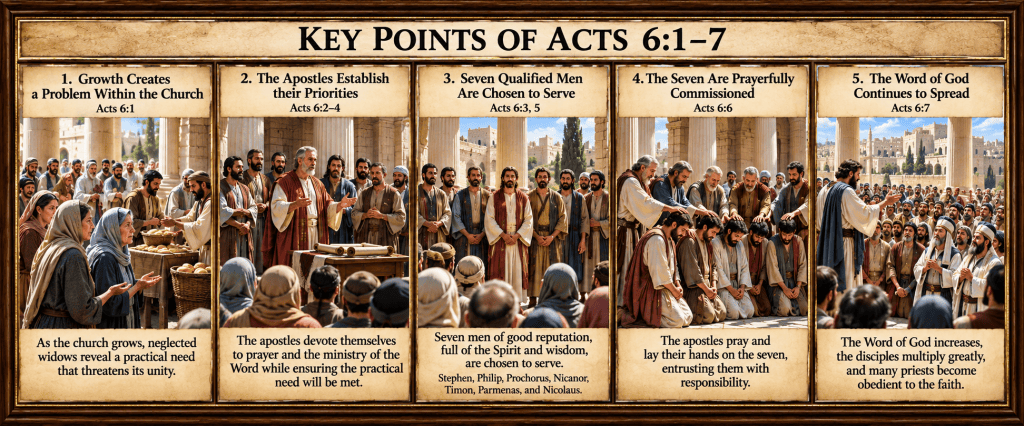
AI: Key Points of Acts 6:1–7
Acts 6:1–7 shows the early church confronting a practical problem that threatened its unity. Rather than allowing the problem to distract from its mission, the apostles establish a wise division of responsibility, resulting in continued spiritual and numerical growth.
1. Growth Creates a Problem Within the Church (v. 1)
- As the number of disciples increases, a complaint arises between the Hellenists (Greek-speaking Jews) and the Hebrews (primarily Aramaic-speaking Jews).
- The Hellenistic widows are being neglected in the daily distribution of food.
- The problem involves vulnerable members of the church and could easily create division.
Key idea: Even a growing, Spirit-filled church can experience practical problems and interpersonal tensions that must be addressed wisely.
2. The Apostles Protect Their Primary Calling (vv. 2–4)
- The Twelve gather the disciples to address the problem.
- They recognize that caring for the widows is important, but they should not neglect “the word of God” to administer the daily distribution.
- They determine that others should assume responsibility for this ministry.
- The apostles will devote themselves “to prayer and to the ministry of the word” (Acts 6:4, ESV).
Key idea: Effective ministry requires recognizing different responsibilities so that important needs are met without neglecting the church’s central spiritual mission.
3. Seven Qualified Men Are Chosen to Serve (vv. 3, 5)
- The congregation is instructed to select seven men of good repute, full of the Spirit and of wisdom.
- Stephen is particularly described as “a man full of faith and of the Holy Spirit.”
- Philip and five others are also selected.
- Their qualifications emphasize character and spiritual maturity, not merely administrative ability.
Key idea: Christian service requires trustworthy character, spiritual maturity, and wisdom as well as practical ability.
4. Responsibility Is Prayerfully Entrusted to Them (v. 6)
- The seven men are brought before the apostles.
- The apostles pray and lay their hands on them.
- This publicly recognizes and entrusts them with responsibility for the ministry.
Key idea: Ministry responsibilities are entrusted prayerfully and with clear recognition by the church.
5. The Word of God Continues to Spread (v. 7)
- Once the problem is wisely addressed, Luke returns immediately to the progress of the gospel.
- “The word of God continued to increase.”
- The number of disciples multiplies greatly in Jerusalem.
- Even “a great many of the priests became obedient to the faith.”
Key idea: Wise organization and shared ministry strengthen rather than distract from the church’s mission, allowing the gospel to continue advancing.
Summary
The passage follows a very clear progression:
Growth creates a need → leaders establish priorities → qualified servants are chosen → responsibility is shared → the gospel advances.
Acts 6:1–7 therefore demonstrates an important principle for the developing church: spiritual ministry and practical ministry are not competitors. When faithful people fulfill their God-given responsibilities, physical needs are cared for, unity is protected, leaders remain focused on prayer and God’s Word, and the church is strengthened for continued growth.
At this point, I have to evaluate how well the information will format and fit into the space of the picture. If there are too many points or not the right presentation, then I will have to make some changes and try again.
Me: How can these points be illustrated with a picture
AI: I think Acts 6:1–7 would work especially well in the same five-panel panoramic format we used for Acts 5:12–16. Each panel can show the passage progressing from a problem to its solution and then to gospel growth.
Suggested Picture — “Key Points of Acts 6:1–7”
1. Growth Creates a Problem — Acts 6:1
Show a large and growing group of believers in Jerusalem. In the foreground, several Greek-speaking widows wait while food is distributed to others, visually suggesting that they have unintentionally been overlooked.
Caption: As the church grows, neglected widows reveal a practical need that threatens its unity.
2. The Apostles Establish Their Priorities — Acts 6:2–4
Show the Twelve addressing the gathered believers. Include an open scroll representing God’s Word and perhaps several apostles praying in the background.
Caption: The apostles devote themselves to prayer and the ministry of the Word while ensuring that the practical need will be met.
3. Seven Qualified Men Are Chosen — Acts 6:3, 5
Show seven men standing before the congregation, with Stephen prominent but not isolated from the others. The congregation should appear supportive of their selection.
Caption: Seven men of good reputation, full of the Spirit and wisdom, are chosen to serve.
4. The Seven Are Prayerfully Commissioned — Acts 6:6
Show the apostles gathered around the seven men, praying and laying their hands upon them. This could be one of the strongest visual scenes in the picture.
Caption: The apostles pray and lay their hands on the seven, entrusting them with responsibility.
5. The Word of God Continues to Spread — Acts 6:7
Finish with a much larger gathering of believers listening as God’s Word is proclaimed. Include a few priests among those responding to the message, perhaps identifiable by their priestly clothing.
Caption: The Word of God increases, the disciples multiply greatly, and many priests become obedient to the faith.
Across the top:
KEY POINTS OF ACTS 6:1–7
The five panels would create a particularly good visual progression:
A Need Arises → Priorities Are Protected → Servants Are Chosen → Responsibility Is Shared → The Gospel Advances
I would keep the wood-and-gold frame, parchment headings, realistic biblical scenes, and five vertical panels from the Acts 5:12–16 picture. That would give these Acts lessons a consistent visual identity while allowing every passage to tell its own story.
Me: Provide the picture as suggested


Leave a comment