image Acts 6:8–15
New Testament Events Series
Event: nte016 Stephen is Seized (Acts 6:8–15)
Facilitator/Editor: Stephen Weller
Information Collection: ChatGPT
Bible Text: BibleGateway
2,046 words, 11 minutes read time
NT Event Index
Event Context
Context for Acts 6:8-15
Acts 6:8–15 shifts the focus from the growing ministry of the early church to Stephen, one of the seven men chosen to help meet the practical needs of the believers. Described as “full of grace and power” (Acts 6:8, ESV), Stephen’s ministry extends beyond serving tables as God works great wonders and signs through him and gives him remarkable wisdom in proclaiming the gospel. Opposition soon arises from members of the Synagogue of the Freedmen, but they are unable to withstand “the wisdom and the Spirit with which he was speaking” (v. 10). Unable to defeat Stephen through honest debate, his opponents secretly persuade men to accuse him falsely of speaking against Moses, God, the temple, and the law. Stephen is seized and brought before the Jewish council, where false witnesses distort his teaching about Jesus. Yet in the midst of these hostile accusations, Stephen remains under God’s evident presence: those sitting in the council see that “his face was like the face of an angel” (v. 15). This passage prepares the way for Stephen’s powerful defense in Acts 7 and ultimately his martyrdom, while emphasizing that faithful witness to Christ may provoke opposition, but the Holy Spirit supplies wisdom, courage, and grace to those who remain faithful.
Understanding the Event
Event Text
Stephen Is Seized
8 And Stephen, full of grace and power, was doing great wonders and signs among the people. 9 Then some of those who belonged to the synagogue of the Freedmen (as it was called), and of the Cyrenians, and of the Alexandrians, and of those from Cilicia and Asia, rose up and disputed with Stephen. 10 But they could not withstand the wisdom and the Spirit with which he was speaking. 11 Then they secretly instigated men who said, “We have heard him speak blasphemous words against Moses and God.” 12 And they stirred up the people and the elders and the scribes, and they came upon him and seized him and brought him before the council, 13 and they set up false witnesses who said, “This man never ceases to speak words against this holy place and the law, 14 for we have heard him say that this Jesus of Nazareth will destroy this place and will change the customs that Moses delivered to us.” 15 And gazing at him, all who sat in the council saw that his face was like the face of an angel.
Questions with answers
Acts 6:8–15 — Questions of Understanding with Extended Answers
1. What distinguished Stephen’s ministry among the early believers?
Answer:
Acts 6:8 describes Stephen as being “full of grace and power” and performing “great wonders and signs among the people.” Stephen had already been identified as a man “full of faith and of the Holy Spirit” (Acts 6:5). Although he had been appointed to help meet practical needs within the church, his ministry was not limited to service at tables. God also used him as a powerful witness for Christ. Stephen demonstrates that there is no sharp division between practical Christian service and spiritual ministry. A believer faithfully serving wherever God places him may also become a powerful instrument for proclaiming the gospel.
2. Who opposed Stephen, and why were they unable to overcome him in debate?
Answer:
Members of the Synagogue of the Freedmen, together with people associated with Cyrene, Alexandria, Cilicia, and Asia, disputed with Stephen (Acts 6:9). Yet verse 10 says, “they could not withstand the wisdom and the Spirit with which he was speaking.” Stephen’s effectiveness did not come merely from intelligence or debating skill. His understanding of Scripture and his testimony concerning Christ were empowered by the Holy Spirit. His opponents could challenge him, but they could not successfully refute the truth he proclaimed.
3. What did Stephen’s opponents do when they could not defeat his message?
Answer:
Unable to overcome Stephen through honest argument, they turned to deception. They secretly persuaded men to claim, “We have heard him speak blasphemous words against Moses and God” (Acts 6:11). They then stirred up the people, elders, and scribes against him. This reveals an important progression: when Stephen’s opponents could not defeat the truth, they attacked the messenger. Their response shows how resistance to God’s truth can move from disagreement to distortion and finally to persecution.
4. What accusations were brought against Stephen?
Answer:
False witnesses accused Stephen of continually speaking “against this holy place and the law” (Acts 6:13). They further claimed that Stephen taught that Jesus would destroy the temple and change the customs Moses had delivered to Israel. These charges probably distorted truths Stephen had actually taught about Jesus and the fulfillment of the Old Testament in Him. Stephen was not attacking God’s revelation through Moses; rather, he was proclaiming that God’s redemptive purposes pointed ultimately to Christ. His lengthy defense in Acts 7 would demonstrate that he understood Israel’s history deeply and honored the true purpose of God’s revelation.
5. Why were accusations concerning the temple and the law so serious?
Answer:
The temple and the Law of Moses stood at the heart of Jewish religious life. To speak against either could be regarded as an attack upon Israel’s covenant identity and even upon God Himself. By framing Stephen’s teaching in these terms, his opponents made him appear dangerous to the entire religious community. The accusations were especially effective because they appealed not simply to theological disagreement but to deeply held traditions and loyalties. Stephen’s proclamation of Christ challenged the assumption that devotion to established religious institutions was sufficient apart from receiving the Messiah to whom Scripture pointed.
6. How does Stephen’s experience resemble the trial of Jesus?
Answer:
There are striking parallels. Both Jesus and Stephen faced hostile religious opposition, both were confronted with false witnesses, and both were accused in connection with the temple. In each case, opponents distorted their words in order to construct charges against them. Stephen’s experience therefore begins to show what Jesus had warned His disciples to expect: following Him could bring believers into conflict with those who rejected His message. Stephen was not suffering because he had abandoned Christ’s way; he was suffering precisely because he was faithfully following it.
7. What is significant about the description of Stephen’s face in Acts 6:15?
Answer:
As the council looked at Stephen, “they saw that his face was like the face of an angel.” The description suggests a visible serenity and divine confirmation resting upon Stephen at the very moment he was being falsely accused. Instead of appearing frightened, bitter, or defeated, Stephen stood before his accusers with evidence of God’s presence upon him. There may also be an intentional connection with Moses, whose face reflected God’s glory after being in God’s presence (Exodus 34:29–35). This would be especially significant because Stephen was being accused of speaking against Moses.
8. What does Stephen’s response teach about facing opposition for one’s faith?
Answer:
Stephen demonstrates that faithfulness does not require retaliation, anger, or fear. He did not compromise the truth to escape opposition, nor did he respond to false accusations with uncontrolled hostility. He remained dependent upon the Holy Spirit and prepared to give an account of God’s work through Israel’s history. His example teaches believers that courage comes not merely from confidence in ourselves but from confidence in God. Opposition may control the circumstances surrounding a believer, but it cannot control the believer’s faithfulness to Christ.
9. What does this passage teach about the relationship between the Holy Spirit and Christian witness?
Answer:
The Holy Spirit was central to Stephen’s entire ministry. He was chosen because he was “full of the Spirit and of wisdom” (Acts 6:3), described as “full of faith and of the Holy Spirit” (6:5), and now his opponents could not withstand “the wisdom and the Spirit with which he was speaking” (6:10). Luke repeatedly emphasizes that Stephen’s effectiveness came from God’s presence and power. Christian witness is therefore more than presenting correct information; it involves speaking God’s truth while depending upon the Holy Spirit for wisdom, courage, and faithfulness.
10. How does Acts 6:8–15 prepare us for Stephen’s speech and martyrdom in Acts 7?
Answer:
This passage establishes the conflict that leads directly into Acts 7. Stephen has been accused of rejecting Moses, the law, and the temple. His defense will therefore review Israel’s history—from Abraham through Joseph and Moses to the tabernacle and temple—to demonstrate that God’s activity has never been confined to one place or institution. More importantly, Stephen will show that Israel repeatedly resisted God’s appointed messengers and has now rejected the Righteous One, Jesus Christ. Acts 6:8–15 therefore sets the stage for Stephen’s final testimony: the accused man will become the witness, and those sitting in judgment over him will ultimately find themselves confronted by God’s truth.
Central Understanding
Acts 6:8–15 presents Stephen as a Spirit-filled servant whose faithful witness to Christ brings increasing opposition. His enemies cannot defeat the wisdom of his message, so they resort to false testimony. Yet even while standing before the council, Stephen displays the unmistakable evidence of God’s presence. The passage prepares us for one of Acts’ great turning points: Stephen will faithfully proclaim Christ even when that faithfulness costs him his life.
Formation of Post Picture
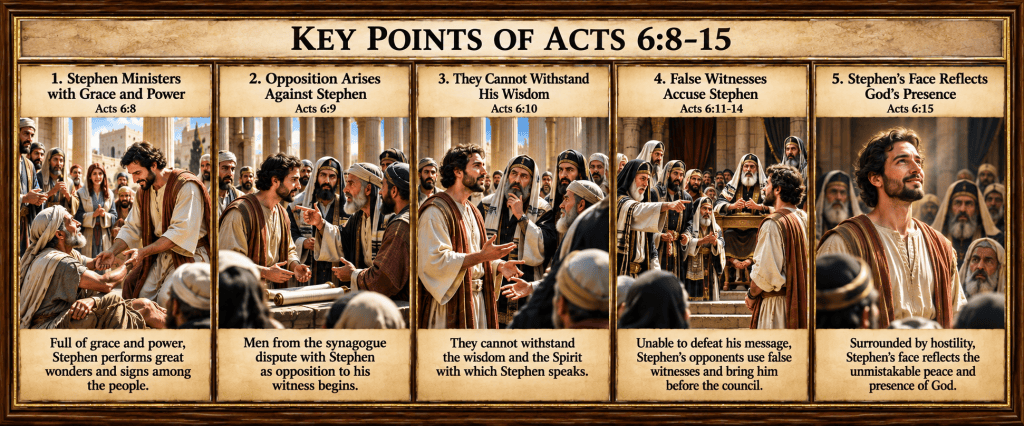
Key Points of Acts 6:8–15
Acts 6:8–15 shifts attention from Stephen’s appointment to serve the church to his powerful public ministry. His Spirit-filled witness produces both remarkable works and intense opposition, setting the stage for his defense before the Sanhedrin in Acts 7.
1. Stephen Ministers with Grace and Power (v. 8)
- Stephen is described as “full of grace and power.”
- God works great wonders and signs among the people through him.
- Stephen demonstrates that his ministry extends beyond caring for practical needs; he also becomes a powerful witness for Christ.
Key idea: God uses Spirit-filled servants in ways that may extend far beyond their original responsibilities.
2. Opposition Arises Against Stephen (v. 9)
- Members of the Synagogue of the Freedmen, together with others from Cyrene, Alexandria, Cilicia, and Asia, begin disputing with Stephen.
- Stephen’s faithful proclamation of Christ brings him into direct conflict with those who reject his message.
Key idea: Powerful gospel witness often produces opposition from those unwilling to accept its message.
3. Stephen’s Opponents Cannot Overcome His Wisdom (v. 10)
- Stephen speaks with extraordinary wisdom.
- His opponents are “not able to withstand the wisdom and the Spirit with which he was speaking.”
- His effectiveness comes not merely from intellectual ability but from the Holy Spirit working through him.
Key idea: Spirit-given wisdom enables believers to stand firmly when their faith is challenged.
4. False Accusations Are Made Against Stephen (vv. 11–14)
- Unable to defeat Stephen through honest debate, his opponents secretly persuade men to accuse him falsely.
- They claim he has spoken blasphemous words against Moses and God.
- The people, elders, and scribes are stirred up against him.
- Stephen is seized and brought before the council.
- False witnesses accuse him of speaking against the temple and the law, claiming that Jesus will destroy the temple and change the customs given through Moses.
Key idea: When Stephen’s opponents cannot defeat the truth of his message, they turn to deception and false testimony.
5. Stephen’s Face Reflects God’s Presence (v. 15)
- Everyone sitting in the council looks intently at Stephen.
- They see that “his face was like the face of an angel.”
- Rather than appearing terrified or defeated, Stephen visibly displays an extraordinary calmness associated with God’s presence.
- The description also prepares for Acts 7, where Stephen will boldly testify before the council.
Key idea: Even while surrounded by hostility and false accusations, Stephen remains under God’s presence and power.
Summary
The passage follows a striking progression:
Spirit-filled ministry → opposition → Spirit-given wisdom → false accusations → visible evidence of God’s presence.
Acts 6:8–15 presents Stephen as a man who is full of grace, power, wisdom, and the Holy Spirit. His opponents can arrest him and falsely accuse him, but they cannot overcome the wisdom God has given him or remove God’s presence from him.


Leave a comment