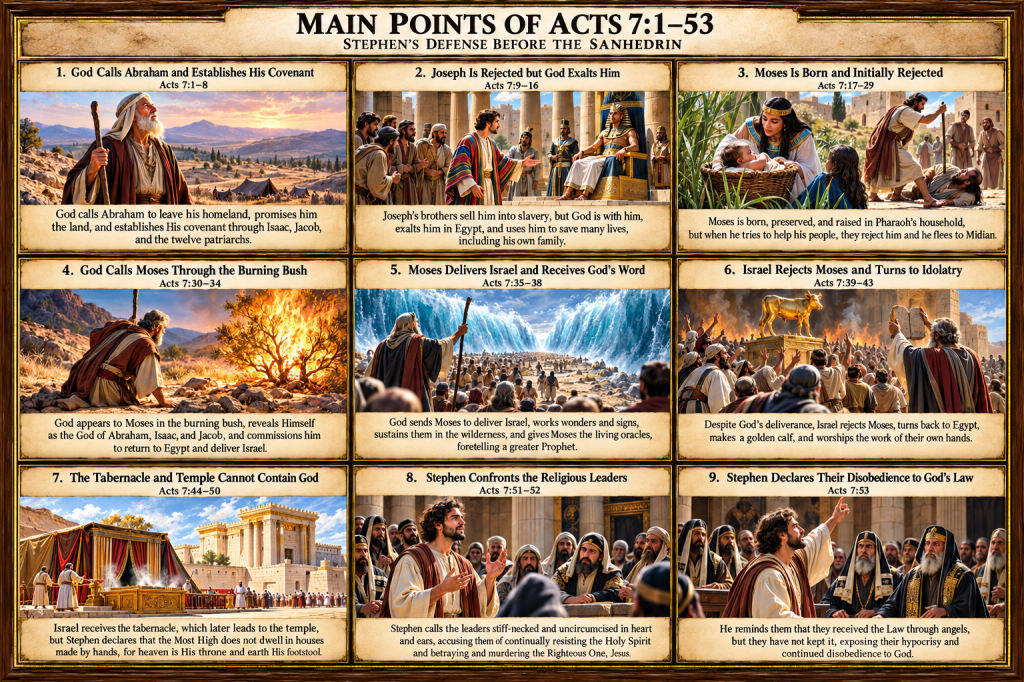
image Acts 7:1-53
New Testament Events Series
Event: nte017 Stephen’s Speech (Acts 7:1–53)
Facilitator/Editor: Stephen Weller
Information Collection: ChatGPT
Bible Text: BibleGateway
1,735 words, 9 minutes read time
NT Event Index
Event Context
Context for Acts 7:1–53
Acts 7:1–53 records Stephen’s powerful defense before the Jewish Sanhedrin after he was falsely accused of speaking against Moses, the Law, and the temple (Acts 6:11–14). Rather than directly defending himself against these accusations, Stephen presents a sweeping review of Israel’s history, beginning with God’s call of Abraham, continuing through the lives of Joseph and Moses, and concluding with the tabernacle and Solomon’s temple. Through these historical accounts, Stephen demonstrates that God’s presence and purposes have never been confined to a particular land, building, or religious institution. He emphasizes how Israel repeatedly rejected the leaders and deliverers God appointed, including Joseph, who was rejected by his brothers, and Moses, whom the Israelites initially refused to recognize as their deliverer. These examples establish a pattern of resistance to God’s authority that ultimately culminated in the rejection and betrayal of Jesus Christ, whom Stephen identifies as the Righteous One. Stephen also explains that although God permitted the construction of the temple, the Most High does not dwell in houses made by human hands, emphasizing God’s sovereignty over all creation. His speech reaches its climax when he confronts the religious leaders for resisting the Holy Spirit, persecuting God’s prophets, and failing to obey the Law they claimed to honor. This passage marks a significant turning point in the early church, revealing that God’s redemptive plan extends beyond the boundaries of Jewish religious institutions and that Jesus Christ is the fulfillment of God’s promises throughout Israel’s history. Stephen’s testimony also prepares the way for his martyrdom (Acts 7:54–60) and the subsequent spread of the gospel beyond Jerusalem (Acts 8:1–4).
Understanding the Event
Event Text
Stephen’s Speech
7 And the high priest said, “Are these things so?” 2 And Stephen said:
“Brothers and fathers, hear me. The God of glory appeared to our father Abraham when he was in Mesopotamia, before he lived in Haran, 3 and said to him, ‘Go out from your land and from your kindred and go into the land that I will show you.’ 4 Then he went out from the land of the Chaldeans and lived in Haran. And after his father died, God removed him from there into this land in which you are now living. 5 Yet he gave him no inheritance in it, not even a foot’s length, but promised to give it to him as a possession and to his offspring after him, though he had no child. 6 And God spoke to this effect—that his offspring would be sojourners in a land belonging to others, who would enslave them and afflict them four hundred years. 7 ‘But I will judge the nation that they serve,’ said God, ‘and after that they shall come out and worship me in this place.’ 8 And he gave him the covenant of circumcision. And so Abraham became the father of Isaac, and circumcised him on the eighth day, and Isaac became the father of Jacob, and Jacob of the twelve patriarchs.
9 “And the patriarchs, jealous of Joseph, sold him into Egypt; but God was with him 10 and rescued him out of all his afflictions and gave him favor and wisdom before Pharaoh, king of Egypt, who made him ruler over Egypt and over all his household. 11 Now there came a famine throughout all Egypt and Canaan, and great affliction, and our fathers could find no food. 12 But when Jacob heard that there was grain in Egypt, he sent out our fathers on their first visit. 13 And on the second visit Joseph made himself known to his brothers, and Joseph’s family became known to Pharaoh. 14 And Joseph sent and summoned Jacob his father and all his kindred, seventy-five persons in all. 15 And Jacob went down into Egypt, and he died, he and our fathers, 16 and they were carried back to Shechem and laid in the tomb that Abraham had bought for a sum of silver from the sons of Hamor in Shechem.
17 “But as the time of the promise drew near, which God had granted to Abraham, the people increased and multiplied in Egypt 18 until there arose over Egypt another king who did not know Joseph. 19 He dealt shrewdly with our race and forced our fathers to expose their infants, so that they would not be kept alive. 20 At this time Moses was born; and he was beautiful in God’s sight. And he was brought up for three months in his father’s house, 21 and when he was exposed, Pharaoh’s daughter adopted him and brought him up as her own son. 22 And Moses was instructed in all the wisdom of the Egyptians, and he was mighty in his words and deeds.
23 “When he was forty years old, it came into his heart to visit his brothers, the children of Israel. 24 And seeing one of them being wronged, he defended the oppressed man and avenged him by striking down the Egyptian. 25 He supposed that his brothers would understand that God was giving them salvation by his hand, but they did not understand. 26 And on the following day he appeared to them as they were quarreling and tried to reconcile them, saying, ‘Men, you are brothers. Why do you wrong each other?’ 27 But the man who was wronging his neighbor thrust him aside, saying, ‘Who made you a ruler and a judge over us? 28 Do you want to kill me as you killed the Egyptian yesterday?’ 29 At this retort Moses fled and became an exile in the land of Midian, where he became the father of two sons.
30 “Now when forty years had passed, an angel appeared to him in the wilderness of Mount Sinai, in a flame of fire in a bush. 31 When Moses saw it, he was amazed at the sight, and as he drew near to look, there came the voice of the Lord: 32 ‘I am the God of your fathers, the God of Abraham and of Isaac and of Jacob.’ And Moses trembled and did not dare to look. 33 Then the Lord said to him, ‘Take off the sandals from your feet, for the place where you are standing is holy ground. 34 I have surely seen the affliction of my people who are in Egypt, and have heard their groaning, and I have come down to deliver them. And now come, I will send you to Egypt.’
35 “This Moses, whom they rejected, saying, ‘Who made you a ruler and a judge?’—this man God sent as both ruler and redeemer by the hand of the angel who appeared to him in the bush. 36 This man led them out, performing wonders and signs in Egypt and at the Red Sea and in the wilderness for forty years. 37 This is the Moses who said to the Israelites, ‘God will raise up for you a prophet like me from your brothers.’ 38 This is the one who was in the congregation in the wilderness with the angel who spoke to him at Mount Sinai, and with our fathers. He received living oracles to give to us. 39 Our fathers refused to obey him, but thrust him aside, and in their hearts they turned to Egypt, 40 saying to Aaron, ‘Make for us gods who will go before us. As for this Moses who led us out from the land of Egypt, we do not know what has become of him.’ 41 And they made a calf in those days, and offered a sacrifice to the idol and were rejoicing in the works of their hands. 42 But God turned away and gave them over to worship the host of heaven, as it is written in the book of the prophets:
“‘Did you bring to me slain beasts and sacrifices,
during the forty years in the wilderness, O house of Israel?
43 You took up the tent of Moloch
and the star of your god Rephan,
the images that you made to worship;
and I will send you into exile beyond Babylon.’
44 “Our fathers had the tent of witness in the wilderness, just as he who spoke to Moses directed him to make it, according to the pattern that he had seen. 45 Our fathers in turn brought it in with Joshua when they dispossessed the nations that God drove out before our fathers. So it was until the days of David, 46 who found favor in the sight of God and asked to find a dwelling place for the God of Jacob.[a] 47 But it was Solomon who built a house for him. 48 Yet the Most High does not dwell in houses made by hands, as the prophet says,
49 “‘Heaven is my throne,
and the earth is my footstool.
What kind of house will you build for me, says the Lord,
or what is the place of my rest?
50 Did not my hand make all these things?’
51 “You stiff-necked people, uncircumcised in heart and ears, you always resist the Holy Spirit. As your fathers did, so do you. 52 Which of the prophets did your fathers not persecute? And they killed those who announced beforehand the coming of the Righteous One, whom you have now betrayed and murdered, 53 you who received the law as delivered by angels and did not keep it.”
Questions with answers
1. Why did Stephen begin his defense by recounting Israel’s history rather than directly answering the accusations against him? (Acts 7:1–2)
Answer: Stephen had been accused of speaking against Moses, God, the temple, and the Law (Acts 6:11–14). Rather than simply denying these accusations, he presented a carefully constructed account of Israel’s history to demonstrate that he understood and honored God’s revelation. Beginning with Abraham, Stephen showed that God had been faithfully working through His people long before the temple existed and even before Israel occupied the Promised Land. His defense established that God’s presence and purposes were never restricted to a particular building or geographical location. As Stephen continued, he revealed a recurring pattern: God raised up individuals to accomplish His purposes, but His people frequently resisted or rejected them. By presenting this history, Stephen turned the accusations back upon his accusers, demonstrating that their rejection of Jesus continued the same pattern of resisting God’s messengers. His speech was therefore both a defense of the gospel and a prophetic confrontation with Israel’s religious leaders.
2. What does God’s calling of Abraham reveal about His sovereignty and covenant faithfulness? (Acts 7:2–8)
Answer: Stephen began with God’s appearance to Abraham while he was still in Mesopotamia, before he settled in Haran. This demonstrated that God’s presence and revelation were not limited to the land of Israel. God sovereignly called Abraham to leave his homeland and journey to a place that He would reveal. Although Abraham did not immediately receive possession of the promised inheritance, God assured him that his descendants would eventually inherit the land. God also foretold their enslavement and suffering before their deliverance. These promises revealed God’s complete knowledge of future events and His authority over history. The covenant of circumcision further demonstrated God’s commitment to Abraham and his descendants. Stephen emphasized that God’s covenant purposes began through divine initiative rather than human achievement. Abraham’s experience teaches that faith involves trusting God’s promises even when their fulfillment lies beyond one’s lifetime.
3. How does the story of Joseph illustrate God’s providence and the rejection of His chosen servants? (Acts 7:9–16)
Answer: Joseph’s brothers became jealous of him and sold him into slavery in Egypt, demonstrating how jealousy and unbelief can lead people to reject someone through whom God intends to work. Yet Stephen emphasized that God was with Joseph throughout his suffering. Although Joseph experienced betrayal, slavery, and imprisonment, God delivered him from his afflictions and granted him favor and wisdom before Pharaoh. Joseph eventually became ruler over Egypt and was positioned to preserve his family during a severe famine. What his brothers intended for harm, God used to accomplish His purposes. Stephen’s inclusion of Joseph was especially significant because Joseph was initially rejected by his own brothers but later became their deliverer. This pattern anticipated the rejection of Jesus by His own people and His exaltation through God’s power. Joseph’s life demonstrates that human opposition cannot overturn God’s sovereign plan and that God often accomplishes His greatest purposes through circumstances that initially appear disastrous.
4. Why was Moses initially rejected by his own people, and what does this reveal about Israel’s history? (Acts 7:17–29)
Answer: As the time approached for God to fulfill His promise to Abraham, the Israelites experienced increasing oppression in Egypt. Moses was born during this period and was preserved through God’s providence. After being raised in Pharaoh’s household and educated in Egyptian wisdom, Moses attempted to defend an Israelite who was being mistreated. He believed his fellow Israelites would understand that God was using him to bring deliverance, but they did not recognize his role. When Moses attempted to reconcile two Israelites, one challenged his authority, asking who had made him a ruler and judge. Moses subsequently fled to Midian. Stephen emphasized this rejection because it illustrated a recurring problem in Israel’s history: God’s chosen servants were frequently misunderstood or rejected by the very people they were called to help. Moses’ experience foreshadowed the rejection of Jesus, whom God sent as the ultimate Deliverer. The account also reminds believers that God’s calling may precede the visible fulfillment of His purposes by many years.
5. What is the significance of God’s appearance to Moses in the burning bush? (Acts 7:30–34)
Answer: Forty years after Moses fled Egypt, God appeared to him in the wilderness near Mount Sinai through an angel in the flame of a burning bush. God identified Himself as the God of Abraham, Isaac, and Jacob, demonstrating the continuity of His covenant promises across generations. He declared that He had seen the affliction of His people, heard their groaning, and had come down to deliver them. This revelation emphasized God’s compassion, faithfulness, and personal involvement in the suffering of His people. God instructed Moses to remove his sandals because the place where he stood was holy ground. This detail was especially important to Stephen’s argument because the encounter occurred outside Israel and centuries before the temple was constructed. The ground was holy because God was present, not because a religious structure stood there. Stephen used this event to demonstrate that God’s holiness and presence cannot be confined to the temple or any particular geographical location.
6. How did God demonstrate His authority by appointing the very Moses whom Israel had rejected? (Acts 7:35–36)
Answer: Stephen emphasized that the Moses whom the Israelites had rejected with the question, “Who made you a ruler and a judge?” was the very man whom God appointed as their ruler and redeemer. This contrast revealed the difference between human judgment and divine appointment. The Israelites initially failed to recognize Moses’ authority, but God established him as the instrument of their deliverance. Through Moses, God performed signs and wonders in Egypt, at the Red Sea, and throughout the wilderness for forty years. These miracles confirmed that Moses’ authority came from God rather than human approval. Stephen’s emphasis was deliberate: just as Israel rejected Moses before recognizing his God-given role, the religious leaders had rejected Jesus, whom God appointed as Savior and Lord. The passage teaches that God’s purposes do not depend upon human acceptance and that rejecting His appointed servants can amount to resisting His authority.
7. What is the significance of Moses’ prophecy about a future prophet like himself? (Acts 7:37)
Answer: Stephen reminded his listeners that Moses had declared God would raise up a prophet like him from among the Israelites, referring to the promise recorded in Deuteronomy 18:15. This prophecy was central to Stephen’s defense because his accusers claimed that he spoke against Moses. Stephen demonstrated that truly honoring Moses required recognizing the One to whom Moses pointed. In the New Testament, this promised prophet is identified with Jesus Christ (Acts 3:22–23). Like Moses, Jesus was sent by God to deliver His people, reveal divine truth, and establish a covenant relationship. Yet Jesus was greater than Moses because His deliverance addressed humanity’s deepest problem—sin and separation from God. By rejecting Jesus, Israel’s leaders were not defending Moses’ teaching but resisting its fulfillment. Stephen’s argument showed that the Law and the prophets ultimately directed attention toward Christ, making faith in Him the proper response to God’s revelation.
8. Why did the Israelites reject Moses even after witnessing God’s miraculous deliverance? (Acts 7:38–41)
Answer: Despite witnessing God’s mighty acts in Egypt and at the Red Sea, the Israelites repeatedly resisted Moses’ leadership. Stephen explained that they refused to obey him and turned their hearts back toward Egypt. Their physical deliverance from slavery had not produced complete spiritual obedience. While Moses was receiving God’s commandments, the people demanded that Aaron make gods to lead them. They fashioned a golden calf, offered sacrifices to it, and celebrated the work of their own hands. Their actions revealed a preference for visible idols over trusting the invisible God who had delivered them. Stephen used this incident to demonstrate that religious privilege and miraculous experiences do not automatically produce faithful hearts. Israel’s rebellion was fundamentally a rejection of God’s authority. The same danger confronted Stephen’s listeners, who possessed the Law and temple worship but resisted the One to whom the Scriptures pointed. True faith requires more than witnessing God’s works; it requires trusting and obeying Him.
9. What does Israel’s idolatry in the wilderness teach about the consequences of persistent rebellion? (Acts 7:42–43)
Answer: Stephen explained that Israel’s continued rebellion resulted in God’s judgment. Because the people repeatedly turned away from Him, God gave them over to the worship of heavenly bodies and false gods. Stephen quoted the prophet Amos to demonstrate that idolatry had been a longstanding problem among God’s covenant people. Their outward religious practices did not necessarily reflect genuine devotion to the Lord. Even while offering sacrifices, their hearts were frequently drawn toward idols. The reference to exile beyond Babylon, reflecting Stephen’s use of the Greek wording of Amos, emphasized the ultimate consequences of persistent unfaithfulness. God had repeatedly warned Israel that covenant disobedience would bring judgment, and their history demonstrated the seriousness of those warnings. This passage teaches that rejecting God’s truth can lead to deeper spiritual blindness and increasingly destructive patterns of worship. It also reminds believers that genuine worship requires exclusive devotion to God rather than merely maintaining outward religious traditions.
10. Why did Stephen mention the tabernacle in the wilderness? (Acts 7:44–45)
Answer: Stephen referred to the tabernacle to demonstrate that God had established a place of worship for Israel long before Solomon constructed the temple. The tabernacle was built according to the pattern God revealed to Moses, making it an expression of divine instruction rather than human invention. It accompanied Israel during the wilderness journey and was later brought into the Promised Land. This movable sanctuary demonstrated that God’s presence with His people was not permanently tied to a single geographical location. The tabernacle served as a witness to God’s covenant relationship with Israel and His willingness to dwell among them. By including this history, Stephen showed that he respected God’s appointed means of worship while challenging the assumption that the Jerusalem temple was the exclusive location of divine activity. The central issue was not whether the temple had value, but whether Israel understood that God Himself was greater than any structure built for His worship.
11. What distinction did Stephen make between Solomon’s temple and God’s true dwelling place? (Acts 7:46–50)
Answer: Stephen acknowledged that David found favor with God and desired to provide a dwelling place associated with His worship. Solomon subsequently built the temple, fulfilling an important purpose in Israel’s religious life. However, Stephen emphasized that the Most High does not dwell in houses made by human hands. Quoting Isaiah 66:1–2, he reminded his listeners that heaven is God’s throne and earth is His footstool. Since God created all things, no earthly building can contain Him. Stephen was not declaring that the temple had been illegitimate or without spiritual significance. Rather, he challenged the mistaken belief that possessing the temple guaranteed God’s favor or restricted His presence. The temple was intended to direct worship toward God, not replace a living relationship with Him. This distinction prepared Stephen’s listeners to understand that God’s redemptive purposes were being fulfilled through Jesus Christ and could not be confined to Jerusalem’s religious institutions.
12. Why did Stephen suddenly confront the religious leaders with such strong accusations? (Acts 7:51)
Answer: After reviewing Israel’s history, Stephen directly confronted the religious leaders, calling them stiff-necked and uncircumcised in heart and ears. His language echoed the Old Testament prophets, who frequently rebuked Israel for stubbornness and spiritual rebellion. Although Stephen’s listeners were physically circumcised and identified themselves as God’s covenant people, he declared that their inward attitudes contradicted their outward religious identity. They possessed the Scriptures and maintained religious traditions, yet resisted the Holy Spirit’s testimony. Stephen’s confrontation was not an unrelated outburst but the conclusion of his historical argument. Just as previous generations had resisted God’s messengers, the present leaders were continuing that pattern by rejecting Jesus. His words demonstrated that outward religious observance cannot substitute for inward submission to God. True covenant faithfulness requires hearts that receive His Word, recognize His authority, and respond in obedience.
13. How did Israel’s treatment of the prophets prepare the way for the rejection of Jesus Christ? (Acts 7:52)
Answer: Stephen asked which of the prophets Israel’s ancestors had not persecuted, emphasizing the repeated opposition faced by those who proclaimed God’s truth. Throughout Israel’s history, prophets were rejected, mistreated, and sometimes killed because their messages challenged disobedience and called the people to repentance. Some of these prophets foretold the coming of the Righteous One, a title Stephen applied to Jesus Christ. Yet the religious leaders had betrayed and murdered the very Messiah whose coming the prophets announced. Stephen thus connected Israel’s past resistance to God’s messengers with its climactic rejection of Jesus. The accusation was particularly serious because the leaders claimed to defend the Law and honor the prophets while opposing the fulfillment of their message. Stephen’s argument demonstrated that genuine faithfulness to Scripture requires recognizing God’s revelation in Christ. The history of the prophets also teaches that God’s truth may be rejected even by those who outwardly claim to represent Him.
14. What did Stephen mean when he accused the leaders of receiving the Law but failing to keep it? (Acts 7:53)
Answer: Stephen concluded his defense by declaring that the religious leaders had received the Law through the ministry of angels but had not obeyed it. This accusation directly reversed the charges brought against him. His opponents had accused him of speaking against Moses and the Law, but Stephen demonstrated that their own actions violated the very revelation they claimed to defend. The Law required wholehearted devotion to God, obedience to His commandments, and faithful reception of His truth. Yet the leaders had resisted the Holy Spirit, rejected the prophets, and participated in the condemnation of Jesus Christ. Their possession of divine revelation had not resulted in genuine submission to God’s will. Stephen’s final accusation revealed the central problem: knowledge of Scripture without obedience cannot establish righteousness before God. His words challenge every generation to examine whether its profession of faith is accompanied by a sincere willingness to follow God’s truth.
15. What is the central message of Stephen’s defense, and how does it apply to believers today? (Acts 7:1–53)
Answer: The central message of Stephen’s defense is that God has remained faithful throughout Israel’s history, even when His people repeatedly resisted His purposes and rejected His appointed servants. From Abraham and Joseph to Moses and the prophets, Stephen demonstrated that God’s sovereign plan continued despite human unbelief and opposition. He also established that God’s presence and authority are not confined to particular places, buildings, or religious institutions. The culmination of his argument was the rejection of Jesus Christ, the Righteous One, who fulfilled God’s promises and the prophetic testimony of Scripture. For believers today, Stephen’s defense provides a warning against allowing religious traditions, outward observances, or familiarity with Scripture to replace genuine faith and obedience. It also offers encouragement that God’s purposes cannot be defeated by human opposition. The proper response to God’s revelation is a humble heart, openness to the Holy Spirit’s work, and faithful submission to Jesus Christ as Lord and Savior.
Summary of Understanding
Acts 7:1–53 presents Stephen’s defense as a sweeping testimony to God’s sovereign direction of history and the persistent resistance of His people.
Five essential truths emerge from the passage:
- God is faithful to His promises. His covenant purposes continued through Abraham, Joseph, Moses, and the generations of Israel.
- God’s presence is not confined to a building. He revealed Himself and accomplished His purposes long before the construction of the temple.
- God’s chosen messengers were repeatedly rejected. Joseph, Moses, and the prophets experienced opposition from those they were called to serve.
- Jesus Christ is the fulfillment of God’s redemptive plan. The rejection of Jesus represented the culmination of Israel’s historical resistance to God’s revelation.
- True faith requires inward obedience. Religious knowledge, sacred traditions, and outward observances cannot replace a heart submitted to God.
Concluding Truth: Stephen’s defense reminds believers that the greatest evidence of faithfulness to God is not merely possessing His Word or practicing religious traditions, but receiving His truth, recognizing Jesus Christ, and responding with genuine faith and obedience.


Leave a comment