image Acts 7:54-60
New Testament Events Series
Event: nte018 The Stoning of Stephen (Acts 7:54–60)
Facilitator/Editor: Stephen Weller
Information Collection: ChatGPT
Bible Text: BibleGateway
1,735 words, 9 minutes read time
NT Event Index
Event Context
Context for Acts 7:54-60
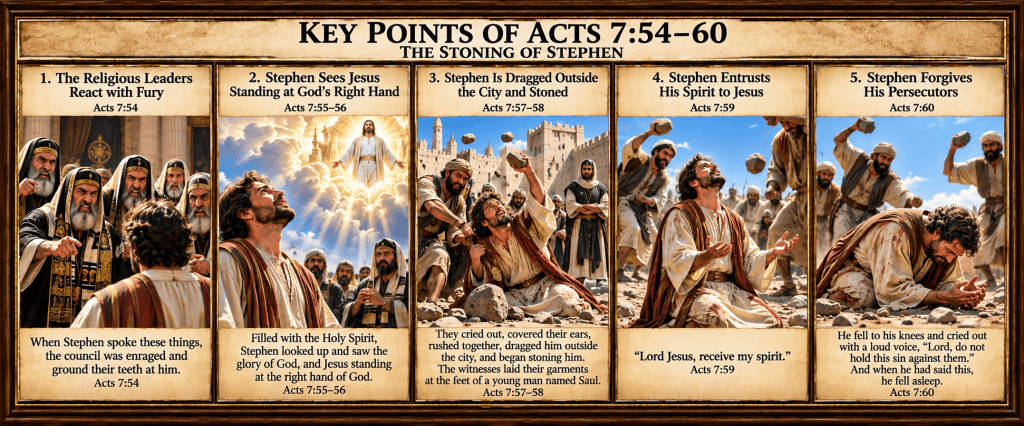
Acts 7:54–60 records the martyrdom of Stephen, the first Christian whose death for his faith is recorded in Scripture, following his powerful defense before the Jewish Sanhedrin. In Acts 7:1–53, Stephen had traced Israel’s history, demonstrating God’s faithfulness while exposing the repeated resistance of the Jewish people to God’s messengers. His concluding accusation that the religious leaders had betrayed and murdered the Righteous One, Jesus Christ, provoked their intense anger. Filled with the Holy Spirit, Stephen looked toward heaven and saw the glory of God and Jesus standing at the right hand of God, affirming Christ’s divine authority and Stephen’s faithfulness. Enraged by his testimony, the crowd rushed upon him, dragged him outside the city, and stoned him. Among those present was a young man named Saul, who watched over the garments of the witnesses and would later become a fierce persecutor of the church before his dramatic conversion. As Stephen faced death, he demonstrated remarkable Christlike compassion, praying for the Lord Jesus to receive his spirit and asking God not to hold his murderers’ sin against them. His final words closely reflected Jesus’ own prayers during His crucifixion (Luke 23:34, 46). Stephen’s death marked a significant turning point in the early church, introducing the persecution that would scatter believers beyond Jerusalem and advance the spread of the gospel (Acts 8:1–4). This passage illustrates the cost of faithful discipleship, the sustaining presence of Christ in suffering, and the transforming power of forgiveness even in the face of death.
Understanding the Event
Event Text
The Stoning of Stephen
54 Now when they heard these things they were enraged, and they ground their teeth at him. 55 But he, full of the Holy Spirit, gazed into heaven and saw the glory of God, and Jesus standing at the right hand of God. 56 And he said, “Behold, I see the heavens opened, and the Son of Man standing at the right hand of God.” 57 But they cried out with a loud voice and stopped their ears and rushed together[a] at him. 58 Then they cast him out of the city and stoned him. And the witnesses laid down their garments at the feet of a young man named Saul. 59 And as they were stoning Stephen, he called out, “Lord Jesus, receive my spirit.” 60 And falling to his knees he cried out with a loud voice, “Lord, do not hold this sin against them.” And when he had said this, he fell asleep. (Acts 7:54-60 ESV)
Questions with answers
1. Why did the religious leaders become so angry when they heard Stephen’s message? (Acts 7:54)
Answer: The religious leaders became furious because Stephen’s message exposed their resistance to God and their rejection of Jesus Christ. Throughout his defense, Stephen had traced Israel’s history, demonstrating how God’s people repeatedly resisted His messengers. In Acts 7:51–53, Stephen directly accused his listeners of following the same pattern of disobedience as their ancestors, culminating in their betrayal and murder of the Righteous One, Jesus Christ.
Rather than responding with repentance, the leaders reacted with hostility. Their gnashing of teeth revealed intense anger and resentment toward Stephen and the truth he proclaimed. His words challenged their religious authority, their understanding of righteousness, and their confidence in their obedience to God.
This response illustrates how the human heart can resist conviction when confronted with uncomfortable spiritual truths. Instead of allowing God’s Word to reveal their sin and lead them toward repentance, the leaders hardened their hearts. Their reaction reminds believers that proclaiming God’s truth does not always produce acceptance. Sometimes, faithful testimony exposes rebellion and provokes opposition.
2. What does Stephen’s experience of being filled with the Holy Spirit teach us about facing persecution? (Acts 7:55)
Answer: As Stephen faced the anger of the religious leaders, Scripture describes him as being full of the Holy Spirit. Rather than being overcome by fear or bitterness, Stephen remained spiritually focused and steadfast in his faith. His confidence came not from his personal strength but from the presence and power of God working within him.
The Holy Spirit enabled Stephen to remain faithful during a moment of extraordinary danger. While his enemies were consumed with rage, Stephen was granted a vision of God’s glory and Jesus standing at God’s right hand. This contrast reveals the difference between hearts controlled by hostility and a life directed by the Spirit.
Stephen’s experience teaches that the Holy Spirit strengthens believers to endure suffering without abandoning their faith. God’s presence does not guarantee freedom from persecution, but it provides the spiritual strength necessary to remain faithful. Stephen’s courage demonstrates that even when circumstances become overwhelming, believers can trust God to sustain them.
3. What is the significance of Stephen seeing Jesus standing at the right hand of God? (Acts 7:55–56)
Answer: Stephen’s vision of Jesus standing at the right hand of God is one of the most significant moments in this passage. Throughout the New Testament, Jesus is commonly described as seated at God’s right hand, a position representing divine authority, honor, and His completed work of redemption. However, Stephen sees Jesus standing, an unusual detail that emphasizes Christ’s personal involvement in this moment.
The vision confirms that Jesus, whom the religious leaders had rejected and crucified, is alive, exalted, and reigning in heavenly glory. Stephen’s testimony directly contradicts the leaders’ rejection of Jesus as the Messiah. The One they condemned is now revealed as the glorified Son of Man.
Jesus standing has often been understood as a picture of His welcoming Stephen into His heavenly presence or standing as his advocate. Although the passage does not explicitly explain why Jesus is standing, it clearly communicates His exaltation and Stephen’s assurance that his Savior is present.
For believers, this vision provides tremendous encouragement. Earthly opposition cannot overturn Christ’s heavenly authority. Even when God’s servants are rejected by the world, they remain known, loved, and received by their risen Lord.
4. Why did Stephen refer to Jesus as the Son of Man? (Acts 7:56)
Answer: Stephen’s reference to Jesus as the Son of Man carries deep theological significance. This title connects Jesus to Daniel 7:13–14, where Daniel describes one like a son of man receiving everlasting dominion, glory, and a kingdom from the Ancient of Days. Jesus frequently used this title to describe Himself, emphasizing both His identification with humanity and His divine authority.
During His trial before the Jewish council, Jesus declared that they would see the Son of Man seated at the right hand of Power and coming with the clouds of heaven (Mark 14:62). Stephen’s vision confirms the truth of Jesus’ declaration. The crucified and risen Christ now occupies the position of heavenly authority.
By using this title, Stephen identifies Jesus as the promised Messiah whose kingdom will never end. His testimony also exposes the seriousness of the religious leaders’ rejection of Christ. They had condemned the very One whom God exalted.
This passage reminds believers that Jesus is more than a historical teacher or prophet. He is the glorified Son of Man, reigning with divine authority and fulfilling God’s eternal plan of redemption.
5. Why did the religious leaders cover their ears and rush against Stephen? (Acts 7:57–58)
Answer: When Stephen declared that he saw heaven opened and Jesus standing at God’s right hand, the religious leaders responded by crying out loudly, covering their ears, and rushing together against him. Their actions demonstrated a deliberate refusal to hear or consider his testimony.
To these leaders, Stephen’s declaration was intolerable because it affirmed that Jesus, whom they had rejected, possessed heavenly authority. They regarded his words as blasphemous rather than recognizing them as a revelation of God’s truth.
Their reaction reveals the danger of spiritual hardness. Earlier in his speech, Stephen had accused them of resisting the Holy Spirit. Their response now demonstrated the very resistance he had described. Instead of examining the evidence of God’s work, they attempted to silence the messenger.
Stephen was driven outside the city and stoned. This action reflected the practice of carrying out executions outside the community, although Luke does not describe a properly conducted judicial proceeding.
The passage warns against allowing pride, religious tradition, or personal hostility to prevent us from receiving God’s truth. A heart unwilling to listen can become increasingly resistant to the very message that offers salvation.
6. What is the significance of Saul being present at Stephen’s execution? (Acts 7:58)
Answer: Saul’s presence at Stephen’s execution introduces a man who would later become one of the most influential servants of Jesus Christ. The witnesses placed their garments at the feet of a young man named Saul, indicating his involvement in the events surrounding Stephen’s death.
Acts 8:1 further explains that Saul approved of Stephen’s execution. At this point in his life, Saul was a zealous opponent of the Christian faith, convinced that persecuting followers of Jesus was consistent with his devotion to God.
Yet God’s plan for Saul would unfold in a remarkable way. In Acts 9, the risen Jesus would confront Saul on the road to Damascus, transforming him from a persecutor of the church into a devoted apostle who proclaimed the gospel he had once opposed.
The inclusion of Saul in Stephen’s story establishes an important connection between the persecution of the early church and the future expansion of the gospel. Although Scripture does not explicitly state how Stephen’s testimony affected Saul personally, Saul witnessed an extraordinary demonstration of Christian faith and forgiveness.
His presence reminds believers that no person is beyond the transforming power of God’s grace. The man associated with Stephen’s death would later suffer persecution himself for proclaiming the same risen Savior.
7. What does Stephen’s prayer, “Lord Jesus, receive my spirit,” reveal about his faith? (Acts 7:59)
Answer: As Stephen was being stoned, he called upon Jesus to receive his spirit. This prayer demonstrates his complete confidence in Jesus Christ as his Savior and Lord. Facing imminent death, Stephen entrusted his eternal future to the One he had faithfully proclaimed.
His words closely resemble Jesus’ prayer from the cross in Luke 23:46, when Jesus entrusted His spirit to the Father. Stephen’s prayer reflects the same confidence in God’s care beyond physical death.
The fact that Stephen addresses Jesus directly is also theologically significant. He recognizes the risen Christ as possessing the authority to receive him into His presence. Stephen’s confidence rests not in his own righteousness or achievements but in the Lord who conquered death.
This moment reveals that Christian faith extends beyond the circumstances of earthly life. Stephen understood that physical death could not separate him from Christ. His final words express assurance that his life belonged to Jesus, both in this world and in eternity.
For believers, Stephen’s prayer offers encouragement when facing suffering, uncertainty, and death. The risen Christ remains trustworthy, and those who belong to Him can entrust their lives and eternal future to His care.
8. Why did Stephen pray that God would not hold his persecutors’ sin against them? (Acts 7:60)
Answer: Stephen’s final prayer reveals the extraordinary influence of Jesus Christ upon his character. Even while suffering a violent death, Stephen asked the Lord not to hold his persecutors’ sin against them. Rather than seeking revenge, he expressed compassion for those responsible for his suffering.
His words closely parallel Jesus’ prayer from the cross in Luke 23:34, where Jesus asked the Father to forgive those who were crucifying Him. Stephen followed the example of his Savior by responding to hatred with mercy and to violence with prayer.
This response demonstrates the transforming power of the gospel. Stephen understood that his enemies needed God’s forgiveness just as every sinner does. His prayer did not suggest that their actions were innocent or insignificant. Instead, he appealed to God’s mercy on behalf of those committing a serious sin.
Stephen’s example teaches believers that forgiveness is not dependent upon receiving an apology or witnessing repentance. Christians are called to reject personal vengeance and entrust justice to God while praying for the salvation of those who oppose them.
His final prayer stands as a powerful testimony that the love of Christ can overcome bitterness, resentment, and hatred, even in the most painful circumstances.
9. How does Stephen’s death reflect the suffering and example of Jesus Christ? (Acts 7:54–60)
Answer: Stephen’s death contains several remarkable parallels to the suffering and crucifixion of Jesus Christ. Both were opposed by religious authorities, both faced accusations associated with blasphemy, both entrusted themselves to God in their final moments, and both prayed for those responsible for their deaths.
These similarities demonstrate that Stephen had not merely accepted the teachings of Jesus intellectually. His life had been transformed by Christ’s example. Under intense persecution, Stephen responded in a manner consistent with the character of his Savior.
There is also an important distinction. Jesus died as the sinless Savior whose sacrifice provides redemption for humanity. Stephen died as a faithful witness to that completed work of redemption. His death did not accomplish salvation, but it testified to the saving power of Jesus Christ.
Stephen’s example illustrates what it means to follow Jesus faithfully, even when obedience requires great personal sacrifice. Christian discipleship involves more than proclaiming correct beliefs; it includes demonstrating Christlike character through humility, courage, forgiveness, and love.
The passage challenges believers to consider whether their responses to opposition reflect the character of the Savior they profess to follow.
10. What does the expression that Stephen “fell asleep” teach about the Christian understanding of death? (Acts 7:60)
Answer: Luke concludes Stephen’s account by describing his death with the expression that he fell asleep. This language appears elsewhere in the New Testament as a way of referring to the death of believers, emphasizing that physical death is not the end of their existence.
The expression points toward the Christian hope of resurrection. Just as sleep is followed by awakening, the death of a believer will ultimately be followed by bodily resurrection through the power of Jesus Christ.
This does not mean that Stephen’s spirit became unconscious or that he ceased to exist until the resurrection. Earlier, Stephen had prayed for Jesus to receive his spirit, expressing confidence that he would enter the presence of his Lord. The imagery of sleep primarily describes the temporary condition of the body awaiting resurrection.
The New Testament consistently presents Christ’s resurrection as the foundation of the believer’s hope. Because Jesus conquered death, those who belong to Him can face death with confidence in God’s promises.
Stephen’s death therefore becomes a testimony not only of faithful suffering but also of eternal hope. His earthly life ended through violence, yet his relationship with Christ remained secure.
11. How did Stephen’s martyrdom contribute to the spread of the gospel? (Acts 7:54–60; 8:1–4)
Answer: Although Stephen’s death appeared to be a victory for those opposing Christianity, it became part of the circumstances through which the gospel spread beyond Jerusalem.
Following his execution, a great persecution arose against the church in Jerusalem. Many believers were scattered throughout Judea and Samaria. Rather than abandoning their faith, these scattered Christians continued proclaiming the Word wherever they went.
This development fulfilled an important part of Jesus’ commission in Acts 1:8, where He declared that His followers would be His witnesses in Jerusalem, Judea, Samaria, and to the end of the earth.
Stephen’s martyrdom marked a significant turning point in the early church’s history. The opposition intended to suppress the Christian movement, but the resulting scattering carried the gospel into new communities.
This demonstrates God’s sovereign ability to accomplish His purposes even through circumstances marked by suffering and injustice. God did not approve of the evil committed against Stephen, yet persecution could not prevent the fulfillment of His redemptive plan.
Believers can draw encouragement from this truth. Faithful service may produce results that are not immediately visible, and God can use even difficult circumstances to advance His kingdom.
12. What is the central lesson believers should learn from Stephen’s final moments? (Acts 7:54–60)
Answer: The central lesson of Stephen’s final moments is that genuine faithfulness to Jesus Christ remains steadfast even in the face of suffering, rejection, and death. Stephen demonstrated courage in proclaiming the truth, dependence upon the Holy Spirit, confidence in the risen Savior, and forgiveness toward his enemies.
His attention remained fixed upon Jesus rather than upon the hostility surrounding him. While his persecutors were consumed by anger, Stephen looked toward heaven and saw the glory of God. His spiritual perspective enabled him to face death without surrendering his faith or responding with hatred.
Stephen also demonstrated that Christian victory is not always measured by earthly deliverance. God did not rescue Stephen from physical death, but Stephen remained faithful to the end. His testimony reveals that the believer’s ultimate security rests in Christ rather than in favorable circumstances.
His example challenges Christians to examine the depth of their commitment to Jesus. Faithfulness involves standing for God’s truth, trusting His promises, forgiving those who cause harm, and remaining confident in eternal life through Christ.
Stephen’s story ultimately directs attention beyond the martyr himself to the glorified Savior who sustained him. The same Jesus who stood at God’s right hand remains the source of hope, strength, and eternal security for all who trust in Him.
Summary: The Enduring Truth of Acts 7:54–60
Stephen’s martyrdom represents a powerful testimony of faithfulness, courage, forgiveness, and hope in Jesus Christ. His death reveals the sharp contrast between human resistance to God’s truth and the transforming presence of the Holy Spirit in a believer’s life.
Three truths stand at the center of this passage: Jesus Christ reigns in heavenly glory, the Holy Spirit strengthens believers to remain faithful, and the hope of eternal life is greater than the fear of death.
Stephen’s final moments also demonstrate that following Christ means reflecting His character, especially when confronted by opposition. His prayer for his persecutors reveals a heart shaped by the mercy of Jesus, while his confidence in the risen Lord reveals a faith that death could not destroy.
The lasting message of Stephen’s testimony is that a life completely surrendered to Jesus Christ can remain faithful in suffering, gracious toward enemies, and confident in the promise of eternal life.


Leave a Reply