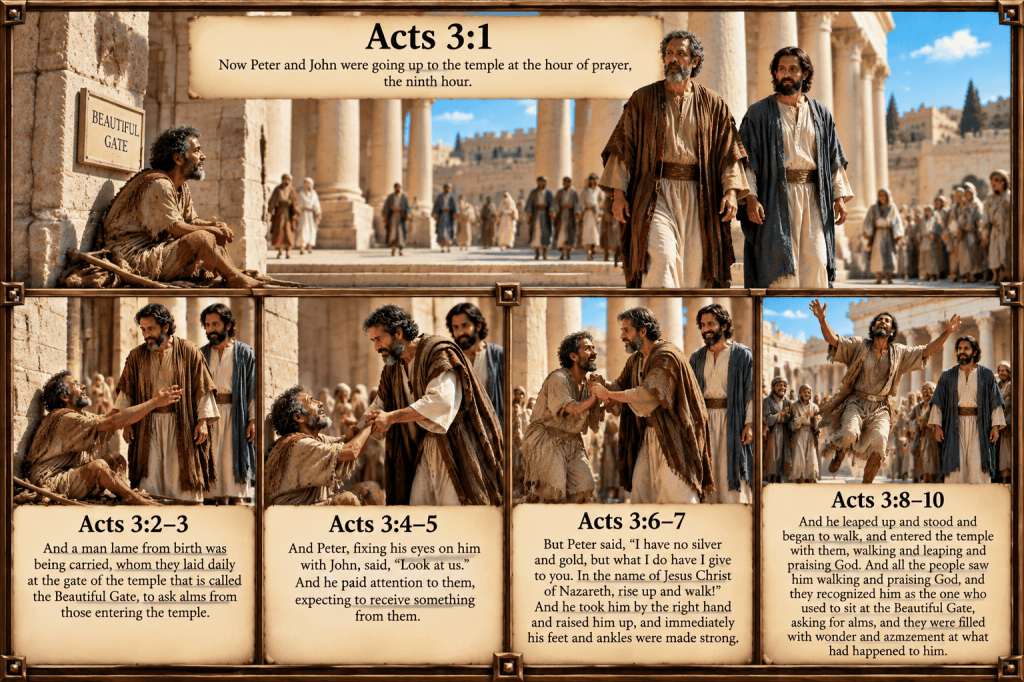
Provide a picture illustrating the main points of Acts 3:1-10
New Testament Events Series
Event: nte007 The Lame Beggar Healed (3:1–10)
Facilitator/Editor: Stephen Weller
Information Collection: ChatGPT
Bible Text: BibleGateway
1,933 words, 10 minutes read time
NT Event Index
Event Context
Context for Acts 3:1-10
Acts 3:1–10 takes place shortly after the coming of the Holy Spirit at Pentecost and the birth of the early church in Jerusalem (Acts 2). The apostles Peter and John are continuing the ministry of Jesus through the power of the Holy Spirit, preaching the gospel and demonstrating that the risen Christ is still at work through His followers. As devout Jews, Peter and John go to the temple at the appointed hour of prayer, where they encounter a man who had been unable to walk from birth and who was regularly carried to the temple gate called Beautiful to beg for money. This man represents the helpless condition of humanity apart from God’s saving power. When Peter and John meet him, they do not offer him material wealth but instead give him something far greater—the healing power of Jesus Christ. Peter declares that the man will walk “in the name of Jesus Christ of Nazareth,” and the man is immediately healed, standing, walking, and praising God. The miracle serves as a public testimony that Jesus is alive, that His authority continues through the apostles, and that salvation and restoration come through faith in His name. The amazement of the people prepares the way for Peter’s sermon in the following verses, where he explains that the miracle points beyond physical healing to the greater need for repentance and restoration with God.
Understanding the Event
Event Text
3 Now Peter and John were going up to the temple at the hour of prayer, the ninth hour.[a] 2 And a man lame from birth was being carried, whom they laid daily at the gate of the temple that is called the Beautiful Gate to ask alms of those entering the temple. 3 Seeing Peter and John about to go into the temple, he asked to receive alms. 4 And Peter directed his gaze at him, as did John, and said, “Look at us.” 5 And he fixed his attention on them, expecting to receive something from them. 6 But Peter said, “I have no silver and gold, but what I do have I give to you. In the name of Jesus Christ of Nazareth, rise up and walk!” 7 And he took him by the right hand and raised him up, and immediately his feet and ankles were made strong. 8 And leaping up, he stood and began to walk, and entered the temple with them, walking and leaping and praising God. 9 And all the people saw him walking and praising God, 10 and recognized him as the one who sat at the Beautiful Gate of the temple, asking for alms. And they were filled with wonder and amazement at what had happened to him. (Acts 3:1-10 ESV)
Questions with answers
Relate questions to above text.
1. What was Peter and John’s purpose for going to the temple at the hour of prayer?
Answer:
Peter and John were going to the temple because they continued the Jewish practice of gathering for prayer, even after becoming followers of Jesus. Acts 3:1 notes that they went “up to the temple at the hour of prayer, the ninth hour,” which was approximately 3:00 p.m. This shows that the earliest believers did not immediately abandon their Jewish background but continued to worship God while proclaiming that Jesus was the promised Messiah.
Their presence at the temple also provided an opportunity for God to work through them. The healing of the lame man was not planned by Peter and John; it occurred as they faithfully followed their normal pattern of prayer and obedience. This reminds believers that God often uses ordinary moments of faithfulness to accomplish extraordinary purposes.
2. Who was the man Peter and John encountered at the temple gate, and what was his condition?
Answer:
The man was a person who had been “lame from birth” and was carried daily to the temple gate called the Beautiful so that he could ask for financial assistance from those entering the temple (Acts 3:2). Because he had never been able to walk, he depended completely on others for his daily needs.
His position at the temple entrance placed him where religious people would regularly pass by. He likely expected that those entering for prayer would show compassion and give him money. However, his greatest need was not simply physical or financial; he needed restoration that only God could provide.
Luke emphasizes that the man’s condition was humanly impossible to change. He had lived this way his entire life, making the miracle a powerful demonstration of God’s authority and compassion.
3. Why did the lame man ask Peter and John for money?
Answer:
The lame man asked Peter and John for money because he had been dependent on charitable gifts throughout his life. Since he could not work or provide for himself, begging was his means of survival. When he saw Peter and John entering the temple, he asked them for assistance just as he had likely asked many others before.
The man’s request reveals his limited expectations. He believed his greatest need was a financial gift that would help him continue his current way of life. He did not approach Peter and John expecting healing because such a thing had never happened to him.
This reflects a common human tendency: people often seek solutions to immediate problems while God desires to address deeper needs. The man wanted silver and gold, but God was preparing to give him something far greater—a restored life.
4. What did Peter mean when he said, “Look at us”?
Answer:
When Peter said, “Look at us” (Acts 3:4), he was directing the man’s attention toward what God was about to do. The man had likely become accustomed to people passing by without truly seeing him. Peter wanted him to recognize that this encounter was different.
The statement also prepared the man for a message that would challenge his expectations. The man looked at Peter and John expecting to receive money, but instead he would receive healing through the power of Jesus Christ.
Peter’s command demonstrates that God’s work often begins by calling people to focus their attention on Him. Before God changes circumstances, He often changes where people look and what they trust.
5. Why did Peter say, “I have no silver and gold, but what I do have I give to you”?
Answer:
Peter’s statement reveals that the apostles did not possess earthly wealth, but they possessed something far more valuable—the authority and power of Jesus Christ. Peter was not offering something from his own ability; he was offering what God had given him through Christ.
The phrase “silver and gold have I none” does not mean material resources are unimportant. Rather, it contrasts temporary earthly assistance with the eternal power of God. Money could have helped the man temporarily, but Jesus would completely transform his life.
Peter understood that the greatest gift he could give was not financial support but the saving and restoring power of Jesus. The healing became a visible demonstration that Jesus was alive and actively working through His followers.
6. What does Peter mean by saying, “In the name of Jesus Christ of Nazareth, rise up and walk”?
Answer:
Peter’s words mean that the healing occurred through the authority, power, and character of Jesus Christ. In biblical understanding, a person’s “name” represents more than a title; it represents who they are and the authority they possess.
Peter did not claim that he or John had the ability to heal. Instead, he clearly identified Jesus as the source of the miracle. The same Jesus who had been crucified and raised from the dead was continuing His work through His apostles.
This statement also demonstrates that Jesus was not merely a teacher from the past. He was the living Lord whose power could restore what human ability could not repair.
7. What happened when Peter took the lame man by the right hand?
Answer:
Peter took the man by the right hand and raised him up, and immediately his feet and ankles were strengthened (Acts 3:7). The man’s healing was complete and instantaneous. He did not gradually recover; he received the ability to stand and walk immediately.
Peter’s action demonstrated compassion and personal involvement. He did not simply announce healing from a distance but reached out to help the man respond in faith. The physical action of lifting him up accompanied the spiritual reality that Jesus was restoring him.
The detail about his feet and ankles being strengthened emphasizes that the healing was genuine. A person who had never walked from birth received the physical ability necessary to stand and move.
8. How did the healed man respond to what God had done for him?
Answer:
The man responded by entering the temple with Peter and John, “walking and leaping and praising God” (Acts 3:8). His response was filled with joy, worship, and thanksgiving. He did not simply enjoy his new ability; he recognized that God was responsible for his transformation.
His actions fulfilled what he had been unable to do before. He could now enter the temple, not as a helpless beggar outside the gate, but as a worshiper inside the presence of God’s people.
This response teaches that genuine encounters with God should lead to worship. The proper response to God’s grace is not merely receiving His blessings but praising Him as the source of all good things.
9. Why did the people recognize the healed man, and why were they amazed?
Answer:
The people recognized the man because he had been a familiar sight at the temple gate for many years. They knew he had been unable to walk since birth and had regularly depended on others for help. When they saw him walking and praising God, they realized that something extraordinary had occurred.
Their amazement came from witnessing undeniable evidence of God’s power. This was not a hidden miracle; it happened publicly before many witnesses. The transformation of this man became a testimony that pointed beyond Peter and John to Jesus Christ.
The miracle also prepared the way for Peter’s sermon in Acts 3:11–26, where he explained that Jesus was the source of the healing and called the people to faith and repentance.
10. What are the major spiritual lessons from Acts 3:1–10?
Answer:
Acts 3:1–10 teaches several important truths:
- God is able to meet needs deeper than our immediate requests.
The man asked for money, but God gave him healing and restoration. God often sees needs that people do not recognize. - Jesus is the source of true transformation.
Peter and John did not heal through their own power. The miracle occurred through the authority of Jesus Christ. - Faithful obedience creates opportunities for God to work.
Peter and John were simply going to pray, but God used their obedience to transform a life. - God’s grace should lead to worship.
The healed man responded with praise because he recognized the greatness of what God had done. - God’s work points others to Christ.
The miracle was not merely about physical healing; it was a testimony that Jesus was alive and continuing His ministry through His followers.
Acts 3:1–10 presents a powerful picture of the gospel: Jesus takes those who are powerless, restores them by His grace, and gives them a new reason to walk, worship, and testify of His goodness.


Leave a comment