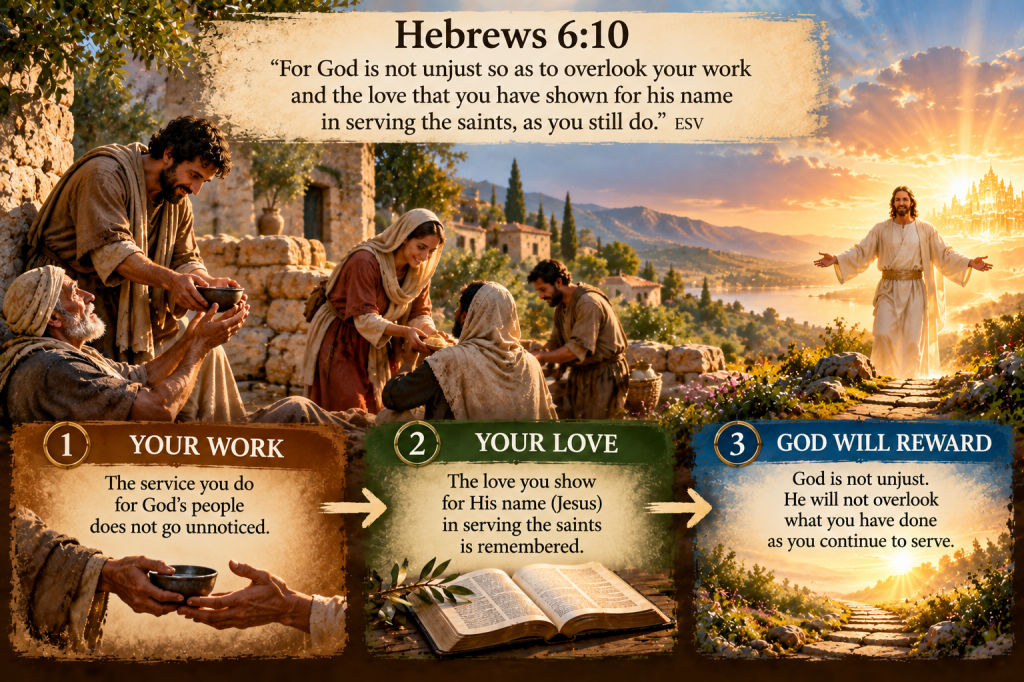
image Hebrews 6:10
dv1003-Daily Verse
Author: Stephen Weller
Facilitator: Stephen Weller
1,653 words, 9 minutes read time
Our Work of Love
Encouragement
Hebrews 6:10 offers strong encouragement to anyone who feels their faithful efforts go unnoticed:
“For God is not unrighteous to forget your work and the love you have shown for his name by having served and continuing to serve the holy ones.”
The verse reassures us that:
- God sees every act of faithful service. Even when other people do not notice or appreciate what you do, God does.
- God remembers acts of love. Kindness, generosity, encouragement, and service done out of love for Him are never overlooked.
- Your labor is not in vain. The recipients of your service may forget, but God does not.
- Faithful endurance matters. The verse highlights both past service and continuing service, encouraging believers to keep doing good without becoming discouraged.
A practical lesson from Hebrews 6:10 is this: when you are tired, unrecognized, or wondering whether your efforts matter, remember that God keeps perfect account of every loving deed done in His name. Your faithfulness is seen, valued, and remembered by Him.
Bible Lesson
For God is not unjust so as to overlook your work and the love that you have shown for his name in serving the saints, as you still do. (Hebrews 6:10 ESV)
Hebrews 6 speaks of our need of salvation and then as believers we are to “leave the elementary doctrine of Christ and go on to maturity” (verse 1). We are to “Do [our] best to present [ourselves] to God as one approved, a worker who has no need to be ashamed, rightly handling the word of truth” (2 Timothy 2:15 ESV). Having been born spiritually, “we are his workmanship, created in Christ Jesus for good works, which God prepared beforehand, that we should walk in them” (Ephesians 2:10 ESV).
As we do these assigned good works, “God is not unjust so as to overlook [our] work but will reward us for our faithfulness” (2 Corinthians 5:9 – 11). On that day the work we have done will be tested “by fire, and the fire will test what sort of work each one has done” (1 Corinthians 3:13 ESV).
God had a purpose for creating the universe and a purpose for the people he chose from that universe. To those chosen, God assigned work for us to do to help fulfill his purpose. That work is to search the domain of darkness for lost sheep and when we find them to lead them to salvation and then to disciple them out of love for God and them. As we make disciples we are serving the saints, a work we are to continue until death.
Questions with Answers
Hebrews 6:10 (ESV): “For God is not unjust so as to overlook your work and the love that you have shown for his name in serving the saints, as you still do.”
1. What does Hebrews 6:10 teach us about God’s awareness of our service?
Answer:
Hebrews 6:10 assures believers that God sees and remembers faithful service, even when it may go unnoticed by other people. Acts of kindness, generosity, encouragement, sacrifice, and ministry performed for Christ are never hidden from Him. People may forget what we have done, and sometimes our efforts may seem to produce little visible result, but God does not overlook them. This gives believers encouragement to continue serving faithfully without depending upon human recognition or praise.
2. Why does the writer connect our work with our love for God?
Answer:
The verse describes believers as showing love “for his name” through their service to other Christians. Christian service is therefore more than simply doing good deeds; it can be an outward expression of love for God. When believers care for God’s people because they belong to Christ, their actions demonstrate their devotion to Him. Genuine love for God should increasingly become visible in practical love toward others.
3. What does it mean to serve “the saints”?
Answer:
In the New Testament, “the saints” refers to those who belong to Christ. Serving the saints means meeting the spiritual, emotional, and practical needs of fellow believers. This might include providing material assistance, encouraging someone who is discouraged, praying for others, teaching God’s Word, offering hospitality, or simply giving time and attention to someone in need. Hebrews 6:10 reminds us that serving God’s people is meaningful service rendered before God Himself.
4. Why are the words “as you still do” important?
Answer:
These words emphasize continuing faithfulness. The believers addressed had served others in the past, but their ministry had not stopped. They were still serving. Christian faithfulness is not demonstrated merely by what we once did for God; it is reflected in a continuing pattern of love and service. The Christian life calls for perseverance—continuing to love, serve, and obey even when ministry becomes difficult, tiring, or unrecognized.
5. How does this verse encourage someone who feels that his or her service is insignificant?
Answer:
Hebrews 6:10 shifts the measure of significance away from human recognition and visible results. A seemingly small act performed out of genuine love for God has value because God sees the heart from which it comes. A quiet prayer, an encouraging word, a meal provided, time spent helping someone, or unnoticed faithfulness may never receive public acknowledgment, but none of it escapes God’s attention. No faithful service offered to God is wasted or forgotten.
6. Does Hebrews 6:10 teach that salvation is earned by good works?
Answer:
No. The broader teaching of Scripture presents salvation as God’s gift received through faith, not something earned through human works (Ephesians 2:8–9). Good works are instead the fruit and evidence of a life touched by God’s grace (Ephesians 2:10). In Hebrews 6, the writer is encouraging believers toward perseverance and spiritual maturity. Their loving service provides evidence of the spiritual realities associated with salvation (Hebrews 6:9). Their works do not purchase salvation; rather, their works demonstrate a living faith expressed through love.
7. What encouragement should believers take from Hebrews 6:10?
Answer:
Believers can serve with confidence because God sees, God remembers, and God values faithful service done out of love for His name. We do not need applause, recognition, or immediate visible results to know that our service matters. This truth encourages perseverance: continue helping, continue loving, continue giving, and continue serving. God does not overlook faithfulness.
Central Truth: God never overlooks faithful service that flows from love for Him. What others may never see or remember, God sees and remembers.


Leave a comment