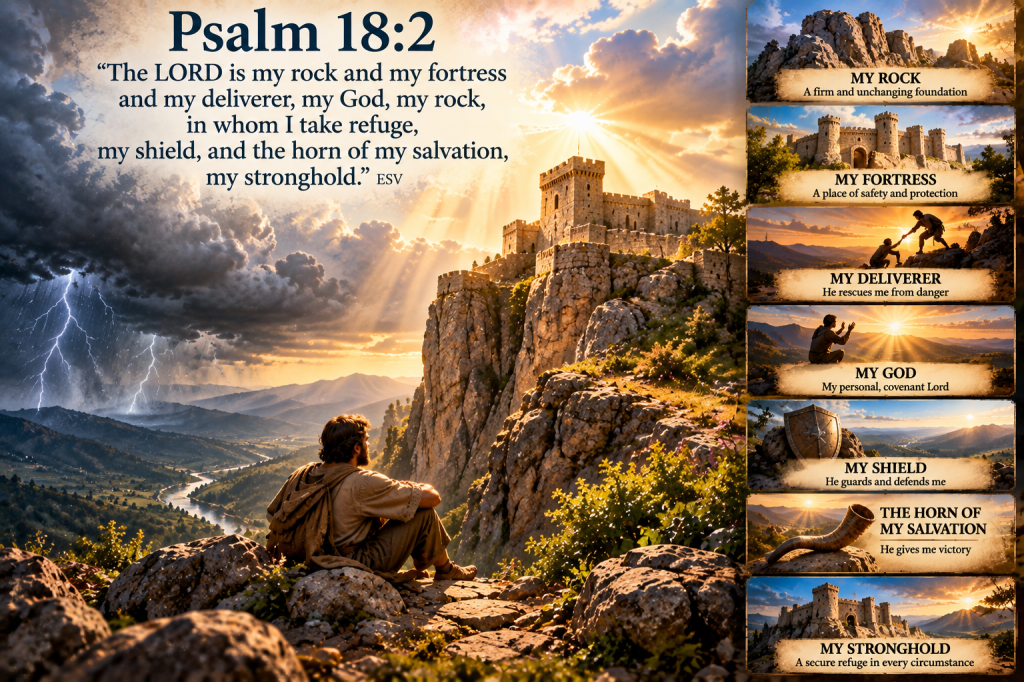
image Psalm 18:2
dv1004-Daily Verse
Author: Stephen Weller
Facilitator: Stephen Weller
1,865 words, 10 minutes read time
The Lord Is My God
Encouragement
Psalm 18:2 says:
“The Lord is my rock, and my fortress, and my deliverer; my God, my strength, in whom I will trust; my shield, and the horn of my salvation, and my high tower.” (KJV)
This verse provides powerful encouragement because it reminds us that God is everything we need in times of trouble:
- My rock: God is stable and unchanging when life feels uncertain.
- My fortress: He provides protection and security from spiritual and emotional attacks.
- My deliverer: He is able to rescue us from difficulties, fears, and trials.
- My strength: When we feel weak, God gives us the strength to endure.
- My shield: He defends those who trust in Him.
- My salvation: He is the source of ultimate rescue and hope.
- My high tower: He lifts us above danger and gives us a place of refuge.
One especially encouraging aspect of this verse is David’s repeated use of “my.” David was not speaking about God in a distant or theoretical way. He knew God personally and confidently trusted Him through hardship.
Practical encouragement: When you face challenges, Psalm 18:2 reminds you that you do not have to rely solely on your own strength. God is a secure refuge, a defender, and a source of help who remains faithful regardless of circumstances.
Devotional thought:
“What threatens me today is not greater than the God who protects me. The Lord is my Rock, and I can stand firmly because He never moves.”
Bible Lesson
The Lord is my rock and my fortress and my deliverer, my God, my rock, in whom I take refuge, my shield, and the horn of my salvation, my stronghold. (Psalm 18:2 ESV)
Psalm 18 parallels 2 Samuel 22, with 2 Samuel 22 being David’s personal expression of gratitude to the Lord, and Psalm 18 being an adaptation for people to sing. Verses 1 – 3 summarize the theme of the psalm in which David has found the Lord to be a reliable defender against his enemies. Of those three verses our daily verse is the middle verse. Consider those three verses.
1 “I love you, O Lord, my strength. 2 The Lord is my rock and my fortress and my deliverer, my God, my rock, in whom I take refuge, my shield, and the horn of my salvation, my stronghold. 3 I call upon the Lord, who is worthy to be praised, and I am saved from my enemies.”
In verse 1 with a heart full of love, David cries out, “I love you, Lord, my strength.” Then in verse 3 we learn that when his enemies were coming upon him, David cried out to the Lord and was protected. Verse 2 David describes what the Lord is to him with six unique “my statements,” listed below. Adding the one from verse 1 gives seven.
- “My strength” – In particular “The joy of the Lord is my strength.” (Nehemiah 8:10). This is expressed in Psalm 28:7 ESV: “The LORD is my strength and my shield; in him my heart trusts, and I am helped; my heart exults, and with my song I give thanks to him.” That connection of faith between the joy and excitement of the heart and the Lord who protects us and provides his strength through his spirit.
- “My rock” – A large rock is solid and strong, just like the Lord. In the wilderness, water flowed from the rock just as living water is provided by the Lord. “He alone is my rock and my salvation, my fortress; I shall not be greatly shaken” (Psalm 62:2 ESV). In Christ we are secure; no enemy can get to us.
- “My fortress” – Psalm 144:2 ESV helps clarify the idea of “fortress”: “he is my steadfast love and my fortress, my stronghold and my deliverer, my shield and he in whom I take refuge, who subdues peoples under me.” A fortress is a stronghold; a place of protection; a refuge.
- “My deliverer” – The Lord delivers us from that which is hurtful. Jesus delivered many from unclean spirits who were harming those they possessed. God delivers us in very practical ways, but his most important deliverance is from the grip of sin on our lives through salvation.
- “My God” – There are many gods that people worship and are in bondage to, but there is only one living God who we know as the Father, the Son and the Spirit; three persons but one God. “know therefore today, and lay it to your heart, that the Lord is God in heaven above and on the earth beneath; there is no other” (Deuteronomy 4:39 ESV). “For you are great and do wondrous things; you alone are God” (Psalm 86:10 ESV). Is he your God?
- “My salvation” – “There is salvation in no one else, for there is no other name under heaven given among men by which we must be saved” (Acta 4:12 ESV). “For there is one God, and there is one mediator between God and men, the man Christ Jesus” (1 Timothy 2:5 ESV). Jesus said to him, “I am the way, and the truth, and the life. No one comes to the Father except through me” (John 14:6 ESV).
- “My stronghold” – A stronghold is a place that has been fortified so as to protect it against attack. “The Lord is a stronghold for the oppressed, a stronghold in times of trouble” (Psalm 9:9 ESV). “The name of the Lord is a strong tower; the righteous man runs into it and is safe” (Proverbs 18:10 ESV). The stronghold or strong tower is the place where the righteous go for safety.
Father, it all begins with “I love you Lord, my strength” and when we truly love the Lord then we have all the benefits covered in this study. Indeed, he is worthy to be praised and to receive all of my worship.
Questions with Answers
Psalm 18:2 (ESV) — “The LORD is my rock and my fortress and my deliverer, my God, my rock, in whom I take refuge, my shield, and the horn of my salvation, my stronghold.”
1. Why does David use so many different descriptions of God in this verse?
Answer:
David had experienced many kinds of danger, so he describes God with several images that emphasize different aspects of His protection. God is his rock, providing stability when circumstances are uncertain. He is his fortress and stronghold, providing security against enemies. He is his deliverer, actively rescuing David from danger. He is his shield, standing between David and the attacks directed against him. Together, these descriptions present God as completely sufficient. David’s security did not ultimately rest in favorable circumstances, military strength, or human assistance. His confidence rested in the character and power of God.
2. What does David mean when he calls the Lord “my rock”?
Answer:
A rock pictures strength, permanence, stability, and security. David’s circumstances often changed dramatically—he experienced victory and defeat, friendship and betrayal, safety and danger—but God remained unchanged. Calling God “my rock” expresses David’s conviction that there was something solid beneath his life even when everything around him seemed unstable. Believers likewise need a foundation that does not shift with circumstances. God provides that foundation. Faith does not mean that life’s difficulties disappear; it means that the believer has an unchanging God upon whom to stand while passing through them.
3. What is significant about David repeatedly using the word “my”?
Answer:
David does not merely say that God is a rock, fortress, or deliverer. He says God is “my rock,” “my fortress,” “my deliverer,” and “my God.” His language expresses a personal relationship with God. David knew truths about God’s character, but those truths had also become realities in his own experience. Biblical faith involves more than recognizing that God can protect, save, and sustain people; it involves personally trusting Him. Psalm 18:2 therefore moves from theology to testimony. David knows who God is, and he can testify to what God has been to him.
4. What does it mean to “take refuge” in God?
Answer:
To take refuge in God means to turn toward Him in trust when confronted by danger, uncertainty, fear, or trouble. A refuge is valuable only when a person enters it. In the same way, knowing that God is powerful should lead to actively trusting Him. Taking refuge in God includes bringing concerns to Him in prayer, believing His promises, obeying His Word, and depending upon His wisdom rather than being controlled by fear. It does not necessarily mean that God immediately removes every difficulty. Instead, it means that the believer finds security in God’s presence and faithfulness while facing the difficulty.
5. What does the image of God as a “shield” teach us?
Answer:
A shield was carried into battle to protect a soldier from weapons directed against him. David’s use of this image emphasizes God’s personal protection. Throughout his life, David faced enemies who wanted to destroy him, yet he recognized that his survival ultimately depended upon God. Spiritually, believers also encounter circumstances that threaten their peace, faith, and confidence. God does not promise a life without conflict, but He does promise His presence and sustaining grace. Calling God our shield reminds us that we do not face life’s battles alone.
6. What is “the horn of my salvation”?
Answer:
In Scripture, a horn often symbolizes strength and power, particularly the strength necessary to defeat an enemy. By calling God “the horn of my salvation,” David acknowledges that the power behind his deliverance belongs to God. David had considerable ability as a warrior, but he refused to attribute his ultimate salvation to himself. His victories were evidence of God’s saving strength. The expression therefore combines two important truths: God saves, and God has the power necessary to accomplish that salvation.
7. How can Psalm 18:2 encourage believers during difficult circumstances?
Answer:
Psalm 18:2 redirects attention from the size of the problem to the character of God. Difficult circumstances can make people feel vulnerable, unstable, or overwhelmed. David responds by remembering who God is: rock, fortress, deliverer, refuge, shield, salvation, and stronghold. The circumstances may remain difficult, but the believer’s perspective changes when God’s character becomes the focus. Rather than asking only, “How will I overcome this?” Psalm 18:2 encourages the believer to remember, “Who is God in the midst of this?” Confidence grows not because the difficulty is small, but because God is greater than the difficulty.
8. What central truth should we carry from Psalm 18:2?
Answer:
The central truth is that God Himself is the believer’s security. David does not merely praise God for providing a fortress; God is his fortress. God does not merely provide a shield; God is his shield. God does not simply send deliverance; God is his deliverer. This makes Psalm 18:2 deeply personal and encouraging. Our ultimate security is not found in possessions, circumstances, abilities, or other people. Those things can change. God does not. When everything else seems uncertain, the believer can confidently say with David, “The LORD is my rock.”


Leave a comment