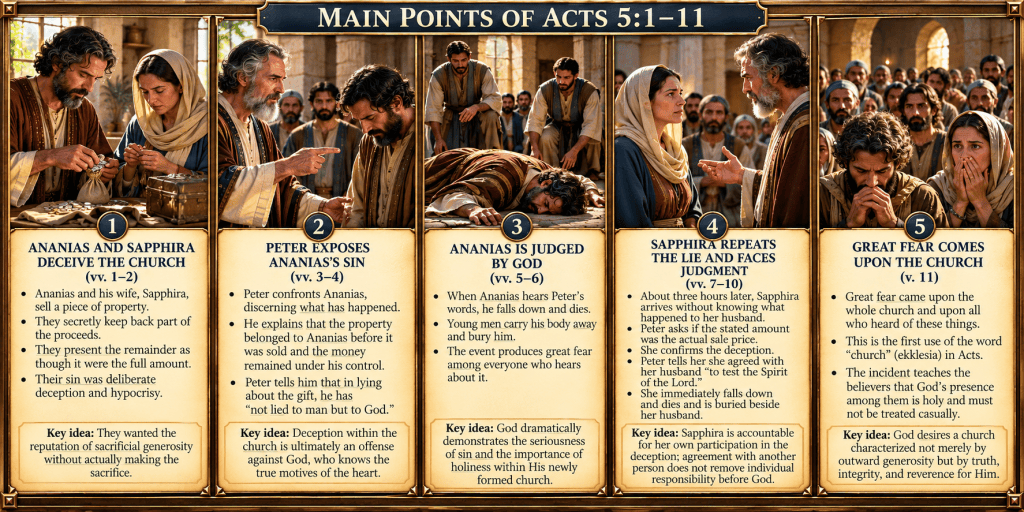
image Acts 5:1-11
New Testament Events Series
Event: nte012 Ananias and Sapphira (Acts 5:1-11)
Facilitator/Editor: Stephen Weller
Information Collection: ChatGPT
Bible Text: BibleGateway
1,801 words, 10 minutes read time
NT Event Index
Event Context
Context for Acts 5:1–11
Acts 5:1–11 takes place during the remarkable growth of the early church in Jerusalem, immediately following the account of the believers’ unity and generosity in Acts 4:32–37. Many Christians voluntarily sold property and gave the proceeds to meet the needs of others, with Barnabas presented as a sincere example of such generosity. Against this background, Ananias and Sapphira sold a piece of property but secretly kept back part of the proceeds while presenting the remainder as though it were the full amount. Their sin was not that they retained some of their money—Peter makes clear that the property and its proceeds were theirs to control—but that they deliberately sought to deceive the apostles, the church, and ultimately God. Their sudden deaths demonstrate the seriousness of hypocrisy and dishonesty before a holy God, particularly at this formative stage in the life of the church. The event also emphasizes the Holy Spirit’s divine presence among God’s people and shows that outward acts of generosity have value only when accompanied by inward integrity. As a result, “great fear came upon the whole church and upon all who heard of these things” (Acts 5:11, ESV), reinforcing that the growing church was called not only to unity and generosity but also to holiness, truthfulness, and reverence for God.
Understanding the Event
Event Text
Ananias and Sapphira
5 But a man named Ananias, with his wife Sapphira, sold a piece of property, 2 and with his wife’s knowledge he kept back for himself some of the proceeds and brought only a part of it and laid it at the apostles’ feet. 3 But Peter said, “Ananias, why has Satan filled your heart to lie to the Holy Spirit and to keep back for yourself part of the proceeds of the land? 4 While it remained unsold, did it not remain your own? And after it was sold, was it not at your disposal? Why is it that you have contrived this deed in your heart? You have not lied to man but to God.” 5 When Ananias heard these words, he fell down and breathed his last. And great fear came upon all who heard of it. 6 The young men rose and wrapped him up and carried him out and buried him.
7 After an interval of about three hours his wife came in, not knowing what had happened. 8 And Peter said to her, “Tell me whether you[a] sold the land for so much.” And she said, “Yes, for so much.” 9 But Peter said to her, “How is it that you have agreed together to test the Spirit of the Lord? Behold, the feet of those who have buried your husband are at the door, and they will carry you out.” 10 Immediately she fell down at his feet and breathed her last. When the young men came in they found her dead, and they carried her out and buried her beside her husband. 11 And great fear came upon the whole church and upon all who heard of these things.
Questions with answers
1. Who were Ananias and Sapphira, and what did they do?
Answer:
Ananias and Sapphira were a married couple who belonged to the early Christian community in Jerusalem. They sold a piece of property and brought part of the proceeds to the apostles, while secretly keeping some of the money for themselves. Keeping part of the money was not itself wrong. Peter specifically acknowledged that the property belonged to them and that, after it was sold, the money remained under their control. Their sin was deception: they presented their gift in a way that falsely suggested they had given the entire amount. Their actions reveal the danger of wanting the reputation of sacrificial generosity without actually making the sacrifice.
2. How does the account of Ananias and Sapphira contrast with Barnabas in Acts 4:36–37?
Answer:
Luke places the account immediately after describing Barnabas, who sold a field and brought the proceeds to the apostles. Barnabas demonstrated sincere generosity, while Ananias and Sapphira attempted to create the appearance of similar devotion through deception. The contrast is therefore not simply between giving more and giving less; it is between genuine devotion and hypocritical appearance. Barnabas gave openly and sincerely, while Ananias and Sapphira wanted others to believe something about their generosity that was not true.
3. Why was keeping part of the money not the real problem?
Answer:
Peter made this especially clear when he told Ananias, “While it remained unsold, did it not remain your own? And after it was sold, was it not at your disposal?” (Acts 5:4, ESV). The early believers were practicing voluntary generosity, not compulsory surrender of private property. Ananias was free to keep the property, sell it, keep some of the proceeds, or give whatever amount he chose. The sin occurred when he lied about what he had given. This distinction is important because Acts 5 condemns dishonesty and hypocrisy rather than ownership or the legitimate retention of possessions.
4. Why did Peter say that Ananias had lied to the Holy Spirit?
Answer:
Ananias apparently thought his deception concerned only the apostles and the other believers. Peter revealed that the matter was far more serious: “you have not lied to man but to God” (Acts 5:4, ESV). God knew exactly what Ananias had done and why he had done it. The passage therefore emphasizes both the divine knowledge of the Holy Spirit and the seriousness of sin within Christ’s church. A person may successfully deceive other people, but God sees the truth of both actions and motives.
5. What role did Satan play in Ananias’s sin?
Answer:
Peter asked Ananias, “why has Satan filled your heart to lie to the Holy Spirit?” (Acts 5:3, ESV). This language shows that Satan was actively working to introduce deception into the newly established church. Yet Peter still held Ananias personally responsible, asking why he had “contrived this deed” in his heart (Acts 5:4). Satanic temptation did not eliminate human responsibility. The episode demonstrates that the church faced threats not only from external persecution, as seen in Acts 4, but also from internal corruption through dishonesty and hypocrisy.
6. Why did Ananias die immediately after Peter confronted him?
Answer:
When Ananias heard Peter’s words, he fell down and died. The suddenness of the judgment demonstrated God’s holiness and the seriousness of deliberately introducing deception into the young church. This occurred at a crucial moment when the Christian community was being established and when remarkable unity, generosity, and the work of the Holy Spirit characterized its life. The judgment showed unmistakably that God’s grace must never be interpreted as indifference toward sin. The God who graciously dwelt among His people was also the holy God who required truthfulness from them.
7. Why was Sapphira questioned separately three hours later?
Answer:
Sapphira entered without knowing what had happened to her husband. Peter gave her an opportunity to tell the truth by asking whether the property had been sold for the amount Ananias had presented. She confirmed the false story, demonstrating that she had knowingly participated in the deception. Her judgment was therefore not merely the consequence of her husband’s actions. She personally chose to maintain the lie when directly confronted with the opportunity to speak truthfully. Acts 5 thus emphasizes individual accountability before God, even when people cooperate together in wrongdoing.
8. What did Peter mean when he asked, “How is it that you have agreed together to test the Spirit of the Lord?”
Answer:
Ananias and Sapphira had apparently agreed beforehand to present the false account. By doing so, they acted as though the Holy Spirit could be deceived or would overlook their dishonesty. To “test the Spirit of the Lord” was to presume upon God’s patience and challenge His knowledge and holiness. Their conspiracy demonstrated deliberate rather than accidental wrongdoing. Their sin was therefore especially serious because they knowingly attempted to maintain a false appearance within a community in which the Holy Spirit was powerfully at work.
9. Why did “great fear” come upon the whole church and everyone who heard about these events?
Answer:
The deaths of Ananias and Sapphira demonstrated dramatically that God’s presence among His people was real and holy. The resulting fear was more than simple terror; it included a profound awareness that God must be taken seriously. The believers learned that membership in the church did not make deliberate sin insignificant and that outward religious appearances could not deceive God. Interestingly, Acts 5:11 contains the first occurrence of the word “church” (ekklesia) in Acts. At this formative stage, the church was learning that it was a community characterized not only by fellowship and grace but also by reverence for God’s holiness.
10. What does Acts 5:1–11 teach about hypocrisy?
Answer:
The passage exposes hypocrisy as the attempt to create an outward appearance of spirituality that does not correspond with inward reality. Ananias and Sapphira wanted to appear extraordinarily generous while secretly withholding part of the proceeds and concealing that fact. Their problem was not that they failed to give enough; it was that they wanted the honor associated with sacrificial devotion without honestly making that sacrifice. Their example warns believers against allowing concern for spiritual reputation to become more important than genuine faithfulness before God.
11. What does this passage teach about the Holy Spirit?
Answer:
Acts 5 presents the Holy Spirit as fully aware of what occurs within the church. Peter described Ananias’s deception as lying “to the Holy Spirit” and then said, “You have not lied to man but to God” (Acts 5:3–4, ESV). The passage therefore closely associates lying to the Holy Spirit with lying to God. It also continues a major theme of Acts: the church is not merely a human organization. God Himself is present and active among His people through the Holy Spirit, making holiness, truth, and integrity essential characteristics of Christian community.
12. What central lesson should believers take from Acts 5:1–11?
Answer:
Acts 5:1–11 teaches that God desires genuine devotion rather than manufactured appearances of spirituality. Ananias and Sapphira were concerned with how others perceived them, but God knew the truth. Their story reminds believers that Christian faith involves integrity between what is presented publicly and what is true privately. Generosity should be sincere, worship should be genuine, and service should arise from an honest heart. The passage therefore calls believers to live with the awareness that God sees beyond appearances, knows the heart, values truth, and is worthy of reverent obedience.


Leave a comment