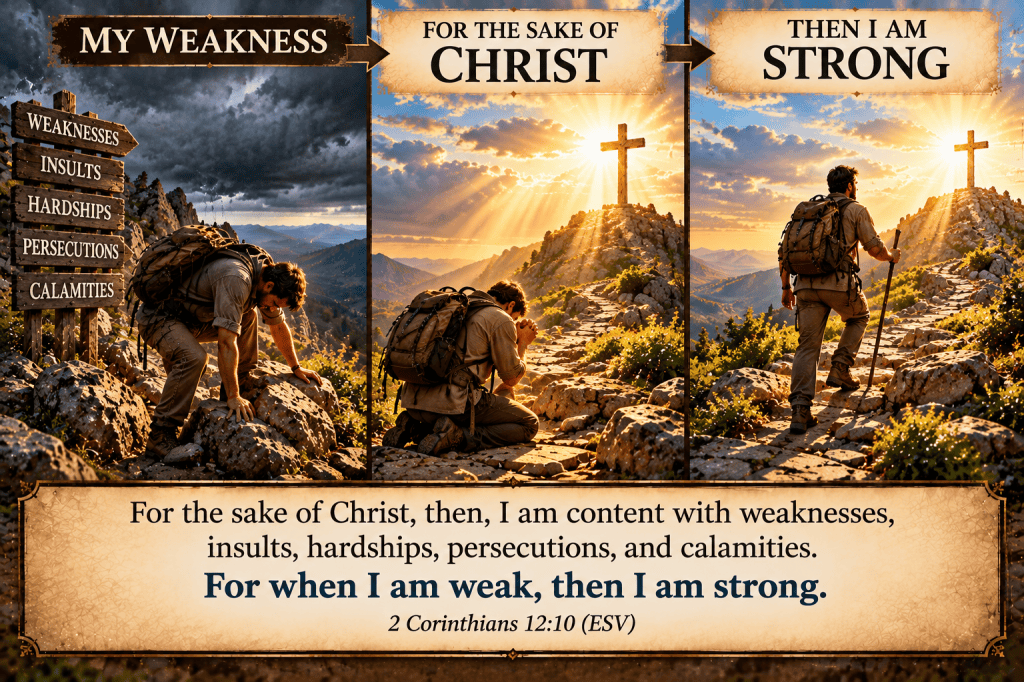
image 2 Corinthians 12:10
dv1007-Daily Verse
Author: Stephen Weller
Facilitator: Stephen Weller
2,028 words, 11 minutes read time
“When I Am Weak, then I Am Strong”
Encouragement
2 Corinthians 12:10 offers encouragement by teaching that God’s strength is often displayed most clearly when we recognize our own weakness.
In this passage, Paul explains that he can be content in hardships, difficulties, and afflictions because those experiences cause him to depend more fully on Christ. His well-known conclusion is that when he is weak, then he is strong. The point is not that suffering is enjoyable, but that God’s power becomes more evident when our own resources are exhausted.
Some encouraging lessons from this verse are:
- Your weaknesses do not disqualify you from being used by God. In fact, God often works through the very areas where you feel inadequate.
- Difficult circumstances are not proof that God has abandoned you. Paul experienced many hardships while faithfully serving Christ.
- You do not have to rely solely on your own strength. God’s grace can sustain you when you feel unable to continue.
- Dependence on Christ brings spiritual strength. What looks like weakness from a human perspective can become a channel for God’s power.
A practical reflection might be:
“I don’t have to be strong enough on my own today. God’s grace is sufficient, and His strength can carry me through what I cannot handle by myself.”
For believers facing illness, loss, disappointment, or personal limitations, 2 Corinthians 12:10 is a reminder that God’s power is often most visible in the moments when we feel weakest.
Bible Lesson
For the sake of Christ, then, I am content with weaknesses, insults, hardships, persecutions, and calamities. For when I am weak, then I am strong. (2 Corinthians 12:10 ESV)
The section of 2 Corinthians 12 in which this verse is found is about Paul’s vision and his thorn in his flesh. The section is the first of the chapter and our verse is the last verse of that section.
Concerning the vision, it was about being caught up to the third heaven, described as a paradise, where things were heard that could not be repeated to us. Paul says he will not speak about the vision and its glory, but only about his weakness. Because of that vision, Paul was given a thorn in the flesh, described as a messenger of Satan to harass him, to keep him from being conceited.
Concerning that thorn in the flesh, Paul pleaded three times with the Lord to remove it, but the Lord refused and said to him, “My grace is sufficient for you, for my power is made perfect in weakness.” (verse 9). Paul’s response was, “Therefore I will boast all the more gladly of my weaknesses, so that the power of Christ may rest upon me” (verse 9).
This lays the context for our verse in which Paul says, “For the sake of Christ, then, I am content with weaknesses, insults, hardships, persecutions, and calamities. For when I am weak, then I am strong.”
“For the sake of Christ” refers to the purpose of or the interest of Christ. With what I have been given or am experiencing, I will apply it in a way to achieve the purpose or interest of Jesus Christ. Jesus suffered and died for us, for our interest, so in return our good works and or our suffering is to be for him. Having this attitude, we can then, as with Paul, be content with such things as “weaknesses, insults, hardships, persecutions, and calamities.”
Being content to suffer results in our connection to the power of God, providing us with the ability to love and forgive our persecutors and to accept that which is causing our suffering. When these fiery trials come upon us in their various forms, contentment allows God to work in and through us in powerful ways to accomplish his purpose for us and himself. It is then then that our weakness becomes strength. 3 “Not only that, but we rejoice in our sufferings, knowing that suffering produces endurance, 4 and endurance produces character, and character produces hope, 5 and hope does not put us to shame, because God’s love has been poured into our hearts through the Holy Spirit who has been given to us” (Romans 5:3 – 5 ESV).
Concerning weakness and strength, think about Jesus. “For he was crucified in weakness but lives by the power of God. For we also are weak in him, but in dealing with you we will live with him by the power of God” (2 Corinthians 13:4 ESV). Have you come to the point in your life in your walk with Jesus that in your weakness you have experienced God’s power at work? Because of our fascination with the things and pleasures of the world, we are not experiencing the things of God and are missing out on so much.
Questions with Answers
“For the sake of Christ, then, I am content with weaknesses, insults, hardships, persecutions, and calamities. For when I am weak, then I am strong.” — 2 Corinthians 12:10 (ESV)
1. Why does Paul say that he is content with weakness?
Paul is not saying that weakness, suffering, or hardship is pleasant. Rather, he has learned that human weakness creates an opportunity for Christ’s power to be displayed. Earlier, the Lord told him, “My grace is sufficient for you, for my power is made perfect in weakness” (2 Corinthians 12:9). Paul therefore no longer views weakness merely as an obstacle. When his own resources are insufficient, he is driven to depend more completely upon Christ. His contentment rests not in the difficulty itself but in knowing that Christ’s grace is sufficient within it.
2. What kinds of difficulties does Paul include in this verse?
Paul mentions weaknesses, insults, hardships, persecutions, and calamities. His list covers both personal limitations and suffering imposed by circumstances or other people. Some difficulties exposed his physical or personal weakness; others came because he faithfully served Christ. Together, they demonstrate that Paul’s confidence was not based upon comfortable circumstances. Whether the pressure came from within or without, he had learned that Christ remained sufficient.
3. What does Paul mean by “for the sake of Christ”?
This phrase gives purpose to Paul’s suffering. He was not glorifying suffering for its own sake. Much of what he endured resulted from his commitment to Christ and his calling to proclaim the gospel. Paul could endure hardship because Christ was more valuable to him than comfort, reputation, or personal security. His suffering became meaningful because it occurred in the course of faithful service to Jesus.
4. How can Paul say, “when I am weak, then I am strong”?
This apparent contradiction expresses one of the great principles of Christian life. When Paul recognized his own weakness, he stopped depending upon his own ability and relied upon Christ. His weakness did not magically become human strength; rather, Christ’s strength operated through his weakness. The less Paul trusted himself, the more clearly the sufficiency of Christ could be demonstrated through him. Christian strength, therefore, is not primarily self-confidence but Christ-dependence.
5. How does this verse change the way believers should view personal limitations?
Believers often see limitations as things that prevent them from being useful to God. Paul teaches the opposite possibility: limitations can become places where dependence upon God grows deepest. God does not require His people to possess unlimited ability, strength, health, resources, or confidence before He can use them. Recognizing our limitations can humble us, deepen prayer, strengthen faith, and remind us that whatever is accomplished ultimately comes through God’s grace rather than our own sufficiency.
6. Does this verse mean Christians should seek suffering or refuse help when suffering occurs?
No. Paul does not teach believers to pursue pain or pretend that suffering does not hurt. Throughout Scripture, God’s people pray for deliverance and appropriately seek relief. Paul himself asked three times for his “thorn” to be removed (2 Corinthians 12:8). The lesson came when God chose not to remove it. Paul discovered that unanswered prayer did not mean absent grace. Sometimes God demonstrates His power by removing a difficulty; at other times, He demonstrates His power by sustaining His people through it.
7. What does 2 Corinthians 12:10 teach about true spiritual strength?
True spiritual strength begins with recognizing dependence upon God. The world often defines strength as independence, control, ability, and self-sufficiency. Paul presents a radically different picture. Spiritual strength is found when believers acknowledge, “I cannot do this in my own strength, but Christ is sufficient for me.” Weakness becomes dangerous only when it leads to despair; surrendered to Christ, it can become the very place where His sustaining power is most clearly experienced.
8. What encouragement does this verse offer believers facing hardship today?
It assures believers that weakness does not mean God has abandoned them or that they have become useless to Him. Difficult circumstances may reveal how limited human strength really is, but they cannot exhaust the grace of Christ. A believer may feel weak and yet be spiritually sustained, discouraged and yet remain faithful, pressured and yet continue trusting God. Our weakness does not limit Christ’s strength. When our own resources are depleted, His grace remains sufficient, and His power can carry us where our strength cannot.
Forming the Lesson Picture
How do I form the pictures that go with these daily verse posts? First, I ask ChatGPT a question like “How might a picture be used illustrate 2 Corinthians 12:10?” To this question, I get a response like the following:
“For the sake of Christ, then, I am content with weaknesses, insults, hardships, persecutions, and calamities. For when I am weak, then I am strong.”
This verse could make a particularly powerful picture because it contains an apparent contradiction: human weakness becomes the setting in which Christ’s strength is revealed.
I would create a wide picture with three connected sections, much like the Proverbs 12:25 picture provided yesterday.
Left — “WHEN I AM WEAK”
Show a weary traveler struggling along a difficult mountain path. Around him, perhaps subtly written on rocks or signposts, are the five difficulties Paul names:
Weaknesses • Insults • Hardships • Persecutions • Calamities
His posture shows that his own strength is nearly exhausted. The sky is dark and the path difficult.
Center — “FOR THE SAKE OF CHRIST”
The traveler has stopped and is kneeling beside the path. Ahead of him, on a hill, stands a cross illuminated by light breaking through the clouds. His attention has shifted away from his circumstances and toward Christ.
This is important because Paul does not say suffering itself makes him strong. His contentment is “for the sake of Christ.” The source of strength must therefore be visually connected to Christ rather than to human determination.
Right — “THEN I AM STRONG”
Show the same traveler continuing up the mountain. The road is still steep and the difficulties have not magically disappeared, but now he walks upright and confidently. Light from the direction of the cross illuminates his path.
That distinction would beautifully illustrate Paul’s point: Christ does not necessarily remove the weakness; He supplies strength within it.
Across the top:
MY WEAKNESS → CHRIST’S SUFFICIENCY → HIS STRENGTH
And across the bottom:
“For when I am weak, then I am strong.”
2 Corinthians 12:10 (ESV)
The deepest message of the picture would be: the Christian’s strength is not found in becoming self-sufficient, but in discovering that when our own resources fail, Christ remains sufficient.
I think the contrast between the same difficult mountain path on both sides would make this especially effective. The circumstances have not changed—the source of the traveler’s strength has.
I enjoy reading the description of the potential picture, and if I approve then, I will say, “Provide the picture to go with the illustration.” The key to getting a good picture is based on your instructions. To obtain a picture to go with passage, like a New Testament event, requires more work on my part. For an example, see the work I did to get the picture to go with the NT event for today.


Leave a comment