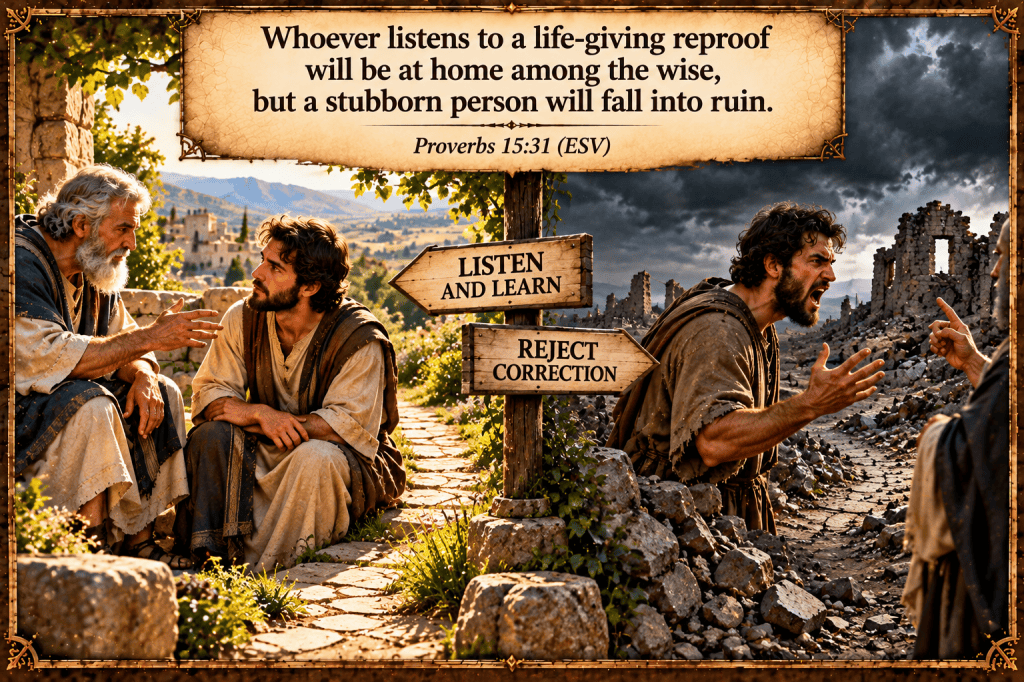
image Proverbs 15:31
dv1010-Daily Verse
Author: Stephen Weller
Facilitator: Stephen Weller
2,316 words, 12 minutes read time
The Ear that Listens
Encouragement
Proverbs 15:31 says:
“Whoever heeds life-giving correction will be at home among the wise.” [biblegateway.com]
The encouragement in this verse is that correction is not a sign of failure, but a pathway to wisdom and growth. Rather than condemning those who need instruction, God reassures us that people who listen, learn, and make adjustments belong “among the wise.” [biblegateway.com], [biblehub.com]
A few encouraging truths from this proverb:
- You do not have to be perfect to be wise. Wisdom begins with a teachable spirit.
- Constructive correction is life-giving. God often uses His Word, trusted believers, and life experiences to guide us onto a better path. [biblehub.com]
- Growth is always possible. Even when mistakes are exposed, God’s purpose is restoration and maturity, not humiliation.
- Humility leads to fellowship with the wise. Those who accept instruction become part of a community marked by understanding and discernment. [biblehub.com], [biblehub.com]
Devotional thought:
When God allows correction into our lives, He is investing in our future, not rejecting us. Every time we receive instruction with humility, we take another step toward wisdom, understanding, and a closer walk with Him.
Prayer:
Father, give me a teachable heart. Help me receive correction with humility and see it as Your loving guidance. Lead me into greater wisdom and help me grow through every lesson You place before me. Amen.
Bible Lesson
The ear that listens to life-giving reproof will dwell among the wise. (Proverbs 15:31 ESV)
This verse is another example of an “if then” statement, which is why I sometimes refer to the word as a software program. If we were to make all the right logic choices we could live as Jesus did when he was on earth and never sin, but in this life, we who were born spiritually dead with a sinful nature will make, more often that we might want, wrong choices.
The “if” part of this verse pertains to the ear and what it listens to. Will it listen to life-giving reproof or will it not? Looking at parallel translations provides several differences. “listens” might be translated as “heeds” or “harken”. “life-giving reproof” might be translated as “life-giving rebukes” or “life-giving correction” or “constructive criticism”. The idea is that reproof brings or preserves life.
One that listens to and heeds life-giving reproof will experience improvement in life; otherwise one will not. He or she who heeds life-giving reproof will “dwell” or “live with” or “be at home with” those who are wise. Thus, one who is teachable will be found living with or among those who are wise.
The cross references for “ear” result in the following verses: “A fool despises his father’s instruction, but whoever heeds reproof is prudent” (Proverbs 15:5 ESV); “The hearing ear and the seeing eye, the Lord has made them both” (Proverbs 20:12 ESV); and “Like a gold ring or an ornament of gold is a wise reprover to a listening ear” (Proverb 25:12 ESV).
The cross reference for “life-giving reproof” points to an interesting verse: “For the commandment is a lamp and the teaching a light, and the reproofs of discipline are the way of life” (Proverb 6:23 ESV). The commandment is a lamp is the source of light. Teaching the commandments is sharing the light and the result of teaching the commandments are reproofs of discipline and are the way of life.
If one lives by Proverbs 15:31 and by Proverbs 6:23, that person will experience quality of life, but it one does not then the “quality” may become just “quantity” in that the things of God may be replaced with things, pleasures and comforts of the world. This is why affluence is a very difficult environment in which to live.
Father help us be more willing to listen to and heed life-giving reproof so that we would become more like Jesus Christ.
Questions with Answers
“The ear that listens to life-giving reproof will dwell among the wise.” — Proverbs 15:31 ESV
1. What does Proverbs 15:31 teach about the importance of listening to correction?
Answer: Proverbs 15:31 teaches that listening to correction is essential for gaining wisdom and growing in righteousness. The phrase “life-giving reproof” describes correction that is intended to lead someone away from harmful behavior, mistaken thinking, or sinful choices and toward a better way of living. Rather than viewing correction as an insult or personal attack, a wise person recognizes its potential to produce spiritual growth. Listening requires humility, patience, and a willingness to acknowledge personal weaknesses. Scripture consistently teaches that wisdom develops through instruction, discipline, and a teachable spirit. Those who welcome godly correction demonstrate that they value truth more than personal pride. By accepting correction and applying it to their lives, believers grow in discernment, strengthen their character, and develop a closer relationship with God.
2. What is meant by the expression “life-giving reproof”?
Answer: The expression “life-giving reproof” refers to correction that promotes spiritual health, moral understanding, and righteous living. It is life-giving because it helps individuals recognize and turn away from attitudes and actions that can lead to destructive consequences. Such correction may come through God’s Word, the conviction of the Holy Spirit, or the loving counsel of spiritually mature individuals. Although correction may initially be uncomfortable, its purpose is restoration rather than condemnation. Hebrews 12:11 explains that discipline can be painful in the moment but afterward produces the peaceful fruit of righteousness for those trained by it. Life-giving correction therefore serves as an expression of God’s love and concern for His people. When believers respond with repentance and obedience, correction becomes an instrument through which God shapes their character and directs their lives toward His purposes.
3. Why does accepting correction demonstrate humility and wisdom?
Answer: Accepting correction demonstrates humility because it requires individuals to recognize that their knowledge, judgment, and behavior are not always perfect. Pride often causes people to resist advice, defend their mistakes, or reject uncomfortable truths. Humility, however, acknowledges the need for continued learning and spiritual development. Proverbs 12:1 teaches that loving discipline is closely connected with loving knowledge. A wise person understands that correction is not necessarily a sign of failure but can be an opportunity for improvement. By considering constructive criticism carefully, believers demonstrate that they are more concerned with becoming righteous than appearing righteous. This attitude allows God to work through His Word and through trustworthy people to reveal areas requiring change. Humility creates an environment in which wisdom can flourish, relationships can strengthen, and spiritual maturity can deepen.
4. What does it mean that those who listen to correction “will dwell among the wise”?
Answer: The promise that those who listen to correction “will dwell among the wise” emphasizes the close relationship between teachability and wisdom. Wisdom is not merely possessing information; it involves understanding truth and applying it correctly in everyday life. Individuals who welcome correction continually develop greater discernment because they are willing to learn from their mistakes and the experiences of others. The expression also suggests belonging among those who value instruction, righteousness, and sound judgment. Proverbs 13:20 teaches that whoever walks with the wise becomes wise, demonstrating the importance of surrounding oneself with godly influences. A teachable person naturally benefits from relationships with others who pursue wisdom. As believers listen, learn, and apply biblical instruction, they increasingly reflect the attitudes and behavior characteristic of those who walk faithfully with God.
5. How should believers respond when correction is difficult or uncomfortable to hear?
Answer: When correction is difficult to hear, believers should respond with patience, humility, and prayerful consideration rather than immediate defensiveness. Human nature often resists criticism because it exposes weaknesses or challenges established habits. However, Proverbs 15:31 encourages believers to evaluate correction according to its truth and potential spiritual benefit rather than the discomfort it produces. The first response should be to listen carefully and determine whether the correction agrees with biblical principles. Not every criticism is accurate or beneficial, so discernment is necessary. When correction is justified, believers should acknowledge their mistakes, seek forgiveness where appropriate, and take practical steps toward change. James 1:19 encourages believers to be quick to hear, slow to speak, and slow to anger. By responding thoughtfully rather than emotionally, believers allow correction to become an opportunity for spiritual growth rather than a source of unnecessary conflict.
6. How does Proverbs 15:31 relate to God’s discipline of His children?
Answer: Proverbs 15:31 reflects the biblical teaching that God’s discipline is an expression of His love and His desire for His children to grow in holiness. Hebrews 12:6 teaches that the Lord disciplines those He loves. God’s correction is not intended to destroy His children but to guide them away from sin and toward righteousness. Through Scripture, circumstances, and the counsel of faithful believers, God reveals attitudes and behaviors that need to change. Receiving His correction requires trusting His wisdom even when the process is uncomfortable. A believer who welcomes divine discipline recognizes that God’s understanding is greater than human understanding and that His purposes are always righteous. As believers submit to His instruction, they become increasingly sensitive to His guidance and better equipped to make decisions that honor Him. God’s discipline therefore becomes an important part of spiritual maturity and the lifelong process of becoming more like Christ.
7. How can believers apply the teaching of Proverbs 15:31 in their daily lives?
Answer: Believers can apply Proverbs 15:31 by developing a consistent willingness to listen, learn, and respond to godly instruction. This begins with regularly studying Scripture and allowing its teachings to examine personal attitudes, priorities, and actions. When trusted individuals offer constructive correction, believers should resist the temptation to respond defensively and instead consider whether the advice reveals an area needing improvement. Prayer is essential because it helps cultivate humility and dependence upon God’s wisdom. Believers should also seek relationships with spiritually mature people who are willing to speak truth in love. When mistakes occur, acknowledging them and making necessary changes demonstrates genuine growth. Over time, a teachable spirit produces greater discernment, stronger relationships, and a more consistent Christian witness. The central application is that wisdom grows when believers value truth enough to receive correction and act upon it.
Concluding Truth
Proverbs 15:31 reminds believers that wisdom is not measured by how much they already know but by their willingness to continue learning. Godly correction is a gift that can protect individuals from destructive choices, deepen spiritual understanding, and strengthen righteous character. Those who listen with humility and respond with obedience place themselves on the pathway of wisdom.
The person who welcomes life-giving correction demonstrates a heart that is willing to be taught, transformed, and guided by God.


Leave a Reply