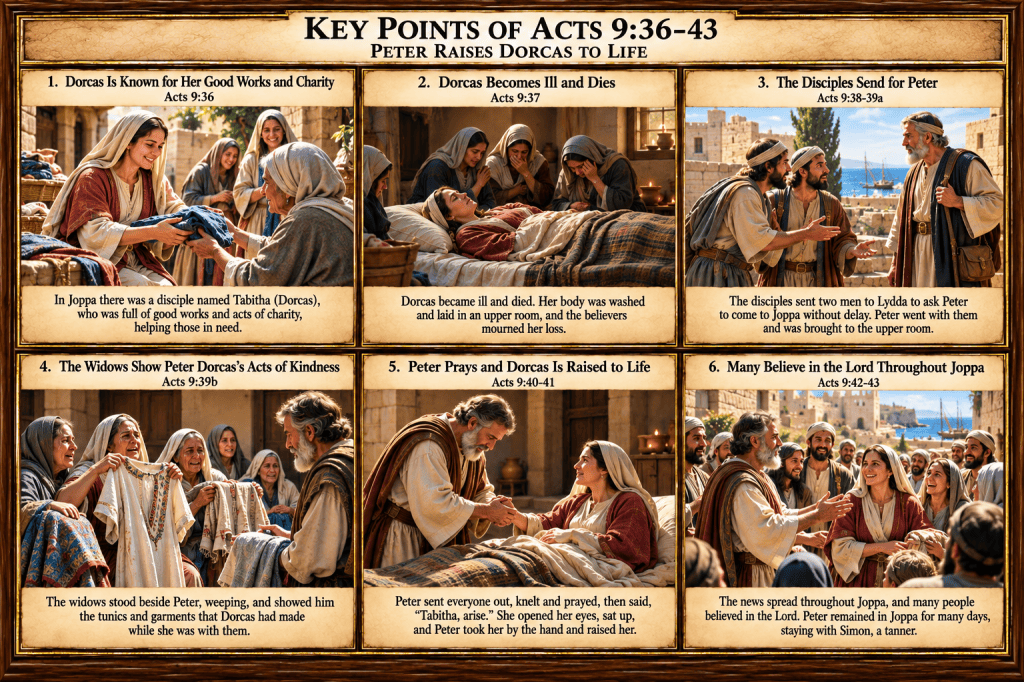
image Acts 9:36-43
New Testament Events Series
Event: nte028 Dorcas Restored to Life (Acts 9:36-43)
Facilitator/Editor: Stephen Weller
Information Collection: ChatGPT
Bible Text: BibleGateway
2,231 words, 12 minutes read time
NT Event Index
Event Context
Context for Acts 9:36-43
Context of Acts 9:36–43 – Peter Raises Dorcas from the Dead
Acts 9:36–43 records a remarkable miracle performed through the apostle Peter in the coastal town of Joppa, demonstrating the life-giving power of Jesus Christ and the continuing expansion of the early church. Following Peter’s healing of Aeneas in Lydda (Acts 9:32–35), Luke introduces a devoted disciple named Tabitha, also known by her Greek name Dorcas, who was widely respected for her good works and acts of charity, particularly her care for widows. When Dorcas became ill and died, the believers in Joppa sent for Peter, who was staying in nearby Lydda. Upon arriving, Peter encountered grieving widows who showed him the garments Dorcas had made, providing a moving testimony to her faithful service. After sending everyone out of the room, Peter knelt in prayer and commanded Dorcas to arise. God restored her to life, and Peter presented her alive to the believers and widows. This extraordinary miracle reflected the authority of the risen Christ working through His apostles and closely paralleled Jesus’ raising of Jairus’s daughter (Mark 5:35–43). As news spread throughout Joppa, many people believed in the Lord, demonstrating how God’s miraculous works opened doors for the gospel. The passage concludes with Peter remaining in Joppa at the home of Simon, a tanner, preparing the setting for the significant events of Acts 10, when God would reveal the inclusion of Gentiles in His plan of salvation. Ultimately, this account emphasizes the importance of compassionate Christian service, the power of prayer, the authority of Jesus Christ over death, and God’s sovereign direction in advancing the gospel.
Understanding the Event
Event Text
Dorcas Restored to Life
36 Now there was in Joppa a disciple named Tabitha, which, translated, means Dorcas.[a] She was full of good works and acts of charity. 37 In those days she became ill and died, and when they had washed her, they laid her in an upper room. 38 Since Lydda was near Joppa, the disciples, hearing that Peter was there, sent two men to him, urging him, “Please come to us without delay.” 39 So Peter rose and went with them. And when he arrived, they took him to the upper room. All the widows stood beside him weeping and showing tunics[b] and other garments that Dorcas made while she was with them. 40 But Peter put them all outside, and knelt down and prayed; and turning to the body he said, “Tabitha, arise.” And she opened her eyes, and when she saw Peter she sat up. 41 And he gave her his hand and raised her up. Then, calling the saints and widows, he presented her alive. 42 And it became known throughout all Joppa, and many believed in the Lord. 43 And he stayed in Joppa for many days with one Simon, a tanner. (Acts 9:36-42 ESV)
Questions with answers
1. Who was Tabitha, also called Dorcas, and what distinguished her life as a disciple of Jesus? (Acts 9:36)
Answer: Tabitha, whose Greek name was Dorcas, was a female disciple living in Joppa, a coastal city of Judea. Scripture describes her as being “full of good works and acts of charity” (ESV). Her life was characterized by practical expressions of Christian love, particularly toward those in need. Rather than merely professing faith, she demonstrated her devotion to Christ through compassionate service. Her example illustrates that genuine discipleship involves both faith and action. The description of Dorcas emphasizes that ordinary acts of kindness, generosity, and service are valuable expressions of God’s love. Her ministry reminds believers that faithful service does not require public recognition or an official position within the church. A life devoted to meeting the needs of others can leave a lasting spiritual influence.
2. What happened to Dorcas, and how did the believers respond to her death? (Acts 9:37)
Answer: Dorcas became ill and died, bringing sorrow to the Christian community in Joppa. Following the customs of the time, her body was washed and placed in an upper room in preparation for burial. The believers’ response reveals both their affection for Dorcas and the significance of her ministry among them. Although she had lived a life of faithful service, she was not exempt from sickness and death. This reminds Christians that faithfulness to God does not guarantee freedom from suffering or the difficulties of earthly life. Her death also created an opportunity for God to demonstrate His power through Peter. What initially appeared to be a moment of overwhelming loss would become an occasion for strengthening the faith of the believers and revealing the life-giving authority of Jesus Christ.
3. Why did the disciples send for Peter, and what does their urgency reveal about their faith? (Acts 9:38)
Answer: When the disciples learned that Peter was nearby in Lydda, approximately ten miles from Joppa, they sent two men to urge him to come without delay. Scripture does not explicitly state whether they expected Peter to raise Dorcas from the dead or simply desired his presence during their time of grief. However, their urgent request suggests that they recognized Peter as an apostle through whom God was working powerfully. They may have known about the recent healing of Aeneas in Lydda and believed that Peter’s presence could bring help or encouragement. Their actions demonstrate the importance of seeking spiritual assistance in times of crisis. Rather than remaining isolated in their sorrow, the disciples reached out to a trusted servant of God. Their response encourages believers to turn toward Christian fellowship, prayer, and spiritual leadership when facing circumstances beyond their control.
4. What is the significance of the widows showing Peter the garments Dorcas had made? (Acts 9:39)
Answer: When Peter arrived, the widows gathered around him weeping and displaying the tunics and other garments Dorcas had made while she was alive. These garments were tangible evidence of her generosity and concern for vulnerable members of the community. In the ancient world, widows frequently faced economic hardship and depended upon the compassion of others for their basic needs. Dorcas had apparently recognized these needs and used her abilities to provide practical assistance. The widows’ grief demonstrated that her ministry had made a meaningful difference in their lives. Their display of the garments was more than a remembrance of her skill; it was a testimony to a life devoted to love and service. This passage teaches that even seemingly simple abilities, such as sewing and making clothing, can become instruments of ministry when offered to God. Acts of kindness may have an influence far beyond what the giver realizes.
5. Why did Peter put everyone outside the room before praying? (Acts 9:40)
Answer: Peter sent everyone out of the room before kneeling to pray beside the body of Dorcas. His actions closely resemble Jesus’ conduct when raising Jairus’s daughter from the dead (Mark 5:35–43). By removing the mourners, Peter established a quiet setting in which he could focus upon God without distraction. The passage does not explicitly explain his reason for clearing the room, but his actions demonstrate dependence upon divine power rather than human ability or public attention. Peter did not approach the situation as someone possessing independent authority over death. Instead, he first knelt in prayer, acknowledging that only God could accomplish such a miracle. This teaches an important principle of Christian ministry: spiritual power originates with God, and His servants must remain dependent upon Him. Peter’s example emphasizes humility, prayer, and confidence in God’s ability to accomplish what human strength cannot.
6. How did Peter raise Dorcas from the dead, and what does this miracle reveal about Jesus Christ? (Acts 9:40–41)
Answer: After praying, Peter turned toward the body and commanded, “Tabitha, arise” (ESV). Dorcas opened her eyes, saw Peter, and sat up. Peter then offered her his hand, helped her stand, and presented her alive to the believers and widows. The miracle closely parallels Jesus’ raising of Jairus’s daughter, demonstrating that the risen Christ continued His powerful work through His apostles. Peter’s prayer before speaking to Dorcas establishes that the miracle was not accomplished through Peter’s personal ability but through the power of God. The restoration of Dorcas to physical life testified to Christ’s authority over death and affirmed the truth of His resurrection. Although Dorcas would eventually experience physical death again, her restoration provided a powerful demonstration of the life-giving power of God. The event also points believers toward the greater promise of eternal resurrection through Jesus Christ.
7. Why did Peter present Dorcas alive to the saints and widows? (Acts 9:41)
Answer: After helping Dorcas to her feet, Peter called the believers and widows into the room and presented her alive. This public presentation confirmed that the miracle had truly occurred and allowed those who had mourned her death to witness God’s extraordinary intervention. The same people who had displayed the garments she had made could now see her restored to life. Their grief was transformed into an occasion for rejoicing and renewed faith. By presenting Dorcas to the community, Peter also demonstrated that God’s miraculous work was not intended to glorify the apostle but to strengthen the church and reveal the power of Jesus Christ. The restoration of Dorcas returned a beloved servant to the fellowship and allowed her ministry of compassion to continue. The event illustrates God’s concern not only for individuals but also for the communities whose lives are affected by them.
8. What effect did the raising of Dorcas have upon the people of Joppa? (Acts 9:42)
Answer: News of Dorcas’s restoration spread throughout Joppa, and many people believed in the Lord. The miracle became a powerful testimony to the reality of Jesus Christ and the truth of the gospel proclaimed by His apostles. The emphasis of the passage is not merely that people were amazed by an extraordinary event, but that many responded with faith in the Lord. This distinction is important because miracles in Acts frequently served to confirm the message of salvation and direct attention toward Jesus rather than toward the human instrument performing the miracle. The raising of Dorcas demonstrated that the risen Christ remained actively involved in the growth of His church. Through this event, a personal tragedy became an opportunity for the gospel to reach additional people. God’s power was displayed in a manner that strengthened existing believers and brought others to faith.
9. Why is Peter’s decision to remain in Joppa with Simon the tanner significant? (Acts 9:43)
Answer: Following the miracle, Peter remained in Joppa for many days with a man named Simon, who worked as a tanner. This detail may initially appear insignificant, but it prepares the reader for the important events recorded in Acts 10. Tanners worked with animal hides, and their occupation frequently involved contact with dead animals, making the trade associated with ceremonial uncleanness under Jewish purity practices. Peter’s willingness to stay with Simon may suggest an increasing openness to associations that some observant Jews would have avoided. More importantly, his residence in Joppa positioned him for the vision and divine instructions that would lead to his encounter with Cornelius, a Gentile centurion. This encounter would become a major turning point in the expansion of the gospel beyond the Jewish community. The passage illustrates how God prepares His servants for future assignments, sometimes through circumstances that initially seem ordinary or unrelated.
10. What does the account of Dorcas teach about the relationship between Christian faith, good works, and God’s power? (Acts 9:36–43)
Answer: The account of Dorcas brings together three important aspects of Christian life: genuine faith, compassionate service, and dependence upon God’s power. Dorcas demonstrated her faith through acts of charity, showing that Christian love should be expressed in practical ways. Her good works did not earn salvation or make her deserving of a miracle; rather, they reflected the character of a woman devoted to following Christ. Peter demonstrated dependence upon God through prayer, recognizing that the power to restore life belonged to the Lord alone. Finally, the response of the people in Joppa revealed the ultimate purpose of the miracle: many believed in Jesus Christ. These three elements form a meaningful picture of Christian discipleship. Believers are called to serve others faithfully, depend upon God prayerfully, and direct attention toward Christ. The passage reminds Christians that God can use both ordinary acts of kindness and extraordinary demonstrations of His power to advance His purposes.
Central Teaching of Acts 9:36–43
The account of Dorcas reveals that a life of faithful service has lasting significance in the kingdom of God, while the power to give life belongs to Jesus Christ alone. Dorcas demonstrated Christlike love through her generosity toward widows and others in need. Peter demonstrated dependence upon God through prayer, and the miracle of her restoration became a testimony that led many people in Joppa to believe in the Lord. Together, these events emphasize that Christian ministry involves compassionate action, prayerful dependence, and a commitment to glorifying Jesus Christ. The passage also prepares the way for the gospel’s expansion to the Gentiles, showing that God was continuing to direct the growth of His church through the ministry of His apostles.


Leave a Reply