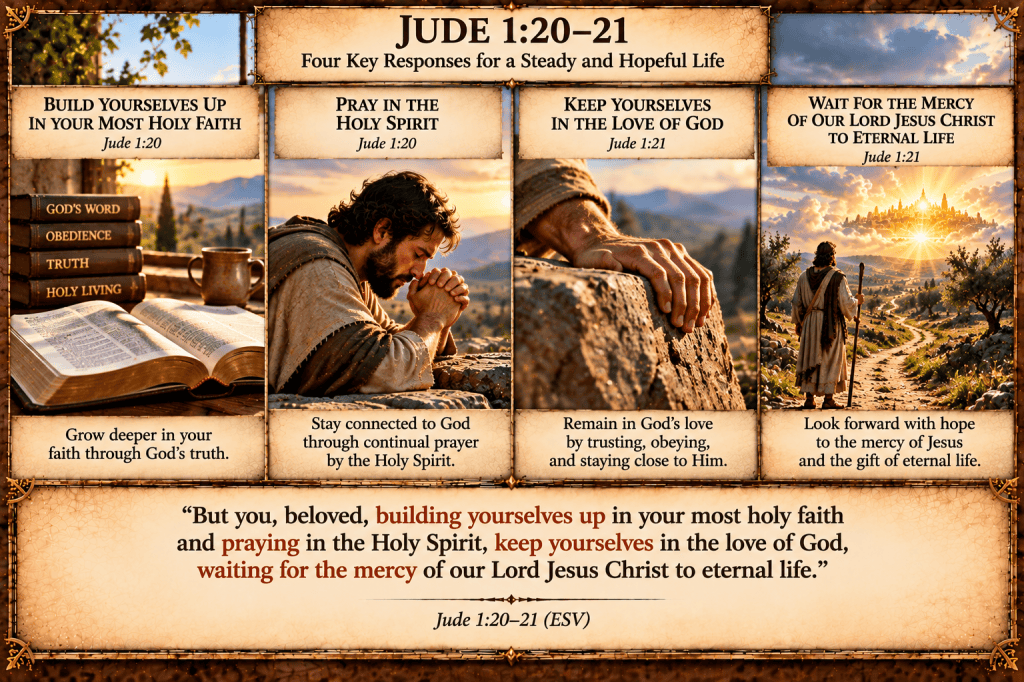
image Jude 1:20-21
dv1021-Daily Verse
Author: Stephen Weller
Facilitator: Stephen Weller
2,221 words, 12 minutes read time
Our Sacrifice For Others
Encouragement
1 John 3:16 encourages believers by showing the depth of God’s love and providing a model for how we should love others.
The verse points to Jesus willingly giving His life for us. From that truth, we can draw several sources of encouragement:
- You are deeply loved.
Christ’s sacrifice demonstrates that God’s love is not merely words or feelings. It is active, personal, and sacrificial. No matter what challenges you face, you can be confident that you are valued by God. - Your worth is established by Christ.
Jesus’ willingness to lay down His life reminds us that our value is not determined by our failures, achievements, or the opinions of others. His sacrifice reveals how precious we are to Him. - Love is meant to be lived out.
The verse calls believers to follow Christ’s example by serving and caring for others. This encourages us that we can reflect God’s love in practical ways, bringing hope and blessing to those around us. - Self-giving love is possible through God’s help.
We are not left to love others in our own strength. The same God who loved us first empowers us to show patience, generosity, forgiveness, and compassion.
Devotional thought:
Because Jesus laid down His life for us, we never have to question whether God loves us. His love has already been demonstrated at the cross. When we remember that love, we are strengthened to love others with the same compassion and selflessness that He has shown to us.
Bible Lesson
By this we know love, that he laid down his life for us, and we ought to lay down our lives for the brothers. (1 John 3:16 ESV)
This verse is found in a section of chapter 3 that is about loving one another. The section begins with an illustration of hate instead of love for a brother. Cain murdered his brother because of his brother’s righteousness. Paul told Timothy that “all who desire to live a godly life in Christ Jesus will be persecuted” (2 Timothy 3:12 ESV). Because of being clothed with the righteousness of Christ, the world hates us. We must not be like the world and hate our brother in the faith because if we do we are guilty of murder. We are to love our brother and if we do that is an indication that we have passed out of death into life.
How do we know love? Jesus was willing to leave heaven and come live in a fallen sin contaminated world and die a shameful death on a cross to redeem us sinners. Because of his love for us and the joy that would be his from his relationship with us in his kingdom, he was willing to lay down his life for us. His sacrifice for us is the greatest love there is (John 15:13). The greatest love is a love that is willing to sacrifice to meet the needs of others.
As followers of Jesus, Paul tells us to “look not only to his own interests, but also to the interest of others (Philippians 2:4 ESV). As we see others with needs we need to be willing to sacrifice when we can to provide the help needed. Jesus saw our need of salvation and was willing to lay down his life for us. He then instructed us to 19 “Go therefore and make disciples of all nations, baptizing them in the name of the Father and of the Son and of the Holy Spirit, 20 teaching them to observe all that I have commanded you” (Matthew 28:19 – 20 ESV). To obey that command will require a sacrificial love and for some it may require them to lay down their lives.
When we were born again, we became a new creation in Christ in which the old has passed away, being replaced with the new (2 Corinthians 5:17 ESV), but with that new creation came a work assignment of doing good works (Ephesians 2:10). Doing those good works will most likely require a sacrificial love like that demonstrated by Jesus.
Questions with Answers
1 John 3:16 — Understanding Christlike Love
Key Verse — 1 John 3:16 (ESV)
“By this we know love, that he laid down his life for us, and we ought to lay down our lives for the brothers.”
Discussion Questions with Extended Answers
1. How does 1 John 3:16 define true love?
Answer: First John 3:16 defines true love through the sacrificial death of Jesus Christ. Rather than presenting love merely as an emotion, affection, or spoken expression, John points to the greatest demonstration of love in human history: Jesus willingly laying down His life for sinners. His sacrifice reveals that genuine love is selfless, costly, and directed toward the good of others. Christ did not wait until humanity deserved His love; He acted out of grace and mercy. This verse establishes Jesus as both the perfect example and the ultimate source of Christian love. Believers are therefore called to understand love not primarily by what they feel or receive, but by what they are willing to give for the benefit of others.
2. What does the phrase “he laid down his life for us” reveal about Jesus Christ?
Answer: This phrase reveals the voluntary, sacrificial, and redemptive nature of Christ’s death. Jesus did not surrender His life because circumstances overcame Him; He willingly gave Himself to accomplish the Father’s plan of salvation. His sacrifice demonstrates both His obedience to the Father and His immeasurable love for those He came to redeem. Through His death, Jesus bore the penalty of sin and opened the way for reconciliation between God and humanity. His willingness to suffer and die reveals the depth of divine love, showing that salvation rests upon God’s grace rather than human merit. The cross is therefore the supreme revelation of God’s love, justice, mercy, and faithfulness.
3. Why does John connect Christ’s sacrifice with our responsibility to love fellow believers?
Answer: John connects Christ’s sacrifice with Christian responsibility because those who have received God’s love are called to demonstrate that same love toward others. The love believers experience through salvation should transform their attitudes, priorities, and relationships. Christ’s willingness to lay down His life establishes the standard by which Christian love is measured. Although believers cannot duplicate His unique sacrifice for sin, they can reflect His selflessness through acts of compassion, generosity, forgiveness, and service. John’s teaching emphasizes that Christian faith must produce visible evidence of spiritual transformation. Love for fellow believers is not an optional expression of faith but an essential characteristic of those who belong to Christ.
4. Does the command to “lay down our lives for the brothers” always require physical death?
Answer: No. Although this command includes a willingness to sacrifice one’s life when circumstances require it, its application extends into everyday Christian living. Laying down one’s life involves placing the legitimate needs of others ahead of personal comfort, convenience, or advantage. It may mean sacrificing time to help someone in distress, sharing financial resources with those experiencing hardship, caring for the sick, or remaining faithful to others during difficult circumstances. The following verse, 1 John 3:17, specifically addresses helping a brother in material need, demonstrating that sacrificial love must be expressed through practical action. John teaches that the spirit of Christlike sacrifice should characterize ordinary relationships, not merely extraordinary moments of courage.
5. How does 1 John 3:16 relate to the surrounding passage in 1 John 3:11–18?
Answer: The surrounding passage contrasts hatred and selfishness with the sacrificial love demonstrated by Jesus Christ. John first reminds believers that they are commanded to love one another. He then presents Cain, who murdered his brother Abel, as an example of hatred arising from an evil heart. Against this destructive example, John places Jesus Christ, who willingly gave His life for others. The contrast is striking: Cain took his brother’s life, while Christ gave His own life. John then moves from this theological truth to practical application, explaining that believers who possess material resources should respond compassionately when they encounter someone in need. The passage concludes with an appeal to love through genuine actions rather than empty words. Together, these verses teach that authentic Christian love reflects the character of Christ through sacrificial concern for others.
6. What is the relationship between sacrificial love and spiritual maturity?
Answer: Sacrificial love is an important evidence of spiritual maturity because it demonstrates the transforming work of the Holy Spirit in a believer’s life. Human nature often encourages self-preservation, personal recognition, and the pursuit of individual desires. As believers grow in their relationship with Christ, however, they increasingly learn to place God’s purposes and the needs of others above selfish ambitions. Spiritual maturity does not mean that believers become perfect in love, but that their lives progressively reflect Christ’s humility, compassion, patience, and generosity. A spiritually mature Christian recognizes opportunities to serve rather than merely seeking opportunities to be served. The willingness to sacrifice personal comfort for another person’s spiritual or physical well-being demonstrates a growing understanding of the love revealed at the cross.
7. How can believers distinguish genuine sacrificial love from love expressed only through words?
Answer: Genuine sacrificial love becomes evident through actions that demonstrate sincere concern for the welfare of others. Words of encouragement, sympathy, and affection are valuable, but John warns against allowing verbal expressions to replace practical assistance when help is needed and possible. A believer who claims to love others while consistently ignoring their suffering reveals a contradiction between profession and conduct. Genuine love responds to needs through generosity, compassion, forgiveness, and faithful service. This does not mean that every believer can meet every need, but it does mean that Christians should respond willingly and responsibly according to the opportunities and resources God provides. True love is recognized not simply by what someone promises, but by the willingness to act when love requires personal sacrifice.
8. How does understanding Christ’s sacrificial love strengthen our assurance of salvation?
Answer: Understanding Christ’s sacrificial love strengthens assurance by directing believers toward the completed work of Jesus rather than their own achievements. The foundation of salvation is not the strength of human love but the perfect love of Christ demonstrated through His death and resurrection. Believers can rest in the knowledge that Jesus willingly gave Himself to secure their redemption. At the same time, John’s letter teaches that a growing love for fellow believers provides evidence of genuine spiritual life. Such love does not earn salvation; rather, it reflects the transformation produced by God’s grace. When Christians recognize an increasing desire to serve, forgive, and care for others, they can see evidence of God’s work within them. Their ultimate confidence, however, remains grounded in Christ and His sufficient sacrifice.
9. What challenges might Christians face when attempting to practice the sacrificial love described in this verse?
Answer: Practicing sacrificial love can be difficult because it often conflicts with personal desires, comfort, pride, and expectations. Believers may struggle to love those who have offended them, serve individuals who cannot repay their kindness, or remain compassionate when their efforts go unrecognized. Fear of rejection, limited resources, emotional exhaustion, and competing responsibilities may also create obstacles. Furthermore, sacrificial love requires discernment because helping others does not mean encouraging harmful behavior or neglecting legitimate responsibilities. Christians overcome these challenges by remaining dependent upon God’s grace, studying Christ’s example, praying for wisdom, and allowing the Holy Spirit to develop patience, humility, and compassion. Sacrificial love is not simply the product of human determination; it grows from an ongoing relationship with the Savior who first loved us.
10. How should 1 John 3:16 influence the daily life of a Christian?
Answer: First John 3:16 calls believers to make Christlike love a guiding principle in their daily decisions and relationships. Rather than asking only what benefits themselves, Christians should consider how their words, actions, resources, and opportunities can serve others and honor God. Within families, this may involve patience, forgiveness, encouragement, and a willingness to place another person’s needs ahead of personal convenience. Within the church, it includes supporting struggling believers, caring for the vulnerable, and promoting unity through humility and service. In the broader community, sacrificial love can be demonstrated through generosity, kindness, integrity, and compassion toward those experiencing hardship. Every act of genuine Christian love becomes an opportunity to reflect the character of Jesus Christ. The central lesson is that those who have received the extraordinary love of Christ should seek to make that love visible through ordinary acts of faithful obedience.
Concluding Truth
The measure of Christian love is found in the sacrifice of Jesus Christ. First John 3:16 reminds believers that love is more than an emotion or spoken promise; it is a willingness to give of oneself for the good of others. Jesus demonstrated perfect love by laying down His life for our salvation, and His example establishes the pattern for Christian relationships. As believers grow in their understanding of His sacrifice, they are called to express that love through humility, compassion, generosity, and faithful service. The Christian life becomes a testimony to God’s transforming grace when the love received from Christ is extended to others.


Leave a Reply