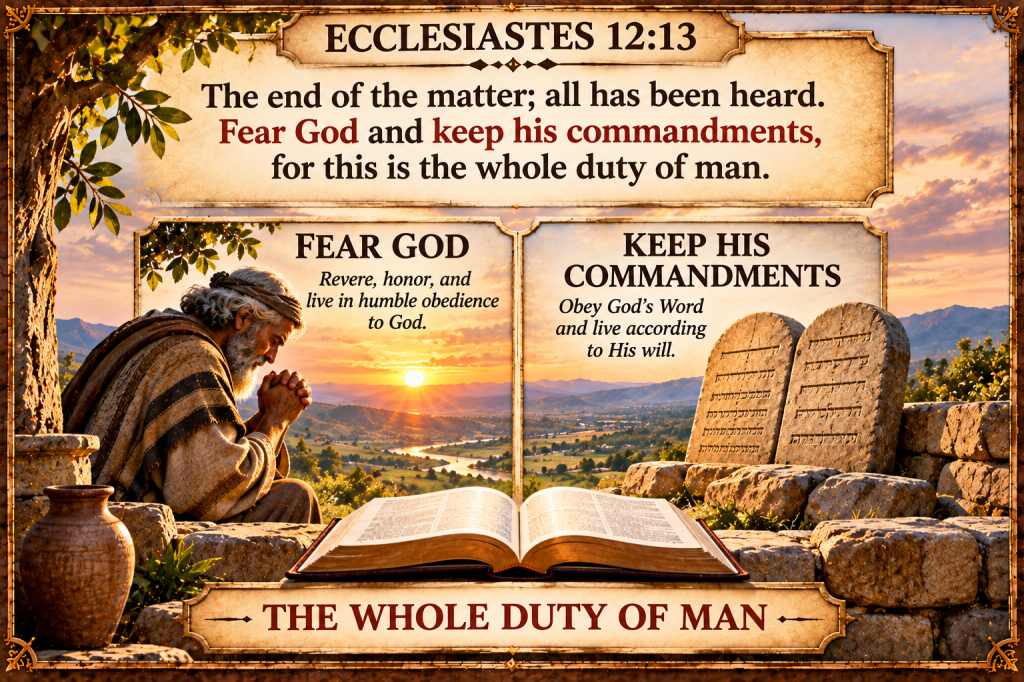
image Ecclesiastes 12:13
dv1023-Daily Verse
Author: Stephen Weller
Facilitator: Stephen Weller
2,100 words, 11 minutes read time
Fear God and Keep His Commandments
Encouragement
Ecclesiastes 12:13 says:
“Fear God and keep his commandments, for this is the whole duty of man.” (ESV)
This verse provides encouragement in several ways:
- Life has a clear purpose.
After exploring many of life’s pursuits, including wealth, pleasure, achievement, and wisdom, Solomon concludes that the ultimate purpose of life is simple: honor God and obey Him. This gives direction when life feels confusing or uncertain. - You do not have to figure everything out.
The book acknowledges that many things in life are difficult to understand. Ecclesiastes 12:13 encourages us to focus on what God has clearly revealed rather than becoming overwhelmed by unanswered questions. - Faithfulness matters more than success.
The world often measures people by accomplishments, status, or possessions. This verse reminds us that what ultimately matters is our relationship with God and our obedience to Him. - God’s standards bring stability.
In a changing world, God’s commandments provide a trustworthy foundation for making decisions and living wisely. - Your life has eternal significance.
The following verse (Ecclesiastes 12:14) points to God’s final judgment. This reassures believers that God sees every act of faithfulness, even those unnoticed by others, and that justice will ultimately prevail.
Devotional thought:
When life feels complicated, Ecclesiastes 12:13 brings us back to the essentials. We are not called to master every mystery or achieve every ambition. We are called to walk humbly with God, reverence Him, and live according to His ways. In doing so, we find the purpose and peace for which we were created.
Bible Lesson
The end of the matter; all has been heard. Fear God and keep his commandments, for this is the whole duty of man. (Ecclesiastes 12:13 ESV)
With this verse we come to the next to the last verse of the book of Ecclesiastes. They are: 13 “The end of the matter; all has been heard. Fear God and keep his commandments, for this is the whole duty of man. 14 For God will bring every deed into judgment, with every secret thing, whether good or evil.”
After looking at life and all the things we can do to try to find meaning, the Preacher draws his conclusions. His first conclusion is to “fear God.” He first mentions this in 3:14 ESV: “I perceived that whatever God does endures forever; nothing can be added to it, nor anything taken from it. God has done it, so that people fear before him.” The work we do produces things that don’t last, but that which God does through us is enduring and cannot be added to or taken away. The sovereignty of God and his purpose is intended to bring sinful humans to a sense of humble reverence and awe of him. Since God has done this, we come in reverent fear before him.
His second conclusion is to “keep his commandments.” John has some meaningful comments on this in 1 John 5:2 – 4 ESV: 2 “By this we know that we love the children of God, when we love God and obey his commandments. 3 For this is the love of God, that we keep his commandments. And his commandments are not burdensome. 4 For everyone who has been born of God overcomes the world. And this is the victory that has overcome the world—our faith.” Keeping his commandments involves both love and faith and when done out of love through faith they are found to be not burdensome.
Fearing God and keeping his commandments is described by the Preacher as “the whole duty of man.” The whole duty of man involves genuine faith in God as well as good works. James speaks of this in James 2:14 – 17 ESV: 14 “What good is it, my brothers, if someone says he has faith but does not have works? Can that faith save him? 15 If a brother or sister is poorly clothed and lacking in daily food, 16 and one of you says to them, “Go in peace, be warmed and filled,” without giving them the things needed for the body, what good is that? 17 So also faith by itself, if it does not have works, is dead.”
Let us draw upon the findings of the Preacher and reverently fear God and keep his commandments. To keep his commandments implies that we do his will out of our love for him. God chose us and caused us to be born again, and as a new creation he gave us an assignment of good works to do (Ephesians 2:10).
Questions with Answers
Ecclesiastes 12:13 — Discussion Questions
Key Verse (ESV)
“Fear God and keep his commandments, for this is the whole duty of man.” — Ecclesiastes 12:13
1. What is the central message of Ecclesiastes 12:13?
Answer: Ecclesiastes 12:13 presents the concluding message of Solomon’s examination of life. After considering wisdom, pleasure, wealth, work, achievement, and the uncertainties of human existence, the Preacher concludes that life’s ultimate purpose is found in fearing God and obeying His commandments. Earthly pursuits, while sometimes valuable and enjoyable, cannot provide lasting meaning apart from God. This verse directs believers away from seeking ultimate satisfaction in temporary accomplishments and toward a life centered on their Creator. True fulfillment comes not from what people accumulate or achieve but from living in a right relationship with God. Solomon’s conclusion reminds us that reverence for God and obedience to His Word are the foundations of a meaningful and purposeful life.
2. What does it mean to fear God?
Answer: Fearing God means recognizing His holiness, authority, wisdom, and sovereignty with deep reverence and respect. It is not merely being frightened of divine punishment but possessing an attitude of awe that leads to humility, worship, trust, and obedience. Proverbs 9:10 teaches that the fear of the Lord is the beginning of wisdom, emphasizing that genuine understanding begins with acknowledging God’s rightful place over our lives. Those who fear God recognize that He is the Creator and righteous Judge, and they desire to honor Him in their thoughts, words, and actions. This reverence influences everyday decisions, encouraging believers to reject without, pursue righteousness, and remain faithful even when obedience is difficult. A proper fear of God produces both a profound respect for His holiness and a growing desire to live according to His will.
3. Why does Solomon connect fearing God with keeping His commandments?
Answer: Solomon connects these two responsibilities because genuine reverence for God naturally expresses itself through obedience. It is possible to acknowledge God’s existence or speak respectfully about Him without allowing His truth to influence personal behavior. However, biblical faith involves more than intellectual agreement; it requires a willing response to God’s authority. Keeping His commandments demonstrates that a person’s reverence is sincere and practical. Jesus reinforced this principle in John 14:15 when He taught that love for Him is expressed through obedience to His commandments. Obedience is not a means of earning salvation but a response of faith, gratitude, and love toward God. Solomon’s instruction reminds believers that worship and daily conduct cannot be separated. A life that honors God must reflect His character through integrity, compassion, righteousness, and faithfulness.
4. Why does Solomon describe fearing God and keeping His commandments as the whole duty of man?
Answer: Solomon’s conclusion emphasizes that humanity’s essential responsibility is to live in a proper relationship with God. Throughout Ecclesiastes, he examines the limitations of human wisdom, the fleeting nature of pleasure, the uncertainty of wealth, and the inevitability of death. These experiences reveal that earthly pursuits cannot provide an enduring foundation for life. By describing reverence and obedience as humanity’s whole duty, Solomon identifies what remains important regardless of circumstances, possessions, or accomplishments. Every person, whether wealthy or poor, powerful or unknown, is accountable to the same Creator. This truth gives dignity and purpose to ordinary life because faithfulness to God is not dependent upon worldly success. The verse teaches that humanity was created for something greater than temporary satisfaction: to know God, honor His authority, and live according to His righteous purposes.
5. How does Ecclesiastes 12:13 help believers establish proper priorities?
Answer: Ecclesiastes 12:13 provides a clear standard for evaluating life’s priorities by placing God above every earthly pursuit. Responsibilities involving family, work, possessions, relationships, and personal ambitions are important, but none should replace devotion to God. When reverence for God becomes the guiding principle of life, believers can evaluate decisions according to whether they honor His character and According to to His Word. This perspective prevents temporary achievements from becoming ultimate goals and helps believers maintain spiritual stability during both prosperity and adversity. Jesus expressed a similar priority in Matthew 6:33 by instructing His followers to seek first God’s kingdom and righteousness. Ecclesiastes 12:13 therefore encourages intentional living, where daily choices reflect eternal values rather than passing desires. By placing God first, believers discover a foundation for wisdom, contentment, and faithful service.
6. How does Ecclesiastes 12:13 relate to the message of salvation through Jesus Christ?
Answer: Ecclesiastes 12:13 establishes humanity’s responsibility to honor God and obey His commandments, while the New Testament reveals how sinful humanity can be reconciled to God through Jesus Christ. Scripture teaches that all people have sinned and fall short of God’s glory (Romans 3:23). Consequently, no one can achieve righteousness before God through perfect personal obedience. Salvation is received by grace through faith in Jesus Christ, whose death and resurrection provide forgiveness and reconciliation with God (Ephesians 2:8–9). However, grace does not eliminate the importance of obedience. Instead, genuine faith produces a transformed life characterized by love for God and a desire to follow His commands. Ephesians 2:10 explains that believers are created in Christ Jesus for good works. Thus, Solomon’s instruction finds its fullest expression in a life redeemed by Christ, guided by the Holy Spirit, and devoted to honoring God.
7. How does the promise of God’s final judgment reinforce the message of Ecclesiastes 12:13?
Answer: Ecclesiastes 12:14 immediately follows Solomon’s conclusion by declaring that God will bring every deed into judgment, including every secret thing, whether good or evil. This statement reinforces the seriousness of fearing God and obeying His commandments. Human actions are not ultimately evaluated by public recognition, personal success, or the opinions of others but by the righteous judgment of God. Even actions concealed from human observation remain fully known to Him. This truth encourages personal integrity, reminding believers that faithfulness matters even when no one else is watching. It also provides Insurance that injustice and wickedness will not escape God’s final judgment. For Christians, this accountability is understood in light of Christ’s saving work and the believer’s calling to live faithfully before Him. The certainty of divine judgment gives eternal significance to daily decisions and encourages believers to pursue holiness, humility, and righteousness.
8. How can believers apply Ecclesiastes 12:13 to their daily lives?
Answer: Believers can apply Ecclesiastes 12:13 by making reverence for God the foundation of their attitudes, decisions, relationships, and responsibilities. This begins with regular attention to Scripture, prayer, worship, and a willingness to submit personal desires to God’s revealed will. In relationships, fearing God encourages honesty, forgiveness, kindness, and love. In work and personal responsibilities, it promotes diligence, integrity, and faithful stewardship. During trials, reverence for God strengthens trust in His wisdom and sovereignty, even when circumstances are difficult to understand. Obedience also requires recognizing without, seeking forgiveness, and allowing the Holy Spirit to shape one’s character. Rather than treating faith as an isolated religious activity, believers are called to honor God in every aspect of life. Ecclesiastes 12:13 reminds us that a successful life is not ultimately measured by possessions, achievements, or recognition, but by faithful devotion to the Lord.
Concluding Truth
The purpose of life is not found in what we possess, accomplish, or experience, but in knowing God, revering His holiness, and faithfully obeying His Word. Ecclesiastes 12:13 brings the entire book to its central conclusion: everything in this world is temporary, but our relationship with God carries eternal significance. Through Jesus Christ, believers receive the grace and strength to live lives that honor Him, finding lasting meaning in faithful obedience to their Creator.


Leave a Reply