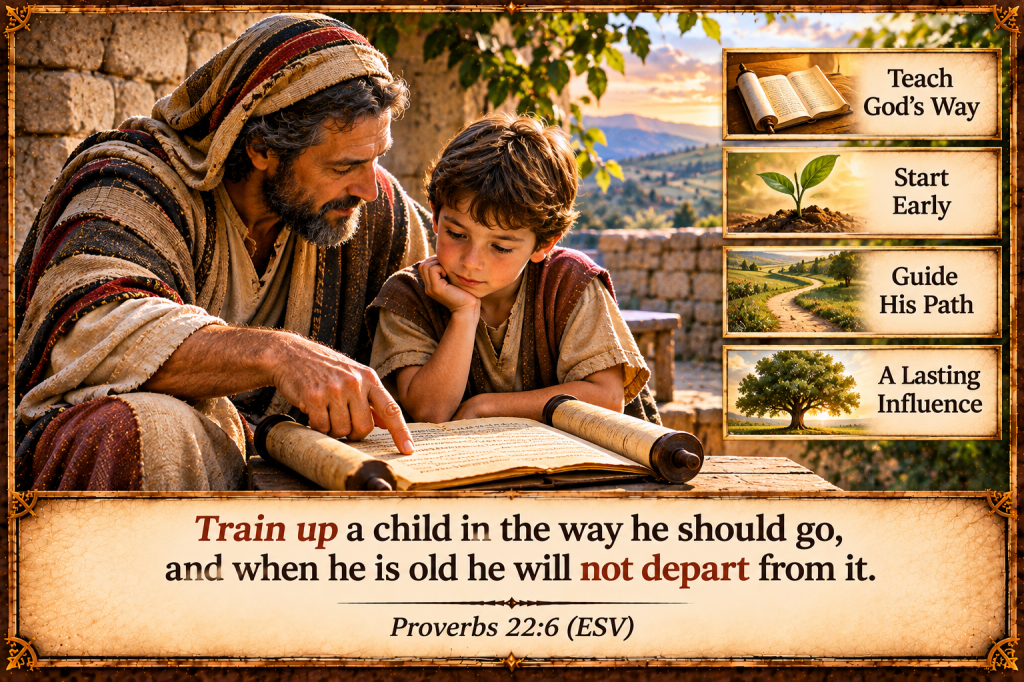
image Proverbs 22:6
dv1026-Daily Verse
Author: Stephen Weller
Facilitator: Stephen Weller
2,443 words, 13 minutes read time
Train Up A Child
Encouragement
Proverbs 22:6 says:
“Train up a child in the way he should go; even when he is old he will not depart from it.” (ESV)
This verse provides encouragement in several ways:
- Your efforts matter.
God affirms that intentional teaching, guidance, and example have lasting influence. The values, faith, and wisdom you invest in a child are not wasted. - Early foundations are powerful.
What is learned in youth often shapes a person’s character and decisions throughout life. This encourages parents, grandparents, teachers, and mentors to be faithful in their influence. - There is hope when the path seems uncertain.
Even if a child temporarily wanders from the lessons they were taught, the truth planted in their heart remains. Many believers find comfort knowing that God’s Word can continue working in a person’s life for years. - Faithful training is a partnership with God.
The verse encourages perseverance. While parents cannot control every choice a child makes, they can faithfully point them toward wisdom and trust God with the results.
A balanced understanding
Proverbs are generally statements of wisdom, not absolute guarantees. The verse teaches a principle: godly training has a strong and enduring influence. It is not meant to create guilt for parents whose children make poor choices, but rather to encourage faithful instruction and trust in God’s ongoing work.
Devotional reflection
The encouragement of Proverbs 22:6 is that seeds planted in love, truth, and faith often bear fruit far beyond what we can see today. God calls us to be faithful in teaching and modeling His ways, trusting that He can use those lessons throughout a person’s lifetime.
Key encouragement: Never underestimate the lasting impact of godly instruction and a faithful example.
Bible Lesson
Train up a child in the way he should go; even when he is old he will not depart from it. (Proverbs 22:6 ESV)
Proverbs 22 has some rich material in it. Over the years I have underlined several verses, which include: “A good name is to be chosen rather than great riches” (verse 1); 3 “The prudent sees danger and hides himself, but the simple go on and suffer for it. 4 The reward for humility and fear of the Lord is riches and honor and life” (verses 3 and 4); 6 “Train up a child in the way he should go; even when he is old he will not depart from it. 7 The rich rules over the poor, and the borrower is the slave of the lender” (verses 6 and 7); and “Folly is bound up in the heart of a child, but the rod of discipline drives it far from him” (verse 15).
Among those I underlined is our verse of study about training up a child in the way he or she should go. This proverb finds its origin in Genesis 18:19 ESV: “For I have chosen him, that he may command his children and his household after him to keep the way of the Lord by doing righteousness and justice, so that the Lord may bring to Abraham what he has promised him.” From this verse we learn that the way to go is to “keep the way of the Lord by doing righteousness and justice.”
For children to learn to keep the way of the Lord, parents are to train their children to understand and do this. We are not to provoke our children to anger, but we are to bring them up in the discipline and instruction of the Lord (Ephesians 6:4). As early as possible, we are to acquaint our children with the sacred writings, which are able to make them wise for salvation through faith in Jesus Christ (2 Timothy 3:15). Teaching them from the Scripture is important because 16 “All Scripture is breathed out by God and profitable for teaching, for reproof, for correction, and for training in righteousness, 17 that the man of God may be complete, equipped for every good work” (2 Timothy 3:16 – 17 ESV). We are to prepare them to be able to make a defense to anyone who asks them for a reason for the hope that in in them (1 Peter 3:15).
Our verse of study includes a promise that we need to approach with care. I know of children who were trained up in the way they should go who didn’t live out that training and departed from the way. This means there are conditions to the promise. If the child remains unsaved then as an adult that person will continue to resist God and his ways. Unless the child becomes a child of God and surrenders his life to live out verses like 2 Timothy 2:15, Galatians 2:20, Galatians 5:16 and Galatians 5:22 – 23 the results most likely will not be according to promise.
I am so thankful that the children of my wife (of 67 years) and I are walking in the ways of the Lord and training up their children to walk in the way also and even seeing grandchildren training up their children. This is a very good reason why this verse is so special to us.
Questions with Answers
Proverbs 22:6 — Train Up a Child in the Way He Should Go
Discussion Questions with Extended Answers
Key Verse — Proverbs 22:6 (ESV)
“Train up a child in the way he should go; even when he is old he will not depart from it.”
1. What does Proverbs 22:6 teach about the responsibility of parents in raising their children?
Answer: Proverbs 22:6 emphasizes the God-given responsibility of parents to provide intentional instruction, guidance, and discipline throughout a child’s formative years. The phrase “train up a child” suggests more than simply teaching rules or correcting improper behavior. It involves developing a child’s character, shaping moral understanding, and establishing a foundation of wisdom rooted in God’s Word. Parents are called to demonstrate godly living through their actions, attitudes, and decisions, recognizing that children learn through observation as well as instruction. Deuteronomy 6:6–7 reinforces this responsibility by instructing parents to teach God’s commandments diligently throughout everyday life. The goal is not merely outward obedience but the development of an inward commitment to righteousness, truth, and reverence for God.
2. What does the phrase “in the way he should go” mean?
Answer: The phrase “in the way he should go” points toward the importance of directing children along a path characterized by wisdom, righteousness, and obedience to God. Throughout Proverbs, the imagery of a path or way frequently represents the moral and spiritual direction of a person’s life. Proverbs 4:11 speaks of instruction in the way of wisdom and guidance along upright paths. Parents are therefore responsible for helping children distinguish between right and wrong, recognize the consequences of their decisions, and develop habits consistent with biblical principles. This guidance should consider each child’s maturity, understanding, and individual needs while remaining grounded in God’s unchanging truth. The ultimate objective is to prepare children to make wise decisions independently as they mature.
3. Why is early childhood instruction so important according to this proverb?
Answer: Early childhood represents a particularly influential period in the development of habits, values, attitudes, and patterns of behavior. Proverbs 22:6 recognizes that instruction received during these formative years can establish a foundation that influences a person throughout life. Children who consistently experience loving discipline, biblical teaching, and examples of godly character are given valuable tools for navigating future challenges. These early lessons help shape their understanding of authority, responsibility, relationships, and moral accountability. The principle is illustrated in 2 Timothy 3:14–15, where Paul reminds Timothy that he had known the sacred writings from childhood. Timothy’s early exposure to Scripture helped prepare him for a life of faith and ministry. The passage encourages parents to recognize that ordinary moments of instruction can have lasting spiritual significance.
4. Does Proverbs 22:6 guarantee that a child raised according to biblical principles will never turn away from God?
Answer: Proverbs 22:6 expresses a general principle of wisdom rather than an unconditional promise that every child raised in a godly home will remain faithful throughout life. The book of Proverbs frequently describes the normal outcomes of wise and foolish behavior, but these observations should not always be interpreted as guarantees without exceptions. Children eventually become responsible for their own decisions and may choose paths contrary to their upbringing. Even faithful parents cannot control every decision their children make. Ezekiel 18:20 emphasizes individual moral responsibility, teaching that each person is accountable for his or her own righteousness or wickedness. This distinction is important because it prevents parents from assuming that a child’s spiritual rebellion necessarily proves parental failure. The proverb encourages diligent instruction while recognizing that genuine faith and obedience ultimately involve personal responsibility before God.
5. How does the example set by parents influence the spiritual development of their children?
Answer: Parental example is one of the most powerful forms of instruction because children observe how biblical principles are applied in everyday circumstances. Parents who demonstrate honesty, patience, forgiveness, humility, and dependence upon God provide visible examples of the truths they teach. Conversely, when parental behavior contradicts verbal instruction, children may struggle to understand the importance of those principles. Proverbs 20:7 connects righteous living with blessings experienced by subsequent generations. A parent’s response to difficulties, treatment of others, commitment to prayer, and willingness to acknowledge personal mistakes all communicate important spiritual lessons. Effective biblical training therefore requires consistency between instruction and conduct. Parents are not expected to demonstrate perfection, but they should model repentance, forgiveness, and a sincere desire to follow God’s will.
6. What role does loving discipline play in training a child according to Proverbs 22:6?
Answer: Loving discipline is an essential component of biblical training because it teaches children that choices have consequences and that wisdom requires self-control. Proverbs 13:24 emphasizes the importance of parental correction motivated by love. Biblical discipline should never be confused with uncontrolled anger, humiliation, or harsh treatment. Instead, it should reflect patience, consistency, fairness, and a genuine concern for the child’s well-being. Ephesians 6:4 instructs fathers not to provoke their children to anger but to bring them up in the discipline and instruction of the Lord. This establishes an important balance between correction and encouragement. Effective discipline helps children understand why certain behaviors are harmful and guides them toward better choices. Its purpose is not simply to produce immediate compliance but to cultivate lasting wisdom, responsibility, and moral discernment.
7. How can parents encourage children to develop a personal relationship with God rather than merely following family traditions?
Answer: Parents can encourage genuine faith by helping children understand the reasons behind biblical teachings and by creating opportunities for thoughtful questions, prayer, and personal reflection. While participation in worship, Bible reading, and family traditions provides valuable spiritual structure, these activities should direct children toward knowing God personally rather than merely repeating inherited practices. Parents can explain God’s character, His plan of salvation through Jesus Christ, and the importance of repentance and faith. They can also encourage children to examine Scripture and understand how biblical truth applies to their own lives. Second Timothy 3:15 explains that the sacred writings are able to make a person wise for salvation through faith in Christ Jesus. Ultimately, parents can teach, encourage, and model faith, but each child must personally respond to God’s truth.
8. How does Proverbs 22:6 apply to grandparents, teachers, and other adults who influence children?
Answer: Although Proverbs 22:6 primarily addresses the responsibility of raising children, its principle extends to everyone who participates in the spiritual and moral development of younger generations. Grandparents, teachers, pastors, and other trusted adults can reinforce biblical values through instruction, encouragement, and personal example. Second Timothy 1:5 highlights the sincere faith of Timothy’s grandmother Lois and mother Eunice, demonstrating how spiritual influence can extend across generations. Psalm 78:4 similarly emphasizes the responsibility of one generation to declare God’s mighty works to the next. These passages remind believers that teaching children is not limited to formal lessons. Conversations, shared experiences, acts of kindness, and consistent examples of faith can leave lasting impressions. Every generation has an opportunity to communicate God’s truth to those who follow.
9. What should parents do when an adult child departs from the biblical principles taught during childhood?
Answer: When an adult child rejects the principles taught during childhood, parents should respond with continued love, faithful prayer, patience, and trust in God’s wisdom. Proverbs 22:6 should not become a source of condemnation or a justification for attempting to control an adult child’s decisions. Instead, parents can remain faithful witnesses through their conduct and maintain opportunities for honest, respectful communication. The parable of the prodigal son in Luke 15:11–32 provides a powerful illustration of a father’s enduring love for a son who chooses a destructive path. Although the father does not prevent his son’s departure, he welcomes him with compassion when he returns. This example encourages parents to remain hopeful without assuming they can determine the outcome. Their responsibility is to continue demonstrating Christlike love while entrusting their children to God’s care.
10. What is the central spiritual lesson believers should remember from Proverbs 22:6?
Answer: The central lesson of Proverbs 22:6 is that faithful instruction during childhood can establish a foundation of wisdom and godly character that influences an entire lifetime. The verse emphasizes the lasting significance of intentional teaching, consistent example, and loving guidance. It reminds parents that raising children involves more than meeting physical and emotional needs; it includes preparing them to understand God’s truth and live according to His wisdom. At the same time, the proverb encourages humility by recognizing that spiritual growth cannot be manufactured through parental effort alone. Parents are responsible for faithfully planting and nurturing seeds of truth, while each child remains accountable for responding to God’s Word. The enduring principle is that the investment of time, love, prayer, and biblical instruction in a child’s early years can bear fruit long after childhood has passed.
Summary Truth
Proverbs 22:6 teaches that the spiritual direction established during childhood can influence the course of an entire life. Parents and those entrusted with guiding children should faithfully teach God’s Word, demonstrate godly character, and provide loving discipline. Although the proverb does not guarantee that every child will remain faithful, it emphasizes the enduring value of early instruction and the responsibility of one generation to prepare the next to walk in wisdom and righteousness.
Supporting Scripture: Deuteronomy 6:6–7; Proverbs 4:11; Proverbs 13:24; Psalm 78:4–7; Ephesians 6:4; 2 Timothy 1:5; 2 Timothy 3:14–15.


Leave a Reply