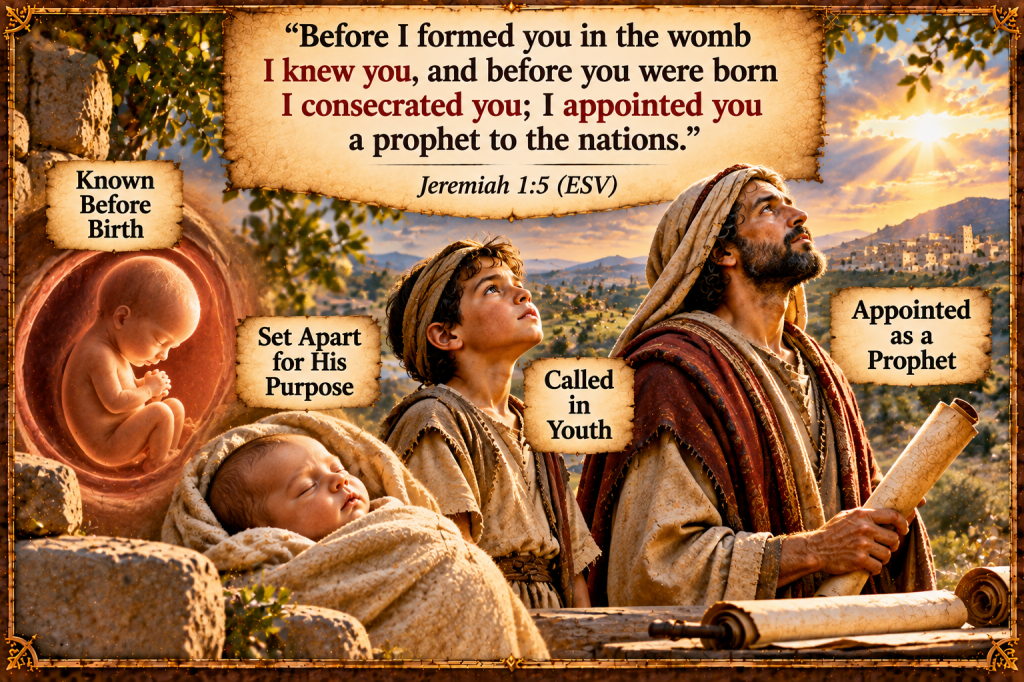
image Jeremiah 1:5
dv1027-Daily Verse
Author: Stephen Weller
Facilitator: Stephen Weller
2,509 words, 13 minutes read time
Known Before Conception
Encouragement
Jeremiah 1:5 says:
“Before I formed you in the womb I knew you, before you were born I set you apart; I appointed you as a prophet to the nations.”
This verse provides several powerful encouragements:
- You are known by God
- God knew Jeremiah before he was even born. This reminds us that our lives are not accidental or unnoticed. God sees us, understands us, and cares about us personally.
- You have purpose
- God had a plan for Jeremiah before his birth. While Jeremiah’s specific calling was unique, the principle encourages believers that God has purpose and meaning for their lives as well.
- Your value does not depend on others’ opinions
- Jeremiah later struggled with feelings of inadequacy and fear, yet God had already declared His purpose for him. Our worth is grounded in God’s knowledge of us, not in our abilities, achievements, or the approval of others.
- God’s calling comes with God’s help
- The context of Jeremiah 1 shows that when Jeremiah objected, saying he was too young, God promised to be with him (Jeremiah 1:7-8). The encouragement is that God does not merely call people to a task; He also equips and strengthens them for it.
- Your life matters in God’s larger plan
- Jeremiah’s ministry would affect nations, showing that God can use ordinary people to accomplish extraordinary purposes. Even seemingly small acts of faithfulness can have significance beyond what we can see.
Devotional Reflection
Jeremiah 1:5 reminds us that long before anyone else knew our name, God did. Before our strengths and weaknesses became apparent, He already saw our entire story. When we feel uncertain about our future or inadequate for the challenges before us, this verse encourages us to rest in the truth that God knows us completely and works through those He calls. Our confidence comes not from who we are, but from the One who formed us and holds our lives in His hands.
Bible Lesson
Before I formed you in the womb I knew you, and before you were born I consecrated you; I appointed you a prophet to the nations. (Jeremiah 1:5 ESV)
Our first glance at this verse gives us the impression that this verse is about us, but it isn’t. Looking back one verse, we read, 4 Now the word of the Lord came to me, saying, 5 “Before I formed you in the womb I knew you, and before you were born I consecrated you; I appointed you a prophet to the nations.” The Lord spoke to Jeremiah and told him, not you and me, that before he was in the womb that he was consecrated and appointed a prophet to the nations. Since this verse appears on the list of daily verses, the intention was that also had application to us. That application will require other verses for support.
When I Googled to see what verses I could find, I was presented with a list of 100 entries from which to choose. The verse at the top of the list was Jeremiah 1:5, by popular vote, which suggest a choice on first glance impression not on context. The second choice, by popular vote, was Psalm 139:1 – 24, from which I chose verse 16 ESV: “Your eyes saw my unformed substance; in your book were written, every one of them, the days that were formed for me, when as yet there was none of them.” This was David speaking but it does draw closer to you and me.
Paul, speaking to believers, said in Ephesians 1:1-6 ESV, 3 Blessed be the God and Father of our Lord Jesus Christ, who has blessed us in Christ with every spiritual blessing in the heavenly places, 4 even as he chose us in him before the foundation of the world, that we should be holy and blameless before him. In love 5 he predestined us for adoption to himself as sons through Jesus Christ, according to the purpose of his will, 6 to the praise of his glorious grace, with which he has blessed us in the Beloved.”
God knew all people before creation and from that vast multitude of individuals, he chose those he would adopt as his and recorded their names in the Lamb’s book of life (Revelation 17:8) and assigned good works for them to do as believers when on earth (Ephesians 2:10). Even those not chosen for salvation, God had plans for them in fulfilling his purpose. Everyone has free will and makes plans, but the Lord establishes his steps (Proverbs 16:9) to accomplish his purpose. God knows every individual that will ever live and knew before creation how he would use each for accomplishing his purpose. How fascinating it has been to see God’s plans unfold for me over my lifetime; plans he determined before the beginning of creation.
Questions with Answers
Jeremiah 1:5 – Known, Set Apart, and Appointed by God
Discussion Questions
Key Verse – Jeremiah 1:5 (ESV)
“Before I formed you in the womb I knew you, and before you were born I consecrated you; I appointed you a prophet to the nations.”
1. What does God mean when He tells Jeremiah, “Before I formed you in the womb I knew you”?
Answer:
God’s declaration reveals His complete knowledge of Jeremiah before his physical existence. Jeremiah’s life was neither an accident nor an unexpected development. Before Jeremiah was conceived, God already knew him and had determined the purpose for which He would call him.
The word knew carries significance beyond simple awareness. In this context, it expresses God’s personal knowledge of Jeremiah and His intentional choice of him for a particular mission. God was not discovering Jeremiah’s potential as he grew older; He had already determined to appoint him as a prophet.
This statement reveals an important truth about God’s sovereignty. His knowledge and purposes are not limited by time or human circumstances. God sees the beginning and the end, and His plans are established according to His wisdom.
For believers, this verse offers encouragement that human life is never outside God’s knowledge. Although Jeremiah’s particular prophetic appointment was unique, the passage reminds us that God knows His creation intimately and that His purposes are established long before human beings recognize them.
2. What is the significance of God’s statement, “Before I formed you in the womb”?
Answer:
God identifies Himself as the One who formed Jeremiah in his mother’s womb. This emphasizes God’s personal involvement in the creation of human life. Jeremiah was not merely the result of biological processes operating independently of God; his existence was part of God’s creative work.
The statement also establishes God’s authority over Jeremiah’s life. Because God formed him, God had the right to call him into service and determine the responsibilities associated with that calling.
This truth is consistent with Psalm 139:13–16, where David describes God’s intimate involvement in his development before birth. Both passages present human life as known and formed under God’s sovereign care.
The spiritual significance extends beyond Jeremiah. Every human being owes existence to God, and human life possesses dignity because it comes from the Creator. Recognizing God as the source of life should produce humility, gratitude, and a willingness to honor Him with the life He has given.
3. What does it mean that God consecrated Jeremiah before he was born?
Answer:
The word consecrated means to set apart for a sacred purpose. God was declaring that Jeremiah had been designated for a particular responsibility before his birth.
Jeremiah’s calling was not something he invented or earned through personal achievement. It originated entirely in God’s sovereign decision. God had already determined that Jeremiah would serve as His prophet, delivering divine messages to Judah and the surrounding nations.
Being consecrated did not mean Jeremiah would experience an easy or comfortable life. His ministry would involve opposition, rejection, persecution, and personal suffering. Nevertheless, his assignment remained sacred because it came from God.
This teaches that being set apart for God’s purposes involves responsibility as well as privilege. Those whom God calls are expected to demonstrate faithfulness, even when obedience becomes difficult.
For Christians, the broader principle is reflected in passages such as Ephesians 2:10, which teaches that believers are created in Christ Jesus for good works prepared by God. Although not everyone receives Jeremiah’s prophetic commission, every believer is called to live in a manner that honors God’s purposes.
4. Why did God appoint Jeremiah as a prophet to the nations rather than only to Judah?
Answer:
God’s appointment of Jeremiah as a prophet to the nations demonstrates that His authority extends beyond Israel and Judah. Although Jeremiah’s ministry focused heavily on Judah and Jerusalem, his prophetic messages also addressed surrounding nations and powerful kingdoms.
Jeremiah would announce God’s judgment against nations that practiced idolatry, injustice, violence, and rebellion. His messages revealed that every nation is accountable to the sovereign Creator.
This appointment also emphasized the universal scope of God’s purposes. God was not merely concerned with the political and spiritual condition of Judah. His plans encompassed the rise and fall of kingdoms and the unfolding of history.
Jeremiah 1:10 further explains this responsibility through language describing the uprooting, breaking down, destroying, overthrowing, building, and planting of nations and kingdoms.
The lesson for believers is that God’s authority is universal. No individual, government, or nation exists outside His sovereignty. His righteousness establishes the standard by which all people and nations are ultimately judged.
5. What does Jeremiah 1:5 teach about God’s sovereignty and human purpose?
Answer:
Jeremiah 1:5 reveals that God’s purposes can precede human awareness, preparation, or achievement. Before Jeremiah had the ability to speak, make decisions, or demonstrate personal qualifications, God had already appointed him to a specific ministry.
This illustrates the sovereignty of God in directing human history. God’s plans do not depend entirely upon human initiative or natural ability. He chooses individuals and equips them to accomplish His purposes.
Jeremiah initially responded to God’s calling by expressing his inadequacy. In Jeremiah 1:6, he protested that he did not know how to speak because he was only a youth. God’s response demonstrated that Jeremiah’s success would depend upon divine authority and provision rather than personal confidence.
However, God’s sovereignty does not eliminate human responsibility. Jeremiah was still required to respond in obedience, speak God’s words, and remain faithful through difficult circumstances.
The passage encourages believers to recognize that their abilities, opportunities, and circumstances can become instruments through which God accomplishes His purposes. Rather than relying exclusively upon personal strength, believers should seek God’s direction and respond faithfully to the responsibilities He places before them.
6. How does Jeremiah’s calling demonstrate that God’s purposes are not limited by human weakness?
Answer:
Jeremiah’s calling demonstrates that God can accomplish His purposes through individuals who feel inadequate or unprepared.
When Jeremiah learned of his appointment, he immediately focused on his limitations. He believed his youth and lack of speaking ability made him unsuitable for the prophetic ministry.
God did not respond by praising Jeremiah’s natural abilities. Instead, He assured Jeremiah of His presence, authority, and protection. In Jeremiah 1:7–8, God instructed him to go wherever he was sent and speak whatever he was commanded.
The emphasis was not upon Jeremiah’s qualifications but upon God’s sufficiency.
This principle appears throughout Scripture. Moses questioned his ability to speak, Gideon considered himself insignificant, and Paul acknowledged that God’s power is made perfect in weakness.
For believers, the lesson is that feelings of inadequacy do not necessarily indicate an inability to serve God. When God calls someone to a responsibility, obedience and dependence upon Him are more important than personal confidence.
God’s purposes are accomplished through His power, even when His servants recognize their limitations.
7. Does Jeremiah 1:5 mean that God has appointed every person to a specific purpose?
Answer:
Jeremiah 1:5 specifically describes God’s unique appointment of Jeremiah as a prophet. Therefore, the verse should not be interpreted as a direct promise that every individual has received the same kind of predetermined prophetic assignment.
Nevertheless, the passage reveals broader truths about God’s knowledge, sovereignty, and involvement in human life.
Scripture teaches that God created human beings for His glory (Isaiah 43:7) and that believers are created in Christ Jesus for good works (Ephesians 2:10). These passages demonstrate that life has meaning and purpose within God’s larger plan.
God provides different gifts, opportunities, and responsibilities to different individuals. Some are called to public ministry, while others serve through teaching, encouragement, generosity, hospitality, leadership, or faithful service within their families and communities.
The important distinction is between Jeremiah’s unique prophetic appointment and the general calling of believers to glorify God.
Christians should not assume that God has revealed every detail of their future. Instead, they should seek His wisdom through Scripture, prayer, and faithful obedience in their present circumstances.
The encouragement is that meaningful service to God does not require a dramatic calling like Jeremiah’s. Faithfulness in ordinary responsibilities can also accomplish purposes that honor Him.
8. How should knowing that God knew Jeremiah before birth influence our understanding of human life?
Answer:
God’s declaration emphasizes that Jeremiah’s identity and significance were established before his birth. His value and calling did not originate from public recognition, personal accomplishments, or the approval of others.
This provides an important foundation for understanding human dignity.
Scripture consistently presents human life as the work of God. Genesis 1:27 teaches that humanity was created in God’s image, while Psalm 139 describes God’s involvement in human development before birth.
Jeremiah 1:5 contributes to this understanding by demonstrating that God’s knowledge and purposes can extend to a person before physical birth.
The passage also challenges the idea that human worth depends upon strength, intelligence, productivity, or social position. Jeremiah had accomplished nothing when God declared His knowledge and appointment of him.
For believers, these truths should encourage respect for human life, humility before the Creator, and compassion toward others.
They should also inspire gratitude. Life is a gift from God, and the appropriate response is to use that gift in ways that reflect His character and honor His purposes.
Summary Truth
Jeremiah 1:5 reveals that God’s knowledge precedes our existence, His purposes are established according to His wisdom, and His calling rests upon His authority rather than human qualifications.
Before Jeremiah was formed in his mother’s womb, God knew him, set him apart, and appointed him to serve as a prophet to the nations. This extraordinary calling demonstrates God’s sovereignty over human life and history. Although Jeremiah’s appointment was unique, the passage provides lasting encouragement to believers: God knows His creation, human life has dignity and purpose, and faithful service depends upon trusting the One who calls and equips His servants.
Central Lesson: God knew Jeremiah before he was born, prepared a purpose for his life, and called him to serve. Our responsibility is to trust God’s wisdom, recognize His authority, and faithfully fulfill the responsibilities He places before us.


Leave a Reply