dv1102-Daily Verse
Author: Stephen Weller
Facilitator: Stephen Weller
2,287 words, 12 minutes read time
How Do We Walk?
Encouragement
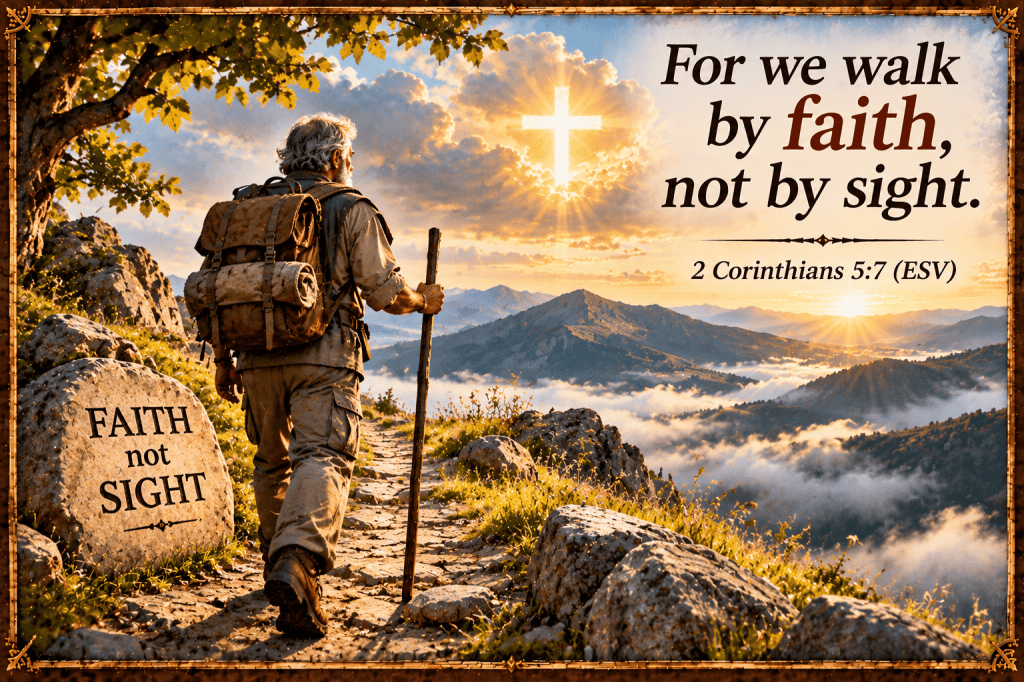
2 Corinthians 5:7 says:
“For we walk by faith, not by sight.”
The encouragement in this verse is that our confidence does not have to depend on what we can currently see, understand, or control. Life often brings uncertainty, delays, challenges, and unanswered questions. Paul reminds believers that God is trustworthy even when circumstances seem unclear.
This verse encourages us to:
- Trust God’s guidance when the future is uncertain.
- Persevere through difficulties without losing hope.
- Look beyond present circumstances to God’s promises.
- Live with confidence that God is at work even when evidence is not immediately visible.
In its context, Paul is speaking about the believer’s hope in Christ and the eternal realities that lie beyond this present life. The message is that faith enables us to move forward courageously, knowing that God’s purposes are greater than what our physical eyes can see.
Practical reflection: When you face a situation where the outcome is unknown, this verse invites you to ask, “What does God promise?” rather than “What do I currently see?” Faith does not ignore reality; it trusts that God is present and faithful within it.
Short devotional thought:
“Lord, help me trust You when the path ahead is unclear. Teach me to walk by faith in Your character, Your promises, and Your timing rather than by what I can see today.”
Bible Lesson
for we walk by faith, not by sight. (2 Corinthians 5:7 ESV)
This verse by itself leaves so much unsaid, like the condition of our walk and the reason for our faith. Without the original context we tend add our own context and apply the verse in a way that fits our desire. Looking at the verses around it we find the context is about our heavenly dwelling. Verse 1 describes our earthly body as a tent that is vulnerable to damage, even destruction, and if and when it is destroyed, “we have a building from God, a house not made with hands, eternal in the heavens. Verses 2 through 4 then describe how inferior this earthly body is when compared to our heavenly body. God has promised that we will inherit this new body and in verse 5 he has given us the Spirit as a guarantee.
The context is about our body that we dwell in. On earth it is mortal to be swallowed up by life, providing an immortal body, perfect in all its ways. Concerning this earthly body, Paul then says, “6 So we are always of good courage. We know that while we are at home in the body we are away from the Lord, 7 for we walk by faith, not by sight” (verses 6 and 7). While we live in our earthly body, we suffer because of its imperfections, but we look ahead, with good courage, by faith, to what God has promised.
As Jesus left the disciples and ascended into heaven, we, while in our earthly bodies are away from the Lord. Paul continues in verse 8 by explaining that while in our earthly body we are to be of good courage, desiring to be away from the body and at home with the Lord. It is this resurrection hope and God’s promise that allows us to walk by faith and not by sight.
In addition to believing in our resurrection and our presence with the Lord, our faith is also important in pleasing him (verse 9). It is to be our aim to live our life in light of a hope that our actions will bring delight to God day by day. It is possible for us to please or displease God in our daily actions. This is expressed in Ephesians 5:10 with the command to “try to discern what is pleasing to the Lord.” In Colossians 3:20 it is pleasing to the Lord that children obey their parents in everything. In Philippians 4:18 it pleased the Lord that a gift was given to Paul, described as “a fragrant offering, a sacrifice acceptable and pleasing to God.” God has equipped us with everything good that we may do his will as he works in us that which is pleasing in his sight (Hebrews 13:21).
It is important that we walk by faith and not by sight and seek to please him because in verse 10, of our passage, we are given a warning: “For we must all appear before the judgment seat of Christ, so that each one may receive what is due for what he has done in the body, whether good or evil.” Just like in the parable of the ten minas (Luke 19:11 – 27) and the parable of the talents (Matthew 25:14 – 30), God assigns us work to do (Ephesians 2:10; Matthew 28:18 – 20) and gives us the resources to do that work and then one day we will be called before him to give an account, like those in the two parables, to determine our reward.
When we look at the expression, “for we walk by faith, not by sight,” out of its context, we don’t know the reason for faith. We are to walk by faith in regard to our resurrection and the work we do in pleasing the Lord.
Questions with Answers
“For we walk by faith, not by sight.” — 2 Corinthians 5:7
Questions of Understanding
1. What does Paul mean when he says, “We walk by faith, not by sight”?
Paul teaches that the Christian life is to be guided by trust in God rather than dependence upon what can be physically seen, measured, or understood through human reasoning alone. Walking by faith means believing God’s promises, trusting His character, and obeying His Word even when circumstances appear uncertain or the outcome remains unknown. Faith does not require believers to ignore reality but calls them to recognize that God’s truth extends beyond what human eyes can observe. Christians live with confidence that God is faithful, sovereign, and actively working according to His purposes. This kind of faith shapes everyday decisions, strengthens perseverance through difficulties, and directs attention toward eternal realities rather than temporary circumstances.
2. How does the context of 2 Corinthians 5 help us understand this verse?
In 2 Corinthians 5:1–10, Paul contrasts the temporary nature of our earthly bodies with the eternal dwelling God has prepared for believers. He acknowledges that Christians experience weakness, suffering, and uncertainty while living in this present world. However, they possess the Insurance of eternal life through Jesus Christ and the promise of resurrection. Paul explains that believers are presently away from the Lord in the sense that they have not yet entered His immediate heavenly presence. Therefore, walking by faith means confidently trusting God’s promise of future glory while continuing to live faithfully in the present. The verse emphasizes that Christian confidence rests not upon visible circumstances but upon God’s trustworthy promises concerning eternal life.
3. What is the difference between walking by faith and walking by sight?
Walking by sight means allowing visible circumstances, personal experiences, and human understanding to become the ultimate basis for decisions and confidence. When people depend entirely upon what they can see, difficulties may produce fear, uncertainty may lead to hesitation, and apparent obstacles may weaken their trust in God. Walking by faith, however, means evaluating circumstances through the truth of God’s Word and relying upon His wisdom and faithfulness. This does not mean rejecting evidence, careful planning, or responsible judgment. Rather, it means recognizing that human understanding is limited while God’s knowledge and purposes are perfect. Faith enables believers to remain obedient and hopeful even when the immediate situation appears discouraging.
4. Why does God call believers to trust Him when they cannot see the outcome?
God calls believers to trust Him because faith is rooted in His unchanging character rather than in their ability to understand His plans. Throughout Scripture, God demonstrates His faithfulness by fulfilling promises, providing for His people, and accomplishing His purposes in ways that often exceed human expectations. Trusting God without knowing the outcome teaches dependence, humility, patience, and perseverance. It also reminds believers that God’s wisdom is greater than their own and that His purposes extend beyond immediate circumstances. Although God does not promise that every situation will unfold according to personal desires, He assures His people that He remains faithful and that His ultimate purposes will prevail. Walking by faith is therefore an expression of confidence in who God is, even when His ways are not fully understood.
5. How does walking by faith influence a believer’s response to suffering and uncertainty?
Walking by faith provides a foundation of hope and stability during suffering because believers understand that present difficulties of the not determine their eternal destiny. Paul himself experienced persecution, physical hardship, opposition, and uncertainty, yet he remained confident in God’s promises. Faith does not eliminate pain, disappointment, or grief, but it provides a perspective that looks beyond temporary circumstances toward God’s eternal purposes. Believers can bring their concerns before God in prayer, seek His wisdom through Scripture, and continue in obedience even when answers are delayed. Their confidence rests in the Insurance that God remains present, that His grace is sufficient, and that present suffering cannot overturn the eternal hope secured through Jesus Christ.
6. How does walking by faith relate to God’s sovereignty?
Walking by faith is closely connected to recognizing God’s sovereign authority over creation, history, and the lives of His people. Because God possesses perfect knowledge and wisdom, believers can trust Him even when events seem confusing or beyond their control. God’s sovereignty assures Christians that history is not governed by chance and that His eternal purposes cannot be defeated. However, trusting God’s sovereignty does not remove personal responsibility. Believers are still called to make wise decisions, act faithfully, and obey His commands. Faith acknowledges that while human beings are responsible for their actions, the ultimate outcome rests in God’s hands. This understanding encourages humility, patience, and confidence in His providential care.
7. What role does God’s Word play in helping Christians walk by faith?
God’s Word provides the foundation upon which genuine biblical faith is built. Romans 10:17 teaches that faith comes through hearing the word of Christ. Scripture reveals God’s character, explains His promises, demonstrates His faithfulness throughout history, and provides guidance for righteous living. Without the truth of Scripture, faith can easily become dependent upon personal feelings, assumptions, or desires. Regular study and meditation upon God’s Word strengthen believers by reminding them of what God has revealed and accomplished. When circumstances challenge their confidence, Scripture provides an enduring standard of truth. Walking by faith therefore involves knowing God’s Word, believing His promises, and applying His instructions in everyday life.
8. How does the example of Abraham illustrate walking by faith rather than by sight?
Abraham provides one of Scripture’s clearest examples of walking by faith. When God called him to leave his homeland and travel to a place he would later receive as an inheritance, Abraham obeyed without knowing the full details of his destination (Hebrews 11:8). He trusted God’s promise that he would become the father of many nations despite circumstances that appeared humanly impossible. His faith was not based upon visible evidence that everything would happen immediately but upon confidence in God’s ability to fulfill His Word. Abraham’s experience demonstrates that faith often requires obedience before the fulfillment of God’s promises becomes visible. His example encourages believers to trust God’s direction, remain patient during periods of waiting, and recognize that God’s timing and purposes are greater than human expectations.
9. How does walking by faith affect the choices and priorities of everyday Christian living?
Walking by faith influences how believers approach relationships, responsibilities, difficulties, and decisions. Instead of allowing fear, worldly success, material possessions, or temporary circumstances to determine their priorities, Christians seek to honor God through obedience to His Word. Faith encourages honesty when dishonesty might offer an advantage, forgiveness when resentment seems easier, generosity when resources appear limited, and perseverance when difficulties arise. It also shapes the believer’s understanding of success, emphasizing faithfulness to God rather than merely achieving visible results. Every decision becomes an opportunity to demonstrate confidence in God’s wisdom and commitment to His purposes. Walking by faith is therefore not limited to extraordinary moments but is expressed through consistent obedience in ordinary life.
10. How does 2 Corinthians 5:7 encourage believers to maintain an eternal perspective?
Paul’s statement reminds believers that their present earthly existence is temporary and that their ultimate hope rests in eternal fellowship with Jesus Christ. The surrounding passage emphasizes the promise of resurrection, the Insurance of God’s presence, and the responsibility to live in a manner pleasing to Him. Walking by faith allows Christians to view earthly difficulties in light of eternity rather than allowing temporary experiences to dominate their understanding of life. This eternal perspective does not diminish the importance of present responsibilities but gives them greater meaning. Believers are encouraged to remain faithful, serve others, pursue holiness, and trust God’s promises because their lives are directed toward an eternal future secured through Christ. Faith sustains confidence in what God has promised, even before those promises are fully realized.
Central Truth
Walking by faith means trusting the character, promises, and sovereignty of God even when His purposes cannot be clearly seen. The believer’s confidence rests not in favorable circumstances or complete understanding but in the faithfulness of the Lord. Because God has promised eternal life through Jesus Christ, Christians can face uncertainty with courage, endure suffering with hope, and pursue obedience with confidence that their ultimate future is secure in Him.


Leave a Reply