dv1108-Daily Verse
Author: Stephen Weller
Facilitator: Stephen Weller
2,406 words, 13 minutes read time
We Do Not Know Or Understand
Encouragement
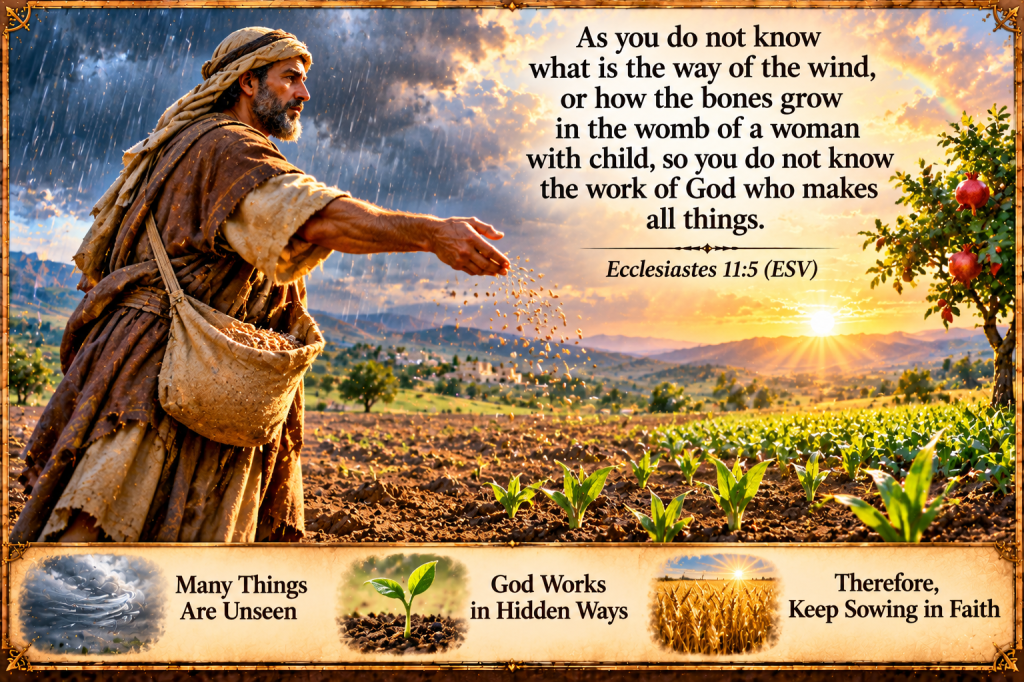
Ecclesiastes 11:5 says:
“As you do not know the way the spirit comes to the bones in the womb of a woman with child, so you do not know the work of God who makes everything.” (ESV)
This verse provides encouragement in several ways:
1. God is at work even when we cannot see or understand it
Just as the development of a child in the womb is a profound mystery, God’s plans and actions often remain hidden from us. The verse reminds us that our inability to understand what God is doing does not mean He is not working.
2. We can trust God’s wisdom over our limited understanding
Life contains many uncertainties. Ecclesiastes acknowledges that human knowledge has limits, but God sees the whole picture. This encourages believers to trust Him when circumstances are confusing or unanswered questions remain.
3. Uncertainty should not paralyze us
The surrounding verses encourage diligence, generosity, and faith-filled action. Since we cannot know everything God is doing, we should continue to obey, serve, and sow good seeds rather than waiting for perfect certainty.
4. God’s creative power inspires confidence
The verse points to God’s role as Creator. The same God who forms life in the womb and sustains the universe is capable of guiding our lives. His power and wisdom are greater than any problem we face.
A devotional thought
When you cannot trace God’s hand, you can trust His heart. Ecclesiastes 11:5 teaches that mystery is not the absence of God but often the evidence of His greatness. What we cannot understand today may be part of a larger work that only God can see.
Key encouragement: You do not have to understand everything God is doing in order to trust Him and move forward in faith.
Bible Lesson
As you do not know the way the spirit comes to the bones in the womb of a woman with child, so you do not know the work of God who makes everything. (Ecclesiastes 11:5 ESV)
This verse impresses me as somewhat unusual to be selected as the verse for the day. The verse presents a woman who is with child and indicates that the spirit somehow enters the bones of the child. The spirit spoken of here is the human spirit and distinguishes us from lower forms of life. To the writer of the book of Ecclesiastes, this human spirit is a mysterious entity. He does not know how or when it enters the fetus. He does know that when the person dies, “the dust returns to the earth as it was, and the spirit returns to God who gave it” (Ecclesiastes 12:7 ESV).
Having pointed out the mystery of the human spirit, the preacher of Ecclesiastes then points out another mystery that is related. It is God that places the spirit in humans in some mysterious way and it is he that makes everything in ways that we do not understand. Jesus spoke the universe into existence and scientists are still trying to understand a great many things about its design. We think of the mystery of our own bodies; of how they were made and what happens to them at spiritual birth.
13 “For you formed my inward parts; you knitted me together in my mother’s womb. 14 I praise you, for I am fearfully and wonderfully made. Wonderful are your works; my soul knows it very well. 15 My frame was not hidden from you, when I was being made in secret, intricately woven in the depths of the earth. 16 Your eyes saw my unformed substance; in your book were written, every one of them, the days that were formed for me, when as yet there was none of them” (Psalm 139:13 – 16 ESV). This indeed is a great mystery.
Another related mystery is found in John 3:8 ESV: “The wind blows where it wishes, and you hear its sound, but you do not know where it comes from or where it goes. So, it is with everyone who is born of the Spirit.” We can’t see the Spirit, but we know that at spiritual birth he enters us to dwell with us forever and we see evidence of him living within us.
Two great mysteries that make humans unique; the human spirit that all humans have and the Spirit that lives within those who are born again. Two births and two spirits.
Questions with Answers
Ecclesiastes 11:5 — Trusting God’s Work Beyond Human Understanding
Key Verse — Ecclesiastes 11:5 (ESV)
“Just as you do not know how the spirit comes to the bones in the womb of a woman with child, so you of the not know the work of God who makes everything.”
Questions of Understanding
1. What is the central message of Ecclesiastes 11:5?
Answer: The central message is that God’s work extends far beyond the limits of human understanding. Solomon uses the mystery of life developing in the womb to illustrate how God accomplishes His purposes through processes that people cannot fully comprehend. Although humanity can observe many aspects of creation, the ultimate wisdom, power, and purposes of God remain beyond complete human knowledge. The verse encourages humility by reminding believers that they of the not need to understand everything God is doing in order to trust Him. Just as God brings life into existence through His marvelous creative power, He is also working in circumstances that may appear confusing, uncertain, or beyond human control. Faith rests not upon knowing every detail of God’s plan but upon knowing the character of the One who Governments all things.
2. Why does Solomon use the development of a child in the womb as an illustration of God’s work?
Answer: Solomon chooses the development of a child because it is an extraordinary example of God’s creative power operating beyond ordinary human observation and control. In Solomon’s day, the processes of conception and fetal development were largely mysterious. Although modern science has revealed much about these processes, the illustration continues to emphasize the wonder of life and the limitations of human knowledge. The formation of a child demonstrates that God accomplishes remarkable things through processes that unfold independently of human understanding. Psalm 139:13–16 reinforces this truth by describing God’s intimate involvement in forming a person in the womb. Solomon’s illustration teaches that the God who governs the mysteries of human life can also be trusted with the mysteries of our circumstances.
3. What does Ecclesiastes 11:5 teach about the limitations of human wisdom?
Answer: Ecclesiastes 11:5 teaches that human wisdom, although valuable, has definite boundaries. People can investigate creation, gain knowledge, develop understanding, and make wise decisions, but they cannot fully comprehend the entirety of God’s activity. Throughout Ecclesiastes, Solomon repeatedly emphasizes that human beings cannot discover everything God is doing from beginning to end (Ecclesiastes 3:11). This limitation should produce humility rather than frustration. Human wisdom becomes most valuable when it recognizes its dependence upon divine wisdom. Proverbs 3:5–6 similarly instructs believers to trust in the Lord rather than rely entirely upon their own understanding. The believer is therefore encouraged to pursue knowledge diligently while acknowledging that God’s wisdom is infinitely greater than human comprehension.
4. How does this verse reveal God’s sovereignty over creation and human life?
Answer: The statement that God “makes everything” emphasizes His sovereign authority as Creator and Sustainer. Nothing in creation exists independently of His creative power, and no aspect of life falls outside His knowledge and ultimate authority. The development of a child provides a specific illustration of this broader truth. God is not merely observing creation from a distance; He is actively sustaining the world He has made. Isaiah 46:9–10 reinforces God’s sovereignty by declaring that His purposes will Status and that He will accomplish all His pleasure. Ecclesiastes 11:5 therefore reminds believers that circumstances beyond their understanding are never beyond God’s knowledge or authority. His sovereignty provides a foundation for confidence even when the reasons behind His actions remain hidden.
5. How should believers respond when they cannot understand what God is doing in their lives?
Answer: Believers should respond with humility, patience, prayer, and trust in God’s character. Human understanding is limited to what can be observed or revealed, while God’s knowledge encompasses every circumstance and its ultimate significance. Difficult experiences may raise questions that cannot be answered immediately, and some questions may remain unresolved throughout earthly life. Nevertheless, Scripture consistently teaches that God’s wisdom and faithfulness remain dependable. Romans 8:28 assures believers that God works for the good of those who love Him and are called according to His purpose, although this does not mean every circumstance will be pleasant or immediately understandable. Ecclesiastes 11:5 encourages believers to distinguish between understanding God’s methods and trusting His character. Faith does not require complete knowledge of God’s plans; it requires confidence in the God who holds those plans.
6. How does Ecclesiastes 11:5 relate to the surrounding teaching in Ecclesiastes 11:1–6?
Answer: The surrounding passage encourages wise, diligent action despite uncertainty about future outcomes. Ecclesiastes 11:1–2 emphasizes generosity and Cautious activity, while verses 3–4 warn against allowing uncertainty to become an excuse for inactivity. Verse 5 explains why complete certainty is impossible: human beings cannot fully understand God’s work. Verse 6 then encourages continued diligence, instructing people to sow their seed in the morning and not withhold their hand in the evening because they cannot know which efforts will prosper. Together, these verses teach that uncertainty should not produce paralysis. Instead, believers should act faithfully, make responsible decisions, and entrust the results to God. The inability to predict outcomes does not eliminate human responsibility; it reinforces the importance of faithful stewardship.
7. What is the difference between trusting God’s sovereignty and becoming passive about life’s responsibilities?
Answer: Trusting God’s sovereignty means recognizing that God ultimately Governments outcomes while accepting responsibility for the actions He has entrusted to us. Passivity, by contrast, uses uncertainty or divine sovereignty as an excuse to avoid obedience, effort, or wise decision-making. Ecclesiastes 11:5 must be understood alongside verse 6, which explicitly encourages diligent activity despite uncertain results. Farmers cannot control the weather or guarantee a harvest, but they must still prepare the soil and sow the seed. Similarly, believers cannot control every outcome in their families, ministries, work, or personal lives, but they remain responsible for faithful action. Trusting God does not mean doing nothing; it means doing what is right while leaving the results in His hands. This understanding balances human responsibility with confidence in divine providence.
8. How can recognizing the mystery of God’s work strengthen a believer’s faith?
Answer: Recognizing the mystery of God’s work can strengthen faith by shifting confidence away from human control and toward God’s wisdom and faithfulness. People often desire explanations before they are willing to trust, but Ecclesiastes 11:5 teaches that complete understanding is not always possible. When believers acknowledge that God’s knowledge exceeds their own, they become better prepared to accept circumstances they cannot explain. Isaiah 55:8–9 emphasizes that God’s thoughts and ways are higher than human thoughts and ways. This truth does not remove suffering or uncertainty, but it provides a foundation for perseverance. Faith Mature when believers learn that God’s reliability does not depend upon their ability to understand His actions. The mystery of divine providence can therefore become an invitation to deeper trust rather than a reason for doubt.
9. How does Ecclesiastes 11:5 encourage humility in our relationship with God?
Answer: Ecclesiastes 11:5 encourages humility by reminding believers that they are creatures rather than the Creator. Human beings possess remarkable abilities to reason, investigate, and discover, yet their knowledge remains incomplete. God’s understanding, by contrast, is unlimited. A humble relationship with God begins by recognizing this distinction and accepting that His wisdom is greater than our own. Job 38–42 provides a powerful illustration of this principle when God confronts Job with questions about creation that expose the limitations of human knowledge. Job ultimately responds with humility and a deeper recognition of God’s greatness. Similarly, Ecclesiastes 11:5 calls believers to approach God with reverence, acknowledging that His purposes are not always subject to human explanation. Such humility encourages worship, dependence, and obedience.
10. What practical encouragement does Ecclesiastes 11:5 provide for everyday Christian living?
Answer: Ecclesiastes 11:5 encourages believers to live faithfully without demanding certainty about every outcome. Life frequently presents situations involving unanswered questions, delayed results, unexpected difficulties, and decisions that must be made without complete information. Solomon reminds readers that God is working even when His activity cannot be fully observed or understood. This truth encourages believers to pray faithfully, serve diligently, make wise decisions, and persevere through uncertainty. It also provides reassurance that the limitations of human understanding of the not limit God’s power. Whether facing difficulties within a family, uncertainty about the future, or questions concerning God’s purposes, believers can remain confident that the Creator possesses wisdom far beyond their own. The appropriate response is not fearful inactivity but faithful obedience grounded in trust.
Concluding Truth
Ecclesiastes 11:5 teaches that God’s work is greater than human understanding, yet His wisdom and sovereignty provide a secure foundation for faith. Just as the formation of life in the womb demonstrates the wonder of God’s creative power, His providential activity throughout our lives often unfolds beyond our ability to comprehend. Believers are not called to understand everything God is doing but to trust His character, obey His Word, and faithfully carry out their responsibilities.
The central encouragement is this: We may not understand how God is working, but we can trust the God who is at work.


Leave a Reply