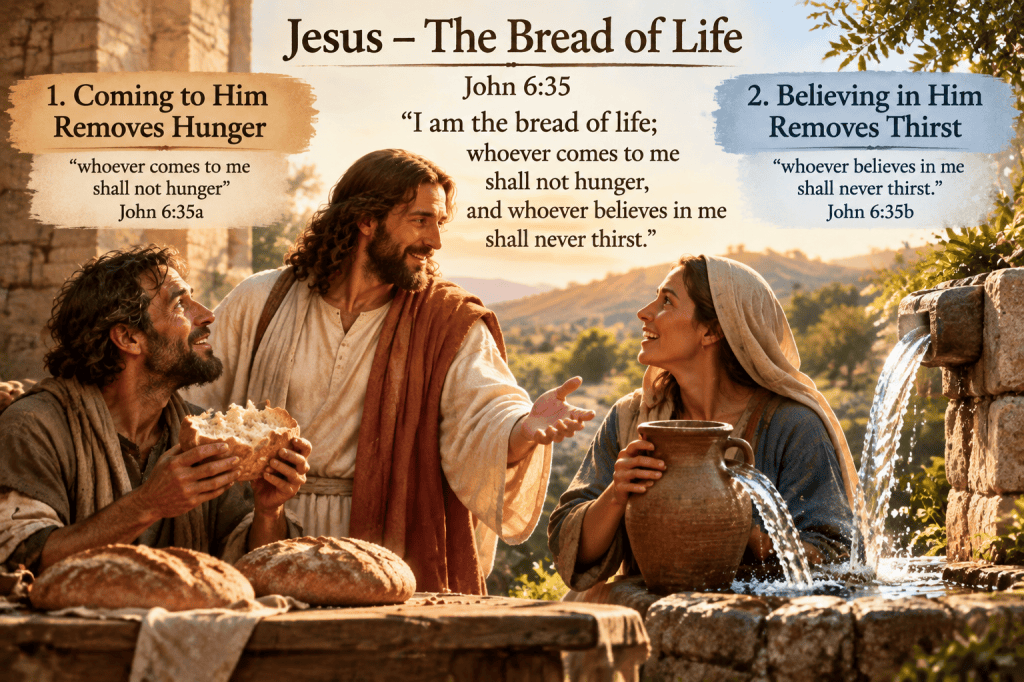
image John 6:35
dv0929-Daily Verse
Author: Stephen Weller
Facilitator: Stephen Weller
1,765 words, 9 minutes read time
Jesus Is the Bread of Life
Encouragement
John 6:35 offers one of the most tender, stabilizing encouragements Jesus ever spoke:
“I am the bread of life; whoever comes to Me shall not hunger, and whoever believes in Me shall never thirst.”
Here’s the heart-strengthening encouragement this gives you today.
Encouragement from John 6:35
1. Jesus Himself is your daily satisfaction
He doesn’t offer things to fill you — He offers Himself. Your deepest needs for meaning, peace, identity, and hope are met in a Person, not in circumstances.
2. You don’t have to live spiritually empty
“Hunger” and “thirst” picture the ache of the soul. Jesus promises that when you come to Him, you will not be left longing for something else to make you whole.
3. Coming to Jesus is enough
He doesn’t say, “Whoever performs well,” or “Whoever has perfect faith.” He simply says: come and believe. Your weakness doesn’t disqualify you — it draws you to the One who satisfies.
4. His provision is constant, not occasional
“Never hunger… never thirst.” This is ongoing, steady, dependable nourishment. Jesus doesn’t feed you once; He sustains you continually.
5. You are invited to rest, not strive
Bread is simple, daily, accessible. Jesus is reminding you that He is not hard to reach — He is near, available, and enough.
A devotional takeaway for today
Jesus is the One who meets the deepest needs of your heart. Come to Him today — He will satisfy you with Himself.
Bible Lesson
Jesus said to them, “I am the bread of life; whoever comes to me shall not hunger, and whoever believes in me shall never thirst. (John 6:35 ESV)
Chapter 6 of the Gospel of John reveals to us the power and position of Jesus. It begins with his feeding the five thousand, plus women and children, from five barley loaves and two fish, demonstrating his ability to create. Jesus then walks on the surface of the Sea of Galilee to join his disciples in a boat on their way to Capernaum, demonstrating his power over physical laws. Once in Capernaum, the crowds again gather around him and hear a teaching that many could not accept and as a result part company with him. Jesus claimed to be the bread of life, bread that comes down from heaven which they must eat.
About this bread, Jesus makes a profound statement: 48 “I am the bread of life. 49 Your fathers ate the manna in the wilderness, and they died. 50 This is the bread that comes down from heaven, so that one may eat of it and not die. 51 I am the living bread that came down from heaven. If anyone eats of this bread, he will live forever. And the bread that I will give for the life of the world is my flesh.” Like Nicodemus trying to figure out how one can be born again, these Jews were trying to figure out what it means to eat his flesh.
Within this context we find the statement of Jesus: “I am the bread of life; whoever comes to me shall not hunger, and whoever believes in me shall never thirst.” The statements “you must be born again” and “I am the bread of life,” that was to be eaten, are being interpreted at the physical level and not understood at the spiritual level. To be born again is to be born spiritually and to eat of the bread of life is a one-time event of coming to Jesus by faith and accepting him into one’s life resulting in spiritual birth. Jesus is the bread of life that came down from heaven and once eaten by faith results in eternal life through spiritual birth.
Being born spiritually, “we are his workmanship, created in Christ Jesus” (Ephesians 2:10 ESV). That spiritual being needs nourishment and Jesus is the bread, who is the Word (John 1:1) and as we study the Word we are nourished and are satisfied. Coming to him by faith we find nourishment for our souls and our hunger is satisfied.
Believing that Jesus is the Son of God clothed with flesh through a virgin birth, provides us with access to “living water” (John 7:38). 37 “On the last day of the feast, the great day, Jesus stood up and cried out, “If anyone thirsts, let him come to me and drink. 38 Whoever believes in me, as the Scripture has said, ‘Out of his heart will flow rivers of living water.’” 39 Now this he said about the Spirit, whom those who believed in him were to receive, for as yet the Spirit had not been given, because Jesus was not yet glorified” (John 7:37 – 39 ESV). The living water is the Spirit.
It is the Word that satisfies our spiritual hunger and the Spirit that satisfies our spiritual thirst, both of which are provided through faith in Jesus Christ; a faith that requires us to come in humble submission to his lordship.
Questions with Answers
“Jesus said to them, ‘I am the bread of life; whoever comes to me shall not hunger, and whoever believes in me shall never thirst.’” — John 6:35
1. What does Jesus mean when He declares, “I am the bread of life”?
Answer:
When Jesus calls Himself “the bread of life,” He is revealing that He is the essential source of spiritual nourishment and eternal life. In the same way that physical bread sustains the body, Jesus sustains the soul. The people following Jesus had witnessed the feeding of the five thousand and were seeking more physical bread, but Jesus directed their attention to a greater need—their need for God’s salvation.
The statement points back to the Old Testament provision of manna, which God gave Israel in the wilderness. Although manna sustained Israel temporarily, those who ate it eventually died. Jesus explains that He is the greater provision from God, the true bread that gives life forever. He is not merely someone who gives blessings; He Himself is the blessing God provides.
To receive Jesus as the Bread of Life means recognizing that only He can satisfy the deepest needs of the human heart—our need for forgiveness, reconciliation with God, purpose, and eternal hope.
2. What does Jesus mean when He says, “whoever comes to me shall not hunger”?
Answer:
Jesus is describing the complete satisfaction found in a relationship with Him. The hunger He addresses is not physical hunger but the spiritual longing within every person for meaning, acceptance, and peace with God.
Human beings often attempt to satisfy this hunger through possessions, achievements, relationships, pleasures, or personal accomplishments. While these things may provide temporary enjoyment, they cannot satisfy the deepest spiritual need. Jesus promises that those who come to Him will find what their souls truly require.
This does not mean believers will never experience struggles, disappointments, or unmet earthly desires. Rather, it means that those who trust in Christ receive a lasting satisfaction rooted in God’s presence and promises. The believer’s deepest need has been met because Christ provides forgiveness and restores fellowship with God.
3. What is the significance of Jesus saying, “whoever believes in me shall never thirst”?
Answer:
Jesus uses the image of thirst to describe humanity’s need for spiritual renewal. Just as water is necessary for physical life, God’s grace is necessary for spiritual life. To “believe” in Jesus means more than simply acknowledging that He exists; it means trusting Him, relying on Him, and placing one’s hope in Him as the Savior.
Throughout Scripture, thirst often represents a longing for God. The psalmist wrote, “As a deer pants for flowing streams, so pants my soul for you, O God” (Psalm 42:1). Jesus fulfills this longing by offering the living water of eternal life.
Those who believe in Christ may still experience earthly difficulties, but they possess an inner source of hope and renewal through the Holy Spirit. Their relationship with God is not dependent on changing circumstances but on the unchanging grace of Christ.
4. How does John 6:35 help us understand the difference between seeking Jesus for His gifts and seeking Jesus Himself?
Answer:
The crowd in John 6 had followed Jesus because He had provided physical food through the miraculous feeding of the five thousand. They wanted more signs and more bread, but Jesus challenged them to look beyond temporary blessings to the eternal gift He offered.
Many people are tempted to approach God primarily for what He can provide—health, success, comfort, protection, or material blessings. While God graciously provides for His people, the greatest gift is not what He gives but who He is.
Jesus calls people to seek Him as the source of life itself. When Christ becomes our greatest treasure, we learn to trust Him even when circumstances do not unfold as we desire. The greatest blessing of Christianity is not merely receiving something from God but knowing God through Jesus Christ.
5. What does “coming to Jesus” and “believing in Jesus” look like in everyday life?
Answer:
Coming to Jesus involves turning to Him in faith and recognizing that He alone can provide salvation and spiritual life. Believing in Jesus means trusting His identity, His sacrifice, and His promises.
In everyday life, this is demonstrated through dependence on Christ rather than self-reliance. It means seeking His guidance through Scripture, bringing our needs and struggles to Him in prayer, and allowing His teachings to shape our decisions and attitudes.
A person who comes to Jesus continually returns to Him as the source of strength, wisdom, and hope. Just as physical life requires daily nourishment, spiritual life requires continual dependence upon Christ, the Bread of Life.
6. How does John 6:35 point us toward the promise of eternal life?
Answer:
Jesus’ promise that those who believe in Him “shall never thirst” points beyond temporary earthly existence to eternal life with God. The satisfaction Jesus provides is not limited to this world; it is a promise of lasting fellowship with God.
Physical bread can only sustain life for a time, but Jesus gives life that death cannot overcome. Those who come to Him receive forgiveness of sins and the assurance that they belong to God forever.
This verse reminds believers that their ultimate hope is not found in temporary circumstances but in the eternal provision of Christ. Jesus is the Bread of Life because He meets humanity’s greatest need—the restoration of a broken relationship with God.


Leave a comment