
John Anderson (Toadstool Hoodoos, Utah)
Previous Lesson
Next Lesson
Author: Stephen Weller
2,890 words, 15 minutes read time
Who Is the Greatest?
Scripture Reference: Matthew 18:1-5; Mark 9:33b-41; Luke 9:46-50
Context:
Matthew 18:1–5; Mark 9:33b–41; Luke 9:46–50
These parallel passages occur during a period when Jesus was intensively teaching His disciples about the true nature of His kingdom. Just before this event, Jesus had again foretold His coming suffering, death, and resurrection, but the disciples still struggled to understand His mission. Instead of focusing on His approaching sacrifice, they became concerned about their own status and importance, even arguing among themselves about who would be the greatest in the kingdom. Their thinking reflected common worldly values that equated greatness with power, position, authority, and recognition. Knowing their hearts, Jesus used this moment to correct their misunderstanding and teach one of the most important lessons of discipleship.
To illustrate His point, Jesus called a young child and placed the child in their midst. In the culture of the first century, children possessed little social status, authority, or influence. By using a child as an example, Jesus was not emphasizing childish behavior but childlike qualities such as humility, dependence, trust, and the absence of self-promotion. He taught that entrance into the kingdom requires conversion and a humble spirit, and that true greatness is found not in elevating oneself above others but in willingly taking the lowest place. Those who receive and care for the humble and seemingly insignificant are, in reality, receiving Christ Himself.
Mark and Luke further reveal that this lesson extended beyond the issue of personal ambition. The disciple John reported that they had attempted to stop a man from casting out demons in Jesus’ name because he was not part of their immediate group. This revealed another form of pride; a desire to control who could participate in God’s work. Jesus corrected this attitude by teaching that those who genuinely minister in His name should not be opposed simply because they are outside a particular circle of disciples. The kingdom of God is larger than any single group, and God can work through those who sincerely honor Christ.
Mark’s account concludes with Jesus emphasizing the value of even the smallest acts of service performed for His followers. A simple cup of water given in His name would not go unnoticed by God. This reinforces the central lesson of the passage: greatness in God’s kingdom is measured not by rank, prestige, or recognition, but by humility, service, and a willingness to value others. Together, these passages present a powerful contrast between worldly ambition and kingdom-minded discipleship, teaching that the path to true greatness is found in humble dependence upon God and loving service toward others.
Event Narrative:
The narrative for this section was obtained from three similar texts, using the highlighted material shown below. The selection was determined by Jerry Peyton and copyrighted in 2015 by Jerry Peyton and Biblical Studies Press L.L.C.
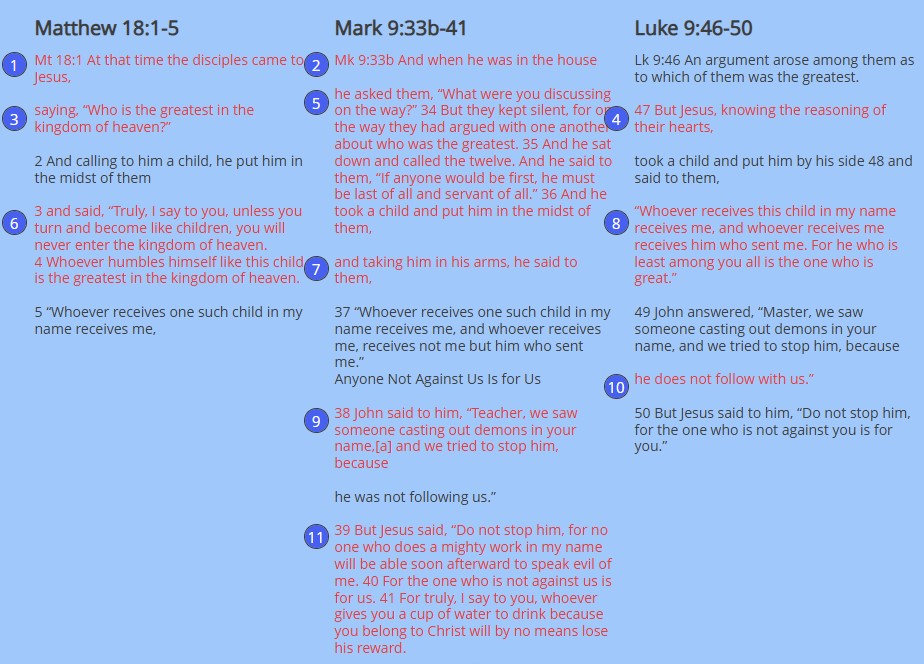
From the above worksheet photo, following the numbers and the text in red, the following narrative is produced.
Mt 18:1 At that time the disciples came to Jesus, Mk 9:33 [inside] the house Mt 18:1 saying, “Who is the greatest in the kingdom of heaven?”
Lk 9:47 But Jesus, knowing the reasoning of their hearts, Mk 9:33 he asked them, “What were you discussing on the way?” 34 But they kept silent, for on the way they had argued with one another about who was the greatest.
Mk 9:35 And he sat down and called the twelve. And he said to them, “If anyone would be first, he must be last of all and servant of all.”
Mk 9:36 And he took a child and put him in the midst of them, Mt 18:3 and said, “Truly, I say to you, unless you turn and become like children, you will never enter the kingdom of heaven. 4 Whoever humbles himself like this child is the greatest in the kingdom of heaven.”
Mk 9:36 And taking [the child] in his arms, he said to them, Lk 9:48 “Whoever receives this child in my name receives me, and whoever receives me receives him who sent me. For he who is least among you all is the one who is great.”
Mk 9:38 John said to him, “Teacher, we saw someone casting out demons in your name, and we tried to stop him, because Lk 9:49 he does not follow with us.”
Mk 9:39 But Jesus said, “Do not stop him, for no one who does a mighty work in my name will be able soon afterward to speak evil of me. 40 For the one who is not against us is for us. 41 For truly, I say to you, whoever gives you a cup of water to drink because you belong to Christ will by no means lose his reward
Bible Lessons for this event:
H406 The Mark of a Great Leader (Matthew 18:1; Mark 9:33-35; Luke 9:47)
H407 The Humility of a Child (Matthew 18:3-4; Mark 9:36; Luke 9:48)
H408 Don’t Hinder One Who Is Doing Good (Mark 9:39; Luke 9:49)
Event Summary:
This event recounts Jesus teaching his disciples about humility, service, and inclusion as essential qualities in his kingdom. The disciples’ argument over who is the greatest and their concerns about others performing miracles in Jesus’ name prompt Jesus to clarify the attitudes and behaviors expected of his followers.
Key points of this event are:
(1) Humility as the Path to Greatness: This event opens with the disciples arguing about who is the greatest in the kingdom of heaven. Jesus responds by bringing a child before them and says, “Whoever humbles himself like this child is the greatest in the kingdom of heaven.” (Matthew 18:4 ESV). Unlike the disciples thinking, true greatness in God’s kingdom comes through humility and childlike trust, not status or ambition. Followers of Jesus must adopt an attitude of dependence on God and a willingness to serve others.
(2) Welcoming the Least: Jesus says, “Whoever receives this child in my name receives me, and whoever receives me receives him who sent me. For he who is least among you all is the one who is great.” (Luke 9:48 ESV) Serving and valuing the “least” in society, such as children or the marginalized, reflects a heart that is aligned with God’s values. Welcoming others in Jesus’ name is an act of honoring him.
(3) Encouragement of Unity and Inclusion: The disciples see someone casting out demons in Jesus’ name and express concern to Jesus because he is not part of their group. Jesus responds, “Do not stop him, for no one who does a mighty work in my name will be able soon afterward to speak evil of me. For the one who is not against us is for us. For truly, I say to you, whoever gives you a cup of water to drink because you belong to Christ will by no means lose his reward.” (Mark 9:39-41 ESV) The work that God is doing is not confined to one group. Jesus teaches inclusivity and encourages his followers to recognize and support others who genuinely serve in his name.
(4) The Importance of Serving Others: Jesus says, “If anyone would be first, he must be last of all and servant of all.” (Mark 9:35) Leadership in God’s kingdom is marked by servanthood and selflessness. Those who aspire to greatness must prioritize serving others above themselves.
(5) Assurance of God’s Recognition: Jesus assures his disciples, saying, “Whoever gives you a cup of water to drink because you belong to Christ will by no means lose his reward.” (Mark 9:41 ESV) Acts of kindness and service done in Jesus’ name, no matter how small, are valued by God and will be rewarded.
This event emphasizes that true greatness in God’s kingdom comes through humility, service, and unity. Jesus calls his followers to adopt childlike humility, value and serve the least among them, and embrace inclusivity in God’s work. These teachings challenge believers to reflect Christ’s love through selflessness, kindness, and an open-hearted approach to others.
Discussion Questions with Extended Answers:
Matthew 18:1–5; Mark 9:33b–41; Luke 9:46–50
1. What question did the disciples ask Jesus, and what does it reveal about their thinking?
Answer:
The disciples asked Jesus, “Who is the greatest in the kingdom of heaven?” (Matthew 18:1). This question reveals that they were still thinking in terms of earthly status, rank, and importance. Like many people of their day, they assumed that greatness was measured by position, authority, recognition, or influence. Even after spending considerable time with Jesus, they struggled to understand the values of God’s kingdom. Their concern was not how to serve God more faithfully but who would hold the highest place. This attitude exposed pride and self-interest within their hearts. Jesus used this opportunity to teach that His kingdom operates according to entirely different principles. Greatness in God’s kingdom is not achieved by elevating oneself above others but by humbly submitting to God and serving others.
2. Why did Jesus place a child in the midst of the disciples?
Answer:
Jesus placed a child before the disciples as a living illustration of kingdom values. In the ancient world, children possessed little social status, power, or influence. They were dependent upon others and had no claim to honor or prestige. By placing a child in their midst, Jesus challenged the disciples’ assumptions about greatness. He wanted them to see that entrance into and greatness within the kingdom require humility rather than self-promotion. The child represented dependence, trust, teachability, and a lack of concern for status. Jesus was not teaching that believers must become childish but childlike—willing to trust God, submit to His authority, and recognize their dependence upon Him. The child became a powerful object lesson demonstrating that true greatness begins with humility.
3. What did Jesus mean when He said, “Unless you turn and become like children”?
Answer:
Jesus was calling for a radical change of heart and attitude. The phrase “turn” implies repentance, a change in direction and thinking. The disciples needed to abandon their pursuit of personal greatness and embrace humble dependence upon God. Becoming like children means recognizing one’s need for God’s grace rather than relying on personal achievements or status. Children understand their dependence upon parents for provision, protection, and guidance. Likewise, believers must acknowledge their complete dependence upon God. Jesus taught that humility is not merely desirable but essential for entering the kingdom of heaven. The kingdom belongs to those who trust God rather than themselves and who willingly submit to His authority.
4. According to Jesus, who is the greatest in the kingdom of heaven?
Answer:
Jesus answered that the greatest person in the kingdom is the one who humbles himself like a little child (Matthew 18:4). This teaching completely reverses worldly definitions of greatness. The world often admires power, wealth, influence, and achievement. Jesus taught that greatness is measured by humility, obedience, and service. A humble person does not seek recognition or demand honor. Instead, such a person seeks to glorify God and serve others. True greatness comes from lowering oneself before God rather than exalting oneself above others. Throughout Scripture, God consistently honors those who walk humbly before Him. Jesus Himself became the ultimate example of humility through His incarnation, service, suffering, and sacrificial death.
5. What significance does Jesus attach to receiving a child in His name?
Answer:
Jesus taught that whoever receives a child in His name receives Him (Matthew 18:5; Mark 9:37; Luke 9:48). Receiving a child means welcoming, caring for, valuing, and serving those who may appear insignificant in society. Jesus identifies Himself with the humble and lowly. When believers show love and kindness toward those who cannot repay them or enhance their status, they demonstrate Christlike character. This principle extends beyond literal children to all who are weak, vulnerable, overlooked, or dependent. Jesus teaches that service rendered to such individuals is service rendered to Him. The kingdom of God values people according to God’s image and love rather than worldly importance.
6. Why did Jesus ask the disciples what they had been discussing on the road?
Answer:
In Mark’s account, Jesus asked the disciples what they had been arguing about while traveling. They remained silent because they had been discussing which of them was the greatest (Mark 9:33–34). Their silence revealed both guilt and embarrassment. They knew their conversation contradicted the spirit of Jesus’ teaching. Jesus used their silence as an opportunity to address the pride hidden within their hearts. Rather than condemning them harshly, He patiently taught them the true meaning of leadership and greatness. This interaction reminds believers that Jesus knows not only our actions but also our thoughts, motives, and private conversations. He desires to transform our hearts so that they reflect His kingdom values.
7. What does Jesus mean when He says, “If anyone would be first, he must be last of all and servant of all”?
Answer:
Jesus taught that leadership in God’s kingdom is fundamentally different from leadership in the world. Worldly leaders often seek authority over others, but kingdom leaders seek opportunities to serve others. Being “last of all” means willingly setting aside personal ambition and self-interest. Being a “servant of all” means using one’s gifts, resources, and influence for the benefit of others rather than for personal advancement. Jesus demonstrated this principle throughout His ministry by serving the sick, teaching the crowds, washing the disciples’ feet, and ultimately giving His life on the cross. Greatness in God’s kingdom is measured by sacrifice, humility, and service rather than prominence and power.
8. Why did John object to the man casting out demons in Jesus’ name?
Answer:
John reported that he and the other disciples tried to stop a man from casting out demons because he was not part of their group (Mark 9:38; Luke 9:49). Their objection reflected a spirit of exclusivity and perhaps jealousy. The disciples assumed that only those officially associated with them should minister in Jesus’ name. They viewed ministry as belonging to their circle rather than to Christ. This attitude revealed the same pride and desire for status that had motivated their discussion about greatness. They were more concerned about who was performing the ministry than whether God’s work was being accomplished.
9. Why did Jesus tell the disciples not to stop the man?
Answer:
Jesus explained that anyone who performs a genuine miracle in His name is unlikely to immediately speak evil of Him afterward. He then stated, “For the one who is not against us is for us” (Mark 9:40). Jesus emphasized unity among those who sincerely serve Him. The disciples needed to understand that God’s work is larger than their own group or personal sphere of influence. Jesus was teaching them not to be possessive or territorial regarding ministry. While Scripture elsewhere warns against false teachers, this particular man was genuinely acting in Jesus’ name and contributing to the work of God’s kingdom. Believers should rejoice when Christ is honored and His work advances, even when it occurs through people outside their immediate circle.
10. What lesson about humility connects all three Gospel accounts?
Answer:
The central lesson uniting Matthew 18:1–5, Mark 9:33b–41, and Luke 9:46–50 is that true greatness is found in humility. The disciples repeatedly focused on status, position, and recognition. Jesus redirected their attention toward childlike dependence, humble service, and appreciation for others who faithfully serve God. The kingdom of heaven does not operate according to human standards of success and prestige. Instead, God values humility, selflessness, and service. Whether receiving a child, serving others, or recognizing God’s work through others, believers are called to set aside pride and embrace the attitude of Christ. The pathway to greatness in God’s kingdom begins with humility before God and loving service toward others.
11. How does Jesus Himself model the teachings found in these passages?
Answer:
Jesus perfectly embodied every principle He taught. Though He is the eternal Son of God, He humbled Himself by taking on human flesh and living as a servant. He welcomed children, cared for the weak, associated with outcasts, and consistently placed the needs of others before His own comfort. He never sought earthly glory but lived in complete submission to the Father’s will. His ultimate act of humility was His death on the cross for sinners. Because Jesus modeled humble service, He possesses the authority to call His followers to do the same. These passages point believers not merely to a moral ideal but to the example of Christ Himself.
12. How should believers apply these teachings today?
Answer:
Believers should regularly examine their hearts for pride, ambition, jealousy, and a desire for recognition. Jesus calls His followers to value humility, serve others willingly, welcome those whom society overlooks, and celebrate God’s work wherever it is genuinely being accomplished. Christians should avoid comparing themselves with others or competing for status within the church. Instead, they should focus on faithful service and obedience to Christ. These passages encourage believers to adopt the mindset of a servant, to trust God with their position and influence, and to remember that true greatness is found not in being noticed but in faithfully honoring Christ. When believers live this way, they reflect the character of their Savior and advance the values of His kingdom.


Leave a Reply