
Jim Hallman (Ticonderoga NY)
Previous Lesson
Next Lesson
Author: Stephen Weller
2,405 words, 13 minutes read time
Children and Stumbling Blocks
Scripture Reference: Matthew 18:6-14; Mark 9:42-49; Luke 17:1-3
Context:
These passages occur during a period when Jesus was teaching His disciples about true greatness in the kingdom of God. Just before these teachings, the disciples had been arguing about who among them was the greatest. In response, Jesus placed a child before them and taught that humility, dependence upon God, and a willingness to serve others are the marks of genuine greatness. Building on that lesson, Jesus warned His followers about the serious responsibility they have toward those who believe in Him, especially those who are spiritually vulnerable or young in faith. He declared that causing one of His “little ones” to stumble is a grievous offense that brings severe judgment. Jesus then used vivid language about cutting off a hand, foot, or eye to emphasize the necessity of removing anything from one’s life that leads to sin. His point was not self-mutilation but radical repentance and a willingness to forsake anything that hinders obedience to God. In Matthew’s account, Jesus followed these warnings with the Parable of the Lost Sheep, illustrating the Father’s deep concern for every believer and His desire that none should perish. The combination of these teachings reveals the value God places on each individual soul, the seriousness of sin, and the responsibility believers have to protect, encourage, and restore one another. Luke’s account adds the command to watch carefully over oneself and to address sin among fellow believers with the goal of repentance and restoration. Together, these passages teach that life in God’s kingdom requires humility, vigilance against sin, loving concern for fellow believers, and a commitment to seek and restore those who wander from the faith.
Event Narrative:
The narrative for this section was obtained from three similar texts, using the highlighted material shown below. The selection was determined by Jerry Peyton and copyrighted in 2015 by Jerry Peyton and Biblical Studies Press L.L.C.
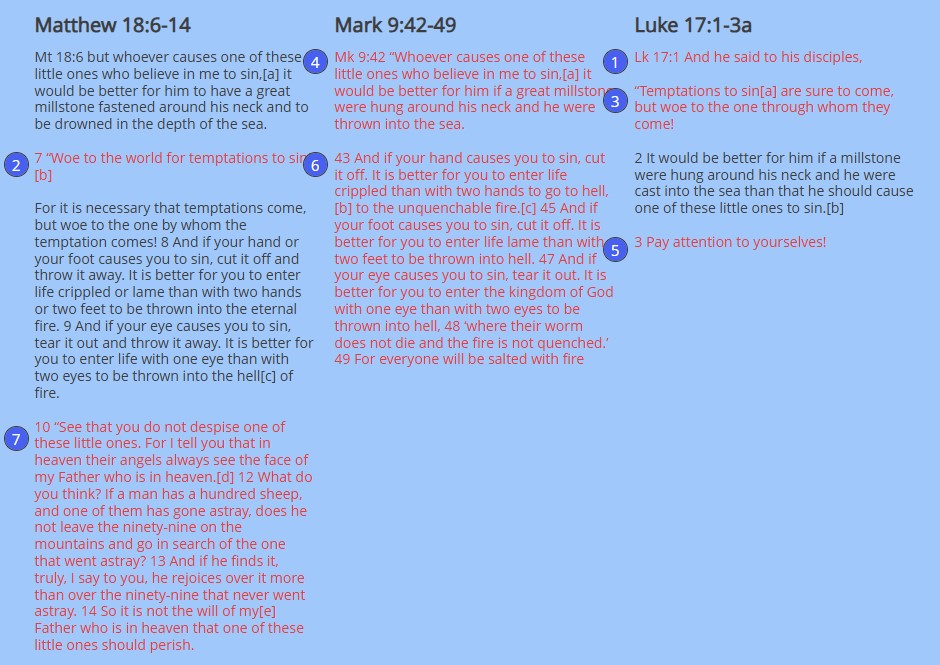
From the above worksheet photo, following the numbers and the text in red, the following narrative is produced.
Lk 17:1 And he said to his disciples, Mt 18:7 “Woe to the world for temptations to sin! Lk 17:1 Temptations to sin are sure to come, but woe to the one through whom they come! Mk 9:42 Whoever causes one of these little ones who believe in me to sin, it would be better for him if a great millstone were hung around his neck and he were thrown into the sea. Lk 17:3 Pay attention to yourselves!”
Mk 9:43 “And if your hand causes you to sin, cut it off. It is better for you to enter life crippled than with two hands to go to hell, to the unquenchable fire. 45 And if your foot causes you to sin, cut it off. It is better for you to enter life lame than with two feet to be thrown into hell. 47 And if your eye causes you to sin, tear it out. It is better for you to enter the kingdom of God with one eye than with two eyes to be thrown into hell, 48 ‘where their worm does not die, and the fire is not quenched.’ 49 For everyone will be salted with fire.”
Mt 18:10 “See that you do not despise one of these little ones. For I tell you that in heaven their angels always see the face of my Father who is in heaven. 12 What do you think? If a man has a hundred sheep, and one of them has gone astray, does he not leave the ninety-nine on the mountains and go in search of the one that went astray? 13 And if he finds it, truly, I say to you, he rejoices over it more than over the ninety-nine that never went astray. 14 So it is not the will of my Father who is in heaven that one of these little ones should perish.”
Bible Lessons for this event:
H409 The Seriousness of Temptation (Matthew 18:7; Mark 9:42; Luke 9:42)
H410 The Seriousness of Sin (Mark 9:43-49)
H411 The Parable of the Lost Sheep (Matthew 18:10-14)
Event Summary:
This event focuses on the importance of avoiding sin, protecting others from stumbling, and pursuing those who are lost. Jesus uses vivid imagery to emphasize the seriousness of sin and the value of every individual in God’s kingdom. The primary themes include responsibility, self-discipline, humility, and God’s care for the lost.
Key points of this event are:
(1) Responsibility to Protect Others from Stumbling: Jesus warns his listeners against causing “little ones” (often interpreted as new believers or vulnerable individuals) to stumble in their faith, explaining to them that it would be better to have a millstone tied around their neck and be drowned in the sea. (See Mark 9:42) Those who follow Christ have a responsibility to protect others from spiritual harm. To lead others into sin is a grave offense, and believers must act with care and integrity toward the vulnerable.
(2) The Inevitability of Temptation: Jesus points out that temptations are bound to occur, and he warns them about the consequences for those through whom they come. (See Luke 17:1) While temptations are a reality of life, believers are called to resist them and not be agents of temptation or sin for others.
(3) Radical Self-Discipline to Avoid Sin: Jesus uses hyperbolic language, such as cutting off a hand or foot or gouging out an eye if they cause sin, to emphasize the need to eliminate anything that leads to sin. () Sin is to be taken seriously, and believers must be willing to make significant sacrifices to avoid it because the eternal consequences of sin far outweigh the cost of self-discipline.
(4) The Value of the “Little Ones” and the Pursuit of the Lost: Jesus speaks of the Father’s care for the “little ones” and illustrates God’s love through the parable of the lost sheep, where the shepherd leaves the ninety-nine to find the one that went astray. (See Mark 9:43-48) God deeply values each individual and actively seeks to restore those who have gone astray. Believers are called to reflect this compassion and care for others, especially to those who have wandered from the faith.
(5) Fire and Refinement: Jesus mentions that “everyone will be salted with fire,” symbolizing the refining process of trials and challenges. Paul speaks of this as “Growing in Christ likeness” or being transformed into the image of Christ (2 Corinthians 3:18). (See Mark 9:49) Believers are refined and purified through the trials of life, which help them grow in faith and holiness. This also underscores the importance of maintaining righteousness in the face of challenges.
This event emphasizes the gravity of sin and the need to protect others, especially the vulnerable, from stumbling. They challenge believers to pursue radical self-discipline, reflect God’s love for the lost, and embrace the refining process of trials. These teachings call Christians to live with integrity, compassion, and a deep sense of responsibility for their own spiritual health and the well-being of others.
Discussion Questions with Extended Answers:
Matthew 18:6-14; Mark 9:42-49; Luke 17:1-3
1. Who are the “little ones” Jesus refers to in these passages?
Answer:
The “little ones” are not limited to children, although children are included in the immediate context. Jesus is referring to those who belong to Him, especially humble believers who may appear weak, insignificant, or vulnerable in the eyes of the world. These are disciples who trust Christ with childlike faith. Jesus places great value on them and warns that anyone who causes them to stumble spiritually will face severe judgment. This teaches that every believer matters to God, regardless of age, position, knowledge, or status. The Lord identifies closely with His people and takes seriously any harm done to their faith.
2. What does Jesus mean by causing someone to “stumble”?
Answer:
To cause someone to stumble means to lead another person into sin, unbelief, spiritual confusion, or discouragement. This can happen through false teaching, hypocrisy, temptation, bad example, abuse of authority, or any behavior that weakens another person’s faith. Jesus emphasizes that believers have a responsibility to help others grow in holiness rather than become obstacles in their spiritual journey. Since disciples influence one another, they must carefully consider how their words, actions, and attitudes affect fellow believers. Leading someone away from God is a serious offense because it damages a relationship that God treasures.
3. Why does Jesus use the illustration of a millstone around the neck?
Answer:
Jesus uses an intentionally shocking image to demonstrate the seriousness of leading others into sin. A large millstone was a heavy stone used for grinding grain, and a person thrown into the sea with such a weight would certainly drown. Jesus is not describing a preferred punishment but emphasizing that causing spiritual harm to one of His followers is an extremely grave offense. The image highlights God’s concern for His people and warns against treating sin lightly. Christ wants His disciples to understand that spiritual influence carries great responsibility and accountability.
4. What does Jesus mean when He says to cut off a hand, foot, or eye if it causes sin?
Answer:
Jesus is using vivid figurative language to emphasize the necessity of dealing decisively with sin. He is not commanding literal self-mutilation, because sin originates in the heart rather than in body parts. Instead, He teaches that believers should be willing to remove anything from their lives that leads them into sin, no matter how valuable or desirable it may seem. This could include harmful relationships, sinful habits, tempting environments, or destructive practices. Jesus is teaching that eternal realities are far more important than temporary comforts, and that radical commitment to holiness is necessary for faithful discipleship.
5. Why does Jesus compare entering life maimed with being cast into hell with all one’s limbs?
Answer:
Jesus is contrasting temporary sacrifice with eternal consequences. Losing something valuable in this life for the sake of obedience is far better than clinging to sinful desires and facing eternal judgment. The comparison highlights the seriousness of sin and the immeasurable value of eternal life. Jesus wants His listeners to evaluate everything in light of eternity. Any earthly loss endured for faithfulness to God is insignificant compared to the blessing of eternal fellowship with Him.
6. What is the significance of the statement, “their angels always see the face of My Father”?
Answer:
This statement emphasizes God’s special care and concern for His people. While Scripture does not provide extensive details about the ministry of angels, Jesus reveals that heaven is actively aware of the needs and circumstances of believers. The picture of angels standing before God’s face suggests continual access to His presence and readiness to serve His purposes. The main point is not to explain angelology but to show the immense value God places upon every one of His children. No believer is overlooked or forgotten in God’s kingdom.
7. What does the Parable of the Lost Sheep teach about God’s character?
Answer:
The parable reveals God’s pursuing love and personal concern for every believer. The shepherd leaves the ninety-nine sheep to search for the one that has wandered away. This demonstrates that God does not view people merely as part of a crowd; He values each individual personally. The shepherd’s joy upon finding the lost sheep illustrates heaven’s delight when someone is restored. The parable highlights God’s mercy, patience, and determination to seek those who have strayed. It assures believers that God actively works to bring wandering people back into fellowship with Himself.
8. What does Jesus mean when He says it is not the Father’s will that one of these little ones perish?
Answer:
Jesus is emphasizing God’s compassionate desire for the preservation and restoration of His people. God takes no pleasure in spiritual ruin but seeks the salvation and growth of those who belong to Him. The statement reflects the heart of God toward the vulnerable and wandering believer. Rather than abandoning those who drift, God pursues them through His Word, His Spirit, His church, and His providential care. This truth encourages believers to participate in God’s work of restoration rather than condemnation.
9. Why does Jesus say that temptations and stumbling blocks will inevitably come?
Answer:
Because the world is affected by sin, temptations are unavoidable. Satan opposes God’s people, human hearts struggle with sinful desires, and believers live in a fallen world. Therefore, occasions for stumbling will occur. However, Jesus distinguishes between the existence of temptation and the responsibility of those who create it. While temptation is inevitable, those who deliberately lead others into sin remain accountable before God. This warning calls believers to vigilance and responsibility in how they influence others.
10. What does Luke 17:3 add to Jesus’ teaching about stumbling blocks?
Answer:
Luke records Jesus saying, “Pay attention to yourselves.” This instruction places responsibility upon believers to examine their own lives carefully. Rather than focusing only on the failures of others, disciples must evaluate their own attitudes, actions, and influence. Jesus calls His followers to personal holiness and spiritual self-awareness. By watching their own conduct, believers can avoid becoming a source of temptation or discouragement to others. Spiritual growth begins with honest self-examination before God.
11. What does Jesus teach about correcting a brother who sins?
Answer:
Jesus commands believers to rebuke a brother who sins. Biblical rebuke is not motivated by anger, pride, or condemnation but by love and concern for restoration. Ignoring sin can allow spiritual damage to continue, while loving correction seeks to bring repentance and healing. The goal is always reconciliation rather than punishment. Jesus teaches that believers have a responsibility to care for one another’s spiritual well-being by speaking truth graciously and faithfully when necessary.
12. How should these passages influence the way believers treat one another?
Answer:
These passages call believers to value one another as God values them. Christians should avoid actions that harm another person’s faith, actively pursue holiness in their own lives, help restore those who wander, and lovingly correct those caught in sin. They should remember that every believer is precious to God and worthy of care, protection, encouragement, and respect. The teachings of Jesus create a community characterized by humility, accountability, compassion, and a shared commitment to helping one another follow Christ faithfully.


Leave a Reply