
Hannes Koenig (The needle)
Previous Lesson
Next Lesson
Author: Stephen Weller
2,809 words, 15 minutes read time
Sin, Repentance and Forgiveness
Scripture Reference: Matthew 18:15-35; Luke 17:3-6
Context:
Matthew 18:15–35 is part of Jesus’ teaching on life within the community of believers. After warning against causing others to stumble and after telling the Parable of the Lost Sheep (Matthew 18:10–14), Jesus turns His attention to how His followers are to relate to one another when sin occurs. The passage begins with instructions for restoring a sinning brother through a process that starts privately and gradually involves additional witnesses and, if necessary, the church. The goal is not punishment but repentance, reconciliation, and the preservation of fellowship. Jesus then emphasizes the authority of the church in matters of discipline and restoration, assuring His disciples that heaven stands behind decisions made according to God’s will and that Christ is present among believers gathered in His name. Peter’s question about the limits of forgiveness provides the setting for Jesus’ teaching on unlimited forgiveness. In response, Jesus tells the Parable of the Unforgiving Servant, contrasting God’s immeasurable mercy toward sinners with the often-limited mercy people show toward one another. The passage reveals that forgiveness is not optional for those who have received God’s grace. Since believers have been forgiven an unpayable debt through Christ, they are expected to extend forgiveness to others. The entire section highlights the themes of restoration, church unity, accountability, mercy, forgiveness, and the transforming effect of God’s grace within the body of Christ.
Luke 17:3–6 occurs during a section of Jesus’ ministry in which He is instructing His disciples about the attitudes and responsibilities that characterize true discipleship. Immediately before these verses, Jesus warns about the serious consequences of causing others to stumble, emphasizing God’s concern for His people and the importance of spiritual responsibility. Against this backdrop, Jesus teaches His disciples how to respond when fellow believers sin. They are commanded to rebuke those who sin and, when repentance occurs, to forgive them. Jesus then intensifies the command by teaching that forgiveness must be repeatedly extended, even if the same person sins and repents multiple times in a single day. Recognizing the difficulty of such a standard, the apostles respond by asking Jesus to increase their faith. Jesus answers by teaching that genuine faith, even in very small measure, possesses great power because its effectiveness depends on God rather than human strength. The illustration of a mustard seed emphasizes that true faith trusts God’s ability to accomplish what seems impossible, including the difficult work of continual forgiveness. Within Luke’s Gospel, this passage reinforces major themes of discipleship, repentance, forgiveness, humility, and dependence upon God. It teaches that believers are called to reflect God’s mercy toward others and that such obedience is made possible through faith in God’s power rather than confidence in themselves.
Event Narrative:
The narrative for this section was obtained from two similar texts, using the highlighted material shown below. The selection was determined by Jerry Peyton and copyrighted in 2015 by Jerry Peyton and Biblical Studies Press L.L.C.
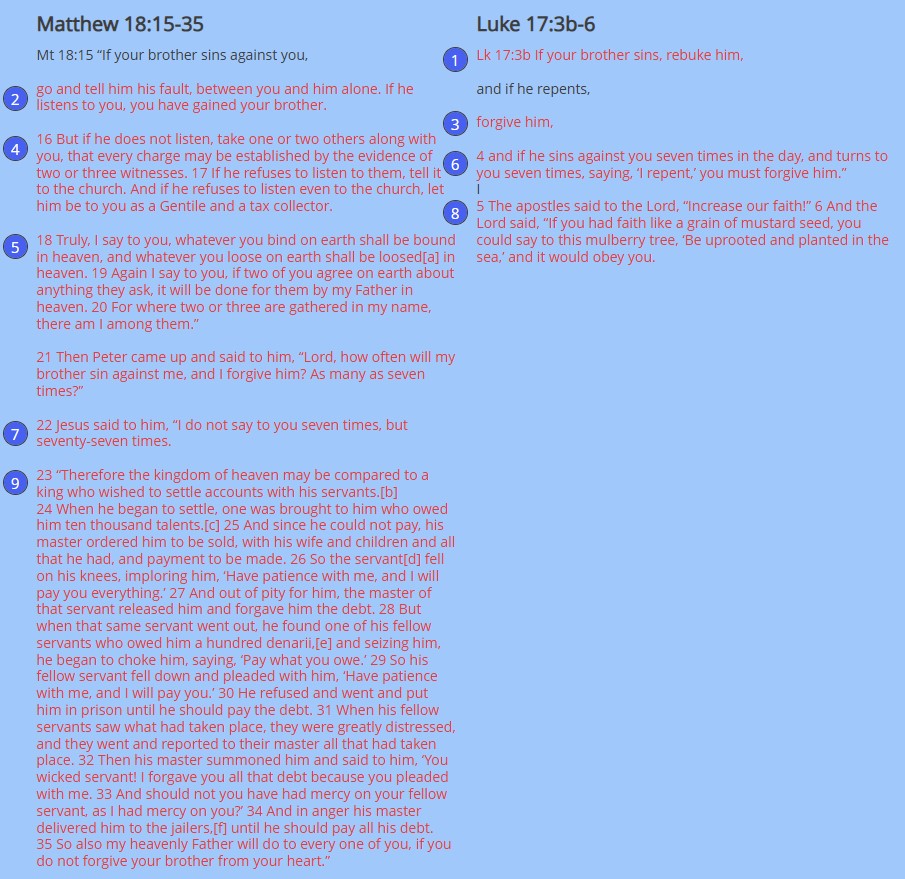
From the above worksheet photo, following the numbers and the text in red, the following narrative is produced.
How Many Times Do I Forgive?
Lk 17:3 “If your brother sins, rebuke him, Mt 18:15 go and tell him his fault, between you and him alone. If he listens to you, you have gained your brother. Lk 17:3 Forgive him. Mt 18:16 But if he does not listen, take one or two others along with you, that every charge may be established by the evidence of two or three witnesses. 17 If he refuses to listen to them, tell it to the church. And if he refuses to listen even to the church, let him be to you as a Gentile and a tax collector.”
Mt 18:18 “Truly, I say to you, whatever you bind on earth shall be bound in heaven, and whatever you loose on earth shall be loosed in heaven. 19 Again I say to you, if two of you agree on earth about anything they ask, it will be done for them by my Father in heaven. 20 For where two or three are gathered in my name, there am I among them.”
Mt 18:21 Then Peter came up and said to him, “Lord, how often will my brother sin against me, and I forgive him? As many as seven times?”
Lk 17:4 [Jesus said to him], “If he sins against you seven times in the day, and turns to you seven times, saying, ‘I repent,’ you must forgive him.” Mt 18:22 Jesus said to him, “I do not say to you seven times, but seventy-seven times.” Lk 17:5 The apostles said to the Lord, “Increase our faith!”
Lk 17:6 And the Lord said, “If you had faith like a grain of mustard seed, you could say to this mulberry tree, ‘Be uprooted and planted in the sea,’ and it would obey you.”
What the Kingdom of Heaven is Like
Mt 18:23 “Therefore the kingdom of heaven may be compared to a king who wished to settle accounts with his servants. 24 When he began to settle, one was brought to him who owed him ten thousand talents. 25 And since he could not pay, his master ordered him to be sold, with his wife and children and all that he had, and payment to be made.
26 So the servant fell on his knees, imploring him, ‘Have patience with me, and I will pay you everything.’ 27 And out of pity for him, the master of that servant released him and forgave him the debt.
28 But when that same servant went out, he found one of his fellow servants who owed him a hundred denarii, and seizing him, he began to choke him, saying, ‘Pay what you owe.’
29 So his fellow servant fell down and pleaded with him, ‘Have patience with me, and I will pay you.’ 30 He refused and went and put him in prison until he should pay the debt. 31 When his fellow servants saw what had taken place, they were greatly distressed, and they went and reported to their master all that had taken place.
32 Then his master summoned him and said to him, ‘You wicked servant! I forgave you all that debt because you pleaded with me. 33 And should not you have had mercy on your fellow servant, as I had mercy on you?’ 34 And in anger his master delivered him to the jailers, until he should pay all his debt.
35 So also my heavenly Father will do to every one of you, if you do not forgive your brother from your heart.”
Bible Lessons for this event:
H412 Sin Must Be Controlled (Matthew 18:15-17; Luke 17:3
H413 When Two or Three Are Gathered Together (Matthew 18:18-20)
H414 Is it 3 or 7 or 77 Times (Matthew 18:22; Luke 17:4-6)
H415 The Parable of the Unforgiving Servant (Matthew 18:23-27)
H416 The Forgiven Must Forgive Others (Matthew 18:28-35)
Event Summary:
This event focus on forgiveness, reconciliation, and accountability in relationships within the community of believers. Jesus teaches practical steps for addressing sin, the importance of extending forgiveness, and the immense value of mercy in God’s kingdom.
Key points of this event are:
(1) Accountability and Reconciliation (Matthew 18:15-20; Luke 17:3-4):
This event opens with Jesus giving instruction to his followers on how to address a fellow believer who sins. He tells them to go and confront the person privately and rebuke him and if he repents, forgive him, but if he does not repent, then return with a witness or two. If he still refuses to repent, then bring the matter before the church. If he still refuses to repent then treat him as an outsider (e.g., a Gentile or tax collector). This prompts Peter to ask Jesus how many times he should forgive his brother who sins. Would seven times be sufficient? Jesus responds with “No” and tells him “seventy-seven times.”
This teaches us that accountability and reconciliation are central to the Christian community. We are to address sin with humility and seek restoration, reflecting God’s heart for unity and healing. Forgiveness must be extended generously when there is repentance.
(2) The Power of Faith (Luke 17:5-6):
When the disciples ask Jesus to increase their faith, he responds, “If you had faith like a grain of mustard seed, you could say to this mulberry tree, ‘Be uprooted and planted in the sea,’ and it would obey you.” It is not the amount of faith you have but a faith that genuinely placed in God, who can accomplish great things. Faith enables believers to forgive and reconcile, even in seemingly impossible situations.
(3) The Parable of the Unforgiving Servant (Matthew 18:21-35):
As an example of forgiving someone, Jesus gives another parable: A king forgives a servant’s enormous debt of ten thousand talents, but the forgiven servant refuses to forgive a fellow servant’s small debt of a hundred denarii. When the king hears what the servant did, he revokes his mercy, throwing the servant into prison, saying, “Shouldn’t you have had mercy on your fellow servant just as I had on you?”
The king in the parable forgave much, which points to God whose forgiveness is limitless. Thus, his followers are called to extend the same mercy to others. A refusal to forgive reveals a lack of understanding or gratitude for God’s grace.
This event emphasizes the transformative power of forgiveness, faith, and accountability in the life of a believer. These teachings challenge Christians to extend mercy generously, seek reconciliation in relationships, and recognize the profound grace they have received from God. In doing so, they reflect God’s love and build a community rooted in humility, faith, and compassion.
Discussion Questions with Extended Answers:
Matthew 18:15–35; Luke 17:3–6
1. What steps does Jesus give for dealing with a brother or sister who sins against us? (Matthew 18:15–17)
Answer:
Jesus provides a clear process for addressing sin within the community of believers. First, the offended person is to go privately to the one who has sinned and seek reconciliation. The goal is not punishment but restoration. If the person listens and repents, the relationship is restored. If the person refuses to listen, one or two others are brought along to establish the facts and encourage repentance. If there is still no response, the matter is brought before the church. Persistent refusal to repent results in separation from fellowship. This process demonstrates God’s desire for holiness, accountability, and restoration. Every step emphasizes love and the hope of winning back a fellow believer rather than condemning them.
2. Why is private confrontation the first step in resolving conflict?
Answer:
Private confrontation protects the dignity and reputation of the person who has sinned. It prevents unnecessary gossip and allows the issue to be handled with humility and grace. By speaking directly to the offender, believers imitate God’s heart for reconciliation. Many conflicts can be resolved quickly when addressed honestly and lovingly. This approach also reveals whether the individual is willing to repent. Jesus teaches that restoration should always be pursued in the least public and most gracious manner possible.
3. What authority does Jesus give the church regarding discipline? (Matthew 18:18–20)
Answer:
Jesus grants His church the authority to make decisions concerning discipline and restoration when acting according to His Word. The language of “binding” and “loosing” refers to recognizing what is permitted or forbidden according to God’s standards. Church discipline is not merely a human action; it is a serious spiritual responsibility carried out under Christ’s authority. Jesus also promises His presence among believers gathered in His name, assuring them of His guidance and support as they seek to uphold truth and pursue reconciliation.
4. What did Peter ask Jesus about forgiveness, and why was his question significant? (Matthew 18:21)
Answer:
Peter asked, “Lord, how often shall my brother sin against me, and I forgive him? Up to seven times?” Peter likely thought he was being generous because many rabbis taught forgiving three times was sufficient. By suggesting seven times, Peter doubled the common standard and added one more. Yet Jesus showed that forgiveness is not measured by counting offenses. Peter’s question reveals a common human tendency to place limits on grace, while Jesus teaches that God’s people are to cultivate hearts characterized by continual forgiveness.
5. What did Jesus mean by forgiving “seventy-seven times” or “seventy times seven”? (Matthew 18:22)
Answer:
Jesus was not establishing a literal number of offenses that must be forgiven. Rather, He was teaching that forgiveness should be limitless. Believers are not to keep records of wrongs or calculate when forgiveness can stop. Since God continually forgives His children, His people are to reflect that same spirit of grace. The emphasis is on maintaining a forgiving heart that is always ready to restore relationships when repentance occurs.
6. What is the main lesson of the Parable of the Unforgiving Servant? (Matthew 18:23–35)
Answer:
The parable teaches that those who have received God’s immense forgiveness must also forgive others. A servant owed his king an impossibly large debt that he could never repay. Out of compassion, the king completely forgave the debt. However, that same servant refused to forgive a fellow servant who owed him a comparatively tiny amount. His unwillingness to extend mercy revealed that he had not truly appreciated the mercy he had received. The lesson is that God’s forgiveness should transform the believer’s heart, producing a willingness to forgive others.
7. Why is the size of the servant’s debt important in the parable?
Answer:
The servant’s debt was extraordinarily large, representing humanity’s overwhelming debt of sin before God. No amount of good works or personal effort could ever repay such a debt. The king’s complete forgiveness illustrates God’s grace in Christ, freely cancelling what sinners could never pay. In contrast, the second debt was relatively small. The comparison highlights the absurdity of receiving unlimited mercy from God while refusing to show mercy to others. Jesus wants His listeners to recognize how much they have been forgiven.
8. What happened to the unforgiving servant, and what warning does this provide?
Answer:
When the king learned of the servant’s lack of mercy, he revoked his favor and delivered the servant to punishment. The servant’s actions demonstrated that he had not truly embraced the grace he received. Jesus concludes with a sobering warning that believers must forgive from the heart. Genuine faith produces a spirit of forgiveness. An unforgiving heart reveals a serious spiritual problem because it contradicts the grace God has shown through Christ.
9. According to Luke 17:3–4, what should believers do when someone repents after sinning against them?
Answer:
Jesus commands believers to forgive those who repent, even if the offense is repeated many times. If a person sins and then genuinely repents, forgiveness should be extended each time. This does not mean ignoring sin; Jesus first says, “rebuke him,” showing that wrongdoing should be addressed. However, when repentance occurs, forgiveness must follow. God’s people are called to imitate His mercy, offering restoration rather than holding grudges.
10. Why did the apostles respond, “Increase our faith”? (Luke 17:5)
Answer:
The disciples realized that the kind of forgiveness Jesus required was beyond normal human ability. Repeatedly forgiving those who offend us can be difficult and painful. Recognizing the challenge, they asked Jesus to increase their faith. Their response shows that forgiveness is not merely an act of willpower; it flows from trusting God, remembering His grace, and relying on His strength. The disciples understood that obeying Jesus in this area required spiritual dependence.
11. What does Jesus mean by faith like a mustard seed? (Luke 17:6)
Answer:
Jesus teaches that even a very small amount of genuine faith can accomplish what seems impossible because the power lies not in the size of the faith but in the greatness of God. The mustard seed was one of the smallest seeds known to His audience, yet it could grow into a large plant. Jesus uses this illustration to show that authentic faith trusts God’s power rather than human ability. Forgiveness, reconciliation, and obedience become possible when believers depend on God.
12. How do Matthew 18:15–35 and Luke 17:3–6 work together to teach about relationships among believers?
Answer:
Together, these passages present a complete picture of biblical reconciliation. Matthew 18 explains how believers should address sin, pursue restoration, and extend forgiveness. Luke 17 emphasizes the necessity of forgiving repentant sinners and trusting God for the strength to do so. Both passages reveal God’s desire for unity, holiness, and grace within His people. Believers are called to confront sin lovingly, seek repentance faithfully, forgive generously, and rely on God through faith. These teachings reflect the gospel itself, where God confronts sin, offers forgiveness, and restores sinners through His grace.


Leave a Reply