
Justa Traveler (Have you ever felt a Florida Sunrise)
Previous Lesson
Next Lesson
Author: Stephen Weller
2,208 words, 12 minutes read time
Jesus Again Predicts His Death and Resurrection
Scripture Reference: Matthew 17:22-23; Mark 9:30-33a; Luke 9:43-45
Context:
After Jesus had demonstrated His authority over demonic powers by delivering a boy whom His disciples had been unable to help, the crowds were once again amazed at His power and greatness. While the people were focused on His miracles and growing reputation, Jesus deliberately turned His attention to His disciples and began preparing them for the events that lay ahead in Jerusalem. This marks the second major prediction of His death and resurrection in the Synoptic Gospels. As they traveled quietly through Galilee, Jesus sought privacy so that He could teach the Twelve about the true nature of His mission. Unlike the crowds, who expected a conquering Messiah who would establish an earthly kingdom, Jesus repeatedly emphasized that He would be betrayed into the hands of men, suffer, be killed, and then rise again on the third day. The disciples struggled to understand these words because they conflicted with their expectations of the Messiah’s glory and victory. Luke notes that the meaning was concealed from them, and they were afraid to ask Jesus for further explanation. Matthew records that the disciples were deeply grieved by His prediction, while Mark highlights Jesus’ intentional effort to teach them privately during their journey. This passage reveals the growing contrast between divine revelation and human expectation. While Jesus clearly understood the path of suffering that awaited Him, His followers were still unable to comprehend how the cross fit into God’s redemptive plan. The prediction serves as a crucial transition in Jesus’ ministry, moving the focus away from public miracles and toward the approaching sacrifice that would accomplish salvation. It also demonstrates Christ’s complete awareness of His coming death and resurrection, showing that the events of the Passion would not be accidental tragedies but the fulfillment of God’s sovereign purpose for the redemption of humanity.
Event Narrative:
The narrative for this section was obtained from three similar texts, using the highlighted material shown below. The selection was determined by Jerry Peyton and copyrighted in 2015 by Jerry Peyton and Biblical Studies Press L.L.C.
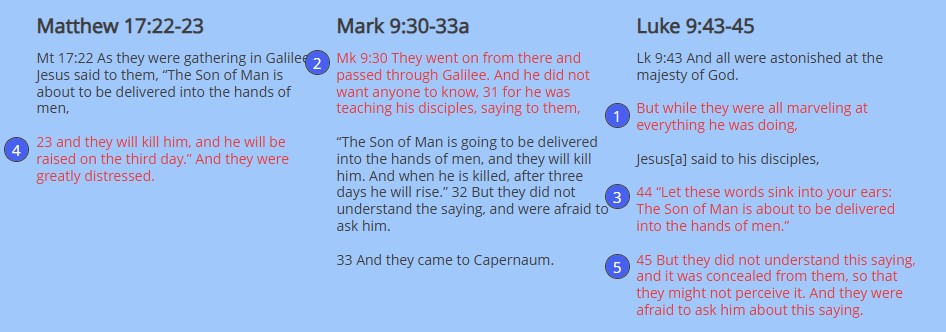
From the above worksheet photo, following the numbers and the text in red, the following narrative is produced
Lk 9:43 While [the crowds] were all marveling at everything [Jesus] was doing, Mk 9:30 [he and his disciples] went on from there and passed through Galilee. [But Jesus] did not want anyone to know, 31 for he was teaching his disciples, saying to them, Lk 9:44 “Let these words sink into your ears: The Son of Man is about to be delivered into the hands of men, Mt 17:23 and they will kill him, and he will be raised on the third day.”
Mt 17:23 [The disciples became] greatly distressed. Lk 9:45 They did not understand this saying, [as] it was concealed from them, so that they might not perceive it. And they were afraid to ask him about this saying.
Bible Lessons for this event:
H404 The Coming Death and Resurrection of Jesus (Matthew 17:23; Mark 9:30-31; Luke 9:43-45)
Event Summary:
This event describes Jesus’ second prediction of his suffering, death, and resurrection. Despite the disciples’ astonishment at his earlier works, they struggle to comprehend his mission. The focus is on Jesus’ foreknowledge of his sacrifice, the disciples’ lack of understanding, and the need for spiritual preparation.
Key points of this event are:
(1) Jesus Foretells his Suffering and Death: Jesus tells his disciples that he will be delivered into the hands of men, killed, and raised on the third day. He emphasizes the inevitability of his sacrifice. (On the above worksheet photo see circles 1 – 4) Jesus demonstrates his full awareness of his mission as the Messiah, including his suffering and resurrection. His death is not an accident but a deliberate act of obedience to God’s redemptive plan.
(2) The Disciples’ Lack of Understanding: The disciples fail to understand Jesus’ words and are afraid to ask him for clarification. The disciples are trying to understand based on their view of an earthly Messiah who would drive out Rome, and not yet being born spiritually they were unable to understand what Jesus was saying at the spiritual level. They saw deliverance from Rome, but Jesus was speaking of deliverance from their sin. Because of their lack of salvation, the meaning was hidden from them. (On the above worksheet photo see circle 5) The disciples’ confusion reflects their limited understanding of God’s plan. Spiritual truths are sometimes difficult to grasp without divine revelation and readiness of heart.
(3) Emotional Reactions to Jesus’ Prediction: The disciples are “filled with grief” upon hearing about Jesus’ impending death. This highlights their attachment to him and their struggle to reconcile his suffering with their expectations of the Messiah. (On the above worksheet photo see circle 4) The disciples’ grief reveals their human perspective, focused on loss rather than the ultimate victory of Jesus’ resurrection. Faith involves trusting God’s plan, even when it defies expectations.
(4) Jesus’ Intentional Preparation: Jesus teaches his disciples privately, avoiding public crowds to focus on preparing them for the events to come. (On the above worksheet photo see circle 2) Jesus intentionally prepares his disciples for his suffering and death, emphasizing the importance of understanding his mission and their role in it. They will not understand his mission until after the resurrection of Jesus and the coming of the Spirit.
This event emphasizes Jesus’ awareness of his mission to suffer, die, and rise again for humanity’s redemption. The event highlights the disciples’ struggle to understand and accept this truth, encouraging readers to trust in God’s plan even when it is difficult to comprehend. This moment serves as a reminder that spiritual preparation, faith, and reliance on Jesus are essential in navigating the challenges of discipleship.
Discussion Questions with Extended Answers:
Matthew 17:22-23; Mark 9:30-33a; Luke 9:43-45
1. Why did Jesus tell His disciples again that He would be delivered into the hands of men, killed, and raised on the third day?
Answer:
Jesus repeated this prediction because His disciples still did not fully understand His mission. They expected the Messiah to establish an earthly kingdom, defeat Israel’s enemies, and reign in visible power. Jesus, however, wanted them to understand that God’s plan of redemption required His suffering, death, and resurrection. By announcing these events beforehand, Jesus demonstrated that His death would not be a tragic accident but the fulfillment of God’s sovereign plan. Each prediction prepared the disciples for what was coming and provided evidence after the resurrection that everything occurred exactly as Jesus had foretold. Although they struggled to grasp His words at the time, these predictions later strengthened their faith and became a foundation for their witness to the world.
2. What does Jesus mean when He says that the Son of Man will be “delivered into the hands of men”?
Answer:
The phrase “delivered into the hands of men” refers to Jesus being betrayed, arrested, condemned, and crucified by sinful humanity. While Judas would physically betray Him, and religious and political leaders would carry out His execution, the expression points to a larger reality. The Holy Son of God would willingly submit Himself to the judgment and cruelty of sinful people. Yet even this was under God’s control. Jesus was not being overpowered by circumstances; He was voluntarily giving Himself as the sacrifice for sin. The statement highlights both human responsibility and divine sovereignty. Wicked men would act according to their sinful desires, but through those actions God would accomplish salvation for all who believe.
3. Why was Jesus trying to travel secretly through Galilee according to Mark’s account?
Answer:
Mark explains that Jesus did not want anyone to know where He was because He was focused on teaching His disciples. Throughout much of His ministry, large crowds constantly surrounded Him seeking miracles, healing, and signs. At this stage, however, Jesus concentrated on preparing the Twelve for His approaching death and resurrection. The cross was drawing near, and the disciples still had much to learn about the nature of His kingdom and their future responsibilities. By avoiding unnecessary public attention, Jesus created opportunities for private instruction. This demonstrates the importance He placed on discipling His followers and ensuring they were prepared to carry His message after His departure.
4. Why were the disciples greatly distressed when they heard Jesus’ prediction?
Answer:
The disciples loved Jesus and could not imagine losing Him. The thought of His suffering and death filled them with sorrow and confusion. They had left everything to follow Him and believed He was the promised Messiah. Since they expected Him to establish a victorious earthly kingdom, His prediction seemed to contradict everything they anticipated. Their grief was sincere, but it was also rooted in misunderstanding. They focused on the prediction of death while failing to comprehend the promise of resurrection. Even though Jesus repeatedly told them He would rise again, they could not yet understand how suffering and victory could exist together in God’s plan.
5. According to Luke, why were the disciples unable to understand what Jesus was saying?
Answer:
Luke states that the meaning of Jesus’ words was concealed from them so that they did not perceive it. This does not mean God was preventing them from believing but rather that their understanding was not yet complete. They were spiritually and mentally unprepared to grasp the full significance of the Messiah’s suffering. Their expectations concerning the kingdom made it difficult for them to accept the idea of a suffering Savior. God’s timing for their understanding would come after the resurrection and the ministry of the Holy Spirit. This reminds believers that spiritual truth is ultimately understood through God’s revelation and illumination rather than human reasoning alone.
6. Why were the disciples afraid to ask Jesus about what He meant?
Answer:
The disciples likely sensed that Jesus was speaking about painful and difficult events. His words challenged their expectations and created uncertainty. Rather than seeking clarification, they hesitated because they feared what the answer might reveal. Their fear may also have stemmed from previous occasions when Jesus corrected their misunderstandings. Instead of openly discussing their confusion, they remained silent. This response highlights a common human tendency to avoid difficult truths. Yet Jesus desired His followers to learn and grow through honest questions. Believers today can learn from this example by bringing their questions and uncertainties directly to Christ rather than allowing confusion to remain unresolved.
7. How does this passage reveal the contrast between God’s plan and human expectations?
Answer:
The disciples expected glory, power, and immediate victory, while God’s plan involved suffering, sacrifice, and redemption through the cross. Human thinking often seeks success without sacrifice and victory without suffering. God’s wisdom, however, accomplished salvation through the very event that appeared to be defeat. The cross seemed like the triumph of evil, but it became the means of conquering sin and death. This contrast teaches believers that God’s purposes often unfold differently than expected. What appears to be loss may be the pathway to eternal gain, and what seems like weakness may display the greatest expression of God’s power.
8. What does Jesus’ prediction teach about His divine knowledge and authority?
Answer:
Jesus accurately foretold His betrayal, death, and resurrection before they occurred. Such detailed knowledge demonstrates His divine authority and His complete awareness of God’s redemptive plan. Nothing that happened during His arrest, trial, or crucifixion took Him by surprise. Jesus willingly moved toward the cross knowing exactly what awaited Him. His predictions confirm that He was not merely a prophet or teacher but the Son of God who possessed perfect knowledge of future events. For believers, this provides assurance that Jesus remains sovereign over all circumstances and that His promises can be trusted completely.
9. What is the significance of the resurrection being included in Jesus’ prediction?
Answer:
The resurrection is the essential conclusion of Jesus’ prediction. Without it, His death would appear to be a tragic defeat. By declaring that He would rise on the third day, Jesus revealed that death would not have the final word. The resurrection validates His identity as the Son of God, confirms the acceptance of His sacrifice for sin, and guarantees victory over death for all who trust in Him. Although the disciples focused on the sorrow of His death, the resurrection would transform their despair into joy and become the cornerstone of the Christian faith.
10. What practical lessons can believers learn from this passage today?
Answer:
Believers learn that God’s plans are often greater and deeper than human understanding. Like the disciples, Christians may face situations that seem confusing or contrary to their expectations. This passage teaches the importance of trusting God’s wisdom even when His purposes are not immediately clear. It also reminds believers that suffering is not necessarily a sign of failure or abandonment but may be part of God’s redemptive work. Finally, the passage points to the certainty of Christ’s victory. Just as the cross led to the resurrection, God’s purposes ultimately lead to triumph for those who place their faith in Him and follow His will.


Leave a Reply