
Justa Traveler (Afternoon, Lake Sherbourne, Glacier NP.)
Previous Lesson
Next Lesson
Author: Stephen Weller
2,119 words, 11 minutes read time
Temple Tax Found in a Fish – Capernaum, Galilee
Scripture Reference: Matthew 17:24-27; Mark 9:33
Context:
Context for Matthew 17:24–27
This passage takes place shortly after Jesus has again foretold His death and resurrection to His disciples. As Jesus and the disciples arrive in Capernaum, collectors of the temple tax approach Peter and ask whether Jesus pays the required tax. The temple tax originated from the instructions given in Exodus 30:11–16 and was used to support the ministry and maintenance of the temple. Peter quickly answers that Jesus does pay the tax, but when he enters the house, Jesus addresses the matter before Peter even speaks, demonstrating His divine knowledge. Jesus explains that earthly kings do not require taxes from their own sons, implying that as the Son of God, He is not obligated to pay a tax that supports His Father’s house. Yet, rather than creating unnecessary offense or hindering His ministry, Jesus willingly chooses to pay the tax. He then performs a miracle, directing Peter to catch a fish that contains a coin sufficient to pay the tax for both of them. This event reveals several important truths: Jesus’ divine sonship, His supernatural authority over creation, His humility, and His willingness to surrender personal rights for the sake of peace and testimony. The passage serves as a practical lesson in balancing Christian liberty with loving consideration for others, demonstrating that believers should sometimes forego legitimate rights in order to avoid becoming a stumbling block and to promote the advancement of God’s kingdom.
Event Narrative:
The narrative for this section was obtained from two similar texts, using the highlighted material shown below. The selection was determined by Jerry Peyton and copyrighted in 2015 by Jerry Peyton and Biblical Studies Press L.L.C.
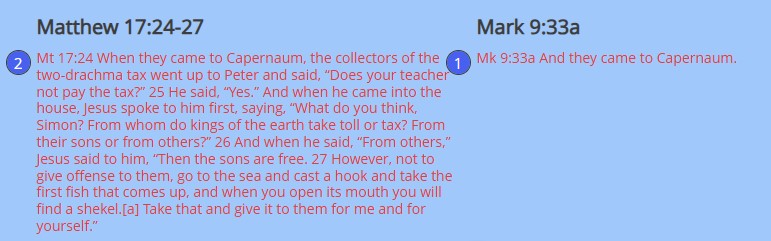
From the above worksheet photo, following the numbers and the text in red, the following narrative is produced.
Mk 9:33 [Then] they came to Capernaum. Mt 17:24 [After they arrived in] Capernaum, the collectors of the two-drachma tax went up to Peter and said, “Does your teacher not pay the tax?”
25 He said, “Yes.”
When [Peter] came into the house, Jesus spoke to him first, saying, “What do you think, Simon? From whom do kings of the earth take toll or tax? From their sons or from others?”
26 [Peter] said, “From others.”
Jesus said to him, “Then the sons are free. 27 However, not to give offense to them, go to the sea and cast a hook and take the first fish that comes up, and when you open its mouth, you will find a shekel. Take that and give it to them for me and for yourself.”
Bible Lessons for this event:
H405 A Fish Pays the Tax (Matthew 17:24-27; Mark 9:33)
Event Summary:
This event focuses on the episode of Jesus addressing the temple tax in Capernaum. It highlights themes of Jesus’ divine authority, his humility, his provision for his followers, and the balance between exercising freedom and avoiding unnecessary offense.
Key points of this event are:
(1) Question About the Temple Tax: The tax collectors ask Peter whether Jesus pays the two-drachma temple tax, which was required for the upkeep of the temple. (Matthew 17:24) The question reflects the perception of Jesus as a faithful Jew who would honor religious obligations, but it also sets the stage for Jesus to teach about his identity and his mission.
(2) Jesus’ Authority and Identity: Jesus asks Peter, “From whom do the kings of the earth collect duty and taxes—from their own children or from others?” Peter responds, “From others,” and Jesus affirms, “Then the children are exempt.” (Matthew 17:25-26) Jesus, as the Son of God, is exempt from the temple tax because he is the true King, and the temple represents his Father’s house. This reveals his divine authority and identity as God’s Son.
(3) Avoiding Offense While Exercising Freedom: Jesus tells Peter to pay the tax to avoid offending others, even though he is not obligated to do so. He provides the means miraculously by instructing Peter to catch a fish, which contains a coin sufficient for both their taxes. (Matthew 17:27) Jesus models humility and wisdom by willingly submitting to earthly obligations to avoid unnecessary offense. This teaches believers the importance of balancing freedom in Christ with sensitivity toward others.
(4) Provision for His Followers: The miraculous provision of the coin from the fish demonstrates Jesus’ power and his care for his disciples, ensuring they are equipped to fulfill their responsibilities. Jesus provides for the needs of his followers, often in unexpected ways, reinforcing trust in his ability to sustain them.
This event highlight Jesus’ divine authority and identity as the Son of God while demonstrating his humility in fulfilling earthly obligations. The passage teaches believers to balance their freedom in Christ with sensitivity toward others and to trust in God’s provision for their needs. Jesus’ actions serve as an example of how to navigate worldly responsibilities with wisdom and grace.
Discussion Questions with Extended Answers:
Matthew 17:24–27
1. What was the temple tax, and why did the collectors approach Peter about Jesus paying it?
Answer:
The temple tax was a yearly contribution required of Jewish males for the maintenance and service of the temple. Its origin can be traced to Exodus 30:13–16, where a half-shekel offering was collected for the work of the sanctuary. By the time of Jesus, this tax was an established practice among the Jewish people.
The collectors approached Peter because Jesus was a recognized teacher, and they wanted to know whether He complied with this religious obligation. Their question was not necessarily hostile; it appears to have been a routine inquiry. Peter quickly answered that Jesus did pay the tax, perhaps assuming that Jesus would naturally fulfill such a requirement. This interaction set the stage for Jesus to teach an important lesson about His identity and His relationship to God the Father.
2. Why did Jesus ask Peter about kings receiving taxes from their sons or from strangers?
Answer:
Jesus used an illustration from everyday life to reveal a deeper spiritual truth. Earthly kings do not usually tax their own children because the royal family belongs to the household of the king. Instead, taxes are collected from subjects outside the family.
Jesus applied this principle to God’s kingdom. Since the temple belonged to God and Jesus is the Son of God, He was not obligated to pay the temple tax. The temple existed for His Father’s worship, making Him uniquely exempt from the requirement.
Through this question, Jesus was gently leading Peter to recognize His divine sonship. The issue was not merely about money but about understanding who Jesus truly is. He is not simply another worshiper supporting God’s house; He is the Son of the One to whom the house belongs.
3. What did Jesus mean when He said, “Then the sons are free”?
Answer:
Jesus was declaring His rightful freedom from the temple tax because of His unique relationship with God. As the Son of God, He was not under obligation to support His Father’s house in the same way ordinary worshipers were.
This statement also points forward to a greater spiritual reality. Through faith in Christ, believers become adopted children of God. While Jesus alone is the eternal Son by nature, Christians become sons and daughters by grace. Therefore, the statement hints at the privileges that belong to God’s family.
Jesus was teaching that relationship comes before obligation. Those who belong to God are not merely servants fulfilling requirements; they are members of His household who enjoy the privileges of sonship.
4. If Jesus was exempt from the tax, why did He choose to pay it anyway?
Answer:
Jesus explained that He would pay the tax “lest we should offend them” (Matthew 17:27). Although He had every right to refuse, He chose to surrender that right to avoid creating an unnecessary stumbling block.
This demonstrates an important principle of Christian living. Not every issue should become a battle over personal rights. Sometimes believers willingly limit their freedoms for the sake of peace, testimony, and ministry effectiveness. Jesus was not compromising truth; He was showing wisdom and humility.
His example teaches that love often chooses service over self-assertion. The kingdom of God advances not merely through claiming rights but through sacrificial consideration for others.
5. What does this passage teach about Jesus’ humility?
Answer:
This passage reveals remarkable humility. Jesus is the divine Son of God, the rightful Lord of the temple, yet He willingly paid a tax from which He was exempt. He did not insist upon recognition of His privileges or demand special treatment.
Throughout His earthly ministry, Jesus repeatedly laid aside His rights in order to serve others. This event reflects the same attitude described in Philippians 2:5–8, where Christ humbled Himself and took the form of a servant.
His humility challenges believers to follow His example. True greatness is not found in demanding honor but in willingly serving God and others with a humble heart.
6. Why did Jesus instruct Peter to catch a fish and find a coin in its mouth?
Answer:
The miracle demonstrated Jesus’ divine authority and omniscience. Jesus knew exactly where the fish would be, what would be in its mouth, and how much money would be needed to pay the tax for both Himself and Peter.
The coin was a stater, equal to the amount required for two people. This miracle revealed that all creation is under Christ’s authority. The fish of the sea, the movement of money, and the circumstances of life are fully known to Him.
The miracle also showed that God provides what is needed for His purposes. Jesus could have produced the money in many ways, but He chose a method that displayed His sovereign control over creation and strengthened Peter’s faith.
7. What does this miracle teach about God’s provision?
Answer:
God’s provision often comes in unexpected ways. Peter likely would never have imagined that the money needed would be found in a fish’s mouth. Yet Jesus already knew exactly how the need would be met.
This teaches believers to trust God’s wisdom and resources. The Lord is never limited by human circumstances. He can provide through ordinary means or extraordinary means according to His perfect will.
The passage reminds Christians that God knows their needs before they ask and that He is fully capable of supplying what is necessary for His work and His people.
8. Why did Jesus include Peter in the payment of the tax?
Answer:
Jesus instructed Peter to use the coin to pay for both of them. This demonstrates Christ’s gracious identification with His followers. Although Jesus alone possessed the right of exemption, He chose to stand alongside His disciple.
This act reflects the broader work of Christ. Throughout His ministry, Jesus associated Himself with sinners and ultimately bore the penalty they deserved. Here, He includes Peter in the provision He miraculously supplies.
The event illustrates how believers benefit from their union with Christ. What belongs to Him becomes a blessing to those who follow Him. Peter’s tax was paid through the provision Jesus directed and supplied.
9. What does this passage reveal about Jesus’ identity?
Answer:
Matthew 17:24–27 presents Jesus as both the Son of God and the sovereign Lord over creation. His argument concerning the temple tax reveals His unique relationship with the Father. His miracle involving the fish demonstrates His authority over the natural world.
These truths work together to provide a powerful testimony concerning who Jesus is. He is not merely a teacher or prophet. He is God’s Son, possessing divine authority and perfect knowledge.
The passage calls readers to recognize and worship Jesus for who He truly is, the divine King who humbled Himself to serve and save His people.
10. What practical lessons can believers learn from this passage today?
Answer:
Believers can learn several important lessons from this account:
- Know who Christ is. Jesus is the Son of God and the Lord of creation.
- Use freedom wisely. Not every right must be exercised if doing so harms others or hinders ministry.
- Practice humility. Jesus willingly surrendered His rights for the benefit of others.
- Trust God’s provision. The Lord is able to meet needs in ways we cannot anticipate.
- Avoid unnecessary offenses. Christians should seek peace whenever possible without compromising truth.
- Rest in God’s sovereignty. The God who controlled the fish in Galilee still rules over every detail of life today.
This passage beautifully combines Christ’s deity, humility, wisdom, and provision, encouraging believers to trust Him and follow His example.


Leave a Reply