
Debra Miller
Entering God’s Presence
Author: Stephen Weller
11,478 words, 61 minutes read time
3 videos, 58:34 minutes listen time
Introduction
Entering God’s presence is not a moment we stumble into; it is a sacred journey that begins where we are and gently draws us closer to the heart of God. Too often we live on the edges of spiritual life, distracted, hurried, or unsure how to move deeper. But Scripture shows a God who continually invites His people inward, from the outer courts of curiosity to the inner courts of communion. This study traces that journey step by step, using the Jerusalem Temple as a living picture of how God leads us from distance to nearness, from noise to stillness, from self‑reliance to surrender. If your heart longs for deeper fellowship with God, this path will help you slow down, breathe, and enter His presence with confidence and awe.
Page Sections
- Jerusalem Temple
- Court of Gentiles
- Court of Women
- Altar of Sacrifice
- Holy Place
- Holy of Holies
- Summary of Our Journey
- Questions of Understanding for the Journey Into God’s Presence
- Court of the Gentiles — “What keeps me standing at a distance from God?”
- Court of the Women — “What does it mean to step inside the boundaries of covenant relationship?”
- Court of Israel (Men’s Court) — “How is God calling me to deeper obedience and surrender?”
- Altar of Sacrifice — “What sin or burden must be laid down before I can move closer to God?”
- Altar of Incense — “What prayers rise from my heart as I draw nearer to God’s presence?”
- Holy of Holies — “How does Jesus’ finished work change the way I enter God’s presence today?”
- Appendix
Jerusalem Temple
Section Contents
The Jerusalem Temple was also referred to as the Second Temple or Herod’s Temple.
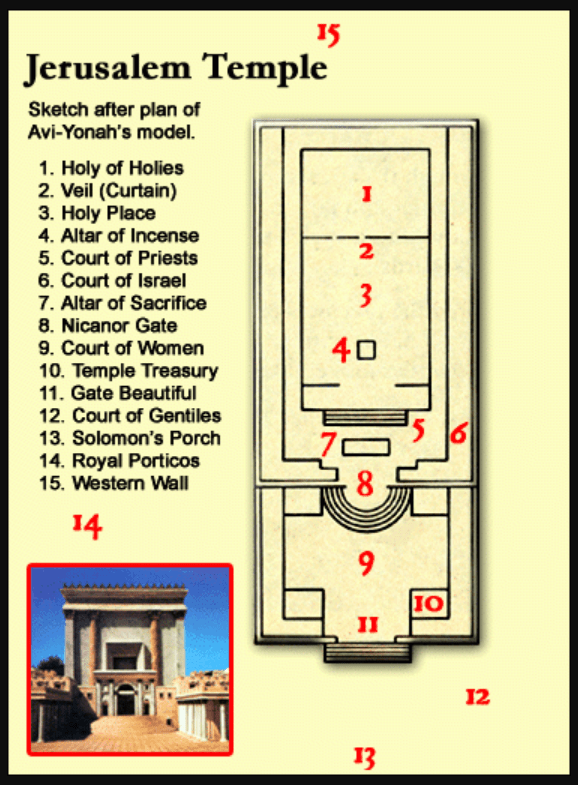
Diagram: Bible-History.com
As we seek God’s presence, the temple diagram becomes a meaningful parallel guide for our journey. We will begin in the outer court and move step by step toward the Holy of Holies. At each stopping point, we will pause to consider how we might prepare our hearts to draw closer to God.
This section outlines the distinct areas of the Jerusalem Temple and the qualifications required to enter each one. As believers walk the parallel spiritual path toward God’s presence, these qualifications are translated into practical steps that deepen and expand our experience of Him.
The Areas of the Jerusalem Temple and Who Could Enter Them
1. Court of Gentiles (Diagram loc12)
Who could enter:
- Everyone — Jews and Gentiles
- Men, women, children
- Foreigners and visitors
Purpose: This was the large outer area surrounding the inner courts. Teaching, buying and selling, and public gatherings happened here. This is where Jesus overturned the money changers’ tables.
Question: What keeps me lingering on the edges of God’s presence instead of drawing closer?
Extended Answer: The Court of the Gentiles was the only place where everyone could gather; Jews, Gentiles, men, women, children, foreigners, and visitors. It was a place of noise, activity, and distraction: buying, selling, teaching, and public debate. Many people stood there content to remain on the outskirts, close enough to observe but far from the inner courts where God’s presence was symbolically nearer. This question invites us to examine the subtle ways we, too, linger at a distance. Sometimes it is busyness, sometimes spiritual indifference, sometimes sin, sometimes fear of what God might ask of us if we draw closer. The Court of the Gentiles reminds us that God invites us to move beyond curiosity and convenience into deeper relationship. Recognizing what keeps us on the edges is the first step toward stepping inward.
Scripture References:
- Acts 17:27 — God desires that people “seek Him and perhaps feel their way toward Him.”
- Jeremiah 29:13 — “You will seek Me and find Me when you seek Me with all your heart.”
- James 4:8 — “Draw near to God, and He will draw near to you.”
2. Court of Women (Diagram loc9)
Who could enter:
- All Jewish men and women
- Gentiles were not allowed to enter here
Purpose: This was the main gathering area for Jewish worshipers. Women could go no farther into the inner courts. The treasury chests were located here.
Question: Am I willing to move from casual interest in God to committed participation in His covenant life?
Extended Answer: Stepping into the Court of the Women meant entering a space reserved for those who belonged to God’s covenant people. It was no longer a place for spectators but for worshipers. This question challenges us to examine whether we are merely curious about God or truly committed to Him. Moving inward requires embracing identity, belonging, and obedience. It asks us to consider whether we are ready to step beyond convenience into covenant relationship.
Scripture References:
- Psalm 100:3 — “We are His people, and the sheep of His pasture.”
- Romans 12:1 — Present your bodies as a living sacrifice.
- John 10:27 — “My sheep hear My voice… and they follow Me.”
3. Court of Israel – Men’s Court (Diagram loc6)
Who could enter:
- Jewish men only
- Women could not enter this area
Purpose: This was the place where Jewish men stood during sacrifices and observed the priestly ministry.
Question: What areas of my life is God calling me to surrender more fully as I draw nearer to Him?
Extended Answer: In the Court of Israel, worshipers stood closer to the altar, watching the priests offer sacrifices on their behalf. It was a place of seriousness and reflection, a place where the cost of sin and the call to obedience became unmistakably clear. This question invites us to consider the parts of our lives where surrender is still incomplete. Drawing nearer to God always involves yielding more of ourselves. The closer we come, the more clearly we see that God desires not just outward actions but inward devotion.
Scripture References:
- Psalm 139:23–24 — “Search me… and lead me in the way everlasting.”
- Luke 9:23 — “Take up your cross daily and follow Me.”
- Proverbs 3:5–6 — Trust in the Lord with all your heart.
4. Court of the Priests (Diagram loc5)
Who could enter:
- Priests only (descendants of Aaron)
- Levites could assist but not enter all areas
Purpose: This court contained:
- The bronze altar (for sacrifices)
- The laver (for washing)
- Access to the Holy Place
Only priests performing their duties could be here.
Question: What sin, burden, or self‑reliance must I lay down before I can move deeper into God’s presence?
Extended Answer: No one could approach God without passing the altar. It was the place where sin was confronted and atonement was made. This question invites honest confession: What must be surrendered, confessed, or released so that we may move forward? What guilt or shame needs to be placed on the altar? The answer is not found in our effort but in Christ’s sacrifice, which cleanses us and opens the way. The altar teaches us that access to God is always through grace, never through performance.
Scripture References:
- 1 John 1:9 — “If we confess our sins, He is faithful and just to forgive.”
- Hebrews 9:14 — Christ’s blood cleanses our conscience.
- Psalm 51:17 — “A broken and contrite heart… You will not despise.”
5. The Holy Place (Diagram loc3)
Who could enter:
- Priests only
- Specifically those on duty for that week
Purpose: This room contained:
- The Lampstand
- The Table of Showbread
- The Altar of Incense
Priests entered daily to tend the lamps, replace the bread, and burn incense.
Question: What prayers rise from my heart as I draw nearer to God’s presence?
Extended Answer: The Altar of Incense filled the Holy Place with a continual fragrance, symbolizing the prayers of God’s people rising before Him. This question invites us to listen to the deeper longings of our soul; prayers of surrender, purification, longing, intercession, and adoration. As we draw closer to God, our prayers shift from requests to relationship, from asking to abiding. These prayers become the fragrance of a heart awakened to God’s nearness.
Scripture References:
- Psalm 141:2 — “Let my prayer be counted as incense before You.”
- Revelation 5:8 — Incense represents “the prayers of the saints.”
- Romans 8:26–27 — The Spirit helps us in our weakness and intercedes for us.
6. The Holy of Holies (Diagram loc1)
Who could enter:
- Only the High Priest
- Only once per year
- Only on the Day of Atonement (Yom Kippur)
Purpose: This was the most sacred space; the earthly symbol of God’s throne room. In Solomon’s Temple it contained the Ark of the Covenant; in Herod’s Temple the Ark was no longer present, but the room remained sacred.
Question: How does Jesus’ finished work change the way I enter God’s presence today?
Extended Answer: Before Jesus, the Holy of Holies was a place of awe and restriction; entered only once a year by the High Priest. But through Christ, the veil has been torn, and the way into God’s presence is open. This question invites us to reflect on the privilege we now possess: we enter not with fear but with confidence; not with ritual but with relationship; not as outsiders but as beloved children. Understanding this transforms prayer into communion and worship into joy. The journey ends not at a barrier, but in the very presence of God Himself.
Scripture References:
- Hebrews 10:19–22 — We enter the Most Holy Place by the blood of Jesus.
- Matthew 27:51 — The veil was torn from top to bottom.
- Ephesians 2:18 — Through Christ we have access to the Father.
Summary Table
| Temple Area | Who Could Enter | Purpose |
|---|---|---|
| Court of the Gentiles | Everyone | Public teaching, gathering |
| Court of the Women | All Jews (men & women) | Worship, treasury |
| Court of Israel | Jewish men | Observe sacrifices |
| Court of the Priests | Priests only | Sacrificial ministry |
| Holy Place | Priests on duty | Lampstand, bread, incense |
| Holy of Holies | High Priest, once/year | God’s presence |
Closing Prayer
Father, thank You for inviting me on this journey into Your presence. I come from the outer courts with all my distractions, questions, and weaknesses, yet You call me to draw near. As I step inward, teach me to leave behind everything that keeps me at a distance. Cleanse my heart at the altar of sacrifice, and let the prayers rising from my life be a pleasing fragrance before You. Through Jesus, my High Priest, the veil has been torn, and I now enter the Holy of Holies with confidence, not because of who I am, but because of what He has done. Draw me deeper still. Let Your presence shape my desires, quiet my fears, and fill my life with Your glory. I rest in Your love, I trust in Your grace, and I delight to dwell with You. Amen.
Court of Gentiles
Section Contents
- Introduction to Section
- Jesus and Change
- Our Next Step
- Closing Reflection
- Prayer: Embracing New Covenant Access
Introduction to Section
In the previous section, it was learned that Gentiles were restricted to the Court of the Gentiles, the large outer area surrounding the Temple complex. They could go no farther.
The boundary between the Court of the Gentiles and the inner courts was marked by a low stone barrier called the soreg. On it were warning inscriptions (several have been found archaeologically) that said:
No foreigner may enter within the balustrade… Whoever is caught will have himself to blame for his death.
This was not symbolic; it was enforced.
Gentiles could not enter the temple because
- They were not part of the covenant people of Israel.
- The Temple purity laws restricted access to those in covenant relationship.
- The inner courts represented increasing holiness and proximity to God’s presence.
This physical separation symbolized a spiritual separation; Gentiles were “far off” from the covenant people and the presence of God, but with the coming of Jesus, the presentation of the Gospel, and the death and resurrection of Jesus, one of the most beautiful shifts in all of Scripture occurred.
Jesus and Change
1. At Jesus’ death: the veil was torn
When Jesus died, the veil of the Temple was torn from top to bottom (Matthew 27:51).
This signified:
- The old system of restricted access was finished
- The barrier between God and humanity was removed
- Access to God was no longer mediated by priests or temple courts
The tearing of the veil was God’s declaration: “The way into My presence is now open.”
Question: Do I truly believe that nothing now stands between me and God’s presence?
Extended Answer: When Jesus died, the veil was torn from top to bottom; God’s own hands removing the barrier that once separated humanity from His presence. This act declared that the old system of restricted access was finished. No priest, ritual, or sacred space now stands between God and His people. Yet many believers still live as though a veil remains, feeling unworthy, distant, or hesitant to draw near. This question invites us to embrace the truth that God Himself has opened the way. There is no barrier left except the ones we imagine. The way into His presence is not only open; it is welcoming.
Scripture References:
- Matthew 27:51 — The veil was torn from top to bottom.
- Hebrews 10:19–20 — We enter by a new and living way through His flesh.
- Romans 5:2 — Through Christ we have obtained access by faith.
2. Through the cross: Jesus removed the dividing wall
Paul explains this directly in Ephesians 2:13–14:
“You who once were far off have been brought near by the blood of Christ… He has broken down the dividing wall of hostility.”
This refers both to:
- The spiritual barrier between God and humanity
- The physical barrier in the Temple that kept Gentiles out
Jesus didn’t just open the door; He tore down the wall.
Question: What walls has Jesus already torn down that I still live behind?
Extended Answer: Paul teaches that Jesus broke down the dividing wall of hostility; both the spiritual barrier between God and humanity and the physical barrier that kept Gentiles out of the inner courts. Yet many believers still live behind walls of shame, fear, insecurity, or past failure. This question invites us to recognize that the walls we feel are not walls God built. Jesus didn’t just open a door; He demolished the structure that kept us out. The question is not whether the wall is gone; it is whether we will step through the space where it once stood.
Scripture References:
- Ephesians 2:13–14 — He has broken down the dividing wall.
- Colossians 1:21–22 — We who were once alienated are now reconciled.
- Hebrews 4:16 — Let us draw near with confidence.
3. In the resurrection: a new Temple was formed
After the resurrection, God’s presence no longer dwelt in a building.
Instead:
- Jesus became the true Temple (John 2:19–21)
- Believers became the dwelling place of God (1 Corinthians 3:16)
- The Church became a “holy temple in the Lord” (Ephesians 2:21–22)
This means:
- No outer courts
- No restricted zones
- No ethnic boundaries
- No priestly caste
Every believer, Jew or Gentile, has equal access to God.
Question: Do I live as someone who carries God’s presence, not someone trying to reach it?
Extended Answer: After the resurrection, God’s presence no longer dwelt in a building. Jesus became the true Temple, and through Him, believers became the dwelling place of God. This means there are no outer courts, no restricted zones, no ethnic boundaries, and no priestly caste. Every believer carries the presence of God within. This question invites us to shift our mindset from seeking a place to living as a place where God dwells. We do not journey toward His presence as outsiders, we carry His presence as His people.
Scripture References:
- John 2:19–21 — Jesus is the true Temple.
- 1 Corinthians 3:16 — You are God’s temple.
- Ephesians 2:21–22 — The Church is a holy temple in the Lord.
4. In Christ: Gentiles now have full access to the Father
Paul states this plainly:
- Ephesians 2:18 — “Through Him we both have access in one Spirit to the Father.”
- Romans 10:12 — “There is no distinction between Jew and Greek… the same Lord is Lord of all.”
- Galatians 3:28 — “There is neither Jew nor Greek… for you are all one in Christ Jesus.”
The old boundaries are gone. The old courts are gone. The old restrictions are gone.
Question: Do I approach God with the confidence of a child or the hesitation of a stranger?
Extended Answer: Paul declares that through Christ, both Jews and Gentiles have access in one Spirit to the Father. The old distinctions, Jew and Greek, insider and outsider, have been erased. Yet many believers still approach God timidly, as though they must earn His attention or prove their worth. This question invites us to embrace the boldness of our new identity. We do not come as tolerated guests but as beloved children. The Father’s presence is not a privilege for a few; it is the inheritance of all who are in Christ.
Scripture References:
- Ephesians 2:18 — We have access to the Father through Christ.
- Romans 10:12 — The same Lord is Lord of all.
- Galatians 3:28 — You are all one in Christ Jesus.
5. The New Covenant reality
Because of Jesus:
- Gentiles are no longer “outsiders”
- They are fellow citizens (Eph. 2:19)
- They are members of God’s household
- They are priests (1 Peter 2:9)
- They have direct access to God’s presence
What Gentiles could never do in the Old Testament, enter the presence of God, they now do freely, boldly, and daily through Christ.
Summary
- Old Covenant: Gentiles were kept outside the Temple, far from God’s presence.
- At the cross: The veil torn, the dividing wall destroyed.
- New Covenant: Gentiles brought near, made part of God’s people, and given full access to the Father through Christ.
Question: Do I live each day as someone welcomed, wanted, and at home in God’s presence?
Extended Answer: Because of Jesus, Gentiles are no longer outsiders. They are fellow citizens, members of God’s household, and priests who minister before Him. What was once impossible, entering the presence of God, is now the daily privilege of every believer. This question invites us to consider whether we live in the fullness of this reality. Do we pray boldly? Do we worship freely? Do we walk with God intimately? The New Covenant is not a theological concept; it is a living relationship in which God’s presence is our home, not our destination.
Scripture References:
- Ephesians 2:19 — We are fellow citizens and members of God’s household.
- 1 Peter 2:9 — We are a royal priesthood.
- Hebrews 10:22 — Let us draw near with a true heart in full assurance of faith.
Our Next Step
Because of the finished work of Jesus on the cross, Gentiles can now “Enter His gates with thanksgiving and His courts with praise.” (Psalm 100:4) In the structure of the temple diagram, we are now qualified to enter through the Beautiful Gate (Diagram loc11) and into the court of women.
Closing Reflection
As we consider what Christ has done, we realize that the story of Gentile access is not a footnote in Scripture; it is a breathtaking revelation of God’s heart. The veil was torn so we would never again stand at a distance. The dividing wall was shattered so no one would be labeled an outsider. The Temple was redefined so God’s presence would no longer be confined to a building but would dwell within His people. Through Christ, we are not merely invited into God’s presence, we are welcomed, wanted, and woven into His household. The journey that once ended at a barrier now begins with open access. What Gentiles could never do under the old covenant, we now do freely, boldly, and daily: we draw near to the Father through the Son, in the power of the Spirit. This is the miracle of grace; the God who once dwelled behind a veil now dwells within us, and His presence is our home.
Prayer: Embracing New Covenant Access
Father, thank You for opening the way into Your presence through Jesus. I praise You that the veil has been torn, the wall has been broken, and nothing now separates me from Your love. Help me to stop living as though I am still on the outside looking in. Teach me to walk in the freedom, confidence, and nearness that Christ purchased for me. Let me remember each day that I am Your temple, Your child, and a member of Your household. Draw me deeper into Your presence, and let my life reflect the grace that brought me near. Thank You that through Jesus, I am welcomed, wanted, and at home with You. Amen.
Court of Women
Section Contents:
- Biblical Qualifications
- Summary: What Qualifies Someone to Enter God’s Presence?
- Closing Reflection — Court of Women
- Prayer
With the death and resurrection of Jesus, what qualifies someone to enter the presence of God?
According to Scripture, no one enters God’s presence by personal merit, ritual purity, or religious performance. Every qualification is something God provides, not something we achieve.
Below are the five biblical qualifications, each rooted in the New Covenant and fulfilled in Christ.
Biblical Qualifications
1. A New and Living Way Opened by Jesus
Primary qualification: The finished work of Christ.
Hebrews 10:19–20 says believers have confidence to enter the Most Holy Place “by the blood of Jesus… through the new and living way.”
This means:
- Access is not earned
- Access is not restricted
- Access is not based on ethnicity, gender, or temple courts
- Access is granted through Christ alone
Jesus Himself is the qualification.
Question: Do I rely on Christ alone as my qualification to enter God’s presence, or do I still try to earn my way in?
Extended Answer:
The Court of Women reminds us that access to God was once limited, structured, and carefully guarded. But Hebrews tells us that Jesus opened a new and living way through His own blood. Many believers still struggle with the subtle temptation to approach God based on performance — good behavior, spiritual disciplines, or emotional worthiness. This question invites us to rest in the truth that Jesus Himself is our qualification. We do not enter because we are worthy, but because He is. Access is not earned, restricted, or based on identity markers — it is granted through Christ alone.
Scripture References:
- Romans 5:2 — Through Him we have obtained access by faith.
- Hebrews 10:19–20 — We enter by the blood of Jesus.
- John 14:6 — Jesus is the way to the Father.
2. A Cleansed Heart and Conscience
Hebrews 10:22 describes the inner condition required:
“Let us draw near with a true heart in full assurance of faith, with our hearts sprinkled clean…”
In the Old Covenant, cleansing was external. In the New Covenant, cleansing is internal; done by the Spirit.
What qualifies you:
- A heart cleansed by Christ
- A conscience washed by His sacrifice
- A sincere desire to come to God
Question: Do I come to God with confidence in His cleansing, or with the weight of guilt He has already removed?
Extended Answer:
In the Old Covenant, cleansing was external; washings, rituals, and sacrifices. But Hebrews 10:22 reveals that in Christ, cleansing is internal: the heart sprinkled clean, the conscience washed. Many believers still carry guilt God has already forgiven, approaching Him as though they are unworthy or unclean. This question invites us to embrace the cleansing Christ has already accomplished. A sincere desire to come to God is itself evidence of the Spirit’s work. We draw near not because we are flawless, but because we are washed.
Scripture References:
- Hebrews 10:22 — Hearts sprinkled clean.
- Psalm 51:10 — “Create in me a clean heart.”
- 1 John 1:9 — He cleanses us from all unrighteousness.
3. Faith in Christ
Faith is not a work; it is the open hand that receives what God gives.
Ephesians 3:12 says:
“In Him we have boldness and access with confidence through faith.”
Faith unites us to Christ, and union with Christ is what brings us into God’s presence.
Question: Am I approaching God with the open hand of faith, or am I still trying to bring something to offer Him?
Extended Answer:
Faith is not a work — it is the empty hand that receives what God gives. Ephesians 3:12 says we have boldness and access through faith in Christ. Yet many believers still feel they must bring something to God: effort, achievement, or spiritual success. This question invites us to let go of self‑reliance and embrace the simplicity of faith. Union with Christ — not personal effort — brings us into God’s presence. Faith is not our contribution; it is our surrender.
Scripture References:
- Ephesians 3:12 — Access with confidence through faith.
- Romans 5:1–2 — We have access by faith into grace.
- Galatians 2:20 — We live by faith in the Son of God.
4. The Indwelling Holy Spirit
The Spirit is not just a helper; He is the guarantee of access.
Ephesians 2:18:
“Through Him we both have access in one Spirit to the Father.”
The Spirit:
- Makes us God’s temple
- Draws us near
- Gives us the desire to seek God
- Makes us fit for His presence
You don’t enter God’s presence alone; the Spirit brings you in.
Question: Do I recognize the Spirit within me as the One who draws me into God’s presence?
Extended Answer:
The Spirit is not merely a helper — He is the guarantee of access. Ephesians 2:18 says we come to the Father in one Spirit. The Spirit awakens desire, produces longing, convicts, comforts, and draws us near. Many believers try to enter God’s presence through effort rather than dependence. This question invites us to recognize that we never approach God alone. The Spirit Himself brings us in, making us God’s temple and preparing our hearts for communion.
Scripture References:
- Ephesians 2:18 — Access in one Spirit to the Father.
- Romans 8:15–16 — The Spirit testifies that we are God’s children.
- 1 Corinthians 3:16 — You are God’s temple.
5. A New Identity as God’s Child
Only priests could enter the Holy Place. Only the High Priest could enter the Holy of Holies.
But in Christ:
- You are a royal priesthood (1 Peter 2:9)
- You are God’s child (Galatians 4:6)
- You are seated with Christ (Ephesians 2:6)
Your identity, not your performance, qualifies you.
Question: Do I enter God’s presence as a beloved child and royal priest, or as someone unsure of their place?
Extended Answer:
In the Old Covenant, only priests could enter the Holy Place, and only the High Priest could enter the Holy of Holies. But in Christ, every believer is a royal priesthood, a child of God, and seated with Christ in heavenly places. Identity — not performance — qualifies us. This question invites us to examine whether we approach God with the confidence of a child or the hesitation of a stranger. Our identity is not earned; it is given. And it is this identity that opens the way into God’s presence.
Scripture References:
- 1 Peter 2:9 — A royal priesthood.
- Galatians 4:6 — God has sent the Spirit of His Son into our hearts.
- Ephesians 2:6 — Seated with Christ in heavenly places.
Summary: What Qualifies Someone to Enter God’s Presence?
| Qualification | Provided By | Scripture |
|---|---|---|
| The blood of Jesus | Christ | Heb. 10:19–20 |
| A cleansed heart | Christ | Heb. 10:22 |
| Faith | Spirit‑enabled | Eph. 3:12 |
| The Holy Spirit | God’s gift | Eph. 2:18 |
| New identity as God’s child | Adoption | Gal. 4:6 |
Everything required to enter God’s presence is something God Himself provides.
God has qualified us to be able to “Enter His gates with thanksgiving and His courts with praise.” (Psalm 100:4)
As we pass through the gate into court, prepare to spend time there considering all that God has done and provided for you. Draw your focus from the world and to your precious savior and the realization of the indwelling Spirit of God. When ready or prompted by the Spirit, move on to the next court, where the Altar of Sacrifice is located.
Closing Reflection — Court of Women
As we pause in the Court of Women, we stand in a place that once marked the limits of how far most worshipers could go. But in Christ, this court becomes something entirely different; not a boundary, but a reminder of the grace that qualifies us to draw near. Every requirement for entering God’s presence is something God Himself has provided: a new and living way through Jesus, a cleansed heart and conscience, faith that receives rather than earns, the Spirit who draws us in, and an identity rooted not in performance but in adoption. Here we learn that access to God is not a reward for the worthy but a gift for the willing. As we linger in this court, we allow gratitude to rise, distractions to fall away, and our hearts to awaken to the miracle of the New Covenant. When we are ready, or when the Spirit gently prompts, we take the next step, not in fear, but in confidence, knowing that the God who calls us near has already made us fit to come.
Prayer
Father, thank You for providing everything I need to come into Your presence. I praise You for the new and living way Jesus opened for me through His blood. Help me to rest in His finished work and not in my own efforts. Cleanse my heart and conscience again with the grace of Christ, and let me draw near with full assurance of faith. Thank You for the Holy Spirit who lives within me, stirring my desire for You and leading me closer to Your heart. Remind me daily that I am Your child, a royal priest, welcomed and wanted in Your presence. As I stand in this court, quiet my mind, steady my spirit, and prepare my heart for the deeper places You are inviting me to enter. Amen.
Altar of Sacrifice
Section Contents
- The Altar and Jesus
- Impact of Sacrifice
Entering this court, one’s attention is drawn to the Alter of Sacrifice as a two-part question forms in our mind:
- What the altar of sacrifice did
- How it points to and is fulfilled in Jesus.
The Altar and Jesus
1. The Functions of the Altar of Sacrifice (Old Testament)
The bronze altar stood in the Court of the Priests (Court of Women in the diagrm), just inside the Temple entrance. It was the first major object a worshiper encountered, and that was intentional.
A. A place of substitution
An animal died in the place of the worshiper.
- “The life of the flesh is in the blood… it is the blood that makes atonement” (Lev. 17:11).
- The worshiper deserved death for sin, but the animal died instead.
This taught Israel that sin requires a substitute.
B. A place of atonement
The altar was where sins were covered (Hebrew: kaphar).
- Guilt was symbolically transferred to the sacrifice.
- The blood on the altar signified cleansing and forgiveness.
This taught that forgiveness requires shed blood.
C. A place of consecration
Some offerings (like burnt offerings) were fully consumed on the altar.
This symbolized:
- Total surrender
- Devotion to God
- A life offered back to Him
D. A place of access
No one could approach God without first coming to the altar.
The message was unmistakable:
You cannot enter God’s presence without dealing with sin.
2. How This Compares to the Sacrifice of Jesus
The altar was a shadow; Jesus is the substance. The altar was temporary; Jesus is final. The altar required many sacrifices; Jesus offered one perfect sacrifice.
Here’s the comparison:
A. Jesus is the true substitute
Just as the animal died in place of the sinner, Jesus died in our place.
- “He bore our sins in His body on the tree” (1 Pet. 2:24).
- “The Lord laid on Him the iniquity of us all” (Isa. 53:6).
The altar pointed forward to the cross.
B. Jesus provides true atonement
Animal blood could cover sin temporarily. Jesus’ blood removes sin permanently.
- “By a single offering He has perfected for all time those who are being sanctified” (Heb. 10:14).
- “Behold, the Lamb of God who takes away the sin of the world” (John 1:29).
The altar was a symbol; the cross is the reality.
C. Jesus consecrates us completely
The burnt offering symbolized total devotion. Jesus’ sacrifice creates a people devoted to God.
- “He gave Himself… to purify for Himself a people for His own possession” (Titus 2:14).
His sacrifice doesn’t just forgive — it transforms.
D. Jesus gives full access to God
In the Temple, you could not pass the altar without a sacrifice. In the New Covenant, you cannot approach God without Christ.
- “We have confidence to enter the Most Holy Place by the blood of Jesus” (Heb. 10:19).
- “Through Him we both have access in one Spirit to the Father” (Eph. 2:18).
The altar was the doorway to the courts. Jesus is the doorway to God Himself.
Summary
The altar of sacrifice taught Israel that sin requires a substitute, atonement requires blood, and access to God requires cleansing. Jesus fulfills all of this perfectly. He is our substitute, our atonement, our consecration, and our access. Through His once‑for‑all sacrifice, the way into God’s presence is fully open.
Impact of Sacrifice
At our previous stop our hearts were filled awe and thanksgiving from understanding the change God had made in our lives. God caused us to be born spiritually and made us a part of the body of Christ by sending the Spirit to permanently dwell within each believer.
As one views the altar, a sense of anguish may almost overwhelm us knowing that it was our sin that caused Jesus to be nailed to the cross. His life given for us that we might live in his presence forever and enjoy his love and the kindness of his grace. Knowing that his love for us was so great that he was willing to give his life for ours, we bow before him in surrender and thanks and rise up with our hearts full of praise adoration.
With hearts prepared, the Spirit guides us around the Altar of Sacrifice and into the Holy Place where we encounter the Altar of Incense.
Holy Place
Section Contents
- The Function and Purpose of the Altar of Incense
- How This Points to and Is Fulfilled in Jesus
- The Fragrance of Incense
- Prayers of Those Entering Deeper into God’s Presence
- A One‑Sentence Summary
At this stop it is important understand the function and purpose of the Altar of Incense, how this relates to Jesus, and how it can help us enter into a fuller presence with God.
The Function and Purpose of the Altar of Incense
The Altar of Incense stood inside the Holy Place, directly in front of the veil that separated the Holy Place from the Holy of Holies. Its placement was intentional; it was the closest object to the presence of God without entering the Most Holy Place.
1. It symbolized the prayers of God’s people rising to Him
Incense was burned every morning and every evening (Exodus 30:7–8). The smoke rose upward, filling the Holy Place with fragrance.
Scripture interprets this symbol:
- “Let my prayer be counted as incense before You.” (Psalm 141:2)
- “The golden bowls full of incense… are the prayers of the saints.” (Revelation 5:8)
- “The smoke of the incense, with the prayers of the saints, rose before God.” (Revelation 8:3–4)
Meaning: The altar represented constant, continual prayer ascending to God.
2. It represented intercession
Only the priest could burn incense, and he did so on behalf of the people.
This pointed to the need for:
- A mediator
- A representative
- Someone who stands between God and the people
The incense altar was a picture of intercessory prayer.
3. It was connected to atonement
Once a year, on the Day of Atonement, the High Priest placed blood on the horns of the altar (Exodus 30:10).
This showed:
- Prayer is acceptable only because of atonement
- Access to God requires cleansing
- Intercession is grounded in sacrifice
The altar of incense was not a stand‑alone symbol; it was tied to the altar of sacrifice.
4. It created a fragrant atmosphere before God
The incense was a holy blend that could not be used anywhere else (Exodus 30:34–38).
This taught Israel:
- God delights in the prayers of His people
- Prayer is precious and pleasing to Him
- Approaching God is a sacred privilege
How This Points to and Is Fulfilled in Jesus
The altar of incense was a shadow; Jesus is the substance.
1. Jesus is our Intercessor
What the priest symbolized, Jesus fulfills:
- “He always lives to make intercession for them.” (Hebrews 7:25)
- “There is one mediator between God and men, the man Christ Jesus.” (1 Timothy 2:5)
Jesus is the true priest standing before God on our behalf.
2. Jesus makes our prayers acceptable
Just as incense rose before God, our prayers rise through Christ.
- “Through Him we both have access… to the Father.” (Ephesians 2:18)
- “Whatever you ask in My name…” (John 14:13)
Our prayers are a “sweet aroma” because they come through the Son.
Note: A valuable lesson on prayer is found in the Gospel Event on prayer found at this link.
3. Jesus’ sacrifice gives us confidence to pray
The altar of incense was tied to the blood of atonement. Likewise, our prayer life is grounded in the cross.
- “We have confidence to enter… by the blood of Jesus.” (Hebrews 10:19)
Prayer is not based on our worthiness — it is based on Christ’s finished work.
Summary
The Altar of Incense symbolized the prayers of God’s people rising continually before Him, offered through a mediator and made acceptable by atonement. Jesus fulfills this perfectly as our great High Priest, whose intercession never ceases and through whom our prayers become a pleasing aroma to God.
The Fragrance of Incense
As this lesson guides As you guide readers from the Court of the Gentiles into the Holy Place, the Altar of Incense becomes the moment where the journey shifts from approach to intimacy. Here, the prayers rising like incense are not casual or distant; they are the prayers of people who are drawing nearer and nearer to the presence of God.
Below is a set of deep, Scripture‑shaped prayers that fit this stage of the journey. These are the kinds of prayers worshipers would offer as they stand before the Altar of Incense; prayers of surrender, longing, purification, and communion.
Prayers of Those Entering Deeper into God’s Presence
1. Prayers of Surrender
At this point in the journey, the worshiper is no longer negotiating with God — they are yielding.
- “Lord, I surrender my will to Yours.”
- “Shape my desires so they align with Your heart.”
- “Take anything in me that resists Your presence.”
These are prayers that say, “Not my will, but Yours be done.”
2. Prayers of Purification
Standing before the veil, the worshiper longs to be clean — not outwardly, but inwardly.
- “Search me and know me; reveal anything that grieves Your Spirit.”
- “Cleanse my motives, my thoughts, and my affections.”
- “Make my heart a place where You delight to dwell.”
These prayers echo Psalm 139 and Psalm 51.
3. Prayers of Deepening Desire
The closer one comes to God, the more the heart awakens with longing.
- “Lord, I want more of You.”
- “Draw me closer; let nothing distract me from Your presence.”
- “Stir my heart with holy hunger.”
These are the prayers of Psalm 42 and Psalm 63.
4. Prayers of Intercession
The Altar of Incense was a place of intercession — the priest standing before God on behalf of others.
- “Lord, remember Your people.”
- “Have mercy on those who are wandering.”
- “Strengthen the weary, heal the broken, restore the fallen.”
These prayers rise like incense for others.
5. Prayers of Adoration
As the worshiper approaches the Holy of Holies, praise becomes the natural language of the soul.
- “You are holy, worthy, and beautiful beyond description.”
- “There is none like You.”
- “Your presence is my joy, my life, and my treasure.”
These are the prayers of Revelation 4–5.
6. Prayers of Expectant Faith
The worshiper stands at the threshold of God’s presence — the veil is near.
- “Lord, I believe You will meet me.”
- “Open my eyes to behold Your glory.”
- “Lead me deeper still.”
These prayers anticipate communion.
A One‑Sentence Summary
At the Altar of Incense, the prayers of God’s people rise as surrender, purification, longing, intercession, adoration, and expectant faith; the heart’s fragrance offered as they draw near to the presence of God.
Holy of Holies
Section Contents
- The Function of the Holy of Holies Before Jesus Came
- How the Holy of Holies Relates to Jesus
- How the Holy of Holies Relates to Us as Believers
- Summary
From the Holy Place, the Spirit prompts us to approach the Vail and enter into the Holy of Holies. Here we must consider what the Hol of Holies meant before Jesus, how it is fulfilled in Jesus, and what it means for us as believers today.
1. The Function of the Holy of Holies Before Jesus Came
The Holy of Holies (Most Holy Place) was the innermost room of the Tabernacle and later the Temple. It served one supreme purpose:
A. It was the earthly throne room of God
- God’s presence dwelled above the Ark of the Covenant (Exodus 25:22).
- It represented heaven touching earth.
- It was the most sacred space in Israel’s worship.
B. It was completely restricted
Only one person could enter:
- The High Priest
- Once per year
- On the Day of Atonement (Yom Kippur)
- With blood for his own sins and the sins of the people (Leviticus 16)
This taught Israel:
- God is holy
- Sin separates
- Access to God requires atonement
- A mediator is necessary
C. It was a place of atonement
The High Priest sprinkled blood on the mercy seat to:
- Cover sin
- Restore fellowship
- Secure forgiveness for the nation
The Holy of Holies was the center of God’s presence and the center of Israel’s forgiveness.
2. How the Holy of Holies Relates to Jesus
Everything in the Holy of Holies pointed forward to Christ.
A. Jesus is the true High Priest
He does not enter once a year — He entered once for all (Hebrews 9:12).
He does not bring the blood of animals — He brings His own blood.
He does not enter an earthly room — He enters heaven itself (Hebrews 9:24).
B. Jesus is the true sacrifice
The blood sprinkled on the mercy seat was symbolic. Jesus’ blood actually removes sin (Hebrews 10:4, 10:14).
C. Jesus is the true veil
The veil separated humanity from God. When Jesus died, the veil was torn from top to bottom (Matthew 27:51).
Meaning:
- The barrier is gone
- The way is open
- Access is now direct
Hebrews 10:20 says the veil symbolized His flesh; His torn body opened the way to God.
D. Jesus is the true Holy of Holies
The presence of God no longer dwells in a room. It dwells in Christ Himself (John 1:14; Colossians 2:9).
He is the meeting place between God and humanity.
3. How the Holy of Holies Relates to Us as Believers
Because of Jesus, everything has changed.
A. We have full, direct access to God
Hebrews 10:19–22:
- We enter boldly
- We enter confidently
- We enter by the blood of Jesus
- We enter with hearts cleansed
No more:
- Priests
- Veils
- Annual rituals
- Restricted zones
B. We become the temple of God
God’s presence no longer dwells in a building.
It dwells in:
- Every believer (1 Corinthians 6:19)
- The church as a whole (Ephesians 2:21–22)
The Holy of Holies has moved — from a room in Jerusalem to the hearts of God’s people.
C. We become a royal priesthood
1 Peter 2:9:
- We offer spiritual sacrifices
- We intercede
- We draw near
- We live in God’s presence daily
Every believer now enjoys what only the High Priest once experienced.
D. We are invited into God’s presence continually
Not once a year. Not once a week. Not only in crisis.
Continually. Freely. Joyfully.
This is the miracle of the New Covenant.
Summary
Before Jesus: The Holy of Holies was the restricted dwelling place of God’s presence, entered only by the High Priest once a year with sacrificial blood.
In Jesus: He is the true High Priest, the true sacrifice, the true veil, and the true Holy of Holies. His death opened the way into God’s presence forever.
For believers: We now have full access to God, we are His temple, we are His priesthood, and we are invited to live continually in His presence.
Summary of Our Journey
Our journey into God’s presence has carried us from the distant place of the Gentiles, where all we could do was stand on the outside looking in, to the very threshold of the Holy of Holies. Step by step, we moved inward, through cleansing, surrender, worship, and prayer, each court drawing us closer to the heart of God. At the Altar of Sacrifice, we learned that access requires atonement; at the Altar of Incense, we discovered that intimacy is sustained by prayer. And now, through the torn veil and the finished work of Jesus, we enter the Holy of Holies itself; not as outsiders or observers, but as beloved children welcomed into the very presence of God.
One element we did not explore along our parallel journey is the spiritual benefit of fasting. The appendix includes articles that introduce and expand on this often‑overlooked practice.
Questions of Understanding for the Journey Into God’s Presence
1. Court of the Gentiles — “What keeps me standing at a distance from God?”
Extended Answer: In the Court of the Gentiles, anyone could gather, but no one could draw near. This outer court reminds us that many people live with a vague awareness of God yet remain far from Him. Sometimes distance comes from ignorance, sometimes from fear, sometimes from sin, and sometimes simply from distraction. The question invites us to name the barriers that keep us on the outside looking in. As we acknowledge these hindrances, we begin the journey inward — not by our merit, but by God’s invitation to come closer.
2. Court of the Women — “What does it mean to step inside the boundaries of covenant relationship?”
Extended Answer: Moving from the outer court into the Court of the Women symbolizes stepping into a place of belonging. Here, worshipers were no longer spectators but participants. This question invites us to consider what it means to move from casual belief to committed relationship; to embrace the identity God gives His people. It challenges us to ask whether we are merely observing faith from a distance or entering into the life God offers.
3. Court of Israel (Men’s Court) — “How is God calling me to deeper obedience and surrender?”
Extended Answer: In this court, worshipers stood closer to the altar, watching the priests offer sacrifices on their behalf. It was a place of seriousness, reflection, and surrender. This question helps us examine the areas of our lives where obedience is still partial or hesitant. Drawing nearer to God always involves surrender; not as loss, but as liberation. The closer we come, the more we realize that God desires not just our actions but our hearts.
4. Altar of Sacrifice — “What sin or burden must be laid down before I can move closer to God?”
Extended Answer: No one could approach God without passing the altar. It was the place where sin was confronted and atonement was made. This question invites honest confession: What needs to die so that I may live? What guilt, shame, habit, or self‑reliance must be placed on the altar? The answer is not found in our effort but in Christ’s sacrifice, which cleanses us and opens the way forward. The altar teaches us that access to God is always through grace.
5. Altar of Incense — “What prayers rise from my heart as I draw nearer to God’s presence?”
Extended Answer: Here the fragrance of incense filled the Holy Place, symbolizing the prayers of God’s people ascending continually before Him. This question invites us to listen to the deeper longings of our soul; the prayers of surrender, purification, longing, intercession, and adoration. As we draw closer to God, our prayers become less about requests and more about relationship. They become the fragrance of a heart awakened to God’s nearness.
6. Holy of Holies — “How does Jesus’ finished work change the way I enter God’s presence today?”
Extended Answer: Before Jesus, the Holy of Holies was a place of awe and restriction — entered only once a year by one man. But through Christ, the veil has been torn, and the way into God’s presence is open. This question invites us to reflect on the privilege we now possess: we enter not with fear, but with confidence; not with ritual, but with relationship; not as outsiders, but as beloved children. Understanding this transforms prayer from duty into delight and worship from obligation into communion.
A Closing Reflection
These questions help us slow down and feel the weight of the journey; from distance to nearness, from exclusion to welcome, from sacrifice to intimacy. Each step reveals more of God’s heart and more of the grace that makes our approach possible. In Christ, the journey ends not at a veil, but in the very presence of God Himself.
Appendix
In a culture where food holds such a central social place, the practice of fasting as a pathway into deeper fellowship with God is rarely even considered today. Are there benefits if we do fast?
Appendix Articles
Where Fasting Is Found in the Bible
Fasting appears all throughout Scripture—woven into the lives of God’s people from the Old Testament through the New.
1. The Law and the Prophets (Old Testament)
- The Day of Atonement — Israel’s only commanded fast, described as “afflicting yourselves” (Leviticus 16:29–31; 23:27).
- Moses — Fasted forty days on Sinai as he received God’s law (Exodus 34:28).
- David — Fasted in grief, repentance, and intercession (2 Samuel 12:16–23; Psalm 35:13).
- Ezra — Called a fast for protection and humility before God (Ezra 8:21–23).
- Nehemiah — Fasted in mourning over Jerusalem’s broken walls (Nehemiah 1:4).
- Esther and the Jews — Fasted for deliverance from destruction (Esther 4:16).
- Daniel — Practiced both partial fasting and extended prayerful fasting (Daniel 9:3; 10:2–3).
- The Prophets — Spoke about the heart behind fasting (Isaiah 58; Joel 2:12).
2. The Life of Jesus
- Jesus fasted forty days before beginning His public ministry (Matthew 4:1–2).
- Jesus taught about fasting, assuming His followers would do it: “When you fast…” (Matthew 6:16–18).
- Jesus said His disciples would fast after His departure (Matthew 9:14–15).
3. The Early Church (New Testament)
- The church fasted before major decisions, such as appointing elders (Acts 13:2–3; 14:23).
- Paul fasted at his conversion (Acts 9:9) and speaks of fasting as part of his ministry (2 Corinthians 6:5; 11:27).
Summary
Fasting in Scripture is:
- A response to grief, repentance, or urgent need
- A posture of humility and dependence
- A way to seek clarity, deliverance, or God’s presence
- A practice Jesus modeled, taught, and expected of His followers
Devotional Reflection: The Gift of Fasting
Fasting is one of God’s quiet gifts; an invitation to step away from the noise of daily life and rediscover the One who sustains us. When we set aside food for a time, we are not trying to impress God or earn His favor. Instead, we are making room for Him. We are choosing to feel our need rather than hide it, to hunger for His presence more than for the next meal.
In Scripture, fasting is often the doorway to deeper clarity, renewed strength, and a sharpened awareness of God’s nearness. It reminds us that life does not flow from bread alone but from every word that comes from the mouth of the Lord. As the body quiets, the heart begins to listen. As the stomach empties, the soul awakens to the fullness of God.
Fasting exposes the things we rely on to comfort or distract us. It gently reveals where our affections have drifted and invites us back to the simplicity of loving God with an undivided heart. It is a way of saying, “Lord, You are my portion. You are enough.” And in that posture of humility, God often meets us with fresh grace; strength for the weary, wisdom for the confused, peace for the anxious, and joy for those who seek Him.
When we fast, we are not losing something; we are making space to receive. We are stepping into the inner courts, drawing near with intention, and discovering again that the God who calls us to Himself is the God who satisfies.
Prayer
Father, as I set aside food for a time, quiet my heart so I can hear You more clearly. Let this hunger turn my attention toward the One who truly sustains me. Where my desires have drifted, draw them back to You. Where my strength feels small, meet me with Your grace. Use this fast to clear away the noise, soften my heart, and deepen my dependence on Your presence.
Lord, be my portion today. Fill the empty places with Your peace, Your wisdom, and Your joy. Teach me to hunger for what matters most; Your Word, Your will, and Your nearness. I offer this fast to You with a grateful heart, trusting that You will use it to shape me more into the likeness of Christ. Amen.
Benefits of Fasting
Fasting strengthens the body, sharpens the mind, and deepens a believer’s experience of God by creating space for dependence, clarity, and renewal.
1. Physical Benefits
These are well‑documented in medical and nutritional research (independent of any specific diet):
- Improved insulin sensitivity — periods without food allow insulin levels to drop, helping the body burn stored energy more effectively.
- Reduced inflammation — fasting can lower inflammatory markers, which is why many people report less joint pain and clearer breathing.
- Cellular repair (autophagy) — fasting triggers the body to clean out damaged cells and recycle them.
- Improved metabolic health — lower blood pressure, improved cholesterol profiles, and more stable blood sugar.
- Better digestion and gut rest — the digestive system gets a break, often reducing bloating, reflux, and irritation.
- Enhanced mental clarity — many people experience sharper thinking and steadier focus when fasting.
These overlap with many of the benefits you’ve personally experienced through your carnivore lifestyle.
2. Mental and Emotional Benefits
Fasting creates a reset effect:
- Greater mental clarity — fewer energy swings and distractions.
- Improved discipline — training the mind to say “no” strengthens self‑control in other areas.
- Reduced emotional reactivity — fasting often calms the nervous system and stabilizes mood.
- Heightened gratitude — abstaining from food increases appreciation for God’s daily provision.
3. Spiritual Benefits (Biblically Grounded)
Scripture consistently presents fasting as a means of drawing near to God, not earning His favor.
A. Increased sensitivity to God’s presence
Fasting quiets the body so the heart can listen more clearly.
- “When you fast…” (Matthew 6:16–18) — Jesus assumes His followers will fast.
- Fasting often heightens awareness of the Spirit’s prompting.
B. Deepened dependence on God
Fasting reminds us that God is the true source of strength, not food.
- “Man shall not live by bread alone…” (Deut. 8:3; Matt. 4:4)
C. A posture of humility
Biblical fasting is often linked with humbling oneself before God.
- “I humbled my soul with fasting.” (Psalm 35:13)
D. Clarity for prayer and decision‑making
Many key biblical moments involve fasting before major decisions:
- Daniel sought understanding through fasting (Daniel 9:3).
- The early church fasted before appointing leaders (Acts 13:2–3).
E. Strength in spiritual warfare
Fasting sharpens spiritual alertness and dependence.
- Jesus fasted before confronting the enemy in the wilderness (Matthew 4:1–11).
F. A way to realign desires
Fasting exposes misplaced affections and reorders the heart toward God.
4. How Fasting and Your Teaching Work Together
Because your goal is to help believers experience God’s presence more fully, fasting fits naturally into your temple‑themed lessons:
- It mirrors the movement from the outer courts toward the Holy Place.
- It trains the heart to “draw near” with intention.
- It reinforces the truth that access to God is a gift, not a human achievement.
Physical Benefits of Fasting
Fasting gives the body a strategic period of rest that triggers several measurable physical benefits: insulin levels drop, allowing the body to burn stored fat more efficiently; inflammation decreases, which often reduces joint pain and improves overall comfort; cellular repair processes like autophagy increase, helping clear out damaged cells; digestion gets a break, easing bloating and irritation; and many people experience steadier energy and sharper mental clarity as blood sugar stabilizes. Together, these effects create a reset that supports metabolic health, longevity, and overall physical well‑being.
Autophagy is your body’s built‑in cellular recycling system; a process where cells break down old, damaged, or unnecessary components and repurpose them so the cell can function more efficiently. According to the Cleveland Clinic, autophagy is essentially “self‑eating” (from the Greek auto = self, phagy = to eat), where cells dismantle worn‑out parts, remove clutter, and rebuild healthier structures. This process is triggered when cells experience stress, such as nutrient deprivation during fasting, and helps maintain cellular health, energy balance, and resilience. Research shows autophagy plays key roles in aging, immunity, metabolism, and protection against various diseases, though much of the detailed research is still emerging and often based on animal studies rather than humans. Source
Fasting influences autophagy by flipping the body from a fed, growth‑oriented state into a repair‑and‑recycle state, activating the cellular cleanup system that removes damaged components and renews cell function. When you stop eating, insulin levels fall and glucagon rises, signaling that external nutrients are scarce. This hormonal shift suppresses mTOR, the pathway that normally blocks autophagy, and activates AMPK, the cell’s energy‑sensor that promotes autophagy. As a result, cells begin breaking down misfolded proteins, damaged mitochondria, and other worn‑out structures, recycling them into usable building blocks and energy. This process helps maintain cellular balance, reduce inflammation, and support resilience during nutrient deprivation. Source
- The following topics are included under this Appendix Heading
How Many Hours of Fasting Before Autophagy Starts?
Link to video (25:26)
Deep inside every cell in your body, there’s a hidden repair mechanism waiting to activate, one that could hold the key to living longer, thinking clearer, and staying healthier. It’s called autophagy, literally meaning “self-eating,” and it’s your body’s natural way of recycling damaged cells and rebuilding itself from the inside out.
In this video, we reveal the exact timeline of autophagy, showing you precisely when your body begins this Nobel Prize-winning cellular cleanup process. Using groundbreaking research from Dr. Yoshinori Ohsumi’s 2016 discovery, you’ll discover:
- The exact hours when autophagy activates (12, 16, 24, and 36 hour marks explained)
- What’s happening inside your cells at each fasting stage
- How your body knows when to switch from growth mode to repair mode
- The critical difference between strategic fasting and dangerous starvation
- How autophagy triggers AMPK, ketones, and mitophagy, the pathways linked to longevity
- The optimal fasting window for maximum cellular renewal (16 to 36 hours revealed)
Learn how fasting activates your body’s secret anti-aging system, enhancing brain clarity, strengthening immunity, and protecting against disease. Plus, discover other ways to boost autophagy naturally through movement, sleep quality, and smart nutrition timing.
If you’ve ever wondered when your body truly begins healing itself during a fast, this video answers that question with science, not guesswork.
Every Stage of Autophagy Explained and How to Unlock Each Level
Link to Video (15:05)
In this video, we break down every stage of autophagy in a simple and easy-to-understand way. You’ll learn what happens inside your cells during each phase, how autophagy is activated, and the practical lifestyle strategies that may help support this important biological process.
In this video, you’ll discover:
- What autophagy is and why it’s important
- The complete autophagy process explained step by step
- How cells detect and remove damaged components
- The different stages of cellular cleanup and recycling
- How fasting influences autophagy activation
- The connection between exercise and autophagy
- Nutritional factors that may affect autophagy
- Common myths and misconceptions about autophagy
- Practical ways to support healthy cellular renewal
Whether your goal is better metabolic health, healthy aging, improved cellular function, or simply understanding the science behind autophagy, this guide will give you a clear overview of how the process works and how to potentially unlock each level naturally.
What Happens to Your Organs If You Fast for 24 Hours?
Link to Video (18:03)
What really happens to your body when you stop eating for 24 hours?
Discover the science behind fasting, hour by hour, as your organs switch from glucose to fat, activating powerful survival mechanisms like autophagy, ketone production, and growth hormone release.
In this video, we explain how your liver, brain, stomach, heart, and gut microbiome adapt during a 24-hour fast, and how fasting triggers deep cellular repair and fat burning.
Learn how fasting improves metabolism, insulin sensitivity, gut health, and longevity, backed by scientific research.
Whether you’re exploring intermittent fasting, weight loss, or metabolic reset, this breakdown shows the fascinating transformation happening inside you.
Preparing to Fast
Many people I know who have attempted to fast have struggled to continue, not because of a lack of desire, but because withdrawal‑like symptoms quickly set in and overwhelm them. Their experience raises an important question in my mind: Is sugar addiction widespread in the West?
If many people in the West experience addiction‑like dependence on sugar, then preparing for a fast isn’t just a spiritual decision; it’s a physiological transition. The body must be gently weaned from the constant glucose drip it has grown accustomed to. Without preparation, the sudden drop in sugar can trigger headaches, irritability, fatigue, and intense cravings—symptoms that feel like failure but are really signs of withdrawal. A wise approach is to treat fasting the way you would prepare for a long hike: you don’t start by sprinting uphill; you condition your body, so the journey becomes possible, even joyful.
Here are the most effective ways people can prepare to fast successfully:
1. Reduce sugar gradually in the days before the fast
Cutting back on:
- sweets
- sugary drinks
- processed foods
- refined carbs
This lowers insulin and stabilizes blood sugar, reducing withdrawal intensity once the fast begins.
2. Increase protein and healthy fats
These foods:
- stabilize appetite
- reduce cravings
- keep energy steady
This helps the body shift toward fat‑burning before the fast even starts.
3. Hydrate deeply
Many “hunger” symptoms are actually dehydration. Electrolytes (sodium, potassium, magnesium) can dramatically reduce headaches and fatigue.
4. Get good sleep the night before
Poor sleep increases hunger hormones and makes fasting harder than it needs to be.
5. Start with shorter fasts and build up
A 12‑ or 16‑hour fast trains the body gently. Once sugar dependence weakens, longer fasts become surprisingly manageable.
6. Expect the first 24 hours to be the hardest
This is when the body transitions from sugar‑burning to fat‑burning. Once the switch happens, energy often rises and hunger fades.
7. Approach fasting as worship, not punishment
When the heart is anchored in God’s presence, the physical discipline becomes a spiritual joy rather than a battle of willpower.
Definition of Terms
To ensure clarity as you read and watch the videos, the following section provides simple, helpful definitions of the key terms used.
- Autophagy — Autophagy is the body’s built‑in housekeeping system; a God‑designed process where cells identify worn‑out, damaged, or unnecessary components and break them down so they can be repaired, recycled, or removed. When nutrients are scarce, such as during fasting, the body shifts from constant intake to intentional renewal, activating this cellular cleanup to restore balance and strengthen resilience. Through autophagy, cells clear debris, improve efficiency, and support overall health, making it one of the most remarkable ways the body heals and refreshes itself from the inside out.
- Glycogen — Glycogen is the stored form of glucose your body keeps on hand for quick energy, primarily housed in the liver and muscles. When you eat carbohydrates, your body converts the excess into glycogen, creating a readily accessible fuel reserve for moments when blood sugar drops or when you need sudden bursts of strength or endurance. During fasting or extended activity, the body taps into these glycogen stores first before shifting to burning fat. In this way, glycogen acts like your internal energy savings account—filled when food is plentiful and drawn upon when the body needs steady support.
- Ketones — Ketones are clean, efficient fuel molecules your body produces when it shifts from burning sugar to burning fat; most commonly during fasting, low‑carb eating, or extended periods without readily available glucose. When insulin levels drop, the liver begins converting stored fat into ketones, which then circulate through the bloodstream to power the brain, muscles, and other organs with remarkable steadiness. Unlike the spikes and crashes that come from sugar, ketones provide a smooth, sustained energy that supports mental clarity, stable mood, and cellular repair. In many ways, ketones represent the body’s built‑in backup system, designed to keep you sharp, strong, and nourished when food is scarce.
- Ketosis — Ketosis is the metabolic state your body enters when it shifts from burning sugar for fuel to burning fat, producing ketones as its primary energy source. This happens when insulin levels drop, usually during fasting or very low‑carb eating, allowing the liver to convert stored fat into clean, steady fuel. In ketosis, energy becomes more stable, hunger often decreases, and the brain receives a remarkably efficient source of nourishment. Rather than relying on constant glucose spikes, the body runs on its own reserves, creating a state that supports clarity, endurance, and cellular renewal.
- Metabolism — Metabolism is the sum of all the life‑sustaining processes happening inside your body every moment; an intricate system that converts the food you eat into energy, builds and repairs tissues, and regulates everything from temperature to hormone balance. It includes both catabolism, where the body breaks down molecules to release energy, and anabolism, where it uses that energy to create and maintain cells. A healthy metabolism adapts smoothly to your needs, speeding up when energy is required and slowing down when the body is at rest. In many ways, metabolism is the quiet engine of life, constantly working behind the scenes to keep every system functioning with strength and stability.
- Microbiome — The microbiome is the vast, living community of bacteria, fungi, and other microorganisms that inhabit your gut and work in constant partnership with your body to support health. Far from being harmful intruders, these microbes help digest food, produce essential nutrients, regulate the immune system, and even influence mood and mental clarity through the gut–brain connection. A balanced microbiome acts like a well‑tuned ecosystem, nurturing digestion, reducing inflammation, and strengthening overall resilience, while an imbalanced one can contribute to fatigue, cravings, and chronic health issues. In many ways, your microbiome is an unseen ally, quietly shaping your well‑being from the inside out.
- Mitochondria — Mitochondria are the tiny, energy‑producing engines inside your cells; beautiful, intricate structures designed to turn the food you eat into ATP, the fuel that powers every heartbeat, thought, and movement. Often called the powerhouses of the cell, they do far more than generate energy: they help regulate metabolism, support cellular repair, and influence how resilient your body feels day to day. When mitochondria are healthy, your body runs smoothly and efficiently; when they’re stressed or damaged, fatigue, inflammation, and sluggishness often follow. In many ways, mitochondrial health is a direct reflection of your overall vitality.
- Triglycerides — Triglycerides are the main form of fat found in your bloodstream; energy‑rich molecules your body creates from excess calories, especially sugars and refined carbohydrates. After you eat, any calories not immediately needed for energy are converted into triglycerides and stored in fat cells for later use. In healthy amounts, they serve as a valuable fuel reserve, but when levels rise too high, they can contribute to inflammation, insulin resistance, and an increased risk of heart disease. In many ways, triglycerides act as a metabolic mirror, reflecting how well the body is balancing what it takes in with what it burns.


Leave a comment