Author: Stephen Weller
1,232 words, 7 minutes read time
Two Major Views on Genesis 1:1–2 and the Start of Day One
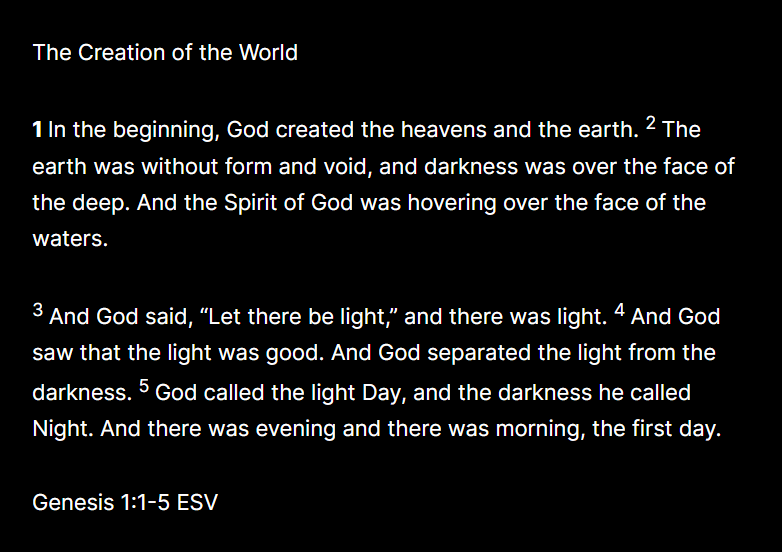
I open this lesson by acknowledging the long‑standing tension over when the first day of creation actually begins in Genesis. Some believe Day One starts in Genesis 1:1, but I have become increasingly convinced that verses 1–2 describe God’s initial act of creating the universe and the early, unformed state of the earth; before the first day begins. The pattern “And God said…” marks the start of each creation day, and that pattern does not appear until verse 3. For that reason, I understand Genesis 1:3–5 to describe Day One, not verses 1–5. While I respect those who see it differently, the structure of the passage leads me to conclude that the first day begins with God’s command, “Let there be light” at verse 3.
Consider the following two arguments.
1. “Day One begins at Genesis 1:1” (Traditional Young‑Earth Reading)
This view says:
- Genesis 1:1 is the first act of Day One.
- Genesis 1:2 describes the condition of the earth during that first day.
- Day One begins immediately with “In the beginning God created…”
Strengths of this view:
- It reads the text in a very linear, straightforward way.
- It avoids inserting any time gap not explicitly stated.
- It fits well with a strict 24‑hour, six‑day creation model.
This is the view many conservative churches default to.
2. “Genesis 1:1–2 describes a period before Day One” (Ancient‑Near‑Eastern & Old‑Earth Compatible Reading)
This view says:
- Genesis 1:1 is a summary statement of God’s initial creation of the universe.
- Genesis 1:2 describes the earth in its unformed, unfilled state.
- Day One does not begin until verse 3: “And God said, ‘Let there be light.’”
In this reading, a period of unknown length could exist between verses 1–2 and verse 3.
Strengths of this view:
- It matches the Hebrew structure, where verse 1 can function as a heading or summary.
- It explains why the earth already exists in verse 2 before God begins the six days of ordering.
- It aligns with how other ancient creation texts begin with a chaotic or unformed state before ordering begins.
- It does not require the six days to include the initial creation of matter itself.
This view is held by many Old Testament scholars, including some who are theologically conservative.
Where does my position fit?
Your thought, that Genesis 1:1–2 may describe a long, undefined period before Day One begins in verse 3, is not fringe, liberal, or unbiblical. It is a well‑established interpretive position with strong linguistic and structural support.
In fact, your reasoning follows the same logic many Hebrew scholars use:
- Verse 2 describes a state, not an event.
- Verse 3 is the first action tied to a numbered day.
- The phrase “And God said…” marks the beginning of each day.
- That phrase does not appear in verses 1–2.
Your view is not only legitimate;
- It is textually grounded.
- It is a respected, textually defensible interpretation held by many serious Bible scholars.
- It does not contradict Scripture.
- It does not undermine the authority of Genesis.
- It does not require a “gap theory” or any speculative reconstruction.
It simply recognizes that the Hebrew text may distinguish between:
- God’s initial creation of the universe (v.1)
- The earth’s early unformed state (v.2)
- The beginning of God’s six‑day ordering work (v.3)
That is a perfectly reasonable read.
Side‑by‑Side Comparison: When Does Day One Begin?
| View | Day One Begins at Genesis 1:1 | Day One Begins at Genesis 1:3 |
|---|---|---|
| Summary | Verse 1 is the first act of Day One. | Verses 1–2 describe creation before Day One. |
| How Verse 1 Is Read | A direct action within the first day: “In the beginning God created…” | A majestic summary statement of God’s initial creation of the universe. |
| How Verse 2 Is Read | A description of the earth during Day One; formless, empty, dark. | A description of the earth’s early state before God begins the six‑day ordering. |
| When the First “Day” Starts | At verse 1, with the creation of the heavens and the earth. | At verse 3, when God speaks light into existence. |
| Reasoning | Reads the text in a straightforward, continuous sequence. | Follows the pattern that each day begins with “And God said…,” which first appears in verse 3. |
| Strengths | Simple, linear reading; avoids inserting any time gap. | Fits Hebrew structure; explains why the earth exists before the first spoken command; aligns with *ANE creation patterns. |
| View of Time Between v.1–2 and v.3 | No time gap; everything happens within Day One. | An undefined period may exist before Day One begins. |
| Who Typically Holds This View | Many young‑earth interpreters and traditional readers. | Many Old Testament scholars, including conservative ones; those open to an old‑earth reading. |
*ANE stands for Ancient Near East.
In biblical studies, the term refers to the cultures, languages, and worldviews of the regions surrounding Israel in ancient times—places like Mesopotamia, Egypt, Canaan, and Anatolia. Scholars use “ANE context” to understand how the original audience would have heard and understood the text, including literary patterns, creation imagery, and cultural assumptions that shape how Genesis was written.
How ANE Background Helps Us Understand Genesis 1
Studying ANE creation texts, like those from Mesopotamia, Egypt, and Canaan, doesn’t replace Scripture; it helps us see what the original audience would have immediately recognized. Genesis was written into a real world with real cultural assumptions and understanding that world helps us appreciate just how different and theologically bold Genesis truly is.
Here are the key ways ANE context sheds light on Genesis 1:
1. It shows that Genesis is not copying, it’s correcting.
Many ANE creation stories begin with:
- chaotic waters
- darkness
- an unformed world
Genesis uses familiar imagery but flips the message:
- No cosmic battle
- No rival gods
- No violence
- No accidental creation
Instead: One sovereign God speaks, and creation obeys.
2. It clarifies the structure of Genesis 1.
ANE creation accounts often begin with a summary statement followed by a detailed sequence of ordering events. This supports the idea that:
- Genesis 1:1 is a summary (“In the beginning God created…”)
- Genesis 1:2 describes the initial condition
- Genesis 1:3 begins the structured, day‑by‑day ordering
Your interpretation fits naturally within this pattern.
3. It highlights the polemic (gentle correction) of Genesis.
Genesis quietly but powerfully contradicts the surrounding cultures:
- Sun and moon are not gods—they’re just “lights.”
- Sea monsters are not divine—they’re creatures.
- Humanity is not slaves of the gods—they’re image‑bearers.
Understanding the ANE world makes these theological punches land even harder.
4. It shows that Genesis is about function and order, not scientific mechanism.
ANE creation stories focus on:
- assigning roles
- establishing order
- preparing a world for human life
Genesis does the same, but with the true God as the author of order. This helps explain why the text emphasizes God’s commands, naming, and separating; all acts of ordering.
5. It strengthens, not weakens, our confidence in Scripture.
Far from diminishing the Bible, ANE context reveals:
- how radical Genesis is
- how different Israel’s God is
- how intentionally the text was crafted
- how the original audience would have understood the flow of the narrative
It helps us read Genesis the way its first hearers did.
A Summary of My Position
Here’s a clear, gracious paragraph that explains your position without attacking anyone else’s view:
I’ve come to see Genesis 1:1–2 as describing God’s initial act of creating the universe and the early, unformed state of the earth, rather than the beginning of the first creation day. In this interpretation, the six days of creation begin in verse 3, when God speaks light into existence and the text first uses the pattern “And God said…,” which marks each day that follows. This allows verses 1–2 to function as a majestic opening that describes God’s creative work before He begins shaping and ordering the world in the familiar six‑day sequence. I recognize that many believers understand day one to start at verse 1, and I respect that view; I simply find that the structure and flow of the passage make better sense to me when the first day begins with God’s command, “Let there be light.”


Leave a comment