
Terri Waters Photography & Design
Previous Lesson
Next Lesson
Author: Stephen Weller
2,629 words, 14 minutes read time
Satan’s Divided Kingdom?
Scripture Reference: Matthew 12:22-29; Mark 3:22-27; Luke 11:14-22
Context:
This event takes place during the height of Jesus’ Galilean ministry, a period when His miracles, authoritative teaching, and growing popularity were attracting large crowds while simultaneously intensifying the opposition of the religious leaders. Jesus had just healed a man who was demon-possessed, blind, and mute, restoring both his speech and sight. The miracle was so extraordinary that the people began asking, “Could this be the Son of David?”—a messianic title that connected Jesus with God’s covenant promise to David of an eternal kingdom (2 Samuel 7:12-16). Rather than acknowledging the undeniable work of God, the scribes and Pharisees, some of whom had come from Jerusalem specifically to investigate Jesus, hardened their hearts and accused Him of casting out demons by the power of Beelzebul (or Beelzebub), a title associated with Satan, the prince of demons. This accusation was not merely skepticism but a deliberate attempt to discredit Jesus before the crowds by attributing the work of the Holy Spirit to the devil himself. Knowing their thoughts, Jesus responded with a series of logical and theological arguments. He explained that a kingdom divided against itself cannot stand; therefore, Satan would not empower someone to destroy his own demonic kingdom. If Jesus were casting out demons by God’s Spirit, then it was evidence that the kingdom of God had arrived among them. Jesus illustrated His authority with the image of a strong man whose house cannot be plundered until he is first bound. In this analogy, Satan is the strong man, while Jesus is the One stronger than Satan who has come to bind him and liberate those held captive by sin and demonic oppression. This confrontation marks a significant turning point in the Gospel narrative. The religious leaders move beyond simple opposition to a willful rejection of clear divine revelation, setting the stage for Jesus’ warning concerning blasphemy against the Holy Spirit in the verses that follow. At the same time, the passage reveals one of the central themes of Christ’s earthly ministry: the arrival of God’s kingdom through the victorious power of the Messiah, who defeats the works of Satan and brings deliverance, freedom, and salvation to all who believe.
Event Narrative:
The narrative for this section was obtained from three similar texts, using the highlighted material shown below. The selection was determined by Jerry Peyton and copyrighted in 2015 by Jerry Peyton and Biblical Studies Press L.L.C.
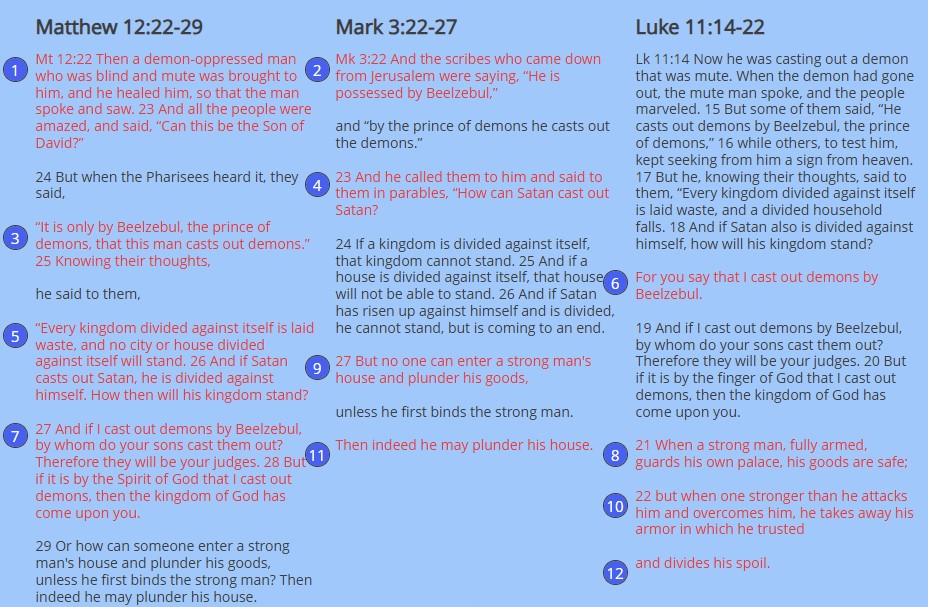
From the above worksheet photo, following the numbers and the text in red, the following narrative is produced.
Mt 12:22 Then a demon-oppressed man who was blind and mute was brought to him, and he healed him, so that the man spoke and saw. 23 And all the people were amazed, and said, “Can this be the Son of David?”
Mk 3:22 And the scribes who came down from Jerusalem were saying, “He is possessed by Beelzebul,” Mt 12:24 “It is only by Beelzebul, the prince of demons, that this man casts out demons.”
Mt 12:25 Knowing their thoughts, Mk 3:23 [Jesus] called them to him and said to them in parables, “How can Satan cast out Satan? Mt 12:25 Every kingdom divided against itself is laid waste, and no city or house divided against itself will stand. 26 And if Satan casts out Satan, he is divided against himself. How then will his kingdom stand? Lk 11:18 For you say that I cast out demons by Beelzebul.”
Mk 12:27 “[Now] if I cast out demons by Beelzebul, by whom do your sons cast them out? Therefore, they will be your judges. 28 But if it is by the Spirit of God that I cast out demons, then the kingdom of God has come upon you.”
Lk 11:21 “When a strong man, fully armed, guards his own palace, his goods are safe, Mk 3:27 and no one can enter a strong man’s house and plunder his goods. Lk 11:22 But when one stronger than he attacks him and overcomes him, he takes away his armor in which he trusted. Mk 3:27 Then indeed he may plunder his house Mk 11:22 and divide his spoil.”
Bible Lessons for this event:
H447 Can This Be the Son of David? (Matthew 12:22-24; Mark 3:22)
H448 A Divided Kingdom Cannot Stand (Matthew 12:25-27; Mark 3:23; Luke 11:18)
H449 Plundering the Strong Man’s House (Matthew 12:28; Mark 3:27; Luke 11:21-22)
Event Summary:
This event recounts an incident where Jesus is accused of casting out demons by the power of Beelzebul (Satan). Jesus responds by highlighting the absurdity of the accusation and teaching about his authority over Satan. The message focuses on Jesus’ power over evil, the nature of his kingdom, and the danger of spiritual blindness.
Key points of this event are:
(1) The Miraculous Healing and the Accusation:
- “Then a demon-oppressed man who was blind and mute was brought to him, and he healed him, so that the man spoke and saw. And all the people were amazed, and said, “Can this be the Son of David?” (Matthew 12:22-23) After this amazing healing the scribes arrive from Jerusalem and accuse Jesus of being possessed by Beelzebul and casting out demons by Beelzebul, the prince of demons. Even after witnessing the miracle, some people reject Jesus and attribute his divine power to Satan. This demonstrates spiritual blindness and a resistance to the truth.
(2) The Absurdity of the Accusation:
- Jesus points out the absurdity of the accusation by saying, “Every kingdom divided against itself is laid waste, and no city or house divided against itself will stand. And if Satan casts out Satan, he is divided against himself. How then will his kingdom stand?: (Matthew 12:25-26) By casting out the man’s demon, Jesus demonstrates that his actions are in direct opposition to Satan’s work, proving that his power comes from God, not from evil.
(3) The Authority of Jesus Over Satan:
- To demonstrate his authority, Jesus uses the analogy of a fully armed strong man guarding his home. His possessions remain secure until someone stronger attacks and overpowers him. In this analogy, the armed man represents Satan, while the stronger one is Jesus, who overcomes Satan, rescues those under his influence, and establishes God’s kingdom by defeating evil.
(4) The Nature of God’s Kingdom:
- The miracles of Jesus reveal that the kingdom of God has arrived and is advancing. Jesus’ authority over demons signifies that God’s kingdom is breaking into the world, overpowering the forces of darkness.
This event emphasizes Jesus’ divine power and authority over Satan and his role in establishing God’s kingdom. They challenge readers to recognize Jesus as the Messiah, reject spiritual blindness, and trust in his victory over evil. These passages highlight the reality of spiritual conflict and the assurance of God’s ultimate triumph through Jesus.
Discussion Questions with Extended Answers:
Matthew 12:22-29; Mark 3:22-27; Luke 11:14-22
1. What miracle did Jesus perform that led to this confrontation with the religious leaders?
Answer:
Jesus healed a man who was demon-possessed and unable to speak. Matthew adds that the man was also blind, and after Jesus cast out the demon, he both spoke and saw (Matthew 12:22). This miracle demonstrated Christ’s authority over the spiritual realm and revealed that the kingdom of God had arrived with power.
The crowds were amazed and began asking, “Could this be the Son of David?” This title referred to the promised Messiah from David’s royal line. Rather than rejoicing that a suffering man had been delivered, the Pharisees focused on preserving their own authority and influence. Their opposition was not based on a lack of evidence but on a refusal to accept Jesus as the Messiah.
This event highlights the different responses people have toward Christ. Some see His works and believe, while others reject Him despite overwhelming evidence.
2. Why did the Pharisees accuse Jesus of casting out demons by the power of Beelzebul?
Answer:
The Pharisees claimed, “He casts out demons by Beelzebul, the ruler of the demons” (Matthew 12:24). Beelzebul (or Beelzebub) was a name associated with Satan, the prince of evil spirits.
The religious leaders could not deny that a genuine miracle had occurred. The formerly afflicted man stood before them completely healed. Since they could not dispute the miracle itself, they attempted to discredit its source by attributing it to Satan.
This accusation revealed the hardness of their hearts. Instead of acknowledging God’s work, they deliberately twisted the truth to maintain their position and influence over the people. Their hostility toward Jesus had reached the point where they were willing to call the work of the Holy Spirit the work of the devil.
Their actions serve as a warning that persistent unbelief can blind a person to even the clearest evidence of God’s power.
3. How did Jesus answer the charge that He was working by Satan’s power?
Answer:
Jesus responded with simple but undeniable logic: “Every kingdom divided against itself is brought to desolation” (Matthew 12:25).
If Satan were casting out his own demons, then his kingdom would be attacking itself. A divided kingdom cannot survive. A city or household torn apart by internal conflict eventually falls. Therefore, if Jesus were truly empowered by Satan, Satan would be working against his own interests.
Jesus further pointed out that the Jews themselves had exorcists (“your sons”), and the Pharisees did not accuse them of serving Satan. Their accusation against Jesus was therefore inconsistent and motivated by prejudice rather than reason.
His argument demonstrated both the irrationality of their claim and the reality that His miracles were evidence of God’s kingdom breaking into the world.
4. What did Jesus mean when He said, “If I cast out demons by the Spirit of God, then the kingdom of God has come upon you”?
Answer:
Jesus declared that His miracles were evidence that God’s reign was actively entering human history. The casting out of demons was not merely an act of compassion toward individuals; it was a visible sign that the Messiah had come to overthrow the kingdom of darkness.
The Old Testament foretold a coming King who would establish God’s kingdom and defeat evil. By delivering people from demonic oppression, Jesus was demonstrating that these promises were being fulfilled before their very eyes.
Luke records the phrase, “by the finger of God” (Luke 11:20), recalling the language used by the magicians in Egypt who recognized God’s power during the plagues (Exodus 8:19). Just as God’s power defeated Pharaoh, Christ’s power was defeating Satan.
The kingdom had not yet reached its final, complete form, but through Jesus its authority and power had already entered the world.
5. What is the meaning of the parable of the strong man?
Answer:
Jesus asked, “How can one enter a strong man’s house and plunder his goods, unless he first binds the strong man?” (Matthew 12:29).
The “strong man” represents Satan, who exercises influence over a fallen world. His “house” symbolizes his domain, and the “goods” are those held captive by sin and demonic oppression.
Jesus is the One stronger than the strong man. By casting out demons, He was proving that He had entered Satan’s territory, bound his power, and was rescuing those enslaved by him.
Luke’s account expands this imagery by describing a stronger man overcoming the armed strong man, taking away his armor, and dividing the spoils (Luke 11:21-22). This illustrates Christ’s victory over Satan through His ministry, ultimately culminating at the cross and resurrection.
The parable teaches that Jesus did not cooperate with Satan—He conquered him.
6. What does this passage teach about the reality of spiritual warfare?
Answer:
These verses reveal that behind the visible world exists a real spiritual conflict between the kingdom of God and the kingdom of darkness. Demonic forces are real, and Satan actively opposes God’s purposes.
However, the passage also demonstrates that Satan’s power is limited and inferior to God’s authority. Jesus commanded demons with a word, and they obeyed instantly. There was never a struggle or uncertainty regarding the outcome.
Believers can therefore have confidence that Christ has authority over every spiritual power. His victory assures His followers that evil will not ultimately prevail.
The New Testament repeatedly emphasizes that Christians fight not against flesh and blood but against spiritual forces, yet they do so with the assurance that Christ has already won the decisive battle.
7. Why were the crowds asking whether Jesus could be the Son of David?
Answer:
The title “Son of David” was one of the most important Messianic titles in Judaism. God had promised David that one of his descendants would establish an everlasting kingdom (2 Samuel 7:12-16).
The miracles Jesus performed matched the expectations many Jews had for the coming Messiah. The healing of the blind, the mute, and the oppressed demonstrated divine authority that ordinary men did not possess.
The people recognized that Jesus was doing works unlike anything they had ever seen, leading them to wonder if He was indeed God’s promised King.
Ironically, while the common people were moving toward faith, the religious experts were moving toward deeper rejection.
8. What warning does this passage give about hardness of heart?
Answer:
The Pharisees witnessed undeniable evidence of God’s power, yet instead of believing, they deliberately rejected the truth. Their problem was not intellectual but spiritual. They refused to accept a Messiah who challenged their pride and authority.
Repeated rejection of God’s revelation can lead to increasing spiritual blindness. A person may become so committed to unbelief that even miraculous evidence no longer changes the heart.
This passage prepares the way for Jesus’ later warning about blasphemy against the Holy Spirit—a persistent and willful rejection of the Spirit’s testimony concerning Christ.
The lesson for believers is to respond humbly to God’s truth and to guard against allowing pride, tradition, or personal ambition to harden the heart against His work.
9. How do Matthew, Mark, and Luke together provide a fuller picture of this event?
Answer:
Matthew emphasizes the healing itself and the crowd’s question about whether Jesus is the Son of David. He also records Jesus saying that He casts out demons “by the Spirit of God.”
Mark places greater emphasis on the accusation that Jesus is possessed by Beelzebul and introduces the discussion that leads directly into the warning about blasphemy against the Holy Spirit.
Luke highlights that Jesus cast out the demon “by the finger of God,” connecting Christ’s ministry with God’s mighty acts in the Old Testament. Luke also expands the illustration of the strong man by describing the stronger man taking away his armor and dividing the spoils.
Together, the three Gospel accounts present a unified testimony: Jesus is the Messiah, empowered by God, defeating Satan, establishing God’s kingdom, and calling people to faith.
10. What practical application should believers take from this passage?
Answer:
Believers should recognize that Jesus possesses absolute authority over every force of evil. No power of darkness can stand against Him. The same Lord who cast out demons and defeated Satan reigns today.
This passage also calls Christians to respond rightly to God’s work. Instead of resisting or explaining away His activity, believers should cultivate humble, obedient hearts that recognize and rejoice in His power.
Finally, the account reminds us that the mission of Christ is one of rescue and liberation. Just as He delivered the demon-possessed man from bondage, He continues to deliver people from the slavery of sin and bring them into the freedom of His kingdom.
The central message of these passages is that Jesus is the stronger One who has entered the enemy’s domain, defeated the power of darkness, and established the kingdom of God through His saving work.


Leave a comment