
Terri Waters Photography & Design (Wave watching as the tide comes in at Portreath.)
Previous Lesson
Next Lesson
Author: Stephen Weller
2,260 words, 12 minutes read time
The Sign of Jonah
Scripture Reference: Matthew 12:38-42; Luke 11:16, 29-32
Context:
These passages occur during a period of increasing opposition to Jesus’ ministry. After Jesus had performed numerous miracles, healed the sick, cast out demons, and taught with divine authority, many people still refused to believe that He was the promised Messiah. In the immediate context, Jesus had just healed a demon-possessed man, leading some to accuse Him of casting out demons by the power of Satan rather than by the Spirit of God. Instead of responding to the overwhelming evidence before them, the religious leaders demanded an additional sign from heaven to prove His identity. Their request did not arise from sincere faith or a desire to know the truth but from hardened unbelief and spiritual blindness. Jesus rebuked them, calling them a “wicked and adulterous generation” because they continually sought spectacular signs while rejecting the clear testimony God had already provided through His works, words, and fulfillment of Scripture. He declared that no sign would be given except the “sign of Jonah,” referring ultimately to His death, burial, and resurrection. Just as Jonah spent three days and three nights associated with the great fish before being restored to life and ministry, Jesus would spend three days in the tomb before rising again. Jesus further warned His listeners that the people of Nineveh, who repented at Jonah’s preaching, and the Queen of the South, who traveled great distances to hear Solomon’s wisdom, would stand in judgment against that generation because they responded to far lesser revelation. In contrast, the Jewish leaders were rejecting One who was far greater than both Jonah and Solomon. The passage highlights the danger of unbelief in the face of abundant evidence, the sufficiency of God’s revelation through Christ, and the central importance of the resurrection as the ultimate sign validating Jesus’ identity as the Son of God and the promised Messiah.
Event Narrative:
The narrative for this section was obtained from three similar texts, using the highlighted material shown below. The selection was determined by Jerry Peyton and copyrighted in 2015 by Jerry Peyton and Biblical Studies Press L.L.C.
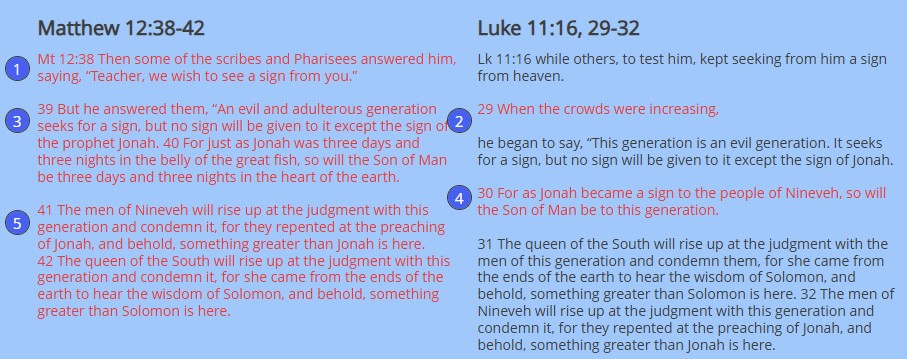
From the above worksheet photo, following the numbers and the text in red, the following narrative is produced.
Mt 12:38 Then some of the scribes and Pharisees answered him, saying, “Teacher, we wish to see a sign from you.”
Lk 11:29 [As] the crowds were increasing, Mt 12:39 [Jesus] answered them, “An evil and adulterous generation seeks for a sign, but no sign will be given to it except the sign of the prophet Jonah. 40 For just as Jonah was three days and three nights in the belly of the great fish, so will the Son of Man be three days and three nights in the heart of the earth. Lk 11:30 For as Jonah became a sign to the people of Nineveh, so will the Son of Man be to this generation.”
Mt 12:41 “The men of Nineveh will rise up at the judgment with this generation and condemn it, for they repented at the preaching of Jonah, and behold, something greater than Jonah is here. 42 The queen of the South will rise up at the judgment with this generation and condemn it, for she came from the ends of the earth to hear the wisdom of Solomon, and behold, something greater than Solomon is here.”
Bible Lessons for this event:
H456 The Sign of Jonah (Matthew 12:38-40; Luke 11:29-30)
H457 Jesus Is the Greatest (Matthew 12:41-42)
Event Summary:
In this event the Pharisees and others demand a sign from Jesus to prove his authority, but he rebukes them, emphasizing their spiritual blindness and lack of faith. He points to “the sign of Jonah” as the only sign they will receive, linking it to his death, burial, and resurrection. The passages focus on faith, repentance, and the consequences of rejecting God’s revelation.
Key points of this event are:
(1) The Request for a Sign:
- This event opens with some of the scribes and Pharisees saying to Jesus, “Teacher, we wish to see a sign from you.” (Matthew 12:38) Despite having witnessed Jesus’ teachings and miracles, they are still skeptical and request additional signs reflecting their lack of genuine faith and demonstrates spiritual hardness and an unwillingness to accept the truth already revealed. Faith should not rely solely on miraculous displays but on trust in God’s Word and his work.
(2) The Sign of Jonah:
- Jesus responds to their request for a sign, saying, “An evil and adulterous generation seeks for a sign, but no sign will be given to it except the sign of the prophet Jonah. For just as Jonah was three days and three nights in the belly of the great fish, so will the Son of Man be three days and three nights in the heart of the earth. (Matthew 12:39-40) Jonah spent three days and nights in the belly of a great fish, which foreshadowed Jesus’ death, burial, and resurrection after three days.
- In the early Christian tradition, the death of Jesus was specified to be on the day of Preparation for the Sabbath. This aligns with Friday in the Jewish calendar, as the Sabbath begins Friday evening. However, the condition of the sigh of Jonah cannot be met if Jesus died on Friday. Careful investigation indicates that there are special sabbaths that occur on Friday. If his death occurred before one of these special sabbaths, it would have been Thursday, then we have three days and three nights to match the sign of Jonah.
(3) The Condemnation of an Unrepentant Generation:
- Jesus then draws a contrast between the Pharisees and their generation and the people of Nineveh, and with the queen of the south (Sheba). The people of Nineveh repented at Jonah’s preaching, but the Pharisees refuse to repent even when a greater preacher, Jesus, is among them. The Queen of Sheba traveled far to hear Solomon’s wisdom, yet the Pharisees disregard the wisdom of one greater than Solomon. The generation rejecting Jesus will face greater judgment than Nineveh or the Queen of Sheba because they had the privilege of witnessing Jesus’ ministry but still refused to believe.
This event emphasizes the importance of repentance, faith, and recognizing Jesus as the ultimate revelation of God. The “sign of Jonah” foreshadows Jesus’ death and resurrection, which stand as the definitive proof of his divine authority. The passages warn against spiritual blindness and challenge readers to respond to Jesus with faith and humility rather than skepticism and rejection.
Discussion Questions with Extended Answers:
Matthew 12:38–42; Luke 11:16, 29–32
1. Why did the scribes, Pharisees, and others ask Jesus for a sign?
Answer:
The religious leaders were not seeking a sign because they genuinely wanted to believe in Jesus. They had already witnessed numerous miracles, including healings, exorcisms, and other demonstrations of divine power. Their request revealed unbelief rather than faith. They wanted Jesus to perform a spectacular sign on their terms, hoping either to justify their skepticism or find a reason to reject Him. Luke notes that some were “testing” Him, showing that their motives were not sincere. Instead of accepting the evidence already before them, they continually demanded more proof. Their attitude demonstrates how a hardened heart can refuse to believe even when confronted with overwhelming evidence of God’s work.
2. What did Jesus mean when He called His generation “wicked and adulterous”?
Answer:
Jesus was not speaking about physical adultery alone. Throughout the Old Testament, spiritual unfaithfulness to God was often described as adultery. Israel had entered into a covenant relationship with God, yet many people had become spiritually unfaithful through unbelief, hypocrisy, and rejection of God’s messengers. By calling them a wicked and adulterous generation, Jesus exposed their spiritual condition. They appeared religious outwardly, but inwardly they resisted God’s truth. Their rejection of the Messiah standing before them was the ultimate expression of spiritual unfaithfulness. The phrase emphasizes that their greatest problem was not a lack of evidence but a lack of genuine devotion and submission to God.
3. What was “the sign of the prophet Jonah”?
Answer:
Jesus explained that the only sign that would be given to that generation would be the sign of Jonah. Just as Jonah spent three days and three nights in the belly of the great fish before being delivered, Jesus would spend three days in the heart of the earth before rising again. Jonah’s experience became a prophetic picture of Christ’s death, burial, and resurrection. The resurrection would be the ultimate proof that Jesus was the Messiah and the Son of God. While many signs had already been performed, the resurrection would stand as the greatest sign of all, confirming His authority and validating everything He taught.
4. Why is the resurrection considered the greatest sign Jesus gave?
Answer:
The resurrection demonstrated Christ’s victory over sin, death, and the grave. Many prophets performed miracles, but only Jesus conquered death through His own power and rose to eternal life. The resurrection validated His claims to be the Son of God and confirmed that His sacrificial death accomplished salvation. It became the central message of apostolic preaching because it provided undeniable evidence that Jesus was who He claimed to be. Every aspect of Christianity rests upon this event. The resurrection remains God’s supreme testimony concerning His Son and continues to be the foundation of Christian faith today.
5. Why did Jesus mention the people of Nineveh?
Answer:
The people of Nineveh responded to Jonah’s preaching with repentance. Jonah was a reluctant prophet who delivered a simple message of coming judgment, yet the entire city humbled itself before God. Jesus pointed out that something far greater than Jonah was present among His hearers. Unlike Jonah, Jesus was sinless, performed miracles, and spoke with divine authority. If the Ninevites repented at Jonah’s message, then the generation hearing Jesus had even greater reason to repent. Their refusal to do so revealed the seriousness of their unbelief. The Ninevites would therefore stand as witnesses against those who rejected Christ.
6. What does it mean that the men of Nineveh will rise up in judgment against that generation?
Answer:
Jesus was teaching that those who responded positively to the light they received would serve as evidence against those who rejected greater light. The Ninevites had far less revelation than the Jewish leaders of Jesus’ day, yet they repented. In contrast, the religious leaders had the Scriptures, the ministry of John the Baptist, the miracles of Jesus, and the presence of the Messiah Himself, yet many still refused to believe. At the final judgment, the response of the Ninevites would demonstrate the guilt of those who rejected Christ despite receiving far greater opportunities to know the truth.
7. Why did Jesus refer to the Queen of the South?
Answer:
The Queen of the South, also known as the Queen of Sheba, traveled a great distance to hear the wisdom of Solomon. She recognized God’s blessing upon Solomon and eagerly sought the truth he possessed. Jesus used her example to show the contrast between her response and the response of His contemporaries. She made a difficult journey to hear a wise king, while those listening to Jesus were rejecting One who was infinitely greater than Solomon. Her eagerness to seek wisdom highlighted their unwillingness to receive the wisdom of God revealed through Christ.
8. What did Jesus mean when He said, “something greater than Solomon is here”?
Answer:
Jesus was declaring His superiority to Solomon. Solomon was renowned for wisdom, wealth, and glory, but he was still merely a human king. Jesus is the eternal Son of God, possessing perfect wisdom and divine authority. Solomon pointed people toward God, but Jesus is God incarnate. Solomon’s kingdom was temporary, while Christ’s kingdom is everlasting. By saying that One greater than Solomon was present, Jesus revealed that the people were encountering the fulfillment of everything Solomon represented. Rejecting Jesus was therefore rejecting someone far greater than Israel’s most celebrated king.
9. What lesson does this passage teach about spiritual responsibility?
Answer:
This passage teaches that greater revelation brings greater responsibility. The people of Jesus’ day had access to extraordinary evidence of God’s truth, yet many remained unbelieving. God holds people accountable for how they respond to the light they receive. The Ninevites and the Queen of Sheba responded faithfully to limited revelation, while many in Israel rejected the fullest revelation of all in Jesus Christ. The principle remains true today. Those who have access to Scripture, the gospel, and the testimony of Christ’s resurrection bear a significant responsibility to respond in faith and obedience.
10. What application does this passage have for believers today?
Answer:
Believers should recognize that faith is based on God’s revealed truth rather than a continual demand for new signs. God has provided sufficient evidence through Scripture, the life and ministry of Jesus, and especially His resurrection. This passage challenges us to avoid the attitude of those who constantly seek additional proof while ignoring what God has already revealed. It also encourages us to respond to Christ with humility, repentance, and faith. Like the Ninevites, we should repent when confronted with God’s truth. Like the Queen of Sheba, we should eagerly seek the wisdom found in Christ. Above all, we should recognize that Jesus is greater than every prophet, king, and teacher who came before Him and therefore deserves our complete trust and devotion.


Leave a comment